

Search results for "tommi+musturi/2010/05/song-without-words/2009/09/what-god-said"
Pen to paper
25 October 2012 | Articles, Non-fiction
Writing is ancient: the act of taking a stylus, a quill or a pen into one’s hand still feels powerful. Will we find a way of scrawling in space, to mark our individuality, wonders Teemu Manninen
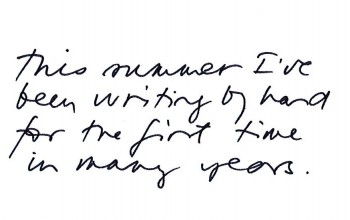
It was my vacation, and I wanted to catch up on some fun writing projects, but because I didn’t want to depend on my devices (would we have wifi? would the batteries last?) or carry around too much extra stuff I bought a red notebook and wrote in black ink on white paper while sitting in cafes and restaurants with my wife.
Writing by hand got me – surprise – to thinking about handwriting in general. Etymologically, ‘writing’, from Old English writan, means scratching, drawing, tearing. In the original Hebrew, God does not simply fashion humans out of clay, he writes them: his word is his image, giving life to the letter of his meaning, the human being.
Writing is violence. It brings about vivid change in the matter of the world: in the age of clay tablets, the stylus was a carving instrument. During the age of ink, cutting the tip of the quill was, if we believe the early Renaissance manuals of handwriting, as precise and violent an act as cutting someone’s head off. More…
Stories in the stone
2 December 2010 | Extracts, Non-fiction
Extracts from Jägarens leende. Resor in hällkonstens rymd (‘Smile of the hunter. Travels in the space of rock art’, Söderströms, 2010)
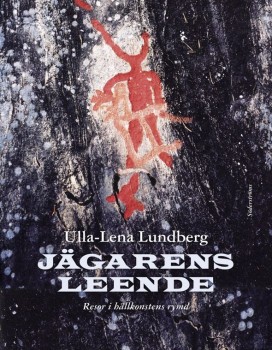 ‘Why do some people choose to expend what is often a great deal of effort hammering images in the bedrock itself, while others conjure up, in the blink of an eye, brilliantly radiant pictures on a rock-face that was empty yesterday but is now peopled by mythological animals, spirits and shamans?
‘I think about this often – I who love painting but who still chose a career that involves me sitting and hammering away, day in and day out, like a true rock-carver,’ writes author and ethnologist Ulla-Lena Lundberg in her new book on the art of the primeval man
When the children of Israel went into Babylonian captivity, hanging up their harps on the willow-trees and weeping as they remembered Zion, my sister and I were already sitting by the rivers of Babylon. We knew how they felt. Our father was dead and we had been sent away from our home. We sat there clinging to each other, or rather I was the one clinging to Gunilla, and she had to try to rouse herself and find something for us to do, to give us something else to think about. More…
Mikko Lahtinen: Kirjastojen maa [Land of libraries]
4 March 2011 | Mini reviews, Reviews
 Kirjastojen maa
[Land of libraries]
Tampere: Vastapaino, 2010. 394 p., ill.
ISBN 978-951-768-315-9
€ 43, hardback
Libraries are the most widely used cultural service in Finland. Kirjastojen maa describes the journey undertaken by the protagonist, who refers to himself as ‘the Library Man’, and his entourage to 250 public libraries around Finland between 2008 and 2010. Many of these sites were celebrating their 150th anniversaries at the time, since there was a great enthusiasm for establishing public libraries in Finland in the 1850s. This travel journal provides a history of libraries as an institution and their development into a central pillar of society. The author also considers Finnish intellectual space in this age of digital media. Libraries currently face significant challenges: the recent wave of local authority mergers, centralisation of public services and funding cuts are all hampering the development of library operations. The importance of libraries is further underlined by the fact that local residents have launched protests in support of libraries threatened with closure – in spite of the usual difficulty of rousing Finns to man the barricades. The author is a philosopher, political researcher and active participant in public policy discussions.
Translated by Ruth Urbom
Make or break?
17 November 2011 | This 'n' that
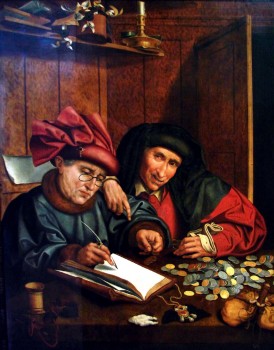
Two tax collectors: anonymous painter, after Marinus van Reymerswaele (ca. 1575–1600). Musée des Beaux-Arts de Nancy. Wikimedia
In Finland, tax returns are public information. So, every November the media publish lists of the top earners in Finland, dividing them into the categories of earned and investment income. Every November it is revealed who are millionaires and who are just plain rich.
The Taloussanomat (‘The economic news’) newspaper offers a list (Finnish only) of the 5,000 people who earned most last year (in terms of both earned and investment income, together with the proportion of income they have paid in tax). You can also search lists of various status and professions: rock/pop stars, media, sports, MPs, celebrities, politicians of various political parties…
So let’s take a look at Taloussanomat’s selected list of authors: number one is the celebrity author Jari Tervo (309,971 euros, tax percentage 45); number two, the internationally famous Sofi Oksanen (302,634 euros, 46 per cent); the next two are Sinikka Nopola, writer of children’s books, (264,000) and Arto Paasilinna (262,300; now after an illness, retired as a writer), translated into more than 30 languages since the 1970s. (The film critic and author Peter von Bagh made almost 900,000 euros – not by writing books, but by selling his share of a music company to an international enterprise.)
As tax data are public in Finland, there’s vigorous and decidedly informed public debate on how much money, for example, directors of public pension institutions and government offices or ministers and other top politicians are paid, and how much they should be paid: what is equitable, what is reasonable? A million dollar question indeed…
Among the European Union countries, it is only in Finland, Sweden and Denmark that there is no universal minimum wage. Here, wages are determined in trade wage negotiations. The average monthly salary in the private sector in 2010 was approximately 3,200 euros. In contrast to that, Olli-Pekka Kallasvuo, the Nokia CEO and President, who tops the 2010 tax list, earned a salary of 8 million last year, because – and precisely because – he was sacked (and replaced by the Irishman Steven Elop).
The CIA’s Gini index measures the degree of inequality in the distribution of family income in a country. The more unequal a country’s income distribution, the higher is its Gini index. The country with the highest number is Sweden, 23; the lowest, South Africa, 65 (data from both, 2005). Finland’s figure is 26.8 (2008), Germany 27 (2006), the European Union’s 34. The United Kingdom stands at 34 (2005), and the USA at 45 (2007). The figure in Finland seems to be on the rise though, as the figure back in 1991 was 25.6.
There’s been plenty of research and debate on economic inequality and the ways it harms societies. This link takes you to a fascinating video lecture (July 2011 – now seen by almost half a million people) by Richard Wilkinson, British author, Profefssor Emeritus of social epidemiology.
Jorma & Päivi Tuomi-Nikula: Nikolai II: Suomen suuriruhtinas [Nicholas II: Grand Duke of Finland]
11 March 2011 | Mini reviews, Reviews
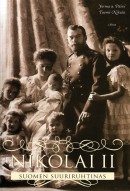 Nikolai II: Suomen suuriruhtinas
[Nicholas II: Grand Duke of Finland]
Jyväskylä: Atena, 2010. 283 p., ill.
ISBN 978-951-796-650-4
Swedish-language edition:
Nikolaj II: Storfurste av Finland
Helsingfors: Schildts, 2010
ISBN 9789515018714
€ 41, hardback
This work is the first Finnish biography of the last Grand Duke of Finland, Tsar Nicholas II (1868–1918). It provides a new approach to historical writing in its treatment of the Tsar’s relationship with Finland in the face of increasing terror, the First World War and the 1917 revolutions. Terrorism as a form of resistance during the period of oppression in 1904–07 was more widespread in Finland than previously thought. Extracts from diaries, letters and other documents provide the background to events on the global political stage as well as the private lives of the figures. Finns initially responded favourably to Nicholas’ ascent to the throne in 1894, but this trust soon declined with Nicholas’ policy of Russification. Despite these increasingly strained relations, Nicholas enjoyed spending his holidays in Finland. This book contains a wealth of photographs, including some from the personal albums of Anna Vyrubova, a lady-in-waiting who fled to Finland. There are also never-before-published postcards dating from the era of oppression and revolution. The authors have previously written about the Tsars in Finland’s era as a Grand Duchy of Russia in their book Keisarit kesälomalla Suomessa (‘The emperors on summer holiday in Finland’, 2002).
Translated by Ruth Urbom
Vesa Sirén: Suomalaiset kapellimestarit. Sibeliuksesta Saloseen, Kajanuksesta Franckiin [Finnish conductors. From Sibelius to Salonen and from Kajanus to Franck]
17 February 2011 | Mini reviews, Reviews
 Suomalaiset kapellimestarit. Sibeliuksesta Saloseen, Kajanuksesta Franckiin
[Finnish conductors. From Sibelius to Salonen and from Kajanus to Franck]
Helsinki: Otava, 2010. 1,000 p., ill.
ISBN 978-951-1-21203-1
€ 38, hardback
This work, by music critic Vesa Sirén – awarded the Finlandia Prize for non-fiction in 2010 – attempts to explain what makes a good orchestra conductor. Including hundreds of interviews, the book takes a chronological approach, presenting portraits of sixty conductors from the 1880s up to current students of conducting. There are also contributions from music critics, as well as even tougher assessments from musicians, contemporaries of the conductors. The high standard of Finnish music education, which has been easily accessible to young people – at least until the recent times –, provides part of the answer, as does the conducting course at the Sibelius Academy under the long-serving leadership of Jorma Panula. Sirén’s archival research has unearthed some forgotten treasures, including the lost archives of Robert Kajanus and conductor’s notes in Jean Sibelius’ own handwriting.
Translated by Ruth Urbom
Candidates for the Runeberg Prize
23 December 2009 | In the news
Seven books were chosen out of approximately 200 to be the candidates of the Runeberg Prize, to be awarded on 5 February 2010. More…
Hip hip hurray, Moomins!
22 October 2010 | This 'n' that
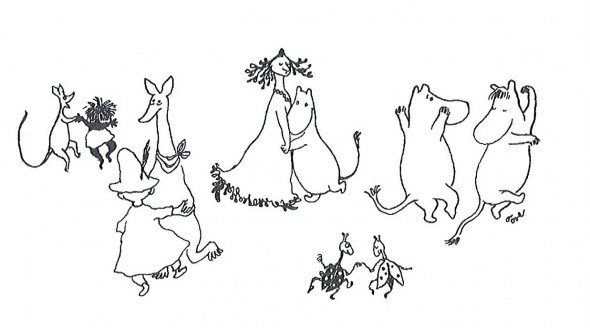
Partying in Moomin Valley: Moomintroll (second from right) dancing through the night with the Snork Maiden (from Tove Jansson’s second Moomin book, Kometjakten, Comet in Moominland, 1946)
The Moomins, those sympathetic, rotund white creatures, and their friends in Moomin Valley celebrate their 65th birthday in 2010.
Tove Jansson published her first illustrated Moomin book, Småtrollen och den stora översvämningen (‘The little trolls and the big flood’) in 1945. In the 1950s the inhabitants of Moomin Valley became increasingly popular both in Finland and abroad, and translations began to appear – as did the first Moomin merchandise in the shops.
Jansson later confessed that she eventually had begun to hate her troll – but luckily she managed to revise her writing, and the Moomin books became more serious and philosophical, yet retaining their delicious humour and mild anarchism. The last of the nine storybooks, Moominvalley in November, appeared in 1970, after which Jansson wrote novels and short stories for adults.
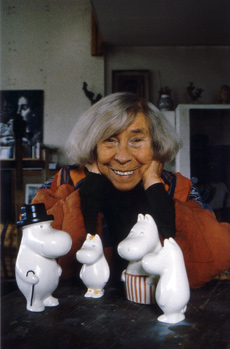
Tove Jansson with her creations (Photo: www.moomin.com/tove/travel, 1993)
Tove Jansson (1914–2001) was a painter, caricaturist, comic strip artist, illustrator and author of books for both children and adults. Her Moomin comic strips were published in the daily paper the London Evening News between 1954 and 1974; from 1960 onwards the strips were written and illustrated by Tove’s brother Lars Jansson (1926–2000).
Tove’s niece, Sophia Jansson (born 1962) now runs Moomin Characters Ltd as its artistic director and majority shareholder. (The company’s latest turnover was 3,6 million euros).
For the ever-growing fandom of Jansson there is a delightful biography of Tove (click ‘English’) and her family on the site, complete with pictures, video clips and texts.
The world now knows Moomins; the books have been translated into 40 languages. The London Children’s Film Festival in October 2010 featured the film Moomins and the Comet Chase in 3D, with a soundtrack by the Icelandic artist Björk. An exhibition celebrating 65 years of the Moomins (from 23 October to 15 January 2011) at the Bury Art Gallery in Greater Manchester presented Jansson’s illustrations of Moominvalley and its inhabitants.
In association with several commercial partners in the Nordic countries Moomin Characters launched a year-long campaign collecting funds to be donated to the World Wildlife Foundation for the protection of the Baltic Sea. Tove Jansson lived by the Baltic all her life – she spent most of her summers on a small barren island called Klovharu – and the sea featured strongly in her books for both children and adults.
The books that sold
11 March 2011 | In the news
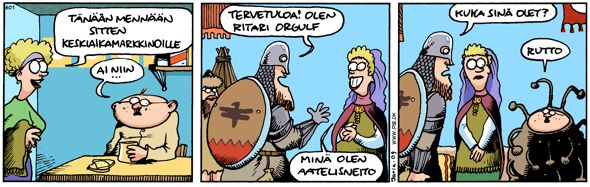
-Today we're off to the Middle Ages Fair. – Oh, right. - Welcome! I'm Knight Orgulf. – I'm a noblewoman. -Who are you? – The plague. *From Fingerpori by Pertti Jarla
Among the ten best-selling Finnish fiction books in 2010, according statistics compiled by the Booksellers’ Association of Finland, were three crime novels.
Number one on the list was the latest thriller by Ilkka Remes, Shokkiaalto (‘Shock wave‘, WSOY). It sold 72,600 copies. Second came a new family novel Totta (‘True’, Otava) by Riikka Pulkkinen, 59,100 copies.
Number three was a new thriller by Reijo Mäki (Kolmijalkainen mies, ‘The three-legged man’, Otava), and a new police novel by Matti Yrjänä Joensuu, Harjunpää ja rautahuone (‘Harjunpää and the iron room’, Otava), was number six.
The Finlandia Fiction Prize winner 2010, Nenäpäivä (‘Nose day’, Teos) by Mikko Rimminen, sold almost 54,000 copies and was fourth on the list. Sofi Oksanen’s record-breaking, prize-winning Puhdistus (Purge, WSOY; first published in 2008) was still in fifth place, with 52,000 copies sold.
Among translated fiction books were, as usual, names like Patricia Cornwell, Dan Brown and Liza Marklund.
In non-fiction, the weather, fickle and fierce, seems to be a subject of endless interest to Finns; the list was topped by Sääpäiväkirja 2011 (‘Weather book 2011’, Otava), with a whopping 140,000 copies. Number two was the Guinness World Records 2011, but with just 43,000 copies. Books on wine, cookery and garden were popular. A book on Finnish history after the civil war, Vihan ja rakkauden liekit (‘Flames of hate and love’, Otava) by Sirpa Kähkönen, made it to number 8 on the list.
The Finnish children’s books best-sellers’ list was topped by the latest picture book by Mauri Kunnas, Hurja-Harri ja pullon henki (‘Wild Harry and the genie’, Otava), selling almost 66,000 copies. As usual, Walt Disney ruled the roost in the translated fiction list.
The Finnish comics list was dominated by Pertti Jarla (his Fingerpori series books sold more than 70,000 copies, almost as much as Remes’ Shokkiaalto!) and Juba Tuomola (Viivi and Wagner series; both mostly published by Arktinen Banaani): between them, they grabbed 14 places out of 20!
Markus Nummi: Karkkipäivä [Candy day]
26 November 2010 | Mini reviews, Reviews
 Karkkipäivä
[Candy day]
Helsinki: Otava, 2010. 383 p.
ISBN 978-951-1-24574-2
€28, hardback
Like this one, Markus Nummi’s previous novel, Kiinalainen puutarha (‘Chinese garden’, 2004), set in Asia at the turn of the 20th century, involves a child’s perspective. Karkkipäivä‘s main theme, however, is a portrait of contemporary Finland. Tomi is a little boy whose alcoholic parents are incapable of looking after him; Mirja’s mother is a frantic workaholic heading for a nervous breakdown. She is a control freak who secretly gorges on chocolate at work and beats her little daughter – a grotesque portrait of contemporary womanhood. Tomi manages to get some adult attention and help from a writer; the relation between them gradually builds into one of trust. Katri is a social worker, empathetic but virtually helpless as part of the social services bureaucracy. Virtually every adult suspects others of lying, finding each other’s motives doubtful. Nummi (born 1959) has structured Karkkipäivä with great skill; the ending, in which matters are resolved almost by chance, is particularly gripping. This novel was nominated for the 2010 Finlandia Prize for Fiction.
Teemu Keskisarja: Vihreän kullan kirous. G.A. Serlachiuksen elämä ja afäärit [The curse of green gold. The life and affairs of G.A. Serlachius]
17 March 2011 | Mini reviews, Reviews
 Vihreän kullan kirous. G.A. Serlachiuksen elämä ja afäärit
[The curse of green gold. The life and affairs of G.A. Serlachius]
Helsinki: Kustannusosakeyhtiö Siltala, 2010. 350 p., ill.
ISBN 978-952-234-041-2
€ 35, hardback
In the famine years of the 1860s and with no inherited fortune to his name, G.A. Serlachius (1830–1901) built his industrial centre in the rural backwoods of Mänttä. His work laid the foundations for what would become one of Europe’s leading paper manufacturers. G.A. Serlachius was a Finnish self-made man whose education was cut short due to his family’s financial difficulties. The energetic Serlachius is considered to have pioneered contacts with Western European markets; he was responsible for bringing the first icebreaker ship to Finland. Serlachius was also known as a patron of the arts and a supporter of artists; the collection of the Serlachius Art Foundation is his best-known legacy. According to this biography, Serlachius suffered from ‘an extremely advanced megalomania’ in the opinion of his bankers, and his personality was ‘more aggressive than many Finnish-born generals of the Pax Russica’. The Association of the Friends of History selected this book as its History Book of the Year for 2010.
Translated by Ruth Urbom
Markku Koski: ‘Hohto on mennyt herrana olemisesta’ [‘The glory has gone from being a VIP’]
7 May 2010 | Mini reviews, Reviews
 ‘Hohto on mennyt herrana olemisesta’ – Televisio ja poliitikko
[‘The glory has gone from being a VIP’ – the television and the politician]
Tampere: Vastapaino, 2010. 254 p.
ISBN 978-951-768-249-7
€ 29, paperback
This book, based on the author’s doctoral thesis in Media and Communication Studies at the University of Tampere, presented in February 2010, takes as its starting point Walter Benjamin’s well-known essay, ‘The Work of Art in the Age of Mechanical Reproduction’. Koski applies Benjamin’s ideas on cinema and film stars to contemporary television and politics. Koski maintains that while the public have become alienated from politics, politicians have also become alienated from themselves and have become reiterative entities whose essential content is repetition. After television and other new media have called into question traditional forms of politics, a significant challenge for politicians has been to prevent viewers from getting bored. Koski discusses relationship between politics and comedy, the ‘cynical’ viewer, the popular public image of Marshal Mannerheim (an iconic figure in Finnish history and politics) and the popularity of Sauli Niinistö, the frontrunner in the upcoming (2012) Finnish presidential election. Dr Koski also considers historical and contemporary image politicians in various other countries.
Hatefully yours
23 December 2011 | Non-fiction, Tales of a journalist
Illustration: Joonas Väänänen
In the new media it’s easy for our pet hatreds to be introduced to anyone who is interested. And of course everyone is interested, how else could it be? Jyrki Lehtola investigates
Twitter, Facebook, Twitter, Twitter, Twitter, Facebook, Twitter, how can we get the revenue model to work by using our old media, Twitter, Facebook, Twitter, Twitter, hey, what about that revenue model of ours, Twitter.
The preceding is a poignant summary of what the Finnish media was like in 2011 when the rules of the game changed like they have changed every year. And we still don’t even fully understand what the game is supposed to be. More…
Riikka Pulkkinen: Totta [True]
22 October 2010 | Mini reviews, Reviews
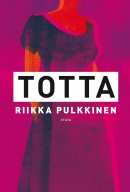 Totta
Totta
[True]
Helsinki: Otava, 2010. 333 p.
ISBN 978-951-1-22965-0
€ 31,40, hardback
The second novel by Riikka Pulkkinen (born 1980) is a comprehensive work that tackles big themes: love, death and rejection. Pulkkinen’s particular strengths as an author are her richly nuanced language and her mastery of structure. While the ending provides food for thought, the book is an enjoyable novel about childhood, growing up, daring to love and live. Martti, a seventy-year-old artist, is caring for his sick wife, a highly respected psychologist. Martti and Elsa have had a long and happy marriage. Then it emerges that Martti had a long affair with their live-in childminder Eeva, whose story grows into one of the main plot strands of the book. Their love story takes place against the background of the 1960s, when the waves passing through European society reached Finland as well. Pulkkinen skilfully brings the perspective of the now grown-up daughter Eleonoora into the mix, as she views her early childhood under the care of two mother figures. At the 2010 Frankfurt Book Fair translation rights to Totta were sold to six countries, which at least goes to show that there is interesting literature to be found in the Nordic countries beyond the ubiquitous crime novels.
Georg August Wallin: Skrifter. Band 1 [Writings. Volume 1]
2 December 2010 | Mini reviews, Reviews
 Skrifter. Band 1: Studieåren och resan till Alexandria
[Writings. Vol. 1: Studies and the journey to Alexandria]
Utg. [Edited by] av Kaj Öhrnberg & Patricia Berg & Kira Pihlflyckt
Helsinki: Svenska litteratursällskapet i Finland, 2010. 455 p., ill.
ISBN 978-951-583-189-7
ISBN 978-91-7353-371-3 (Bokförlaget Atlantis, Stockholm, 2010)
€ 43, hardback
This is the first volume of a planned six-volume critical edition of the writings of Finnish Arabic scholar Georg August Wallin (1811–1852). The main material for the first volume consists of full text of Wallin’s travel diaries and letters from the years 1831–1843. The Arabic texts are accompanied by parallel Swedish translations. The preface contains an overview of the phases of Wallin’s life and the schools of Orientalism and Rousseau which influenced his work. Wallin’s seven-year research journey to the Middle East, and particularly his crossing of the northern Arabian peninsula as the first Western researcher to do so, brought Wallin great international acclaim. Wallin was the first researcher to record the poetry and study the dialects of the desert Bedouin. He is particularly well known for his visits to the holy cities of Mecca and Medina, forbidden to non-Muslims, and to the women’s quarters in their harems.