

Search results for "tommi+musturi/2010/05/song-without-words/2009/09/what-god-said"
The everyday flow
30 June 2006 | Authors, Reviews

Johanna Venho. Photo: Heini Lehväslaiho
Johanna Venho on her own poems
While writing Yhtä juhlaa (‘It’s all a celebration’), my third collection, I was pretty aware of it as a whole. But, generally speaking, the process of writing poetry can’t be fully conscious, or in your control: you can steer it a little, but quite a lot has to be let go. My title shows there’s an irony. It points to the duality of everyday life – and of life in general: both involve celebration and the opposite of celebration.
I’ve played with rhyme – something quite new to me – and reading these poems aloud does, I’ve noticed, work. I’ve recently been having a go at writing song lyrics, too. Something else new is that the collection grows the arc of a story line, and story-telling brings along a fairytale element. More…
Caravans of winds
30 June 1988 | Archives online, Fiction, poetry
Poems from three collections. Introduction by Kaija Valkonen
The river of death froze
It froze, the river of death,
	froze too the boat of death in the nights of the Winter War,
			in the Winter War's nights.
The men shed blood,
				shed blood ,
		and it froze, the river of death.
In the nights of the Winter War, it froze, the river of death.
Day of mourning
For one day I’ve the right to mourn,
for one day I’ll shut the windows of the sky,
I’ll dismiss the blue,
I’ll raise a black sun to mark my mourning.
For one day I’ll wilt the flowers,
for one day I’ll silence the birds. More…
High above the years
23 September 2011 | Fiction, poetry
In Gösta Ågren’s poetry austere aphorisms alternate with concrete observations of life in a small village that was and again is his home, and with portraits of people he has met on his journey in the world. Introduction by David McDuff
Poems from the collection I det stora hela (’On the whole’, Söderströms, 2011)
Father’s hands
(1945)
Father’s hands were like stiff
gloves; a furious
kettle had bewitched them
in his childhood. We ride
from the church’s tall letter
along the river’s long sentence
to the parenthesis of the bridal house,
and the thunder of three hundred hooves
fills the space beneath the clouds.
I saw father driving through
his life with those numbly
gripped reins, and later,
right now, I think of the
life-long body in which a man
comes, is wounded, and goes. More…
Poems
31 March 1980 | Archives online, Fiction, poetry
Poems from Kallista on ja halvalla menee (‘It comes dear and it’s going cheap’,1975) and Reviirilaulu (‘Territorial song’, 1978). Introduction by Pentti Saaritsa
1
A seagull shadow flitters across the gulf of the courtyard
over the gone-sour yellow wall
ogreish and swift as an execution by hanging,
that’s how I’m dangling
from this moment in this city
my ankle in the strangling noose
in the night under the jangling stars while over the roofs
a sheetmetal moon’s rising
and blurred dreams are yawning in a thousand windows,
down below me the city
and in my breast my heart, it’s socking
like a knuckleduster.
2
The simplest noise,
the noise of a glass
when you put the glass down
on a wooden table, the sound of wood
on glass
                     is like
a flash of  happiness
on a melancholy face.
Poems
30 June 1985 | Archives online, Fiction, poetry
Introduction by Bo Carpelan
	A flower beckons there, a secent beckons there, enticing my eye.
A hope glimmers there.
	I will climb to the rock of the sky, I will sink in the wave:
a wave-trough. I am singing tone, and the day smiles in riddles.
*
	Like a sluice of the hurtling rivers I race in the sun:
to capture my heart; to seize hold of that light in an inkling:
sun, iridescence.
	In day and intoxication I wander. I am in that strength:
the white, the white that smiles.
*
	To my air you have come: a trembling, a vision! I know neither
you nor your name. All is what it was. But you draw near: a
daybreak, a soaring circle, your name.
A fifth season
30 December 2000 | Fiction, poetry
Poems from Elävän mieli (‘A mind alive’, WSOY, 1999). Introduction by Lauri Otonkoski
In sparser gusts of wind
metaphors sough through the mind,
spinning as on the much-frequented
boulevards of a great park.
Even one’s most private thoughts are as common
as public transport, what a relief,
as shared as our anatomies and our bacteria,
for there is only one thread in the skein of the Norns
and the same fabric is always being woven
from the whims of fate: is that not a relief?
Treacherous individuality suffices only
for a fingerprint.
Metaphors always the same,
but constantly born anew
like a mind alive. More…
Upstairs, downstairs
31 March 2000 | Archives online, Fiction, Prose
From Harmia lämpöpatterista (‘Trouble with the radiator’, Gummerus, 1999). Introduction by Tero Liukkonen
The view
From here, I can see straight into their bedroom. The thin man chases the red-haired mountain of lard; round and round the room they go: the man is swinging something in his hand, I can’t see what, while the lard-mountain squeals until the man throws her onto the bed. The same thing happens every night; I can’t see the bed. Too low, and I wouldn’t want to, besides; lewd ugly makes me sick that I can even think of it.
Downstairs a young man is always watching TV, sitting there motionless all evening. The blue flickers, never turns on the light, a young man. He has long, slender legs and arms, but his face I can’t see, it’s too dark. There are painting tools on his window sill. More…
Profiles
2 October 2014 | Fiction, Prose
Rosa Liksom’s first book, in 1985, was a collection of short prose; she has also written novels, children’s books, plays, comic and picture books. Her new book, Väliaikainen (‘Temporary’, Like, 2014) – a return to her signature very short prose – features beasts, machines and men
He’s there in the living room. We’ve gotta be very quiet. I left the computer on, and the reading lamp. I’ll go in and turn them off, quietly. Or the computer at least. I can watch Emmerdale on the little tv in the kitchen. You wait here. OK, I turned off the computer but I left the lamp on so I wouldn’t wake him up. I put his nap blanket over him. He’s laying on his left side now. That’s good. Whenever he wakes up on his right side he gets awfully grumpy. Let’s go in the kitchen so we don’t disturb him. The poor guy. It’s been hours since he’s had a good sleep. You know, I think it’s the depression again. It started on Monday when he was supposed to go to his guide’s job.He didn’t taste his breakfast, even though I brought it to him in bed. I had to go to the hospital, my shift was starting, and he just laid there in the bedroom with his eyes open… I don’t know how long it’s gonna last this time. Last month he was depressed for three days. I think it’ll pass more quickly this time because he’s napping a little bit, and licking his paw now and again.

Back in the USSR
3 October 2011 | Fiction, Prose
Extracts from Rosa Liksom’s novel Hytti nro 6 (‘Compartment no 6’, WSOY, 2011). Review by Mervi Kantokorpi
Moscow hunched itself in the dry, frosty March night, protecting itself from the touch of the icy red sun as it set. The girl entered the train’s last sleeping carriage, found her compartment, compartment number six, and breathed deeply. There were four beds in the compartment, the upper ones folded agains the wall, while between the beds was a small table, on the table a white table cloth and a plastic flower vase containing a bunch of pink paper carnations, faded by time; the shelf above the end of the bed was full of large, untidily secured parcels. The girl shoved her modest old suitcase, the one she had got from Zahar, into the metal luggage space under the hard, narrow bed; her small backpack she threw on the bed. When the station bell sounded for the first time, the girl went to stand by the corridor window. She breathed in the scent of the train, iron, coal-dust, the smells left behind by dozens of cities and thousands of people. Travellers and those who had come to see them off pushed past her, shoving her with their cases and parcels. The girl touched the cold window with her hand and looked at the platform. This train would take her through villages inhabited by deportees, through the open and closed towns of Siberia to the capital of Mongolia, Ulan Bator. More…
Disintegration
31 December 1992 | Archives online, Fiction, Prose
From Pythonin yö (‘Night of the python’, Gummerus, 1992). Introduction by Kaija Valkonen
I feel as if the disintegration has already started. I do not want it, I am not yet ready. And I do not want to discuss it with the doctors; I know that they would not understand, and the thing I am talking about has nothing to do with my state of health. It is not an illness; it is something more insidious. It occurs under the cover of health. It is a deception.
It is hard to say when it started, but whenever I try to remember, a certain day comes into my mind. It can hardly be the beginning, how could disintegration start with joy? But it was a day that contained many elements of dissolution: a strong wind, the ice breaking, quickly moving clouds. At one point I picked up an old tub in the corner of the shed, its hoops fell off and it collapsed, ringing. More…
Art or politics?
16 February 2012 | This 'n' that
You’re going about your business in Helsinki Railway Station on a cold winter’s day — waiting for your train, buying tickets or newspapers or just taking short-cut through the building to keep warm – when suddenly the bloke next to you bursts into song. And not just him: along with a couple of dozen others, he makes the air ring with the patriotic song Finlandia, sung in harmony and perfectly in tune. (The video can be viewed at http://www.youtube.com/watch?v=wO63xt2jWtc) More…
Letters from Tove
6 October 2014 | Extracts, Non-fiction
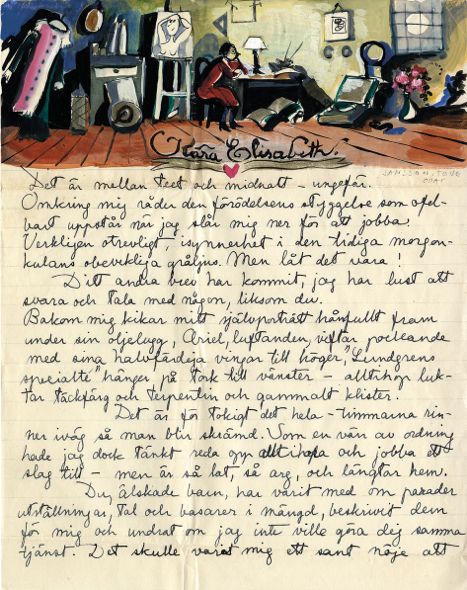
Early days: Tove Jansson went to Stockholm to study art when she was just 16. A letter to her friend Elisabeth Wolff, from November 1932
Artist and author Tove Jansson (1914–2001) is known abroad for her Moomin books for children and fiction for adults. A large selection of her letters – to family, friends and lovers – was published for the first time in September. In these extracts she writes to her best friend Eva Konikoff who moved to the US in 1941, to her lover, Atos Wirtanen, journalist and politician, and to her life companion of 45 years, artist Tuulikki Pietilä.
Brev från Tove Jansson (selected and commented by Boel Westin and Helen Svensson; Schildts & Söderströms, 2014; illustrations from the book) introduced by Pia Ingström
7.10.44. H:fors. [Helsinki]
exp. Tove Jansson. Ulrikaborgg. A Tornet. Helsingfors. Finland. Written in swedish.
to: Miss Eva Konikoff. Mr. Saletan. 70 Fifty Aveny. New York City. U.S.A.
Dearest Eva!
Now I can’t help writing to you again – the war [Finnish Continuation War, from 1941 to 19 September 1944] is over, and perhaps gradually it will be possible to send letters to America. Next year, maybe. But this letter will have to wait until then – even so, it will show that I was thinking of you. Curiously enough, Konikova, all these years you have been more alive for me than any of my other friends. I have talked to you, often. And your smiling Polyfoto has cheered me up and comforted me and has also taken part in the fortunate and wonderful things that have happened. I remembered your warmth, your vitality and your friendship and felt happy! At first I wrote frequently, every week – but after about a year most of it was returned to me. I wrote more after that, but the letters were often so gloomy that I didn’t feel like saving them. Now there are so absurdly many things I have to talk to you about that I don’t know where to begin. Koni, if only I’d had you here in my grand new studio and could have hugged you. After these recent years there is no human being I have longed for more than you. More…
A light shining
28 July 2011 | Essays, Non-fiction
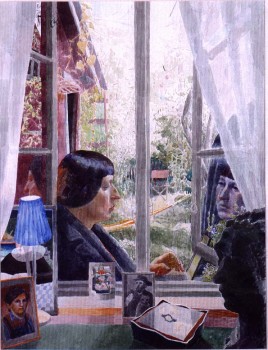
Portrait of the author: Leena Krohn, watercolour by Marjatta Hanhijoki (1998, WSOY)
In many of Leena Krohn’s books metamorphosis and paradox are central. In this article she takes a look at her own history of reading and writing, which to her are ‘the most human of metamorphoses’. Her first book, Vihreä vallankumous (‘The green revolution’, 1970), was for children; what, if anything, makes writing for children different from writing for adults?
Extracts from an essay published in Luovuuden lähteillä. Lasten- ja nuortenkirjailijat kertovat (‘At the sources of creativity. Writings by authors of books for children and young people’, edited by Päivi Heikkilä-Halttunen; The Finnish Institute for Children’s Literature & BTJ Kustannus, 2010)
What is writing? What is reading? I can still remember clearly the moment when, at the age of five, I saw signs become meanings. I had just woken up and taken down a book my mother had left on top of the chest of drawers, having read to us from it the previous day. It was Pilvihepo (‘The cloud-horse’) by Edith Unnerstad. I opened the book and as my eyes travelled along the lines, I understood what I saw. It was a second awakening, a moment of sudden realisation. I count that morning as one of the most significant of my life.
Learning to read lights up books. The dumb begin to speak. The dead come to life. The black letters look the same as they did before, and yet the change is thrilling. Reading and writing are among the most human of metamorphoses. More…
Is it a play, is it a book?
25 February 2011 | This 'n' that
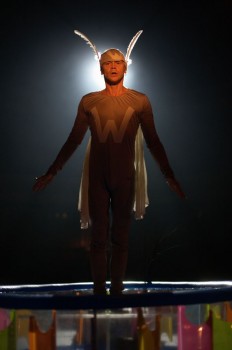
On the way to fame: Walt the Wonder Boy in Kristian Smeds's stage adaptation of Paul Auster's novel Mr. Vertigo at the Finnish National Theatre (2010). Photo: Antti Ahonen
Dramatisations of novels are tricky. Finnish theatremakers like adapting novels for the stage, which often results in a lot of talking instead of action – and action here doesn’t refer to just physical movement but to the subtext, to what happens under and behind the words.
Currently an adaptation of an American novel is running on the main stage of the Finnish National Theatre in Helsinki. Mr Vertigo (1994), Paul Auster’s seventh book, tells the story of an orphan boy in the 1930s St Louis. After harsh years as the long-suffering apprentice of the mysterious Master Yehudi, Walt becomes the sensational Wonder Boy by learning how to levitate.
In theatremaker Kristian Smeds’s adaptation, Auster’s whimsical, rambling novel becomes a capricious, illusory journey about illusions, freedom, and the unattainability of love. Walt (the highly expressive, athletic Tero Jartti) interprets, with hilarious comedy as well as with touching desperation, both the dizzyingly powerful experience of creativity and the ridiculous hubris of the artist. More…