

Search results for "tommi+musturi/2010/05/song-without-words/2009/09/what-god-said"
Is this all?
10 October 2013 | Extracts, Non-fiction
Earth. Andrew Z. Colvin/Wikimedia
In today’s world, many people find that it is not the lack of something that is problematic, but excess: the same goes for knowledge. According to professor of space astronomy, Esko Valtaoja, knowledge should contribute to the creation of a better world. His latest book is a contribution to the sum of all knowledge; over the course of two hundred pages Valtaoja delves deep into the inner space of man by taking his reader on a brief tour of the universe. Extracts from Kaiken käsikirja. Mitä jokaisen tulisi tietää (‘A handbook to everything. What everybody should know’, Ursa, 2012)
Whatever god you bow down to, you’re probably worshipping the wrong god.
The above is almost the only completely certain thing that can be said about religion, and even it does not encompass any deep truth; it’s just a simple mathematical statement. The world’s biggest religion is Roman Catholicism, which is confessed, at least nominally, by 1.1 billion people. If the Roman Catholic god were the true god, the majority of people in the world are therefore worshipping a false god. (According to the official stance of the Catholic church, the other Christian denominations are heresies, and their believers will be condemned to perdition: extra ecclesiam nulla salus. This inconvenient truth is, understandably, politely bypassed in ecumenical debate. But even if all those who call themselves Christians were counted as worshipping the same god, two thirds of the world’s population are still knocking at the wrong door.)
If you’re a religious person, don’t worry; I’m not blaspheming. And if you’re a campaigning atheist, hang on a minute: all I want to do is to find a clear and undisputed starting point to consider what it is we’re talking about when we speak of religion. More…
The almost nearly perfect travel book
4 April 2014 | Articles, Non-fiction
Illustration: Joonas Väänänen
The question of what foreign people think of us Finns, and Finland has always been a particularly burning one in these latitudes: a young nation, a small people. Can we be as good as bigger and wealthier nations? Tommi Uschanov reads a new book on the Nordic countries published in England, keeping a sharp eye on what is being said about…. Finland, naturally
When an article based on The Almost Nearly Perfect People: The Truth About the Nordic Miracle by Michael Booth was published last January in the London Guardian, there was a nationwide outcry in Finland. ‘Finland being bashed in the British media,’ one tabloid headlined grandiosely, while a sober financial paper spoke of ‘a broadside full of stinky stuff’. It takes a re-reading of the article after having read the book to understand why. To create an artificial atmosphere of controversy, the article is lop-sidedly critical of Finland in a way which the book goes out of its way to avoid.
The Almost Nearly Perfect People belongs in a by now time-honoured genre within English letters: the humorous encomium to a host culture by an expatriate – or immigrant, as we hosts impolitely insist on calling them. The only difference is that Michael Booth, a British food and travel writer, does not discuss only Denmark, where he has lived for a decade, but visits each of the other four Nordic countries in turn. More…
Canberra, can you hear me?
31 March 1987 | Archives online, Fiction, Prose
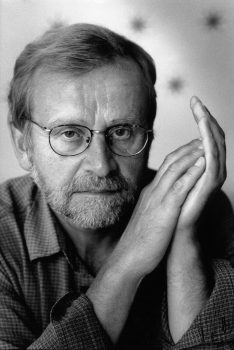
Johan Bargum. Photo: Irmeli Jung
A short story from Husdjur (‘Pets’, 1986)
Lena called again Sunday morning. I had just gotten up and was annoyed that as usual Hannele hadn’t gone home but was still lying in my bed snoring like a pig. The connection was good, but there was a curious little echo, as if I could hear not only Lena’s voice but also my own in the receiver.
The first thing she said was, ‘How is Hamlet doing?’
She’d started speaking in that affected way even before they’d moved, as if to show us that she’d seen completely through us.
‘Fine,’ I said. ‘How are you?’
‘What is he doing?’
‘Nothing special.’
‘Oh.’
Then she was quiet. She didn’t say anything for a long while.
‘Lena? Hello? Are you there?’
No answer. Suddenly I couldn’t stand it any longer. More…
Mary Bloom
31 December 1983 | Archives online, Drama, Fiction
Introduction by Väinö Vainio
‘Is Mary Bloom about a revivalist religious meeting, a party political conference at which a new leader is born, or a rock concert? These are among the things that have been suggested. I don’t know. I don’t hope for restraint in the imaginations of those who choose.to interpret my work, although I observe it myself. The work of a writer is a part of life, it is an individual and collective experience that seeks, finds, takes and uses its materials like a motor machine. For those who create it the drama is real, as in the theatre, for the duration of the performance.’ Jussi Kylätasku
Characters
Mary Bloom
Martha, a doctor
Otto, a preacher
Disabled veteran
Serenity, his wife
Alcoholic
Cold Cal, a prisoner
Blind man, Deaf Wife More…
Brighter than darkness
30 June 2002 | Archives online, Fiction, Prose
An extract from the novel Eksyneet (‘The lost’, WSOY, 2001). Interview by Markus Määttänen
It was a white tiled wall. Too white. Sterile. He wondered how long he had been looking at it. In any case long enough to have forgotten it was a wall. It had changed into a vacuum opening up before him and then shrunk into a tunnel through whose irresistible suction he had hurtled toward the painful images of the past. The past. Yesterday. Almost yesterday. He had stared at the nocturnal entrance, clearly divided in two by the street lamps, and not just that, but now saw only a lifeless and, in its lifelessness, repellant wall. He sighed, rubbed his numb face, pushed himself off the floor and stood up.
‘ware bears!
30 September 1988 | Archives online, Children's books, Fiction
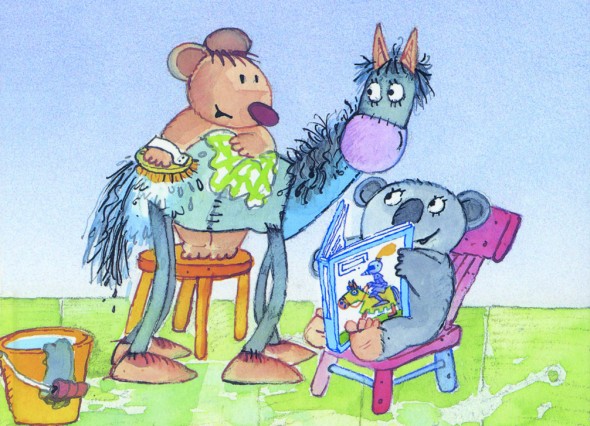
Illustration: Jukka Lemmetty
Urpo and Turpo are a pair of teddy bears. Their family – mother, father and three children – cannot imagine who it is that makes such a mess; the bears live their own absorbing lives in house. Hannele Huovi’s text and Jukka Lemmetty’s illustrations describe the bears’ antics in a way that appeals to the sense of humour of readers of all ages.
In the green house an ordinary family are living a perfectly ordinary life. There’s father, mother, The Big Daughter, The Son, and also The Baby as well. Mother keeps running back and forth all day long shouting, ‘Goodness gracious! Who’s responsible for this?’ For very funny things keep going on in the house. Who on earth is it – always getting up to some sort of hanky-panky?
Father harrumphs and says to The Big Daughter:
‘It was you, wasn’t it?’ But The Big Daughter shakes her head. Father turns to The Son:
‘So it must have been you, then?’ But the son shakes his head. No use asking The Baby. He shakes his head anyway, because he’s always imitating the others. Father and mother are completely stumped. More…
Wo/men at war
9 February 2012 | Essays, Non-fiction
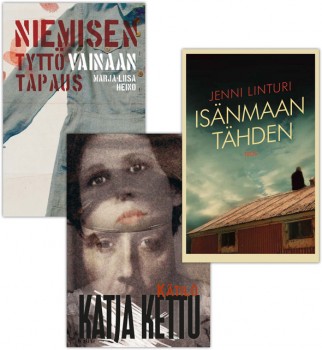 The wars that Finland fought 70 years and a couple of generations ago continue to be a subject of fiction. Last year saw the appearance of three novels set during the years of the Continuation War (1941–44), written by Marja-Liisa Heino, Katja Kettu and Jenni Linturi
In reviews of Finnish books published this past autumn, young women writers’ portraits of war were pigeonholed time and again as a ‘category’ of their own. This gendered observation has been a source of annoyance to the writers themselves.
Jenni Linturi, for instance, refused to ruminate on the impact of her sex on her debut novel Isänmaan tähden (‘For the fatherland’, Teos), which describes the war through the Waffen-SS Finnish volunteer units and the men who joined them [1,200 Finnish soldiers were recruited in 1941, and they formed a battalion, Finnische Freiwilligen Battaillon der Waffen-SS].
The work received a well-deserved Finlandia Prize nomination. Tiring of questions from the press about ‘young women and war’, Linturi (born 1979) was moved to speculate that some critics’ praise had been misapplied due to her sex. The situation is an apt reflection of the waves of modern feminism and the reasoning of the so-called third generation of feminists, who reject gender-limited points of view on principle. More…
On the make
31 December 2007 | Fiction, Prose
Extracts from the novel Benjamin Kivi (WSOY, 2007). Introduction by Lauri Sihvonen
Benjamin Kivi alias Into Penger, the 1930s
What was Kuihkä worth? What were this little man and his sons worth? What was I worth?
I drove where the little man told me to, with no lights, through a densely populated area. I could only see half a meter in front of me, trying to sense the bends and curves in the road and still keep Tallus’ car in good shape. When we got to the woods I turned on the lights and glanced at the little man sitting next to me. He was stuffing a handkerchief into his sleeve like an old housewife. The top of his head was sweating. He brushed his hair back and shoved his cap down on his head.
I had two hours to think as I drove, but it felt like a few minutes. If I didn’t drive the car, someone else would have, everything would happen just like the little man had planned, and I wouldn’t know anything about Kuihkä. What was I going to do, watch while he was thrown to the wolves? Kuihkä rescued me once. Was it meant to be that I should drive the car? Was I meant to change the course of events? How many coincidences can there be in one lifetime, and what do they signify? If events weren’t random, then what the hell was I supposed to do? More…
Moving on
30 June 2003 | Archives online, Fiction, Prose
Extracts from the short story ‘Tunnin kuvat’ (‘One-hour processing’, from the collection Vapiseva sydän, ‘Tremulous heart’, Tammi, 2002). Introduction by Harry Forsblom
Last summer, when I was helping my brother with his move, he said I could take as many of his old LPs as I wanted. There were actually two of us on the job: his younger friend Timbe was along, and when we’d almost completely cleared out the flat and my brother’s two cellar closets (he’d rented an extra closet from the next-door flat, as he was submerging under the clobber lying around everywhere), he said the same to Timbe: ‘Just help yourself.’ The records we ourselves didn’t want would be chucked in the rubbish.
Mothers and sons
30 March 2008 | Archives online, Fiction, Prose
Extracts from Helvi Hämäläinen’s novel Raakileet (‘Unripe’, 1950. WSOY, 2007)
In front of the house grew a large old elm and a maple. The crown of the elm had been destroyed in the bombing and there was a large split in the trunk, revealing the grey, rotting wood. But every spring strong, verdant foliage sprouted from the thick trunk and branches; the tree lived its own powerful life. Its roots penetrated under the cement of the grey pavement and found rich soil; they wound their way under the pavement like strong, dark brown forearms. Cars rumbled over them, people walked, children played. On the cement of the pavement the brightly coloured litter of sweet papers, cigarette stubs and apple cores played; in the gutter or even in the street a pale rubber prophylactic might flourish, thrown from some window or dropped by some careless passer-by.
The sky arched blue over the six-and seven-storey buildings; in the evenings a glimmer could be seen at its edges, the reflection of the lights of the city. A group of large stone buildings, streets filled with vehicles, a small area filled with four hundred thousand people, an area in which they were born, died, owned something, earned their daily bread: the city – it lived, breathed….
Six springs had passed since the war…. Ilmari’s eyes gleamed yellow as a snake’s back, he took a dance step or two and bent over Kauko, pretending to stab him with a knife. More…
Year of the cat
13 November 2014 | Fiction, Prose
Extracts from the novel Kissani Jugoslavia (‘Yugoslavia, my cat’, Otava 2014). Introduction by Mervi Kantokorpi
I met the cat in a bar. And he wasn’t just any cat, the kind of cat that likes toy mice or climbing trees or feather dusters, not at all, but entirely different from any cat I’d ever met.
I noticed the cat across the dance floor, somewhere between two bar counters and behind a couple of turned backs. He loped contentedly from one place to the other, chatting to acquaintances in order to maintain a smooth, balanced social life. I had never seen anything so enchanting, so alluring. He was a perfect cat with black-and-white stripes. His soft fur gleamed in the dim lights of the bar as though it had just been greased, and he was standing, firm and upright, on his two muscular back paws.
Then the cat noticed me; he started smiling at me and I started smiling at him, and then he raised his front paw to the top button of his shirt, unbuttoned it and began walking towards me. More…
For the love of a city
31 December 2004 | Archives online, Fiction, Prose
Extracts from the novel I väntan på en jordbävning (‘Waiting for an earthquake’, Söderströms, 2004). Introduction by Petter Lindberg
Nonna Rozenberg lived quite near the special school where I was a boarder, in a block nine stories high with a bas-relief to the right of the door. This bas-relief featured a fairy-tale figure – the Firebird or the Bird Sirin.
I often saw Nonna stepping out of a tram carrying a large brown case. She moved carefully, as if afraid of falling.
She played the cello, and resembled that bulky, melodious instrument herself. Women’s figures are often compared to guitars. But Nonna’s appearance never hinted at parties at home with parents away or singsongs around the camp-fire.
She was no beauty. Her slow, precociously mature body was neither graceful nor girlishly delicate. If I’d met her later, when I was working at a gym, I’d have said she was overweight and lacking in self-discipline. More…
Tutti frutti
20 November 2009 | In the news
 The chair of the jury for the Finlandia Prize for Non-Fiction 2009, Professor Pekka Puska, compared choosing a winner to the dilemma of choosing between oranges and bananas. The jury found that among the entries were at least 20 or 30 books that could have gone on the final shortlist of six titles. More…
What about me?
30 September 2008 | Fiction, Prose
Extracts from the novel Mitä onni on (‘What happiness is’, Otava, 2008)
I was lying on the sofa watching Sports Roundup. The ski jumpers were flying at Zakopane. When I go one day, I want the cantor to play the Sports Roundup theme on the harmonium and the pallbearers to look on like skiing judges down into the pit.
‘I have an idea,’ Liisa said, sitting down at the other end of the sofa. I muted the television and adopted a focused expression. I focused on thinking about my expression.
‘Finnish happiness,’ Liisa pronounced solemnly. ‘I’ll illustrate, and you write.’
‘A book again,’ I said and turned the sound back on. They were reading off the women’s basketball scores now. Liisa waited patiently. I was disarmed enough by this that I turned the television off. More…
European Union literature prizes 2010
8 October 2010 | In the news
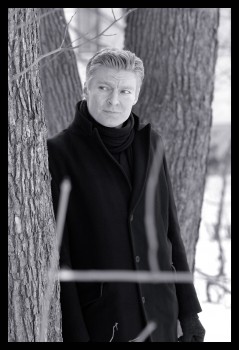
Riku Korhonen. Photo: Harri Pälviranta
With his novel Lääkäriromaani (‘Doctor novel’, Sammakko, 2009), Riku Korhonen (born 1972) is one of the 11 winners of the 2010 European Union Prize for Literature, worth €5,000 each. The winners were announced at Frankfurt Book Fair on 6 October.
The European Commission, the European Booksellers’ Federation (EBF), the European Writers’ Council (EWC) and the Federation of European Publishers (FEP) award the annual prize, which is supported through the European Union’s culture programme. It aims to draw attention to new talents and to promote the publication of their books in different countries, as well as celebrating European cultural diversity. Authors who have published two to four prose works during the last five years and whose work has been translated into two foreign languages at the most are eligible for the prize.
Korhonen has published two novels, a collection of short prose and a collection of poetry. Read translated extracts, published in Books from Finland in 2003, from his first novel, Kahden ja yhden yön tarinoita (‘Tales from two and one nights’, 2003) here. More…