

Search results for "tommi+musturi/2010/05/song-without-words/2009/09/what-god-said"
Chronicles of crisis
31 December 1982 | Archives online, Fiction, Prose
Books from Finland presents here an extract from Dyre prins, a novel by the Finland-Swedish writer Christer Kihlman that is to be published in 1983 by Peter Owen of London under the title Sweet Prince, in a translation by Joan Tate.
Christer Kihlman (born 1930) first became known as a poet; but, after publishing two collections of poetry, he turned to novels. He has been branded a merciless scourge of the bourgeoisie. Equally important in his writing, however, are his masterly psychological analyses, his examination of the myriad aspects of the human personality, his sovereign disregard for taboos and his unflagging search for the truth. His books are about crises – the conflict between the generations, between the individual and society, between opposing political ideologies, between homosexual and heterosexual love. As Ingmar Svedberg remarked in an extensive appreciation of Kihlman’s work that appeared in Books from Finland 1-2/1976, ‘In his perceptive moral analyses, his exploration of the depths of human destructiveness and degradation, Kihlman is sometimes reminiscent of Faulkner.’ Since 1970, Kihlman has published three revealing autobiographical works, two of them dealing with his encounter with South America; Dyre prins, first published in 1975, represents a brief interlude of fiction.
The extract printed below is accompanied with a personal appreciation of the novel by its English translator, Joan Tate
Grandfather’s astonishing revelation gave me a new perspective on my life. I had suddenly been given a concrete, genuine foundation for both my hatred and my self-esteem. In a way I took the story of my origins as an extreme confirmation of the rightness of the Communist interpretation of reality, and at the same time it gave me a wonderful, dazzling sensation of being someone, despite everything, of having a place in a meaningful human perspective of time, despite everything, of being a link, however modest, in the historical family tradition. I did not need to found a dynasty; I already belonged to a dynasty, if only a minor branch. One was less important than the other, and even if the two experiences were irreconcilable and contradictory, they existed all the same in the same consciousness, contained within the same consciousness, my consciousness. I, Donald Blad! More…
Arska
30 September 1982 | Archives online, Fiction, Prose
A short story from Kaksin (‘Two together’). Introduction by Pekka Tarkka
A landlady is a landlady, and cannot be expected – particularly if she is a widow and by now a rather battered one – to possess an inexhaustible supply of human kindness. Thus when Irja’s landlady went to the little room behind the kitchen at nine o’clock on a warm September morning, and found her tenant still asleep under a mound of bedclothes, she uttered a groan of exasperation.
“What you do here this hour of day?” she asked, in a despairing tone. “You don’t going to work?”
Irja heaved and clawed at the blankets until at last her head emerged from under them.
“No,” she replied, after the landlady had repeated the question.
“You gone and left your job again?”
“Yep.” More…
A spot of transmigration
13 January 2011 | Fiction, Prose
A short story, ‘Sielunvaellusta’, from the collection Rasvamaksa (‘Fatty liver’, WSOY, 1973)
‘Where will you be spending Eternity?’ a roadside poster demanded as Leevi Sytky sped by in his car.
‘Hadn’t really thought about it,’ Leevi muttered , as if in reply, and lit a cigarette.
But at the next level crossing, a kilometre or so further on, he was run down by a train, whose approach he had failed to notice. His attention had been distracted by the sight of a young woman who was picking black currants by the side of the track, and who happened to be bending forward in his direction. Intent on obtaining a better view of her ample bosom by peering over the top of her blouse, Leevi neglected to look both ways, and death ensued. Damned annoying, to say the least.
In due course he secured an interview with God, who turned out to be a biggish chap, about a hundred metres tall, wearing thigh-boots and sitting behind a large desk.
‘Well, and how’s Leevi Sytky getting along?’ God asked, lighting his pipe.
‘Mustn’t grumble,’ said Leevi politely.
‘And how are you thinking of spending Eternity?’ God inquired, sucking at his pipe and puffing out his cheeks. More…
In the wars
31 March 2005 | Archives online, Fiction, Prose
A short story from Jussi ja Lassi (‘Jussi and Lassi’, WSOY, 1921). Introduction by Pekka Tarkka
One winter evening, Lassi, who was six, asked: ‘Can’t we go out, mother?’
‘It’s late already,’ she said.
‘We’ve been inside the whole day practically,’ said Jussi, who was seven. ‘It gets on my nerves.’
‘Gets on your nerves, does it? Well, boys, you’ll soon be off in bed,’ she said, ‘so you won’t need to get nervy.’
‘Not off to bed – not yet, it’s not yet, not…’ Lassi broke off, trying to work it out.
‘It’s not six yet,’ Jussi said.
‘No, it isn’t,’ their mother said; ‘but you’ll have to stay in your room and not go charging about here, because visitors are coming.’ More…
Rock or baroque?
30 April 2014 | Extracts, Non-fiction
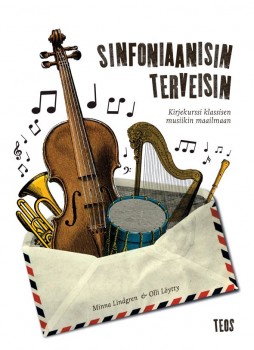 What if your old favourites lose their flavour? Could there be a way of broadening one’s views? Scholar Olli Löytty began thinking that there might be more to music than 1980s rock, so he turned to the music writer Minna Lindgren who was delighted by the chance of introducing him the enormous garden of classical music. In their correspondence they discussed – and argued about – the creativity of orchestra musicians, the significance of rhythm and whether the emotional approach to music might not be the only one. Their letters, from 2009 to 2013, an entertaining musical conversation, became a book. Extracts from Sinfoniaanisin terveisin. Kirjekurssi klassisen musiikin maailmaan (‘With symphonical greetings. A correspondence course in classical music’)
Olli, 19 March, 2009
Dear expert,
I never imagined that the day would come when I would say that rock had begun to sound rather boring. There are seldom, any more, the moments when some piece sweeps you away and makes you want to listen to more of the same. I derive my greatest enjoyment from the favourites of my youth, and that is, I think, rather alarming, as I consider people to be naturally curious beings whom new experiences, extending their range of experiences and sensations, brings nothing but good.
Singing along, with practised wistfulness, to Eppu Normaali’s ‘Murheellisten laulujen maa’ (‘The land of sad songs’) alone in the car doesn’t provide much in the way of inspiration. It really is time to find something new to listen to! My situation is already so desperate that I am prepared to seek musical stimulation from as distant a world as classical music. I know more about the African roots of rock than about the birth of western music, the music that is known as classical. But it looks and sounds like such an unapproachable culture that I badly need help on my voyage of exploration. Where should I start, when I don’t really know anything? More…
In the mirror
30 September 2003 | Archives online, Fiction, Prose
Extracts from the novel Helene (WSOY, 2003). Introduction by Leena Ahtola-Moorhouse
It was raining that day, and I was leafing through art books, as I often do, in the bookshop. Then I happened to pick up a work in which there was a picture; a bowl of apples, one of which was black.
Stories often begin like this, inexplicable as deep waters, secret as an unborn child which moves its mouth in the womb as if it wished to speak. For people do not seek mere understanding… people seek the sulphurous, tumultuous shapes of clouds; people seek bowls of apples of which one is black.
I bought the book and made an enlargement of the still life; on the wall, it was even more remarkable, for its correct position was standing up, tête à tête, looking straight at you, unblinking.
The apples seemed to move, to speak. I began to ponder them more and more. In the end I had to read everything I could lay my hands on about the still life’s painter. I had to visit Hyvinkää, where she lived for a long time, and touch her tree in Tammisaari with my hand. I had to travel as far as Brittany to see the rugged landscape that meant so much to her. More…
The rocket
30 September 1988 | Archives online, Fiction, Prose
Raketen (‘The rocket’), a novella from the collection Den segrande Eros (‘Eros triumphant’), 1912. Introduction by George C. Schoolfield
The sun shone straight in through the veranda’s little windows that made the whole ‘villa’ resemble a hothouse. With a sigh, Elsa let the morning paper fall to the floor; she had gotten halfway through the classified ads: ‘Three lads wish to correspond with likeminded lasses.’ ‘If Mr Söders-m does not fetch his effects, left as bond for unpaid rent, within a week, they will be regarded as our property, and his name will be published in toto.’ Now she could stand no more. The air seemed to come from a bakeoven. Listlessly, she watched two flies as they flicked the ceiling paper in their humming dance of love. It seemed as though knives were being thrust into the back of her head; that was the way her sick headaches began. A long walk might stop it, she knew, but she felt too tired.
At last, she was able to make herself get up and open the door for some fresh air. But with the air she got a powerful smell of roasting pork from the baker’s villa; the yells of the children playing cops and robbers up on the rock were doubled in force. A nasty stabbing sensation began in Elsa ears. And so she decided to take a walk after all, but only to the steamboat jetty. More…
The report
30 September 1984 | Archives online, Fiction, Prose
A short story from Kesä ja keski-ikäinen nainen (‘Summer and the middle-aged woman’) Introduction by Margareta N. Deschner
Dear Colleague,
First of all, I want to thank you and your wife for the pleasant evening I and my wife had in your summer villa in August. Briitta (since we are old acquaintances: with two i’s and two t’s, remember?) especially wants me to mention that she will never forget the half moon climbing the hill behind your sauna, surprising us with its speed. The next time we looked it was half-way up the sky! Without doubt, your fine tequila had something to do with the matter, one shouldn’t forget that. Even so, it was quite a show, just like the time a bunch of us guys had gone skiing and you bragged that you had arranged for the barn to catch fire. I hope that you and your wife – I mean Alli – will be able to visit us next winter and taste a superb Mallorca red wine called Comas, which we brought home. It is by far the best red I have ever tasted and indecently cheap to boot. I hope you will come soon. The wine won’t keep indefinitely, as you well know. We’ll save it for you. So thanks again.
Looking back on a dark winter
31 December 1989 | Archives online, Fiction, Prose
Extracts from the autobiographical novel Talvisodan aika (‘The time of the Winter War’), the childhood memoirs of Eeva Kilpi. During the winter of 1939–40 she was an 11-year old-schoolgirl in Karelia when it was ceded to the Soviet Union and the population evacuated
Time is the most valuable thing
we can give each other
War’s coming.
One day my father comes out with the familiar words in a totally unfamiliar way, while we’re sitting round the kitchen table eating, or just starting to eat.
He says to mother, as if we simply aren’t there, as if we don’t need to bother, or as if listening means not understanding. Or perhaps they’ve simply no other chance to speak to each other, as father’s always got to be off hunting, or on his way to the station, and mother’s always cooking. More…
Still alive
31 March 2000 | Fiction, Prose
Extracts from the novel Maa ilman vettä (‘A world without water’, Tammi, 1999)
The window opened on to a sunny street. Nevertheless, there was a pungent, sickbed smell in the room. There were blue roses on a white background on the wallpaper and, on the long wall, three landscape watercolours of identical size: a sea-shore with cliffs, a mountain stream, mountaintops. The room was equipped with white furniture and a massive wooden table. The television had been lifted on to a stool so that it could be seen from the bed.
The bed had been shifted to the centre of the room with its head against the rose-wall, as in a hospital. Between white sheets, supported by a large pillow, Sofia Elena lay awake in a half-sitting position. More…
Out of this world
31 December 1996 | Archives online, Fiction, Prose
Extracts from the novel Virkamatka (‘Business travel’, Otava, 1996). Introduction by Jyrki Kiiskinen
I spent a couple of weeks alone at home that summer. My brother was at camp and my father on a business trip. Bored one rainy day, I opened up their last game on the computer. They had been going on about it for weeks.
I began from the beginning, A splendid start: texts backed by imaginative visions, Then darkness. In the middle of it a gold-coloured, glimmering dot. Nothing else. I waited for a long time. Nothing else, I waited. Nothing. Then I pressed the computer’s space-bar. The dot exploded and the explosion filled the entire screen. From its centre swarmed familiar patterns, Diagrams of atomic nuclei, electrons, radiation. More…
The Cheap Contractor
30 June 1986 | Archives online, Fiction, Prose
From Kauan kukkineet omenapuut (‘Long-blossoming apple trees’, 1982). Introduction by Arto Seppälä
The men who delivered the hot-water cylinder offered to do the installation as well. I asked how much it would be. They lolled about a bit, exchanged a few private looks, pretended to be thinking. Then one of them fired off a sum. It was three times the quotation I’d already had. They didn’t even look at the location. I told myself I wouldn’t even go to the end of the road with big-dealers like these.
The same evening I rang up ‘a little man’ and told him he could get started as soon as it suited him.
The cheap contractor turned up a couple of days later, driving an elderly van into the yard. I went out. He’d sat himself down in a garden chair near the white lilacs. The morning sun only partially reached there; so half his body was in shade, looking colder than the sunny half. More…
Man and boy
31 December 2006 | Archives online, Fiction, Prose
Extracts from the novel Kansallismaisema (‘National landscape’ Tammi, 2006). Introduction by Tuomas Juntunen
Plans were afoot to establish boys’ camps across the country. This was an experiment, a chance to test the water, to be a pioneer. Here was the opportunity to be the first in line to conquer the Wild West, just as many a brave cowboy had done in years gone by. The Ministry of General Affairs planned to put all 15-year-olds to work for the duration of the summer holidays. Casual labourers were often even younger. Our task was to ascertain a suitable minimum age. In addition, special camps were planned for those not suited to normal work camps. In the summers to come the youth of Finland would be fully employed. Weren’t we in fact driven by the same desire, Tikka had wondered. We both cared about the next generation. We wanted to root out their deficiencies so that they would be able to face life’s challenges to the full. More…
Dinner with Marie
30 June 2008 | Archives online, Fiction, Prose
Extracts from the novel Marie (WSOY, 2008). Introduction by Tuomas Juntunen
For once, Marie decided to plan a dinner without the same old roast beef, boiled potatoes, peas, red wine and berry kissel. And particularly no game. The thought of rabbit reminded her of the hunting trip to Porpakka, the hounds puking up rabbit skins onto the parquet floor, the smell of singed birds, the feathers that turned up even weeks later in a corner of the kitchen, the buckshot in the goose that broke her tooth. Mind you, she had to admit that brown sauce was quite good, especially as an aspic. She had tasted a spoonful once the morning after it was made, when Martta had gone out to buy milk and Marja was cleaning the drawing room, and then Martta had come back quite suddenly, and Marie had panicked and swallowed it the wrong way and had a fit of coughing. ‘Good heavens,’ Martta had said, ‘what’s the matter? I just came back to get my purse. I forgot it on the sideboard.’
The true reason for the plan was that she wanted to show them what a real French formal dinner was like, how much better it was. She planned the menu secretly for months, first in her mind, then in writing, at her bedroom dressing table – the only place she had to herself, although the door wouldn’t lock – at first on wrapping paper, which she later burnt in the tiled stove in the dining room when no one was home. More…