

Search results for "Riikka/2010/10/mikko-rimminen-nenapaiva-nose-day/2011/04/matti-suurpaa-parnasso-1951–2011-parnasso-1951–2011/2009/09/what-god-said"
Out of this world
31 December 1996 | Archives online, Fiction, Prose
Extracts from the novel Virkamatka (‘Business travel’, Otava, 1996). Introduction by Jyrki Kiiskinen
I spent a couple of weeks alone at home that summer. My brother was at camp and my father on a business trip. Bored one rainy day, I opened up their last game on the computer. They had been going on about it for weeks.
I began from the beginning, A splendid start: texts backed by imaginative visions, Then darkness. In the middle of it a gold-coloured, glimmering dot. Nothing else. I waited for a long time. Nothing else, I waited. Nothing. Then I pressed the computer’s space-bar. The dot exploded and the explosion filled the entire screen. From its centre swarmed familiar patterns, Diagrams of atomic nuclei, electrons, radiation. More…
The 101-year anniversary celebration
30 September 1989 | Archives online, Fiction, Prose
From the collection of short stories, Saksalainen vävy (‘The German son-in-law’) , 1988. Interview by Erkka Lehtola
Järvinen thought he must have turned up at the wrong place when he saw an iron cross on a grey concrete wall. Surely the library couldn’t be holding its celebration here?
He groped in his breast pocket for the map the librarian had sent him. No: there the landmarks were, he’d followed them, he was at the right place.
He drove on a bit and saw there were cars parked behind the building. He parked next to them and got out. All the other cars were shiny, as if they’d just been washed; his was the only dirty one, its chassis a dusty grey. Rosinante came into his head, and he started wondering what Rosinante’s colour was supposed to have been: just the sort of knowledge he could fit in somewhere. Grey, he guessed – just as General Sandels’ horse in the Runeberg poem was white. And what colour was Pegasus? Didn’t know that either – it hadn’t ever even occurred to him to wonder. Almost certainly it would be there in the mythology. More…
Is this all?
10 October 2013 | Extracts, Non-fiction
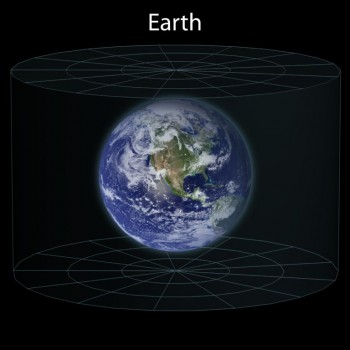
Earth. Andrew Z. Colvin/Wikimedia
In today’s world, many people find that it is not the lack of something that is problematic, but excess: the same goes for knowledge. According to professor of space astronomy, Esko Valtaoja, knowledge should contribute to the creation of a better world. His latest book is a contribution to the sum of all knowledge; over the course of two hundred pages Valtaoja delves deep into the inner space of man by taking his reader on a brief tour of the universe. Extracts from Kaiken käsikirja. Mitä jokaisen tulisi tietää (‘A handbook to everything. What everybody should know’, Ursa, 2012)
Whatever god you bow down to, you’re probably worshipping the wrong god.
The above is almost the only completely certain thing that can be said about religion, and even it does not encompass any deep truth; it’s just a simple mathematical statement. The world’s biggest religion is Roman Catholicism, which is confessed, at least nominally, by 1.1 billion people. If the Roman Catholic god were the true god, the majority of people in the world are therefore worshipping a false god. (According to the official stance of the Catholic church, the other Christian denominations are heresies, and their believers will be condemned to perdition: extra ecclesiam nulla salus. This inconvenient truth is, understandably, politely bypassed in ecumenical debate. But even if all those who call themselves Christians were counted as worshipping the same god, two thirds of the world’s population are still knocking at the wrong door.)
If you’re a religious person, don’t worry; I’m not blaspheming. And if you’re a campaigning atheist, hang on a minute: all I want to do is to find a clear and undisputed starting point to consider what it is we’re talking about when we speak of religion. More…
In the wars
31 March 2005 | Archives online, Fiction, Prose
A short story from Jussi ja Lassi (‘Jussi and Lassi’, WSOY, 1921). Introduction by Pekka Tarkka
One winter evening, Lassi, who was six, asked: ‘Can’t we go out, mother?’
‘It’s late already,’ she said.
‘We’ve been inside the whole day practically,’ said Jussi, who was seven. ‘It gets on my nerves.’
‘Gets on your nerves, does it? Well, boys, you’ll soon be off in bed,’ she said, ‘so you won’t need to get nervy.’
‘Not off to bed – not yet, it’s not yet, not…’ Lassi broke off, trying to work it out.
‘It’s not six yet,’ Jussi said.
‘No, it isn’t,’ their mother said; ‘but you’ll have to stay in your room and not go charging about here, because visitors are coming.’ More…
The rocket
30 September 1988 | Archives online, Fiction, Prose
Raketen (‘The rocket’), a novella from the collection Den segrande Eros (‘Eros triumphant’), 1912. Introduction by George C. Schoolfield
The sun shone straight in through the veranda’s little windows that made the whole ‘villa’ resemble a hothouse. With a sigh, Elsa let the morning paper fall to the floor; she had gotten halfway through the classified ads: ‘Three lads wish to correspond with likeminded lasses.’ ‘If Mr Söders-m does not fetch his effects, left as bond for unpaid rent, within a week, they will be regarded as our property, and his name will be published in toto.’ Now she could stand no more. The air seemed to come from a bakeoven. Listlessly, she watched two flies as they flicked the ceiling paper in their humming dance of love. It seemed as though knives were being thrust into the back of her head; that was the way her sick headaches began. A long walk might stop it, she knew, but she felt too tired.
At last, she was able to make herself get up and open the door for some fresh air. But with the air she got a powerful smell of roasting pork from the baker’s villa; the yells of the children playing cops and robbers up on the rock were doubled in force. A nasty stabbing sensation began in Elsa ears. And so she decided to take a walk after all, but only to the steamboat jetty. More…
Cause of death
30 June 1999 | Archives online, Fiction, Prose
A short story from Åtta kroppar (‘Eight bodies’, Söderströms, 1998). Introduction by Ann-Christine Snickars
It was a bailer, a blue one. There they were, he, she, the bailer and a stormtossed net on the stern board of a hired boat. The boat had come with the cottage and the cottage with ‘Autumn archipelago package. Now nature is aglow.’
And it was aglow.
Masses of foliage and apples, damson and shiny russula spread out around them in all their glory. It happened everywhere, that glowing. Wherever one turned one’s gaze there was something ready to be picked or ready to fall, ready in general. Those first days they had, at least to each other, she to him, feigned enthusiasm about all this ripe richness, but that time was over.
Their time of fire and flames was over. More…
‘ware bears!
30 September 1988 | Archives online, Children's books, Fiction
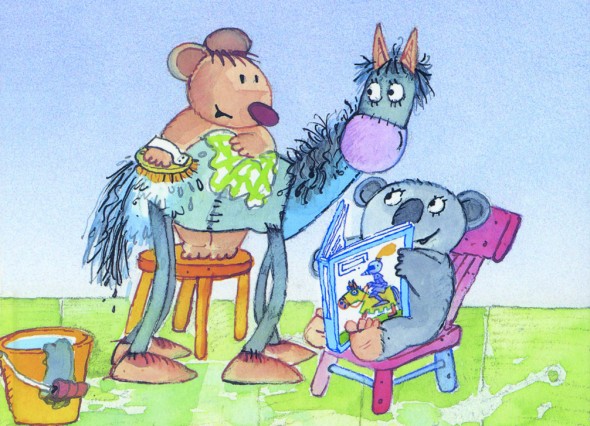
Illustration: Jukka Lemmetty
Urpo and Turpo are a pair of teddy bears. Their family – mother, father and three children – cannot imagine who it is that makes such a mess; the bears live their own absorbing lives in house. Hannele Huovi’s text and Jukka Lemmetty’s illustrations describe the bears’ antics in a way that appeals to the sense of humour of readers of all ages.
In the green house an ordinary family are living a perfectly ordinary life. There’s father, mother, The Big Daughter, The Son, and also The Baby as well. Mother keeps running back and forth all day long shouting, ‘Goodness gracious! Who’s responsible for this?’ For very funny things keep going on in the house. Who on earth is it – always getting up to some sort of hanky-panky?
Father harrumphs and says to The Big Daughter:
‘It was you, wasn’t it?’ But The Big Daughter shakes her head. Father turns to The Son:
‘So it must have been you, then?’ But the son shakes his head. No use asking The Baby. He shakes his head anyway, because he’s always imitating the others. Father and mother are completely stumped. More…
New literary prize
6 May 2011 | In the news
A new literary prize was founded in 2010 by an association bearing the name of Jarkko Laine (1947–2006) – poet, writer, playwright, translator, long-time editor of the literary journal Parnasso and chair of the Finnish Writers’s Union.
The Jarkko Laine Literary Prize will be awarded to a ‘challenging new literary work’ published during the previous two years. The jury, of nine members, will announce the winner on 19 May.
The shortlist for the first prize is made of Kristina Carlson’s novel Herra Darwinin puutarhuri (‘Mr Darwin’s gardener’, Otava, 2009), Juha Kulmala’s collection of poems, Emme ole dodo (‘We are not dodo’, Savukeidas, 2009) and Erik Wahlström’s novel Flugtämjaren (‘Fly tamer’, Finnish translation Kärpäsenkesyttäjä, Schildts, 2010).
The prize money, €10,000, comes jointly from the publishing houses Otava, Otavamedia and WSOY, the Haavikko Foundation, the City of Turku and the University of Turku.
Brighter than darkness
30 June 2002 | Archives online, Fiction, Prose
An extract from the novel Eksyneet (‘The lost’, WSOY, 2001). Interview by Markus Määttänen
It was a white tiled wall. Too white. Sterile. He wondered how long he had been looking at it. In any case long enough to have forgotten it was a wall. It had changed into a vacuum opening up before him and then shrunk into a tunnel through whose irresistible suction he had hurtled toward the painful images of the past. The past. Yesterday. Almost yesterday. He had stared at the nocturnal entrance, clearly divided in two by the street lamps, and not just that, but now saw only a lifeless and, in its lifelessness, repellant wall. He sighed, rubbed his numb face, pushed himself off the floor and stood up.
Jarl Hellemann in memoriam 1920–2010
15 March 2010 | In the news
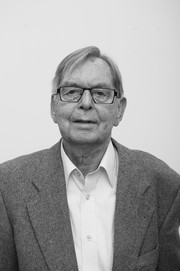
Jarl Hellemann 1920–2010. Photo: Pertti Nisonen (2009)
One of the grand old men of Finnish publishing, Jarl Hellemann, wrote in one of his own books: ‘Book publishing is by nature personified, a personal activity.
‘Most of the world’s old publishing houses still bear their founders’ names: Bonnier, Collins, Heinemann, Harper, Knopf, Bertelsmann, Werner Söderström, Gummerus. Americans ignorant of the exceptions to this rule among Finnish publishers still occasionally begin their letters, “Dear Mr Otava” or “Dear Mr Tammi”.’ (From Kustantajan näkökulma, ‘A publisher’s point of view’, Otava, published in Books from Finland 3/1999)
Hellemann himself was Mr Tammi for a long time; he started as a publishing editor at Tammi Publishing Company in 1945 and retired as managing director in 1982.
In 1955 he founded Keltainen kirjasto, the ‘Yellow Library’, an imprint of novels published since the First World War by prominent writers from all over the world. The first was Too Late the Phalarope by Alan Paton, the latest – published in 2009 – was The Disappeared by Kim Echlin. The series now contains more than 400 works, among them novels by 24 Nobel prize-winners.
Among the books in Keltainen kirjasto (list, in Finnish), Hellemann’s favourite was James Joyce’s Ulysses, translated by the poet and author Pentti Saarikoski in 1964. Hellemann continued choosing books for Keltainen kirjasto long after he retired.
Born in Copenhagen, Hellemann moved with his family to his mother’s home country, Finland, in the 1930s. Well-travelled and fluent in many languages, Hellemann himself published a novel (at the age of 25), three books on publishing and, in 1996, his memoirs.
Daddy dear
30 June 2004 | Archives online, Fiction, Prose
Extracts from the novel Vanikan palat (‘Pieces of crispbread’, Otava, 2004). Interview by Soila Lehtonen
Dad’s at the mess again. Comes back some time in the early hours. Clattering, blubbing, clinging to some poem, he collapses in the hall.
We pretend to sleep. It’s not a bad idea to take a little nap. After a quarter of an hour Dad wakes up. Comes to drag us from our beds. Crushes us four sobbing boys against his chest as if he were afraid that a creeping foe intended to steal us. We cry too, of course, but from pain. Four boys belted around a non-commissioned officer is too much. It hurts. And the grip only tightens. Dad whines:
‘Boys, I will never leave you. Dad will never give his boys away. There will be no one who can take you from me.’ More…
Finlandia Prize candidates 2011
17 November 2011 | In the news
 The candidates for the Finlandia Prize for Fiction 2011 are Eeva-Kaarina Aronen, Kristina Carlson, Laura Gustafsson, Laila Hirvisaari, Rosa Liksom and Jenni Linturi.
Their novels, respectively, are Kallorumpu (‘Skull drum’, Teos), William N. Päiväkirja (‘William N. Diary’, Otava), Huorasatu (‘Whore tale’, Into), Minä, Katariina (‘I, Catherine’, Otava), Hytti no 6 (‘Compartment number 6’, WSOY) and Isänmaan tähden (‘For fatherland’s sake’, Teos).
Kallorumpu takes place in 1935 in Marshal Mannerheim’s house in Helsinki and in the present time. Laila Hirvisaari is a popular writer of mostly historical fiction: Minä, Katariina, a portrait of Russia’s Catherine the Great, is her 39th novel. Gustafsson’s and Linturi’s novels are first works; the former is a bold farce based on women’s mythology, the latter is about guilt born of the Second World War.
The jury – journalist and critic Hannu Marttila, journalist Tuula Ketonen and translator Kristiina Rikman – made their choice out of 130 novels. The winner, chosen by the theatre manager of the KOM Theatre Pekka Milonoff, will be announced on the first of December. The prize is worth 30,000 euros. It has been awarded since 1984, to novels only from 1993.
The fact that this time all the candidates are women has naturally been the object of criticism: why are the popular male writers’ books of 2011 missing from the list?
Another thing that these novels share is history: five of them are totally or partially set in the past – Finland in 1935, Paris in the 1890s, Russia/Soviet Union in the 18th century and in the 1980s, and 1940s Finland during the Second World War. Even the sixth, Huorasatu, bases its depiction of the present day in women’s prehistory, patriarchy and the ancient myths.
The jury’s chair, Hannu Marttila, commented: ‘This book year is sure to be remembered for a generational and gender change among those who write literature about the Second World War in Finland. Young woman writers describe the war with probably greater diversity than before. From the non-fiction writing of recent years it is clear that the struggles and difficulties of the home front are increasingly being recognised as part of the general struggle for survival, and on the other hand the less heroic aspects of war, the shameful and criminal elements, have also become acceptable as objects of study.’
Marttila concluded his speech: ‘When picking mushrooms in the forest, I have learned that it is often worth humbly peeking under the grass, and that the most glaring cap is not necessarily the best…. Perhaps it is time to forget the old saying that there is literature, and then there is women’s literature.’
Human destinies
7 February 2014 | Articles, Non-fiction
To what extent does a ‘historical novel’ have to lean on facts to become best-sellers? Two new novels from 2013 examined
When Helsingin Sanomat, Finland’s largest newspaper, asked its readers and critics in 2013 to list the ten best novels of the 2000s, the result was a surprisingly unanimous victory for the historical novel.
Both groups listed as their top choices – in the very same order – the following books: Sofi Oksanen: Puhdistus (English translation Purge; WSOY, 2008), Ulla-Lena Lundberg: Is (Finnish translation Jää, ‘Ice’, Schildts & Söderströms, 2012) and Kjell Westö: Där vi en gång gått (Finnish translation Missä kuljimme kerran; ‘Where we once walked‘, Söderströms, 2006).
What kind of historical novel wins over a large readership today, and conversely, why don’t all of the many well-received novels set in the past become bestsellers? More…