

Search results for "Riikka/2010/10/mikko-rimminen-nenapaiva-nose-day/2011/04/matti-suurpaa-parnasso-1951–2011-parnasso-1951–2011/2009/09/what-god-said"
Poems
31 December 1985 | Archives online, Fiction, poetry
Introduction by George C. Schoolfield
Birds of passage
Ye fleet little guests of a foreign domain,
When seek ye the land of your fathers again?
When hid in your valley
The windflowers waken,
And water flows freely
The alders to quicken,
Then soaring and tossing
They wing their way through;
None shows them the crossing
Through measureless blue,
Yet find it they do.
Unerring they find it: the Northland renewed,
Where springtime awaits them with shelter and food,
Where freshet-melt quenches
The thirst of their flying,
And pines’ rocking branches
Of pleasures are sighing,
Where dreaming is fitting
While night is like day,
And love means forgetting
At song and at play
That long was the way. More…
Best Translated Book Award 2011
13 May 2011 | In the news
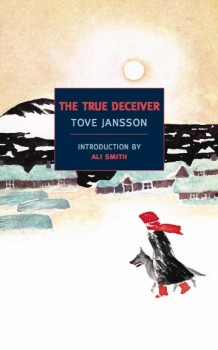 Thomas Teal’s translation from Swedish into English of Tove Jansson’s novel Den ärliga bedragaren (Schildts, 1982), entitled The True Deceiver (published by New York Review Books, 2009), won the 2011 Best Translated Book Award in fiction (worth $5,000; supported by Amazon.com). The winning titles and translators for this year’s awards were announced on 29 April in New York City as part of the PEN World Voices Festival.
Organised by Three percent (the link features a YouTube recording from the award ceremony, introducing the translator, Thomas Teal [fast-forward to 7.30 minutes]) at the University of Rochester, and judged by a board of literary professionals, the Best Translated Book Award is ‘the only prize of its kind to honour the best original works of international literature and poetry published in the US over the previous year’. ‘Subtle, engaging and disquieting, The True Deceiver is a masterful study in opposition and confrontation’, said the jury.
Tove Jansson (1914–2001), mother of the Moomintrolls, story-teller and illustrator of children’s books, translated into 40 languages, began to write novels and short stories for adults in her later years. Psychologically sharp studies of relationships, they are written with cool understatement and perception.
Quality writing will work its way into a wider knowledge (i.e. a bigger language and readership) eventually… even though occasionally it may seem difficult to know where exactly it comes from; in a review published in the London Guardian newspaper, the eminent writer Ursula K. Le Guin assumed Tove Jansson was Swedish.
Landscape
30 June 2006 | Archives online, Fiction, Prose
(Landskap, 1919). Introduction by Juha Virkkunen
12 March
To begin with, there’s a great white field. The field is criss-crossed with low slender fences and little patches of yellow-green stubble peering up through the snow, and hare-tracks slanting away towards the stubble. But we won’t notice the fences and the stubble and the hare tracks. Because we’re going to take a wider, more sort of decorative view.
So we see the great white field. And where the field ends a dark green screen has been drawn. The screen has been cut short rather amusingly in the middle, so one can see yet another white held. This belongs to another village. And this other village itself has crept up timidly to the forest-clad hill and lies close to it, so we don’t notice this other village. Because we want to take a wider view of things. More…
Lest your shadow fade
31 March 1987 | Archives online, Fiction, Prose
An extract from the novel Jottei varjos haalistu (‘Lest your shadow fade’, 1987). Interview by Erkka Lehtola
‘… learn, then, to like yourself.
Dancing beside your shadow, laugh and play.
Dance always in the sunlight, lest your shadow fade.’J. Fr. Erlander, 1876 (Erika Kuovinoja’s grandfather)
‘Tis in life’s hardness that its splendour lies.’
J. Fr. E., 1890
Three days before the date fixed for the funeral, the minister directed his steps towards the home of the deceased, trying, as he walked, to compose his thoughts, which were full of righteous Lutheran anger. There were many good reasons for this. On the other hand, nothing that had happened in the past ought to make any difference, now that he was on his way to visit a house of mourning. A visit that called for the exercise of understanding, and even, if possible, kindness. It was a lot for anyone to expect, even of a clergyman. It was not by his own desire that he was paying this call: it was a matter of duty. And this time he was the protagonist. Petulantly, his shoes crunched the gravel. More…
For the love of a city
31 December 2004 | Archives online, Fiction, Prose
Extracts from the novel I väntan på en jordbävning (‘Waiting for an earthquake’, Söderströms, 2004). Introduction by Petter Lindberg
Nonna Rozenberg lived quite near the special school where I was a boarder, in a block nine stories high with a bas-relief to the right of the door. This bas-relief featured a fairy-tale figure – the Firebird or the Bird Sirin.
I often saw Nonna stepping out of a tram carrying a large brown case. She moved carefully, as if afraid of falling.
She played the cello, and resembled that bulky, melodious instrument herself. Women’s figures are often compared to guitars. But Nonna’s appearance never hinted at parties at home with parents away or singsongs around the camp-fire.
She was no beauty. Her slow, precociously mature body was neither graceful nor girlishly delicate. If I’d met her later, when I was working at a gym, I’d have said she was overweight and lacking in self-discipline. More…
In memoriam Bo Carpelan 1926–2011
24 February 2011 | Authors, In the news
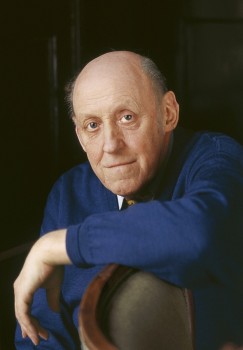
Bo Carpelan. Photo: Irmeli Jung
I write one winter’s day,
write off the day and the night, the planets,
go into my house from a harsh sun
and extend those shadows that are swordlike aimed.
It is a day of drifting snow
and with a voice from that which is I
or was.
(From The Cool Day. English translation by David McDuff, published in Homecoming, Carcanet, 1993)
Bo Carpelan, one of the great names of Finnish literature, died in his home city of Helsinki on 11 February. Carpelan’s first collection of poetry appeared in 1946, his last in 2010.
In his poems and prose he frequently described his childhood in apartment buildings filled with the smell of cooked herring, the noise of quarrels and the sound of the news on the radio. Prosaic life is turned into poetry, images and music, the apartment house is built from the rooms of a dream.
Bo Carpelan loved music. His novel Axel (English translation by David McDuff, 1989), is about his paternal grandfather’s brother, who was a friend of Jean Sibelius and the composer’s first critic. Axel was an unsuccessful musician who chose to live through someone else, and Carpelan relates him to the theme of the dignity of rejected human beings. More…
Year of the cat
13 November 2014 | Fiction, Prose
Extracts from the novel Kissani Jugoslavia (‘Yugoslavia, my cat’, Otava 2014). Introduction by Mervi Kantokorpi
I met the cat in a bar. And he wasn’t just any cat, the kind of cat that likes toy mice or climbing trees or feather dusters, not at all, but entirely different from any cat I’d ever met.
I noticed the cat across the dance floor, somewhere between two bar counters and behind a couple of turned backs. He loped contentedly from one place to the other, chatting to acquaintances in order to maintain a smooth, balanced social life. I had never seen anything so enchanting, so alluring. He was a perfect cat with black-and-white stripes. His soft fur gleamed in the dim lights of the bar as though it had just been greased, and he was standing, firm and upright, on his two muscular back paws.
Then the cat noticed me; he started smiling at me and I started smiling at him, and then he raised his front paw to the top button of his shirt, unbuttoned it and began walking towards me. More…
Close encounters
31 March 1999 | Fiction, Prose
Viimeinen syli (‘The last embrace’, Otava, 1998)
The hospital looked as if a child had been given a big pile of building blocks and told to make a house, a big house. And then, when the building was ready, more bricks had been brought, and the child had been forced to pile them up over a wider and wider area, to spread rows of blocks across the adults’ routes and over the edge of the carpet until at last it had grown bored and left the last blocks higgledy-piggledy next to its creation.
Around the hospital ran a road from which the whole mess was revealed. Wing after wing, corridors and windows from which no one really ever looked out. The hospital was full of window views that did not belong to anyone, which did not open up from anyone’s office or day-room, but varied meaninglessly like a motorway landscape from the window of an accelerating car. Viivi had been born there, on the sixth floor of the old part of the hospital. As Mikael waited in the tiled fathers’ room next to the room where the Caeserean section was being carried out for his child to be brought to him, the view out had been breathtaking. More…
The Cheap Contractor
30 June 1986 | Archives online, Fiction, Prose
From Kauan kukkineet omenapuut (‘Long-blossoming apple trees’, 1982). Introduction by Arto Seppälä
The men who delivered the hot-water cylinder offered to do the installation as well. I asked how much it would be. They lolled about a bit, exchanged a few private looks, pretended to be thinking. Then one of them fired off a sum. It was three times the quotation I’d already had. They didn’t even look at the location. I told myself I wouldn’t even go to the end of the road with big-dealers like these.
The same evening I rang up ‘a little man’ and told him he could get started as soon as it suited him.
The cheap contractor turned up a couple of days later, driving an elderly van into the yard. I went out. He’d sat himself down in a garden chair near the white lilacs. The morning sun only partially reached there; so half his body was in shade, looking colder than the sunny half. More…
Brief lives
30 September 1989 | Archives online, Fiction, Prose
Rosa Liksom’s characters live in the tiny villages of empty Lapland, speaking a dialect that rings oddly in the ears of the southern Finnish majority; or they may inhabit anonymous towns, but there, too, life is full of the anguish of existence. Liksom, whose black comedy can be compared with that of the Danish writer Vita Andersen, is able to cram into her short texts complete life histories, bizarre, comic or tragic. Her first volume of short stories, Yhden yön pysäkki (‘One night stand’) appeared in 1985; the following short stories are from Tyhjän tien paratiisit (‘Paradises of the open road’, 1989)
We got hitched up the 14th of November and by the end of the month it was all over. As far as I’m concerned call it a marriage exactly two weeks too long. We hadn’t set eyes on each other till the Pampam that’s the place me and the girls go after work for a drink and I was sitting there having one with them when who comes through the door but this bloke and it hits me. That bloke’s for me. In the end I went over to his table and said up yours stud. We went over to my place to bunk down and after that I couldn’t get the sod out. The bloody shitbag got his claws into me and hung on just on the strength of that one night. He glued himself to my bed. Lay there flat out when I set off to work and shit he was still there when I came back only arse up this time. More…
A policeman’s crimes
31 December 1985 | Archives online, Authors
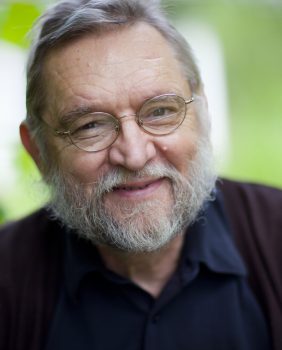
Matti Yrjänä Joensuu. Photo: Jouni Harala 2010
The Finnish section of the major Nordic Crime Novel Competition in 1976 was won by a newcomer, Matti Yrjänä Joensuu, with his Väkivallan virkamies (‘Civil servant in violence’). A realistic crime and police novel in the style of the Swedish writers Sjöwall and Wahlöö, the book represented something completely new in Finland. In the previous competition, held in 1939 as Europe hovered on the brink of war, the winner of the Finnish section was Mika Waltari’s Kuka murhasi Rouva Skrofin (‘Who killed Mrs Skrof?’); the novel is now regarded as one of the classics of Nordic detective fiction. But Waltari was, of course, a literary polymath; his Sinuhe, egyptiläinen (1945; English translation The Egyptian) is among the internationally best-known Finnish novels.
The detective novel and thriller tradition in Finland is both short and slight, and apart from Waltari’s book and its two sequels, many of its representatives – even those that have been most widely acclaimed and read at the time – are of little worth by any objective standards. Joensuu, therefore, has no living tradition to follow, and in interviews he has said that at the start of his career he was not familiar with the two Swedish writers to whom his work is most readily likened, Sjöwall and Wahlöö. This is not difficult to believe; in terms of both politics and social criticism Joensuu’s first novel, in particular, is much tamer than the Swedish writers’ – what all three writers have in common is the gravity with which they approach crime and the individuals who engage in it, and their realistic description of the work of the police. More…
Teemu Kupiainen & Stefan Bremer
Music on the go
3 March 2010 | Extracts, Non-fiction
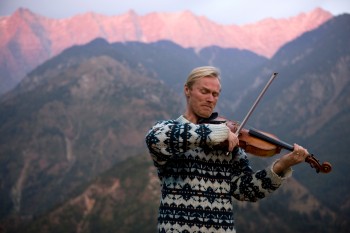
A little night music: Teemu Kupiainen playing in Baddi, India, as the sun sets. Photo: Stefan Bremer (2009)
It was viola player Teemu Kupiainen‘s desire to play Bach on the streets that took him to Dharamsala, Paris, Chengdu, Tetouan and Lourdes. Bach makes him feel he is in the right place at the right time – and playing Bach can be appreciated equally by educated westerners, goatherds, monkeys and street children, he claims. In these extracts from his book Viulun-soittaja kadulla (‘Fiddler on the route’, Teos, 2010; photographs by Stefan Bremer) he describes his trip to northern India in 2004.
In 2002 I was awarded a state artist’s grant lasting two years. My plan was to perform Bach’s music on the streets in a variety of different cultural settings. My grant awoke amusement in musical circles around the world: ‘So, you really do have the Ministry of Silly Walks in Finland?’ a lot of people asked me, in reference to Monty Python. More…
The business of war
30 September 2004 | Archives online, Fiction, Prose
Extracts from the novel Lahti (‘Slaughter’, WSOY 2004). Introduction by Jarmo Papinniemi
Major Tuppervaara put his plate down on a tree stump and walked over towards us. He had long legs and walked with a spring in his step. Twigs crunched beneath every step.
‘Okay, boys,’ he said. ‘Peckish?’
‘Yes.’
‘Take your time and listen carefully to what I’m about to tell you. The training exercise will begin soon. Your job is to help out here, you’ll be doing the medical officers’ jobs, all things you’re familiar with. During the course of this drill you will see things you have never seen before. You must not tell anyone about them. I repeat: no one. Not your father, not your mother’ not your girlfriend or your mates, not even the staff at your divisions. No one. That’s an order. Is that clear?’
‘Yes, Sir,’ said Äyräpää. Hiitola and I nodded. More…
Looking back on a dark winter
31 December 1989 | Archives online, Fiction, Prose
Extracts from the autobiographical novel Talvisodan aika (‘The time of the Winter War’), the childhood memoirs of Eeva Kilpi. During the winter of 1939–40 she was an 11-year old-schoolgirl in Karelia when it was ceded to the Soviet Union and the population evacuated
Time is the most valuable thing
we can give each other
War’s coming.
One day my father comes out with the familiar words in a totally unfamiliar way, while we’re sitting round the kitchen table eating, or just starting to eat.
He says to mother, as if we simply aren’t there, as if we don’t need to bother, or as if listening means not understanding. Or perhaps they’ve simply no other chance to speak to each other, as father’s always got to be off hunting, or on his way to the station, and mother’s always cooking. More…
Success after success
9 March 2012 | This 'n' that
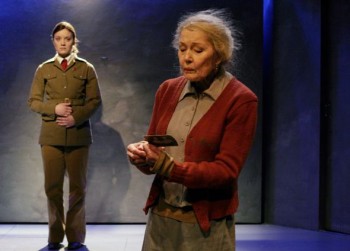
The women of Purge: Elena Leeve and Tea Ista in Sofi Oksanen's Puhdistus at the Finnish National Theatre, directed by Mika Myllyaho. Photo: Leena Klemelä, 2007
Sofi Oksanen’s Purge, an unparalleled Finnish literary sensation, is running in a production by Arcola Theatre in London, from 22 February to 24 March.
First premiered at the Finnish National Theatre in Helsinki in 2007, Puhdistus, to give it its Finnish title, was subsequently reworked by Oksanen (born 1977) into a novel – her third.
Puhdistus retells the story of her play about two Estonian women, moving through the past in flashbacks between 1939 and 1992. Aliide has experienced the horrors of the Stalin era and the deportation of Estonians to Siberia, but has to cope with the guilt of opportunism and even manslaughter. One night in 1992 she finds a young woman in the courtyard of her house; Zara has just escaped from the claws of members of the Russian mafia who held her as a sex slave. (Maya Jaggi reviewed the novel in London’s Guardian newspaper.) More…