

Search results for "Riikka/2010/10/mikko-rimminen-nenapaiva-nose-day/2011/04/matti-suurpaa-parnasso-1951–2011-parnasso-1951–2011"
Turku, city of culture 2011
21 January 2011 | In the news
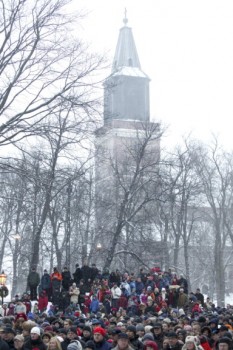
Passing the peace: citizens of Turku gathering to listen to the traditional declaration of peace at Christmas in front of the Cathedral. Photo: Esko Keski-oja
Since 1985, cities in the countries of the European Union have been chosen as European Capitals of Culture each year. More than 40 cities have been designated so far; a city is not chosen only for what it is but, more importantly, what it plans to do for year and also for what will remain after the year is over – the intention is that citizens and the local culture should profit from the investments made.
This year the two cities are Tallinn in Estonia and Turku, the oldest city and briefly (1809–1812) the capital of what was then the Grand Duchy of Finland, on the coast, 160 kilometres west of Helsinki. The pair will also co-operate in making this year a special one in their cultural lives.
The city of Turku declared its Cultural Capital year open on 15 January with a massive firework display glittering over the River Aura. This cultural capital enterprise, with a budget of 50 million euros and an ambitious programme will, hopefully, involve two million participants in the five thousand cultural events and occasions.
Eeva-Kaarina Aronen: Kallorumpu [Skull drum]
23 December 2011 | Mini reviews, Reviews
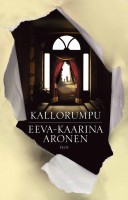 Kallorumpu
[Skull drum]
Helsinki: Teos, 2011. 390 p.
ISBN 978-951-851-413-1
€ 27.40, hardback
Eeva-Kaarina Aronen (born 1948) did not begin her writing career untill 2005, after a long career as editor of the newspaper Helsingin Sanomat. Her third novel Kallorumpu was shortlisted for the Finlandia Prize for Fiction 2011. Aronen’s interest in historical characters and themes that challenge historical truth was already evident in the of her first novel Maria Renforsin totuus (‘The truth of Maria Renfors’, Teos, 2005). At the centre of Kallorumpu is the legendary figure of Finland’s Field Marshal C.G. Mannerheim (1867–1951). The book concentrates on the description of one day in November 1935 by an old filmmaker, the narrator of the novel, who is showing his documentary to a small group of viewers in the present day. He comments on his own film, complementing it with stories about Mannerheim’s home in Helsinki. At home the Marshal’s staff – a cook, a maid and a valet – not only provide narrative twists and turns, but also an insight into the class divisions of the Finnish civil war. Aronen’s portrayal of her gallery of characters is an interesting one, and the novel’s demanding structure, with its alternating time zones, is sound.
Translated by David McDuff
What Finland read in November
17 December 2010 | In the news
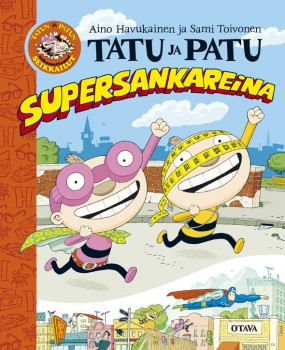
Superheroes: Tatu and Patu by Aino Havukainen & Sami Toivonen
In November the latest thriller by Ilkka Remes, Shokkiaalto (‘Shock wave’, WSOY) topped the Booksellers’ Association of Finland’s list of the best-selling Finnish fiction. Sofi Oksanen’s prize-winning, much-translated 2008 novel Puhdistus (Purge, WSOY), has not left the best-selling list since it was awarded the Finlandia Prize for Fiction this autumn and was now number two.
Riikka Pulkkinen’s novel Totta (‘True’, Otava) was number three, and Tuomas Kyrö’s colllection of episodes from a grumpy old man’s life as told by himself, Mielensäpahoittaja (‘Taking offense’, WSOY), from last spring, occupied fourth place.
A new novel, Harjunpää ja rautahuone (‘Harjunpää and the iron room’, Otava), by the grand old man of Finnish crime, ex-policeman Matti Yrjänä Joensuu, was number five.
The most popular children’s book was a new picture book about two inventive and curious brothers, Tatu ja Patu supersankareina (‘Tatu and Patu as superheroes’, Otava) by Aino Havukainen and Sami Toivonen.
On the translated fiction list were books by, among others, Ildefonso Falcones, Jo Nesbø, Lee Child, Stephen King, Paulo Coelho and Paul Auster.
The non-fiction list included the traditional annual encyclopaedia Mitä missä milloin (‘What, where, when’, Otava, second place) as well as a political skit entitled Kuka mitä häh (‘Who what eh’, Otava) by Pekka Ervasti and Timo Haapala – the latter sold better, coming in at number one. In November the latest thriller by Ilkka Remes, Shokkiaalto (‘Shock wave’, WSOY) topped the Booksellers’ Association of Finland’s list of the best-selling Finnish fiction.
Finlandia Junior Prize 2010
26 November 2010 | In the news
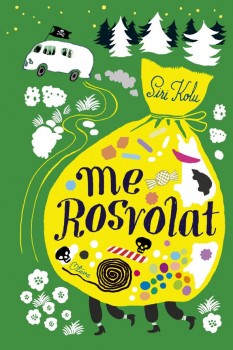 The Finlandia Junior Prize has gone to author Siri Kolu and illustrator Tuuli Juusela for the novel Me Rosvolat (‘Me and the Robbersons’, Otava); they will share the award of €30,000 (see the Prize jury assessments of the shortlist here). The winner was chosen by actor and writer Hannu-Pekka Björkman.
Awarding the prize on 25 November he said: ‘It caught my attention that in none of the six shortlisted children’s books are there any so-called nuclear families, at least not for long. The main characters constantly live and grow without something – the lack of parents or the attention of an adult is a serious matter to a child. However, in these books there is always someone who cares, not perhaps a stereotypical mom or dad, but an adult nevertheless.’ In Björkman’s opinion Me Rosvolat, with its rich language and a whiff of anarchy, presents the reader with moments of realisation and wonderment.
Marja-Leena Tiainen: Kahden maailman tyttö [The girl from two worlds]
18 January 2012 | Mini reviews, Reviews
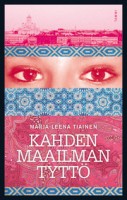 Kahden maailman tyttö
[The girl from two worlds]
Helsinki: Tammi, 2011. 261 p.
ISBN 978-951-31-5937-5
€ 26.65, hardback
Marja-Leena Tiainen (born 1951) has dealt with unemployment, immigration, and racism in her works, in ways that are accessible to her young readership. She researches her topics with care. The idea for this book dates back to 2004, when the author made the acquaintance of a Muslim girl who lived in a reception centre in eastern Finland; her experiences fed into Tara’s story. Tiainen’s central theme, ‘honour’ violence in the Muslim community, is surprisingly similar to Jari Tervo’s Layla (WSOY, 2011). Tiainen’s is a traditional story about a girl growing up and surviving, but the novel’s strong points are the authentic description of everyday multiculturalism, and the intensity of the narration. The reader identifies with Tara’s balancing act, which she must carry out in the crossfire of her father’s authority, family tradition, and her own dreams. In spite of everything, the community also becomes a source of security and support for Tara. The narrative arc is coherent and, despite the numerous overlapping time-frames, the tension is sustained right up to the final, conciliatory solution.
Translated by Fleur Jeremiah and Emily Jeremiah
Icy prospects
8 October 2010 | This 'n' that
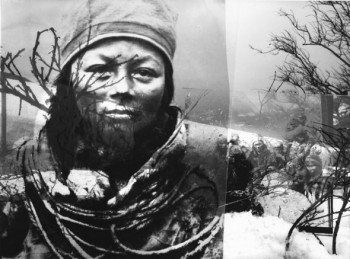
Jorma Puranen: Juovlajohka, Norway, 1997
Photographer Jorma Puranen (born 1951) has long been concerned with nature and the representation of northern landscapes, particularly Lapland, as well as light and its reflection.
One of his most famous projects is Imaginary Homecoming. In the 1990s, on a visit in the Musée de l’Homme in Paris, he found some old archive boxes full of glass negatives. They were ethnographical images of the Sámi, taken by G. Roche, employed by the French Count Bonaparte on an expedition to Lapland in 1884.
Puranen took them back to the wildernesses of Lapland and photographed them once more in their native surroundings, where they became a photographic installation in the tundra. He published them in his book Kuvitteellinen kotiinpaluu / Imaginary Homecoming (Pohjoinen, 1999).
Puranen’s 2006 series Icy Prospects explores landscape: the large pictures are made by painting wood with black gloss paint, reflecting the landscape on the wood and photographing the reflection.
Snow, ice, water, sky and trees are portrayed the way that brings Impressionism to mind, as Liz Wells writes in her introduction in the book entitled Icy Prospects, published by Hatje Cantz (Germany, 2009).
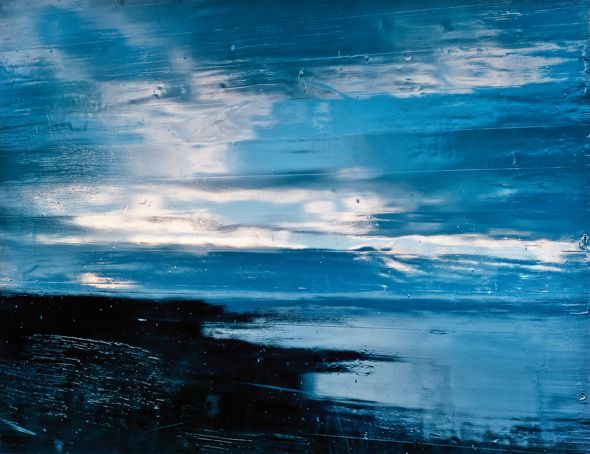
Jorma Puranen: Icy Prospects (series, 2006)
A new exhibition of Jorma Puranen’s work from 1992 to 2010, at EMMA, the Espoo Museum of Modern Art, opened on 29 September; it runs until 9 January 2011. Partly retrospective, it features Puranen’s techniques of chromogenic colour and black and white photography, showcasing his highly original style.
A portrait of Elmer Diktonius
30 June 1982 | Archives online, Authors
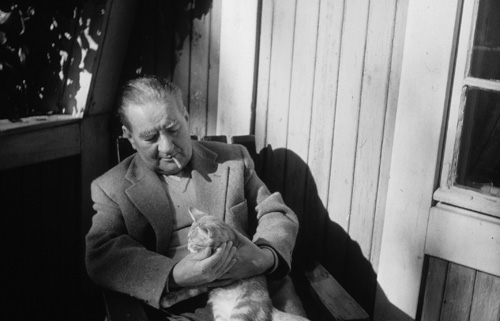
Elmer Diktonius at his home in Kauniainen (Grankulla). Photo: Wikimedia Commons / Public domain
Elmer Diktonius, one of the leading Finland-Swedish modernists of the 1920s, was a revolutionary poet, prose-writer and critic who also tried his hand at composing. Professor George Schoolfield, whose article on Diktonius appears below, appends his own translations of several of the lyrics: a filler selection is going to be published in the United States, Recently Professor Schoolfield has been working on a biography of Diktonius which he hopes to publish soon.
The literary fate of the Finland-Swedish modernist Elmer Diktonius (1896-1961) has not been an altogether happy one. Saluted early and late in his career as Finland’s Strindberg and as a possible rival to Mayakovsky in the contest for the greatest lyricist of the revolution, Diktonius would seem, surely, to deserve a place on the world’s literary stage. Yet the attention he has received outside the north has been mostly unwitting: the writers of program notes quote his description of the Silbelius Fourth, ‘the bark-bread symphony’ without knowing its source, the collected concert-reviews of Opus 12: Musik (1933). Surveys that might have introduced him to a larger public are silent. The chubby Pelican Guide to the European Literature of Modernism ignores him; the Penguin Book of Socialist Verse omits him from its 134 specimens of the lyric left; and Ulrich Weisstein’s volume of Expressionism as an International Literary Phenomenon does not have him in its chapter on ‘Expressionism in Scandinavia’, although he would qualify – as the Swedish scholar Bill Romefors has proved – as the major northern heir of German expressionism. More…
Challenged by colour
1 April 2010 | Authors, Interviews
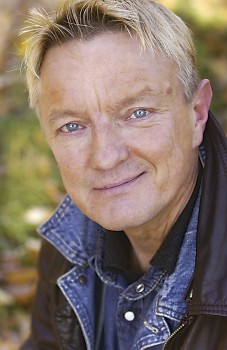
Hannu Väisänen. Photo: Paula Kukkonen
Interview with Hannu Väisänen, author of the novel Kuperat ja koverat (‘Convex and concave’, 2010)
For the painter and writer Hannu Väisänen, colour speaks volumes.
In the novel Toiset kengät (‘The other shoes’, 2007, Otava) awarded the Finlandia Prize for Fiction), teenage wannabe artist Antero manages to escape his grey northern hometown of Oulu; he is heading for the eastern Finnish town of Savonlinna, where he will go to art college. Triumphantly Antero dyes his blond hair black in the bus station toilet.
‘Perhaps it was all a question of the right colours and the right timing of colours,’ Antero thinks. In Kuperat ja koverat (‘Convex and concave’, 2010), he leaves for the capital, determined to get into the academy of art. His hair is still black. More…
Misery me
Extracts from the collection of short prose, Mielensäpahoittaja (‘Taking offense’, WSOY, 2010)
Past pushing up daisies
Well, yeah, so I took offense when the doctor said that considering my age I’m in tip-top shape. His theory was that my 25-kilometre ski circuits would keep an old coot like me in shape, if they didn’t kill me first. He said if I were to start just sitting on the couch and waiting, then the Reaper would be on my back in no time.
I don’t ski for my health. I ski because it’s pretty in the forest, and when a body is sweating he doesn’t think a whole lot. More…
A perfectly ordinary day
30 September 1997 | Archives online, Fiction, Prose
Extract from the novel Kello 4.17 (‘The time was 4.17’, WSOY, 1996). When time loses its meaning, real fear strikes like an iron glove. Aho writes about a man who is different but no outcast
I was lost to myself, if it is possible to be lost if you haven’t gone anywhere. Black birds curved through my mind and it felt as if no one needed me, no one or nothing: my mother bought clothes and make-up and did not seem to care; Uncle Lasse looked after the family business, steam coming out of his head, and kept shopkeepers and shopaholic customers happy; smiling bank managers slapped shy loan applicants encouragingly on the back, the gross national product grew without me having anything to do with it, or because I didn’t; and politics plodded onward as the mud squelched comfortingly. The machine of society hummed and ticked and Finland was as round and fat as a bomb. I looked at it and nothing changed, and on Sundays it was so quiet that you could look out of the window and see the Sahara.
The snake
31 March 1998 | Fiction, Prose
In this horror story by the Finland-Swedish author Kjell Lindblad (born 1951), a man believes he is wandering among art installations in an apartment block – but the reality he is experiencing turns out to be much more sinister. From the collection of short stories Oktober-mars (‘October-March’, Schildts, 1997)
I only noticed the poster on the notice board in the vegetarian restaurant because it was so obviously different from the rest of the colourful items there, with their large headlines offering everything from Atlantic meditation to Zen ping-pong, together with promises of a new and fulfilled life in harmony with the soul and the cosmos. Poster is perhaps an overstatement it was a white sheet of paper with an egg-shaped oval in the middle. Inside the oval there was a horizontal row of seven numbers. For some reason, perhaps because the row of numbers was the only information on the piece of paper, it stuck in my memory and when I got home I had a compulsive desire to find out if it was a phone number. So I dialled the number and a tape-recorded voice that could have belonged to a man but equally well to a woman, said:
‘We bid you welcome. Please don’t write down the address just memorise it….’ More…
Stars above
30 December 1998 | Fiction, Prose
Extracts from the novel Benjamins bok (‘Benjamin’s book’, Schildts, 1997)
There are people who feel they are in contact with the stars. Among those who carry their secret knowledge around with them are both the healthy and the ‘sick’. Now I remember Olli stretching his arm out towards the evening star and seeming to greet it. For others, for me, the starry heavens are a form of distant vertigo. All those milky ways and galaxies, how could they not be inhabited, have developed a culture far older than our own. Perhaps they have watched the development of our planet with distaste, and are waiting for its ruin, which according to their calculation of time will take place in a few years or days from now. If I listen closely I seem to be faintly approached by a celestial choir, composed of indistinct sounds; if I stand on a lonely road in the country, and look up at the sky, the light and faint murmur from a nearby town emerge, and can be separated from the faint voices of the starry heavens. It is probably just my imagination. Perhaps it is an extension of that voice – anonymous, quiet – that I hear when I read a book. A good book is audio-visual. And no harm is done if it gives the reader a mild sense of vertigo. More…
A roof with a view
27 August 2009 | Fiction, Prose
Extracts from the novel Mistä on mustat tytöt tehty? (‘What are black girls made of?’, Tammi, 2009) Introduction by Tuomas Juntunen
I’m a chimney sweep’s daughter, born October 1962 as a gift, a light to a darkened world. I’ve had lots of mothers, but none of them ever stuck around for good. One of them gave birth to me, so she’s Mother, not mother. Her name is Dewdrop, because water has spilled over the only photograph of My Mother and now her face has dissolved into a single translucent droplet; her nose, cheeks and chin are now a fat, shiny blob that looks like it’s about to fall out of the bottom of the picture. More…