

Search results for "Riikka/2010/10/mikko-rimminen-nenapaiva-nose-day"
The day peace came…
18 March 2015 | This 'n' that
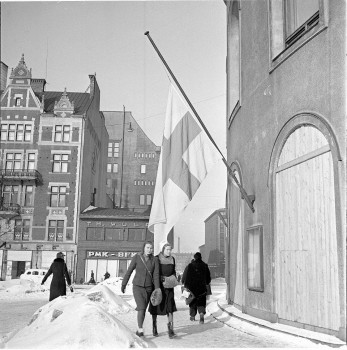
Flags fly at half-mast in Helsinki. Photo: SA-Kuva
Seventy-five years ago, in the period known as the Phony War, while the rest of the world was preparing to fight, it looked as if hostilities were over for one country.
In the preamble to the Second World War, Soviet Union had attacked Finland on 30 November 1939, demanding substantial border territories for the protection of Leningrad. Germany had invaded Poland, and France and Great Britain had declared war; but the Nazi invasions of Norway and Denmark, Italy’s entry into the war, the Battle of Britain, Pearl Harbor, D-Day, Hiroshima, Nagasaki and all the other horrors of the Second World War were yet to come.
As the world watched, ‘plucky little Finland’, massively outnumbered in terms of both men and equipment but superior in morale, organisation and knowledge of the terrain, managed to keep the Red Army at bay for months – far longer than anyone had expected. Eventually, however, the Russians overcame Finnish border defences and the war ended on 13 March 1940. Now generally regarded by Finns as a defensive victory – Finland was not occupied by the Soviet Union – the peace treaty nevertheless imposed a heavy burden on Finland, which lost extensive territories in Karelia to the south and Salla to the north.
In the event, the war was far from over for Finland, which still had the Continuation War (1941-44) and the Lapland War (1944-45) to fight. But for the moment, the country was once more at peace.
To mark the 75th anniversary of the end of the war, the Helsingin Sanomat newspaper has published a selection of photographs of the day peace came.
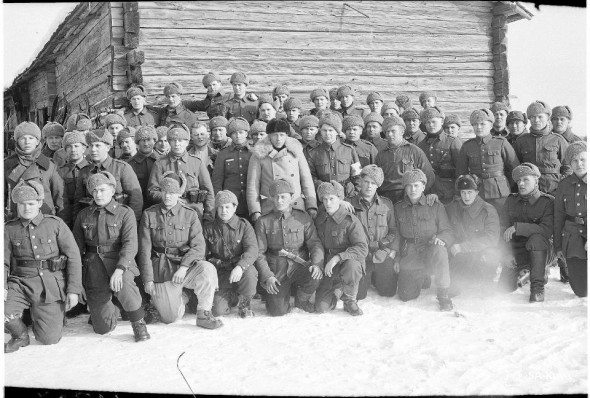
Soldiers of the 69th infantry regiment are able to eat in peace at last. Photo: SA-Kuva
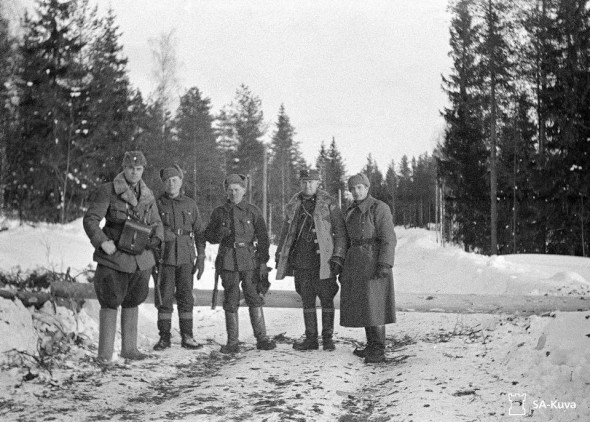
A tree felled across a road provides a makeshift border point. Photo: SA-Kuva
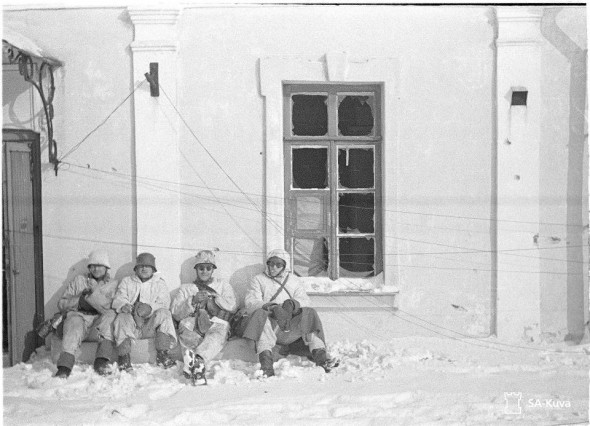
Soldiers in their white winter camouflage rest in Viipuri after peace is declared. Photo: SA-Kuva
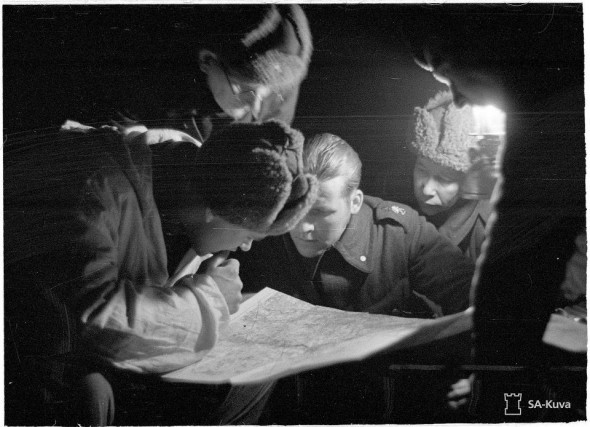
Soldiers in Kuhmo, north-eastern Finland, inspect the new border line. Photo: SA-Kuva
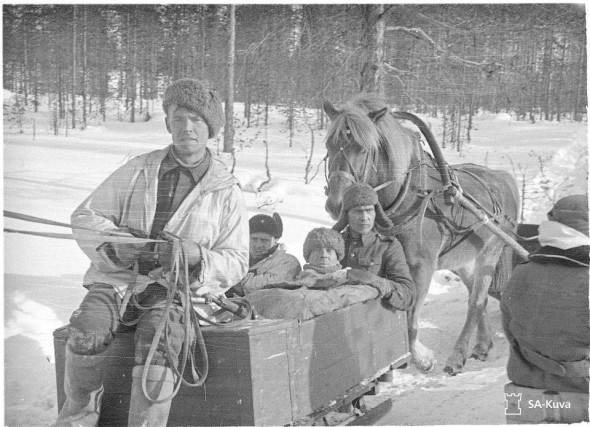
The last wounded soldiers are brought back by horse and cart from Saunajärvi. Photo: SA-Kuva
Star-Eye
31 March 1984 | Archives online, Children's books, Fiction
A story from Läsning för barn (‘Reading for children’,1884). Introduction by George C. Schoolfield
There was once a little child lying in a snowdrift. Why? Because it had been lost.
It was Christmas Eve. The old Lapp was driving his sledge through the desolate mountains, and the old Lapp woman was following him. The snow sparkled, the Northern Lights were dancing, and the stars were shining brightly in the sky. The old Lapp thought this was a splendid journey and turned round to look for his wife who was alone in her little Lapp sledge, for the reindeer could not pull more than one person at a time. The woman was holding her little child in her arms. It was wrapped in a thick, soft reindeer skin, but it was difficult for the woman to drive a sledge properly with a child in her arms.
When they had reached the top of the mountain and were just starting off downhill, they came across a pack of wolves. It was a big pack, about forty or fifty of them, such as you often see in winter in Lapland when they are on the look-out for a reindeer. Now these wolves had not managed to catch any reindeer; they were howling with hunger and straight away began to pursue the old Lapp and his wife. More…
Juha Virta: Sylvi Kepposen pitkä päivä [Sylvia Prank’s long day]
3 March 2009 | Mini reviews
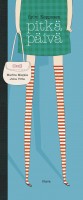 Sylvi Kepposen pitkä päivä
[Sylvia Prank’s long day]
Kuvitus [Ill. by]: Marika Maijala
Helsinki: Otava, 2008. 33 p., ill.
ISBN 978-951-1-22373-3
€ 17, hardback
The long, narrow shape of this picture book is justified, as it literally gives the reader a clear perspective on its illustrations. Sylvi is a little girl whose legs one day grow so long that she is able to leap into space. Sylvi becomes a media phenomenon and the object of universal astonishment – until her legs return roughly to their former size. The book, by Juha Virta (born 1970) and his partner Marika Maijala (born 1974), owes much to nonsense writing and Lewis Carroll’s Alice in Wonderland, but the story and the pictures are an amazingly well-balanced combination, expressing humour, unceremonious wonder and a childlike ability to derive pleasure from moments of absurdity.
Night decorator
31 March 2007 | Archives online, Fiction, Prose
A short story from the collection Yönseutuun (‘Around nighttime’, WSOY, 2006). Introduction by Jani Saxell
Hardly a night went by.
I didn’t want to offend him in any way by my indifference, but as I went to bed I was totally beat, squeezed dry by my day. My most important chore at home was to guard my own rest; people’s survival depended on it being consistent and nourishing. I didn’t concentrate on anything else in my free time.
But often when I was ready for bed, a sharp metal ‘zzzip’ would come from the direction of the living room. A little later I would hear a drawn-out ‘clllack!’, which told me the measuring tape had retracted into its case, the newest interior design had taken shape on the back of some receipt, and Y would soon be coming to see if I was awake and open to suggestions. More…
What the critic said
9 July 2010 | Letter from the Editors

Illustration by Joan Barrás
‘Pay no attention to what the critics say. A statue has never been erected in honour of a critic,’ said the Finnish composer Jean Sibelius.
No, probably not; but people still read what the critics write – and, sometimes, also what they wrote fifty or a hundred years ago.
An annual list of professions most highly valued by the public in Finland is always headed by surgeons. Shepherds generally feature at the bottom of the list. But critics fare none too well, either – a couple of years ago they were ranked between butchers and gravediggers. Which, of course, can be interpreted, in metaphorical terms, either as hilarious or tragicomical. More…
Girl-embryos
30 December 2003 | Authors, Reviews

Photo: Irmeli Jung
Stanza is, of course, Italian for ‘room’, and Saila Susiluoto’s second volume, Huoneiden kirja, is a book of rooms. The 17th-century English poet John Donne said: ‘We’ll build in sonnets pretty rooms’; Susiluoto’s poems are prose poems, not sonnets – but imaginary rooms with real feelings in them. They’re not pretty either, but beautiful, furnished with lyrical echoes, echoing with experience.
The protagonist is a girl, but there are many other personae, women, men, children: ‘Sorrow’s walked through me in the shape of people.’ The personae think there are many ways to walk through things, or towards them. They follow the signs they find on their way – from the ground floor (partly underground) of a draughty house up to the sixth floor (fifth in English), which also floats.
Behind the shining mirror twin girls are squealing, they disappeared inside the walls long ago… Inside us there are two hundred girl-embryos, the girls shout….
The girls are hand-made: fashioned by themselves – ‘like us’ – ‘out of pearls, blood, splinters of mirror’. More…
The tower
31 December 1987 | Archives online, Fiction, Prose
A short story from the collection Torni (‘The tower’, 1987). Introduction by Erkka Lehtola
The dog came through the door first, a big, long-haired brute. He hadn’t said anything about it on the phone, but from the look on his face you could tell it was his and that he meant to take it with him into the forest.
He shuffled across the yard with his rubber boots on and a rucksack on his back. In one hand he held a camera tripod.
I rolled down the window.
‘Wait a minute,’ he said.
He walked behind the cars standing in the parking lot, over to his own car and opened the trunk. The dog twisted around his legs whining softly. He took something out and slammed the trunk shut. More…
The mistake
30 September 2008 | Archives online, Fiction, Prose
A short story (‘Erehdys’, 1956, last published in the collection Lukittu laatikko ja muita kertomuksia, ‘A locked box and other stories’, WSOY, 2003). Introduction by Markéta Hejkalová
My feet are smarter than my head. On an April night in Naples they carried me along the Via Roma past the royal palace and the giant illuminated dome of the church. The people of Naples walked up and down the immortal street like the cool of evening, looking at each other and at the brightly lit display windows. I had nothing against that, but at the comer of Via San Brigida my feet turned to the right. The snow-cold breath of my homeland radiated toward me from Saint Bridget Street.
When I had turned the corner I could see a restaurant window still lit, with its fruit baskets, dead fish and red lobsters. The most hurried diners had already finished their meals. I stepped into the long dining room of the restaurant, the sawdust on the floor stuck to my shoes, a frighteningly icy stare pierced me from behind the counter, but I gathered my courage and whispered bravely, ‘Buona sera, signora.’ More…
The gender of the soul
Scenes from the play Kuningatar K / Queen C
Characters:
Christina, the Queen
Friend
The Queen Mother
Karl Gustav, the Count [Christina’s suitor, the King-to-be]
Descartes, philosopher
Official
Man
The King
Oxenstierna, Per Brahe
A choir of midwives
The play can be performed with six actors (3 female, 3 male). Other ways of dividing the roles are possible. All stage directions may be altered.
1. Prologue
The eels’ court
CHRISTINA
If eels had a court then a great female eel would sit in the centre and the little males would writhe about like seaweed around the throne. However they would not be envious of the queen, because they would know that if they swam up into rivers and lakes, into fresh waters, they themselves would gradually become females, great and heavy, and would be able to rule and close into their great embrace all the small little gentlemen. They just have to wait.
KARL GUSTAV
I don’t know. What I do know is that a great black eel, as thick as a rope, was pulled out of the well last night and the Queen looked at its silver stomach and its thrashing tail, but the eel looked the Queen in the eyes and in the heart and since then she has never been the same. More…
The blow-flower boy and the heaven-fixer
31 December 1984 | Archives online, Fiction, Prose
A short story from Puhalluskukkapoika ja taivaankorjaaja (‘The blow-flower boy and the heaven-fixer’, 1983). Interview by Olavi Jama
Cold.
A chill west wind came over the blue ice. It went right to the skin through woollen clothes. Shivers ran up and down the spine, made shoulders shake.
In the bank of clouds close to the horizon, right where the icebreaker had crunched open a passage to the shore, hung a pale blotch, a substitute for the sun. It gave off more chill than warmth.
Lennu’s teeth were chattering.
He wore a buttoned-up windbreaker, a hand-me-down from Gunnar, over a heavy lambswool shirt. It couldn’t keep off the cold. More…
The unicorn
30 September 1997 | Archives online, Fiction, Prose
A short story from Koira nimeltä Onni ja muita onnettomuuksia (’A dog called Lucky and other misfortunes’, Tammi, 1997)
Hilma was rattling her bars when Pirjo stepped into the ward. Once again, she was the only one awake. The three other old people were asleep, wheezing heavily through their toothless mouths, making the air thick with their breathing. Clutching the bars of her bed, Hilma clambered up to a sitting position and leaned her sparse hair against the side.
‘How are you doing with the medicine?’ Pirjo asked.
‘A mouse took it,’ Hilma said, fixing her with her eyes.
‘And you’re not at all sleepy,’ Pirjo sighed. More…
Eroica
31 December 1984 | Archives online, Fiction, poetry
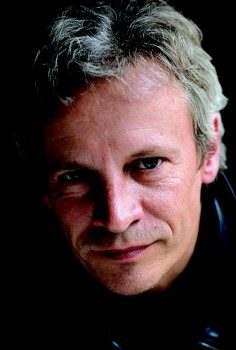
Ilpo Tiihonen. Photo: Irmeli Jung
Poems from From Eroikka (‘Eroica’, 1982). Introduction by Pertti Lassila
Ilpo Tiihonen (born 1950) published his first collection of poetry in 1975. From the beginning, his poems have been couched in the language of the street, and he uses slang liberally. Tiihonen has always been opposed to the miniature idylls of nature that were so characteristic of the 1970s. He aims at the secularisation of poetry, and he uses humour and comedy as a counterweight to high culture. He has evidently been influenced in his technique by Mayakovsky and Yesenin, to whom he often refers in his poems. His preferences in the poetic tradition are apparent in the fresh and liberal new interpretations of poems by Gustav Fröding contained in his collection Eroikka. Unusually for a contemporary Finnish poet, Tiihonen makes extensive use of rhyme. The result is often strongly lyrical poems that could almost be called modern broadsheet ballads, and may also bring Brecht to mind. More…
Mikko Rimminen & Kyösti Salokorpi
Beastly beatitudes
31 December 2001 | Archives online, Fiction, Prose
From Hämärä luonto. Aamunkoista Yön tuhmaan lintuun (niiden käyttäytymysestä ja elämästä yleensä) (’Natura Obscura. From the Moth of Dawn to the Naughty Bird of Night. On their behavior and life in general’, Tammi, 2001. Illustrations by Tatu Tuominen)
Anas cummea
Rubber duck
There are three species living on Earth which, it can be assumed, will survive a possible nuclear catastrophe: the cockroach, the rat and the rubber duck. Of these, the rubber duck is perhaps the most durable. Nothing affects it.
As soon as it emerges from the shell, the rubber duck secretes around its down an insulating layer of gum elastic for it cannot survive among bacteria or other non-mathematical creatures. Here begins the journey toward perfect self-sufficiency.
When young, the rubber duck looks at the world from behind its transparent membrane, protected from causes of disease, bad influences and modern poetry. With age, the rubber layer strengthens and becomes cartilaginous. Finally, the rubber duck lives alone in its own microcosmos, where there are no inter-species competition, nest-usurpers or elephant seals that mishandle their young. On the other hand, it has no room, either, for sunsets, litters of furry soft toys, or the lusty touch of lovers.
Sometimes the rubber duck finds itself in an existential panic: is there anyone, anything, outside the insulating layer? And does it itself exist? Who is speaking? Wrapped up in these thoughts, it reels around, bouncing from one bath to another, one season to the next. More…
Heartstone
2 December 2010 | Reviews
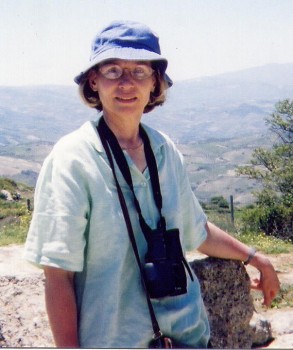
Ulla-Lena Lundberg
‘Knowledge enhances feeling’ is a motto that runs through the whole of Ulla-Lena Lundberg’s oeuvre – both her novels and her travel-writing, covering Åland, Siberia and Africa.
In her trilogy of maritime novels (Leo, Stora världen [‘The wide world’], Allt man kan önska sig [‘All you could wish for’], 1989–1995) she used the form of a family chronicle to depict the development of sea-faring on Åland over the course of a century or so. She gathered her material with historical and anthropological methodology and love of detail. The result was entirely a work of quality fiction, from the consciously old-fashioned rural realism of the first volume to the contradictory postmodern multiplicity of voices in the last – all of it in harmony with the times being depicted.
When Lundberg (born 1947) takes us underground or up onto cliff-faces in her new documentary book, Jägarens leende. Resor i hällkonstens rymd (‘Smile of the hunter. Travels in the space of rock art’), in order to consider cave- and rock-paintings in various parts of the world, she also reveals a little of the background to this attitude towards life that takes such delight in acquiring knowledge – an attitude that is familiar from many of the protagonists of her novels. More…