

Search results for "Riikka/2010/10/mikko-rimminen-nenapaiva-nose-day"
The train
31 March 1995 | Archives online, Fiction, Prose
Extracts from the novel Koe (‘The experiment’; WSOY, 1994). Interview by Tuva Korrström
In the morning a wild rose tapped beseechingly at the window, the wind sighed in the shaft of the chimney, the entire house creaked, pregnant with so great a longing that they had to awaken.
And as soon as they began to speak to each other, the house settled.
‘I should like to see the train,’ Sari said.
‘Why?’
‘Because that is the reason why I am here.’
‘I didn’t plan it like that,’ Kari said. More…
The monster reveal’d
31 March 1997 | Archives online, Fiction, Prose
Extracts from the novel Frankensteinin muistikirja (‘Frankenstein’s notebook’, Kirjayhtymä, 1996). Ern(e)st Hemingway and Gertrud(e) Stein – the narrator in these extracts – meet the famous creature in Paris. According to Juha K. Tapio in this, his first novel, Mary Shelley’s monster has been leading an interesting life during the past few centuries
My first impression was that there wasn’t anything particularly monstrous about him. I have already said that his age was hard to determine, but there was something about him that tempted one to apply the word ‘elderly’ to him. He was up in years, no doubt about that, but in a rather special, indefinable way – which made it hard to infer, at least from his outward appearance, what stage he had reached in terms of normal human life. It had to do with something outside of time. He was tall and a little more raw-boned than the average person, and this made one wonder, looking at him, what kind of body his very fashionable clothing concealed his suit and tie conformed to the latest style. This was certainly not the misshapen and monstrous creature I vividly remembered from Mary Shelley’s description.
It was obvious that the past decades had brought about an inevitable evolution. More…
In the wars
31 March 2005 | Archives online, Fiction, Prose
A short story from Jussi ja Lassi (‘Jussi and Lassi’, WSOY, 1921). Introduction by Pekka Tarkka
One winter evening, Lassi, who was six, asked: ‘Can’t we go out, mother?’
‘It’s late already,’ she said.
‘We’ve been inside the whole day practically,’ said Jussi, who was seven. ‘It gets on my nerves.’
‘Gets on your nerves, does it? Well, boys, you’ll soon be off in bed,’ she said, ‘so you won’t need to get nervy.’
‘Not off to bed – not yet, it’s not yet, not…’ Lassi broke off, trying to work it out.
‘It’s not six yet,’ Jussi said.
‘No, it isn’t,’ their mother said; ‘but you’ll have to stay in your room and not go charging about here, because visitors are coming.’ More…
Incident at Experience Farm
30 September 1998 | Archives online, Fiction, Prose
A short story from Pakkasyön odottaja (‘Waiting for a frosty night’, WSOY, 1997). Introduction by Jukka Petäjä
I
The round steel teapot is new. Father brought it back from Birmingham, where he went on a visit with the others from the concrete factory. In the shop, the teapot was wrapped in rustling, soft tissue paper. Pirjo was given the honour of opening the package. The pot has been used for brewing tea ever since.
At school, her sister Karoliina is proud of the fact that at home they drink only tea; they are different from other people, different in a good way, one to be proud of. They have a real teapot. Sometimes, during breaktime, a morsel of the excellence of Karoliina Kamppinen falls Pirjo’s way. ‘Yes, let’s include her, she’s Karoliina’s sister, after all.’ More…
I’ll never forget you
30 September 2000 | Fiction, Prose
An extract from the novel Mariposa (Schildts, 1999)
Roza and Melancholie were sitting in a bar drinking beer. They hadn’t met for a long time because they bored each other. But they were best friends nonetheless. What do you do when you can’t stand meeting your best friend? You switch on your answerphone and tell lies. Today by mistake one of them had answered the phone.
Roza was dressed in her brother Armand’s old clothes, a bad habit which irritated people but which she found hard to break. Her brother had vanished long ago leaving his clothes behind. They smelled of tobacco and sweat. Roza used them to keep him alive. She could spend whole evenings going through his wardrobe. There was a dress shirt, not that you’d have expected it.
The two young women studied each other. Melancholie noted that Roza had bitten down her cuticles again.
‘How’s life?’ she asked.
‘So-so. And you?’ More…
Being God
30 September 2006 | Fiction, Prose
Extracts from the novel Gud (‘God’, Schildts, 2006)
Side by side, wolves and antelopes graze on the juicy grass.
A deer playfully chases a lion through the bushes.
‘Can you do this?’
Adam crosses his arms in front of his chest and folds his hands back to front so that the right hand is on the left and the left hand is on the right. With his hands folded he twists them downwards and holds them out. Now they point to Eve, still folded, and still with the right hand on the left.
Eve tries. She succeeds, and laughs with delight.
A gentle breeze is blowing from the east, just strongly enough for the couple not to be troubled by the heat, but not so they would feel the need for clothes to keep them warm. More…
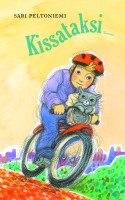
Sari Peltoniemi: Kissataksi [Cat taxi]
4 February 2011 | Mini reviews, Reviews
 Kissataksi
[Cat taxi]
Kuvitus [ill. by]: Liisa Kallio
Helsinki: Tammi, 2010. 154 p.
ISBN 978-951-31-5243-7
€16, hardback
Children’s novels with a humane, everyday approach like that of Kissataksi are few and far between. Juho is a skinny eight-year-old boy with a perfect life: pleasant parents, a nice little brother and a dog called Rekku. But one day, he comes across seven cats and an old biddy – and find that the cats have a plan to alleviate her gloom. Juho finds himself driving a taxi for the cats, who are searching for a reliable carer for their mistress, and soon Juho is joined by Virsu, a punk girl. Kissataksi charms the reader with its genial child’s pace. Understanding of displaced people, and empathy in general, have been sadly lacking in children’s literature in recent years. The title of this book is a homage to the Japanese master animator Hayao Miyazaki’s film My Neighbour Totoro, in which a cat bus figures significantly. As in Peltoniemi’s previous novels for children and young people, there is a pinch of magic in this book.
Translated by Ruth Urbom
Kvinnornas Helsingfors: en kulturhistorisk guide [Women’s Helsinki: a culture-historical guidebook]
6 May 2011 | Mini reviews, Reviews
 Kvinnornas Helsingfors: en kulturhistorisk guide
[Women’s Helsinki: a cultural-historical guidebook]
Red. [Ed. by] Anna Biström, Rita Paqvalén, Hedvig Rask
Helsingfors: Schildts, 2010. 251 p., ill.
ISBN 978-951-50-2007-9
Finnish-language edition: Naisten Helsinki: kulttuurihistoriallinen opas
ISBN 978-951-50-1994-3
€ 34, paperback
A group comprising fourteen women has addressed the question of what the map of Helsinki would look like seen through women’s history: what are the most significant places and monuments; what traces of women’s history could one read in the fabric of the city? This book portrays various eras in the city’s history from the 16th century onwards, along with profiles of female pioneers in fields from architecture to parliamentarians, from early political activists to present-day squatters. Helsinki has often been called ‘the city of women’ due to the large influx of women who came to work in the Finnish capital, particularly in the early 20th century – the increase in the number of office girls even boosted the publishing and film industries. In his Finnish letters written in the 1890s, Spanish author and diplomat Ángel Ganivet expressed his horror at the bicycling women of Helsinki. This book also includes pieces written by prominent contemporary women, from Finnish President Tarja Halonen to author Pirkko Saisio.
Translated by Ruth Urbom
Inside and out
14 February 2011 | Reviews

Markku Pääskynen. Photo: Ville Palonen
It is typical of Markku Pääskynen’s fiction for horrible things to happen both in people’s internal worlds and what goes by the name of the objective reality around them, and you can’t always be sure which one they’re happening in – or they’re happening in both.
From his debut novel, Etanat (‘Snails’, 2002, Tammi), onwards Markku Pääskynen (born 1973) has created a highly original body of work. His special strengths are his linguistic and narrative virtuosity, which allow him to make surprising events and narrative solutions come off in a controlled manner.
Pääskynen’s third novel, Tämän maailman tärkeimmät asiat (‘The most important things of this world’, 2005, featured in Books from Finland 1/2006), was a description of a single day that focused on the relationship between an adult son and his mother. Pääskynen’s sixth book, Enkelten kirja (‘Book of Angels’, 2010), is constructed out of sensory perceptions, thoughts, feelings and memories. The reader has to stay on his toes in piecing together the course of events, gradually revealed from behind these elements, and to find the story behind the plot. More…
What Finland read in April…
18 May 2012 | In the news
…was Tuomas Kyrö mostly, it seems: at the top of the April list of best-selling fiction titles in Finland, compiled by the Finnish Booksellers’ Association, was his novel Mielensäpahoittaja ja ruskeakastike (‘Taking offense: the brown sauce’, WSOY).
In March, Kyrö (born 1974) already featured twice on the list: his first novel about a 80-something man, Mielensäpahoittaja (‘Taking offense’, WSOY, 2010) was number two, and the newly-published sequel, Mielensäpahoittaja ja ruskeakastike had shot up to sixth place. In April they changed places – with the audio book version of the brown sauce book at number five.
This mielensäpahoittaja, ‘he who takes offence’, lives in the countryside and opposes most of what a contemporary lifestyle has to offer. Finns are evidently highly amused by the opinions of this obstinate, grumpy old man. But the popularity of Kyrö’s literary creation may also be boosted by the fact that he currently takes part in a television talk show every week, entertaining the audience and his fellow guests with his often acerbic remarks.
A crime novel by Seppo Jokinen, Hervantalainen (‘The person from Hervanta’, Crime Time), occupied third place, Tarhapäivä (‘Kindergarten day’, Otava) by Eve Hietamies fourth.
On the non-fiction list Solzhenitsyn’s The Gulag Archipelago, republished by Silberfeldt in April, was already in third place; we published a news piece about it on 25 April.
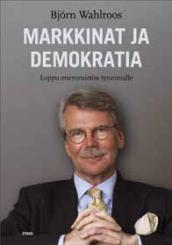 The non-fiction list was topped by a new, controversial book by banker – and one of the richest men in Finland – Björn Wahlroos, Markkinat ja demokratia. Loppu enemmistön tyrannialle (‘Market and democracy. The end of the tyranny of the majority’, Otava). He favours the methods of Margaret Thatcher’s economic policy and opposes social benefits for the poor; according to him, the market economy is superior to democracy any time.
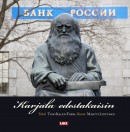
Timo Kalevi Forss & Martti Lintunen: Karjala edestakaisin [Karelia back and forth]
3 August 2011 | Mini reviews, Reviews
 Karjala edestakaisin
[Karelia back and forth]
Teksti [Text by]: Timo Kalevi Forss
Kuvat [Photographs by]: Martti Lintunen
Helsinki: Like Kustannus, 2010. 164 p., ill.
ISBN 978-952-01-0504-4
€ 29, paperback
At the end of the Continuation War (1941–44), some 400,000 Karelians were forced to abandon their homes. They were resettled in various parts of Finland, and nowadays around a fifth of Finns have some Karelian heritage. Through interviews with fifteen people living in the modern-day region of Karelia, this book documents the part of Karelia that was ceded to the Soviet Union. The researchers travelled to Vyborg, Sortavala, Priozersk, and the Valaam Monastery. The interviewees include a construction company owner building a house on an old Finnish stone foundation, a rock music club owner from Vyborg and a colonel who served in the counter-terrorism division of the Russian army. The photographs convey the range of buildings in Karelia, from Finnish houses to traditional Karelian homesteads, from mansions of the nouveaux riches to Soviet-era tower blocks. In the idyllic villages around Lake Ladoga, cows graze near small houses; time seems to have been frozen around the turn of the last century. The long sandy beaches of the spa towns on the shores of the Gulf of Finland are now filled with tourists from St Petersburg.
Translated by Ruth Urbom
How I saved the world for communism
30 September 1996 | Archives online, Fiction, Prose
Extracts from the novel Kreisland (WSOY, 1996). Rosa Liksom’s first novel is a picaresque story of a heroine whose adventures range through Finland, Soviet Russia and America. Introduction by Soila Lehtonen
Maid Agafiina: Got myself some shiny black rubber boots, the kind with the red felt lining, and a colorful crepe de chine dress and a rayon coat, and while shopping for all that I checked out the four wonders of Moscow: a bell that doesn’t ring, a cannon you can’t fire, a ruler who doesn’t speak, and money that doesn’t stink.
In no time at all I made up a new personality, learned the language real good, and obtained a Soviet citizen’s passport. I was totally excited by everything I’d seen. My cheeks were as red as the flag. I wanted to find out about everything and see every achievement of this huge Soviet land. More…
He came in through the bathroom window
30 June 1991 | Archives online, Fiction, Prose
A short story from Utslag och andra noveller (‘Rash and other stories’, Alba, 1989). Introduction by Pekka Tarkka
He heard a voice behind him:
‘Hey, Aspelin, what are you doing here?’
Awakening from a half-sleep, he looked around as Ilpo approached his seat.
‘I work near here. I’m teaching math to the visually impaired.’
Ilpo sat down next to him. For several seconds they sat without speaking. Then Aspelin collected himself.
‘And you?’
‘Visiting a friend. He lives in Mäkkylä.’ More…