

Search results for "Riikka/2010/10/mikko-rimminen-nenapaiva-nose-day"
How to peel an orange
30 December 2002 | Fiction, Prose
Extracts from the novel Auringon asema (‘The position of the sun’, Otava, 2002)
There are times when God rules. Then logic is burned on bonfires and left to rot in damp prisons with rats. There are times when logic rules. Then God is burned in the squares and his houses are made into schools. There are times when attempts are made to demonstrate that God and logic can live in the same place and that they are, in fact, the same thing, but those times are truly strange times. And there are times when God and logic live side by side but in different places, like adult siblings who cannot live in the same place but nevertheless get on well together. When my father and my mother loved each other, they were ruled by God, and there was no logic in it, none at all. More…
Across Europe
30 June 1990 | Archives online, Fiction, Prose
Mika Waltari (1908–1979) was a prolific writer, journalist and translator. In addition to historical novels, he wrote short stories, travel books, thrillers, plays, books for children, film scripts and poetry. The newly independent Finland of the 1920s, as it emerged from a traumatic period of civil war, declared that its windows were open to Europe, and Waltari’s first novel Suuri illusioni (‘The great illusion’), written in Paris when he was only 19, represents urban romanticism and the world of European capitals.The optimism and enthusiasm for modern life of the 1920s are strongly present in Waltari’s travelogue, Yksinäisen miehen juna, (‘Lonely man’s train’; 1929), an account, both ironic and engagingly naïve, of a great adventure in Europe after the post-1918 redrawing of the continent’s map. The book’s motto is a phrase from Paul Morand, a writer Waltari admired: ‘How is it possible to remain stationary when time slips like ice through our hot hands.’ This work of Waltari’s youth has never before been translated. The author travels by ship and train as far as Turkey; in the following extract, he has reached Hungary
Yksinäisen miehen juna (‘Lonely Man’s train’)
How adorable express trains are – the mighty engines, the rhythm of the rails, the sway of the carriages, the flashing-by of the milestones, the gravel embankments contracting into speeding lines. A train is the only place you can be completely at ease, free from heartache, free from longing, free from tormenting thoughts. Whenever I die, I hope it will be on a train flashing towards some unknown town at eighty miles an hour, with mountains looming on the horizon, and the points lighting up in the descending dusk…. More…
Findians, Finglish, Finntowns
16 May 2013 | Extracts, Non-fiction
Workers, miners, loggers, idealists, communists, utopians: early last century numerous Finns left for North America to find their fortune, settling down in Michigan, Minnesota, Wisconsin and Ontario. Some 800,000 of their descendants now live around the continent, but the old Finntowns have disappeared, and Finglish is fading away – that amusing language cocktail: äpylipai, apple pie.
The 375th anniversary of the arrival of the first Finnish and Swedish settlers, in Delaware, was celebrated on 11 May. Photographer Vesa Oja has met hundreds of American Finns over eight years; the photos and stories are from his new book, Finglish. Finns in North America

Drinking with the workmen: The Työmies Bar. Superior, Wisconsin, USA (2007)
The Työmies Bar is located in the former printing house of the Finnish leftist newspaper, Työmies (‘The workman’). The owners, however, don’t know what this Finnish word means, or how to pronounce it.
The Työmies Society, which published the newspaper of the same name, Työmies, was founded in Worcester, Massachusetts in 1903 as a socialist organ. It moved to Hancock, Michigan the following year. More…
Cool, not ice-cool
17 October 2013 | This 'n' that
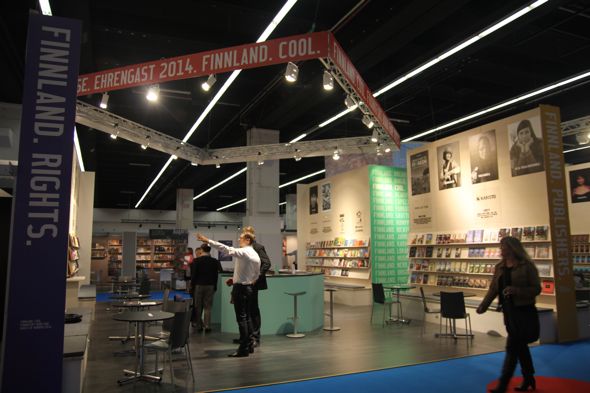
Getting ready: book fair scenery, 2013. Photo: FILI
The Finnish book world is preparing for the big event of ‘F14’: Finland will appear as Guest of Honour at the Frankfurt Book Fair in October next year.
The slogan for this enterprise is Finnland. Cool.
The coordinating organ is FILI, the Finnish Literature Exchange, a part of the Finnish Literature Society. Co-operating with FILI are three ministries, literary organisations and publishers, the Finnish Embassy and Finnland-Institut in Berlin and the Goethe-Institut in Helsinki.
Last week a large proportion of the FILI staff – who now need to keep their cool for the next busy year – went to Frankfurt, and on 10 October (aptly, the memorial day of the national author Aleksis Kivi and also Finnish Literature Day) the press conference was opened by the Finnish Minister of Culture and Sport, Paavo Arhinmäki. On 13 October the 2013 Guest of Honour, Brazil, passed the baton to Finland. (More photographs here.)
The world’s largest book fair, Frankfurt, attracts some 300,000 visitors each year. Accessible to both professionals and the general public, the fair is also the biggest cultural event in Germany.
The Guest of Honour countries receive a vast amount of attention in the media, and the number of new translations from the respective languages into German, as well as other languages, will increase.
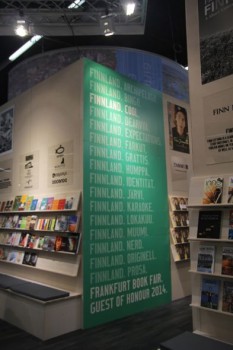
Finnland: arktik. Blondi. Cool. Demokratia. Einsam. Formula 1. Girji. Heimat. Ihminen. Joy…. Photo: FILI
The total Finnish budget for the years 2010–2015 is approximately four million euros, half of it money from the government. And the mission? Here are some warm words from the cool FILI agenda:
‘Why are Finns reading so much? Why are Finns so good at reading? Because we love it. Because reading plays such an important role in everyday life.
‘And because it is so important in Finland that everybody has access to reading – regardless of whether you are male or female, where you live, where you work, what your education or talent is. Fun, everyday life and for everyone – these are the main themes of the satellite programme for the Guest of Honour at the Frankfurt Book Fair 2014.’
A light shining
28 July 2011 | Essays, Non-fiction
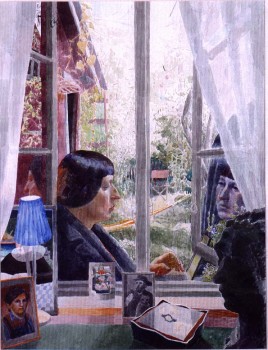
Portrait of the author: Leena Krohn, watercolour by Marjatta Hanhijoki (1998, WSOY)
In many of Leena Krohn’s books metamorphosis and paradox are central. In this article she takes a look at her own history of reading and writing, which to her are ‘the most human of metamorphoses’. Her first book, Vihreä vallankumous (‘The green revolution’, 1970), was for children; what, if anything, makes writing for children different from writing for adults?
Extracts from an essay published in Luovuuden lähteillä. Lasten- ja nuortenkirjailijat kertovat (‘At the sources of creativity. Writings by authors of books for children and young people’, edited by Päivi Heikkilä-Halttunen; The Finnish Institute for Children’s Literature & BTJ Kustannus, 2010)
What is writing? What is reading? I can still remember clearly the moment when, at the age of five, I saw signs become meanings. I had just woken up and taken down a book my mother had left on top of the chest of drawers, having read to us from it the previous day. It was Pilvihepo (‘The cloud-horse’) by Edith Unnerstad. I opened the book and as my eyes travelled along the lines, I understood what I saw. It was a second awakening, a moment of sudden realisation. I count that morning as one of the most significant of my life.
Learning to read lights up books. The dumb begin to speak. The dead come to life. The black letters look the same as they did before, and yet the change is thrilling. Reading and writing are among the most human of metamorphoses. More…
Best foot forward
14 May 2010 | This 'n' that
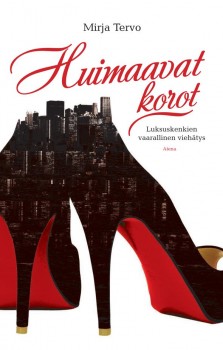 C’est moi. Tribute. Eliza. Muse. Monica. Very Privé, Super Private.
These are names of shoes that women buy in luxury shops on New York’s Fifth Avenue. Six inches or more of heels that cost anything between 500 and 5,000 dollars, make walking torture; but pain is tolerated, as along with the shoes a woman acquires a deeply satisfying feeling of being envied, beautiful and sexy (her toe cleavage has to be clearly visible).
Mirja Tervo (born 1971) is an ethnologist who spent a year and a half selling luxury shoes in Manhattan. Among her fellow sales personnel were a medical doctor, a musician, an actor and a retired baseball pro.
The shoe salon paid no salary, just commission of ten per cent, and the required minimum sale per week was 3,500 dollars. If a sales person failed to sell merchandise worth this sum, he or she was given a loan of 300 dollars, payable immediately when the results improved, and they quickly had to. More…
I am me
30 September 2010 | Fiction, Prose
Extracts from the novel Poikakirja (‘The boy’s own book’, Otava, 2010). Introduction by Mervi Kantokorpi
It’s a small day in spring. Another name for the lark is the skylark. You can only see them sometimes, and even then they’re so high up in the sky that they swoop like fast-moving dots.
The kitchen windowpane is rippling with stripes. The window has a bottom, and at the bottom there is some cotton wool and two opened matchboxes, a blue Sampo and a picture of an army chaplain in his uniform and insignia. As spring has progressed the cotton wool at the bottom has turned into wet blobs and the matches will never light again, as they’ve sucked up the winter frost from the glass.
Most children are made at home but not us, says Eini during walking practice. Outi shoves her, tells her to be quiet and walk in rhythm. I’m behind the table reading the Children’s Encyclopaedia, but I watch them. With every second step, their bottoms swing to the right and then to the left.
Mum comes into th the kitchen and asks what they’re doing; Anna-Liisa responds on the twins’ behalf, says they’re practising walking like in the movies and that’s why they’re wiggling their hips. More…
Serious comics: Angoulême 2011
24 February 2011 | This 'n' that
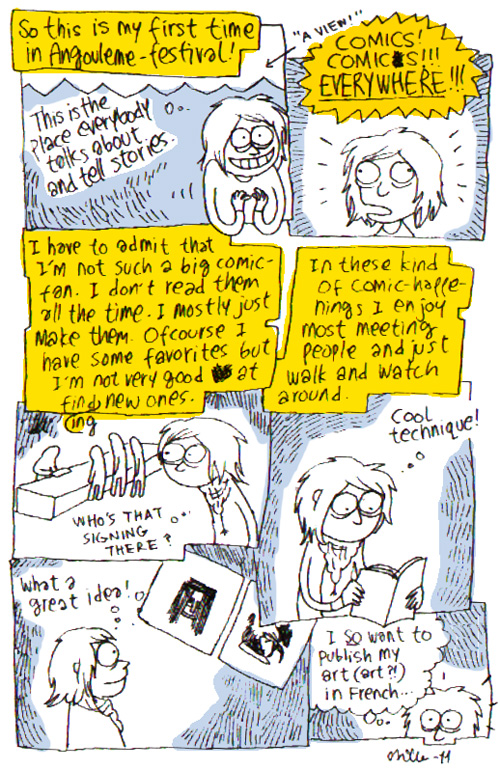
Graphic artist Milla Paloniemi went to Angoulême, too: read more through the link (Milla Paloniemi) in the text below
As a little girl in Paris, I dreamed of going to the Angoulême comics festival – Corto Maltese and Mike Blueberry were my heroes, and I liked to imagine meeting them in person.
20 years later, my wish came true – I went to the festival to present Finnish comics to a French audience! I was an intern at FILI – Finnish Literature Exchange, and for the first time, FILI had its own stand at Angoulême in January 2011.
Finnish comics have become popular abroad in recent years, which is particularly apparent in the young artists’ reception by readers in Europe. Angoulême isn’t just a comics Mecca for Europeans, however: there were admirers of Matti Hagelberg, Marko Turunen and Tommi Musturi from as far away as Japan and Korea.
The festival provides opportunities to present both general ‘official’ comics, ‘out-of-the-ordinary’ and unusual works. The atmosphere at the festival is much wilder than at a traditional book fair: for four days the city is filled with publishers, readers, enthusiasts, artists, and even musicians. People meet in the evenings at le Chat Noir bar to discuss the day’s finds, sketching their friends and the day’s events.
As one Belgian publisher told me, ‘There have always been Finns at Angoulême.’ Staff from comics publisher Kutikuti and many others have been making the rounds at Angoulême for years, walking through the city and festival grounds, carrying their backpacks loaded with books. They have been the forerunners to whom we are grateful, and we hope that our collaboration with them deepens in the future.
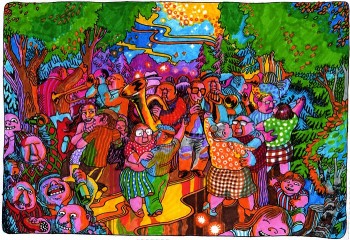
Aapo Rapi: Meti (Kutikuti, 2010)
This year two Finnish artists, Aapo Rapi and Ville Ranta were nominated for the Sélection Officielle prize, which gave them wider recognition. Rapi’s Meti is a colourful graphic novel inspired by his own grandmother Meti [see the picture right: the old lady with square glasses].
Hannu Lukkarinen and Juha Ruusuvuori were also favorites, as all the available copies of Les Ossements de Saint Henrik, the French translation of their adventures of Nicholas Grisefoth, sold out. There were also fans of women comics artists, searching feverishly for works by such artists as Jenni Rope and Milla Paloniemi.
Chatting with French publishers and readers, it became clear that Finnish comics are interesting for their freshness and freedom. Finnish artists dare to try every kind of technique and they don’t get bogged down in questions of genre. They said so themselves at the festival’s public event. According to Ville Ranta, the commercial aspect isn’t the most important thing, because comics are still a marginalised art in Finland. Aapo Rapi claimed that ‘the first thing is to express my own ideas, for myself and a couple of friends, then I look to see if it might interest other people.’
Hannu Lukkarinen emphasised that it’s hard to distribute Finnish-language comics to the larger world: for that you need a no-nonsense agent like Kirsi Kinnunen, who has lived in France for a long time doing publicity and translation work. Finnish publishers haven’t yet shown much interest in marketing comics, but that may change in the future.
These Finnish artists, many of them also publishers, were happy at Angoulême. Happy enough, no doubt, to last them until next year!
Translated by Lola Rogers
Back in the USSR
3 October 2011 | Fiction, Prose
Extracts from Rosa Liksom’s novel Hytti nro 6 (‘Compartment no 6’, WSOY, 2011). Review by Mervi Kantokorpi
Moscow hunched itself in the dry, frosty March night, protecting itself from the touch of the icy red sun as it set. The girl entered the train’s last sleeping carriage, found her compartment, compartment number six, and breathed deeply. There were four beds in the compartment, the upper ones folded agains the wall, while between the beds was a small table, on the table a white table cloth and a plastic flower vase containing a bunch of pink paper carnations, faded by time; the shelf above the end of the bed was full of large, untidily secured parcels. The girl shoved her modest old suitcase, the one she had got from Zahar, into the metal luggage space under the hard, narrow bed; her small backpack she threw on the bed. When the station bell sounded for the first time, the girl went to stand by the corridor window. She breathed in the scent of the train, iron, coal-dust, the smells left behind by dozens of cities and thousands of people. Travellers and those who had come to see them off pushed past her, shoving her with their cases and parcels. The girl touched the cold window with her hand and looked at the platform. This train would take her through villages inhabited by deportees, through the open and closed towns of Siberia to the capital of Mongolia, Ulan Bator. More…
The forest folk’s trip to Helsinki
26 March 2015 | Children's books, Fiction
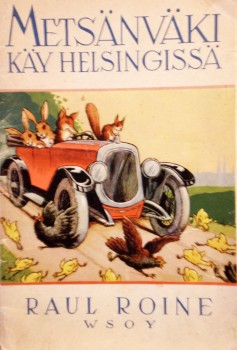 The country comes to town in this coyly modern fairy story of 1937 by the classic children’s writer Raul Roine (1907-1960). Reynard the Fox, the village taxi-driver, celebrates restoring his beat-up old Ford by taking his woodland friends – squirrels, chaffinches, bobtails… – on a day out to Helsinki. Trouble starts when a policeman tells them off for eating the plants in the Esplanade park, but the fun really begins when the hares find themselves participating in the marathon which is being run through the city streets that day…
The translation of this delectable tale is by Books from Finland’s long-time collaborator Herbert Lomas (1924-2011), who was often at his best when working on the whimsy of children’s literature.
Spring had come to the forest homeland. The wood anemones were raising their heads shyly from under the moss, large tears of joy were flowing down the spruce trees’ beards of lichen, and sky-ploughs of cranes were coming from the south. They bugled mightily on their trumpets and then landed in the Great Marsh to sample the cranberries More…
Keeping the day job
30 September 2003 | Authors, Interviews

Photo: Irmeli Jung
Finland’s most famous cop, Chief Superintendent Timo Harjunpää, is the fictional creation of another policeman, Matti Yrjänä Joensuu. The long-awaited eleventh novel in the Harjunpää series, Harjunpää ja pahan pappi (‘Harjunpää and the priest of evil’) appeared this autumn after a gap of a decade. Joensuu talks to Jarmo Papinniemi about crime, the creative process and the powers of darkness
Matti Yrjänä Joensuu (born 1948) is one of the best-known Finnish crime writers and is certainly one of the most respected. He writes novels about ordinary policemen and ordinary crimes; bleak tales of murder which do not pander to the reader with complicated plots, non-stop action or glamorous settings. Like the Swedish writers Maj Sjöwall and Per Wahlöö or Henning Mankell, Joensuu’s narratives focus on social reality and expose the darker sides of society and the day-to-day misery and suffering which gives rise to crime. More…
Between two loves
31 December 1999 | Archives online, Fiction, Prose
From Se tapahtui täällä (’It happened here’, Otava, 1999). Introduction and interview by Nina Paavolainen
She thought of the period between two loves as a spacious room, full of light, outside whose windows the seasons change unhurriedly. On the walls are reflections of the morning light. There is the sound of piano music; and the number of rooms grows. Somewhere, far away, a young girl, dressed in white, is at the piano; the wind fans the curtains. Slow awakening, the soft rocking of time, the sound of bare feet on a wooden floor. In the air there is the scent of flowers, apples, and the gentle morning breeze, and perfume, and the scent of clean, ironed clothes and furniture wax. The afternoon shadows are long and cool; the pages of a book rustle slowly. Now the music pauses.
One hell of a time
31 December 1997 | Archives online, Fiction, Prose
Extracts from Lanthandlerskans son (‘Country shopkeeper’s son’, Söderströms, 1997). Brooklyn Bridge, Christmas Eve: Otto, a Finland-Swede, attempts to start a new life in 1930s America, where swindlers and even gangsters can, he finds, be duped – even Al Capone. Otto’s grandson listens to his story on tape
I have always loved that sight. A city that you see from the air at night, all lit up. It’s’ beautiful – and at the same time so frightening. I don’t really know how to describe it.
Well, it was Christmas Eve. I was wandering around New York. I had eaten at an automat. Do you know what that is? They don’t exist any more, but in the Twenties and Thirties they were common in America. It’s a cafe, but they didn’t have any staff or waiters, instead the walls were full of little glass boxes where the food was on display. You could select what you wanted – sandwiches and pies and salads, anything. Then you put your nickels and dimes in a slot beside the box and the glass opened and’all you had to do was take out the plate. I was fond of the automats. I liked just sitting there and watching other people eat, no one bothered about you, you were left alone and that suited me. When I’d finished eating I went outside again and somehow or other I wandered upon to Brooklyn Bridge. There was a lot of traffic, people were on their way home. Well, just as I was walking there alone in the company of my thoughts I heard someone shouting ‘Help! Help me!’ More…
The engineer’s story
30 June 1981 | Archives online, Fiction, Prose
A short story from Maailman kivisin paikka (‘The stoniest place in the world’, 1980). Introduction by Pekka Tarkka
Coffee was going to be served down by the river. The engineer took my elbow and led me across his paved courtyard and over his lawn; we settled ourselves down in cane chairs under the trees. Mirja came out of the house with a tray of coffee and coffee-cups, a loaf of sweet bread, already cut, some marble cake and some biscuits. The engineer said nothing. My eye wandered over the ample weeping birches by the river, the mist creeping up in the cool of the evening and shifting in the cross-pull of the breeze and the current, and I watched Mirja moving under the trees back to the house and then down again to the riverbank.
As we sipped our coffee we spoke about chance, and the part it plays in life, about my husband – for I was able to speak about him now: enough time had gone by. The engineer eased himself into a comfortable position, gave me a quick look and then launched off into an account of his own, about his trip abroad:
I spotted the news item as I was going through the morning paper on the plane. I sat more or less speechless all of the first leg, listening to Kirsti and her husband confabulating. I didn’t say anything during the stop-over in Copenhagen, either, where they wanted to get some schnapps and, of course, some chocolate ‘if Kirsti would really like some’. We came rushing back into the plane just as the last English, German and Danish announcements were coming over, and then we sat waiting for the take-off. That was delayed too because of a check-up (not announced), and then we were off again for Zurich, me without a word and they whispering together. Then it was the bus as far as the terminal, and after that a taxi to the hotel. Quite clearly Kirsti hadn’t heard a thing about it yet, and probably hadn’t had much contact with Erkki for quite some time, her new husband even less. More…