

Search results for "Riikka/2010/10/mikko-rimminen-nenapaiva-nose-day"
The Cheap Contractor
30 June 1986 | Archives online, Fiction, Prose
From Kauan kukkineet omenapuut (‘Long-blossoming apple trees’, 1982). Introduction by Arto Seppälä
The men who delivered the hot-water cylinder offered to do the installation as well. I asked how much it would be. They lolled about a bit, exchanged a few private looks, pretended to be thinking. Then one of them fired off a sum. It was three times the quotation I’d already had. They didn’t even look at the location. I told myself I wouldn’t even go to the end of the road with big-dealers like these.
The same evening I rang up ‘a little man’ and told him he could get started as soon as it suited him.
The cheap contractor turned up a couple of days later, driving an elderly van into the yard. I went out. He’d sat himself down in a garden chair near the white lilacs. The morning sun only partially reached there; so half his body was in shade, looking colder than the sunny half. More…
In the mirror
30 September 2003 | Archives online, Fiction, Prose
Extracts from the novel Helene (WSOY, 2003). Introduction by Leena Ahtola-Moorhouse
It was raining that day, and I was leafing through art books, as I often do, in the bookshop. Then I happened to pick up a work in which there was a picture; a bowl of apples, one of which was black.
Stories often begin like this, inexplicable as deep waters, secret as an unborn child which moves its mouth in the womb as if it wished to speak. For people do not seek mere understanding… people seek the sulphurous, tumultuous shapes of clouds; people seek bowls of apples of which one is black.
I bought the book and made an enlargement of the still life; on the wall, it was even more remarkable, for its correct position was standing up, tête à tête, looking straight at you, unblinking.
The apples seemed to move, to speak. I began to ponder them more and more. In the end I had to read everything I could lay my hands on about the still life’s painter. I had to visit Hyvinkää, where she lived for a long time, and touch her tree in Tammisaari with my hand. I had to travel as far as Brittany to see the rugged landscape that meant so much to her. More…
Cautionary tales
30 September 2002 | Fiction, Prose
Short stories from Förklädnader. Sagor, parabler (‘Disguises. Stories, allegories’, Schildts, 2001; Valepukuja. Satuja, vertauksia, WSOY, 2002)
Assistance
All over Hellas, even in the barbarian lands, the lyre-players competed with one another. Odes, paeans, dithyrambs echoed endlessly. Phoebus Apollo himself generously oversaw these productions.
A certain promising singer, Deinarchos by name, who hoped to participate in the upcoming Pythian contest, sat in his study-cave in the mountains of Thessaly waiting for inspiration. He prayed repeatedly to Phoebus for help, but did not detect any response. More…
Another morning, another day
Poems from Unen kaivo (‘The well of dreams’, WSOY, 1936). Introduction by Satu Grünthal
IN THE MIRROR
Strange and truly wondrous
in the mirror you look at me.
All I really know is
that you I cannot be.
With my eyes you survey me,
with my lips you smile, too,
what I see in the mirror
is not me, but you, just you.
Whoever you are – astral morning,
eternal night – in the frame
like a wraith, a ghostly phantom,
invisible I remain. More…
Money, Morals and Love
31 March 1980 | Archives online, Authors
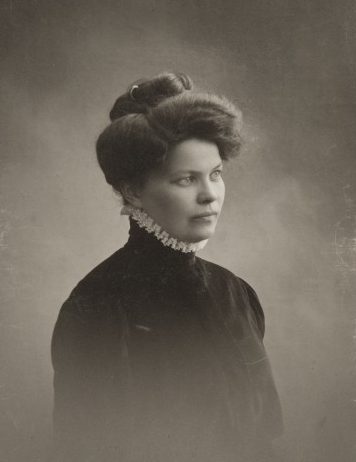
Maria Jotuni. Photo: Atelier Nyblin / CC-BY-4.0
Maria Jotuni‘s reputation as a writer rests on her daring and highly individual portrayals of women and on her gifts as a dramatist. Her works concentrate on analyses of the human condition, the contradictions, the frustrations, the fantasies. As the creative ‘observer’ she is both deeply sympathetic and ruthlessly revealing.
Maria Jotuni, whose centenary is celebrated this year, grew up in the eastern Finnish province of Savo and her early work draws richly on that background for subject matter and local colour. Her style, which over the years was honed and polished into a unique form of expression, certainly owes something to the lilting rhythms of the Savo dialect – and something to the lyricism of the Finnish Bible, with which she was familiar from her earliest years. Maria Haggrén, as she was born, was the second of six children; they lived in Kuopio, the home town of J. V. Snellman (1806–81), a man who did much to formulate the Finnish national identity, and of Minna Canth (1844–97), one of Finland’s major woman writers. The Haggréns were not wealthy, but they believed strongly in the pursuit of learning and knowledge. The home also provided a fruitful contact with rural life with opportunities to listen to the chatter and tales of the farm boys and servant girls. More…
A respectable tragedy
30 June 1988 | Archives online, Fiction, Prose
An extract from the novel Säädyllinen murhenäytelmä (‘A respectable tragedy’, 1941). Introduction by Kaija Valkonen. The central theme of the novel is love: young, old, passionate, innocent, proper, improper. The main characters are a middle-aged couple, the doctor and his wife Elisabet, his sister Naimi and the love of her youth, Artur. Hämäläinen’s fine irony, careful and thoughtful psychology and colourful language have made the novel a bestseller. Naimi, an aesthete and an uncompromising character, has left her husband Artur twenty years ago because of his infidelity. But slowly she begins to forgive: this tragic but compassionately told love story, not without tragicomedy and humour, ends in reconciliation
Embalmed passion
In that new Helsinki of the ‘thirties, which had opened like a garden flower, gaily coloured, sunlit, practical and impractical, in love with every novelty of the moment, which it thought astonishing, lived Naimi Saarinen, back from her exile, where she had been driven by wounded passion twenty years before. More…
Poems
30 June 1987 | Archives online, Fiction, poetry
Poems from Vattenhjulet (‘The water-wheel’, 1986). Introduction by Thomas Warburton
Together with time
One day the door to my room closed
and fate said to me: be still.
It was then that I discovered time.
It had lain hidden beneath a lid
of events and hasty decisions.
It was then that I raised the lid.
So strange! There time lay
completely unused, completely itself
smooth and fresh, as if resting.
I looked at time with reverence.
I saw myself new, I sank into
a miraculous eventlessness
together with time
listened to myself living:
a barely perceptible murmur.
The water-wheel
The old horse plods heavily with blinkered eyes
the wheel turns slowly and inexorably
creating time, a thing that is not visible
that is really nothing
			with the right to kill.
Words like songs
The Finnish poet Helvi Juvonen (1919–1959) often studies small things: moles, lichen, bees and dwarf trees; she ‘doesn’t often dare to look at the clouds’. But small is beautiful; her nature poems and fairy-tales mix humility and the celebration of life. Commentary by Emily Jeremiah
Cup lichen
Luke 17:21
The lichen raised its fragile cup,
and rain filled it, and in the drop
the sky glittered, holding back the wind.
The lichen raised its fragile cup:
Now let’s toast the richness of our lives.
From Pohjajäätä [‘Ground-ice’], 1952) More…
On the job
10 December 2010 | Extracts, Non-fiction
‘I like my pictures to be realistic and truthful, not that I can satisfactorily define what realism is. The real people in my pictures are in their real surroundings, even though they are posing for me. I see this as a series of encounters. The subjects present their “working role” for me, which I record‚’ says photographer Eija Irene Hiltunen. In these extracts she introduces her project and samples of her photography present people at work in contemporary Finland
Extracts from Työn tekijät. Muotokuvia suomalaisesta työstä. / Doing the job. Portraits of Finnish working life by Eija Irene Hiltunen. Texts: Pasi Alametsä. Translations: Joseph White. Layout: Petri Kuokka & Eija Irene Hiltunen (Avain, 2009)
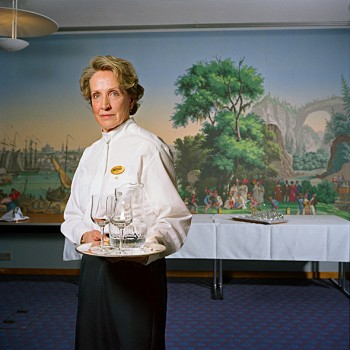
A waitress. Photo: Eija Irene Hiltunen, 2001
One of the most important aims of my portraits has been to record an image of the times. I chose work as the common denominator because it relates to the social structure on so many levels.
The ‘visual inventory’ of Weimar Germany by the classic photographer August Sander has been the major inspiration for my work. He made a huge impression on me during my student days. He told of the upheavals of his own time through his portraits, as the old class society broke down, and of the time before the Second World War and the birth of modern Germany. Sander beautifully depicted history through the individual, and his portraits have remained as testaments to life during that era. More…
Front-Line Tourists
30 September 1976 | Archives online, Fiction, Prose
An extract from the novel Nahkapeitturien linjalla (‘On the tanners’ line’, 1976)
Paavo Rintala (born 1930) published his first novel in 1954 and since then has brought out a new book almost every year. A merciless critic of the myths surrounding certain national figures and events, he has written about Marshal Mannerheim, against attempts to glorify war, and the ‘inevitability’ of Finland’s involvment in the German Barbarossa plan. He has made considerable use of reportage technique to produce anti-war documentaries and in more recent years worked with international subjects.
His books have been widely translated and are popular in East and West Europe. Paavo Rintala’s novel Sissiluutnantti (‘Commando Lieuenant’, Otava 1963) and its reception were the subject of a book by the ltterary critic Pekka Tarkka (Paavo Rintalan saarna ja seurakunta. ‘Paavo Rintala’s sermon and congregation’, Otava 1966). Paavo Rintala is chairman of the Finnish Peace Committee. The passage below is taken from Nahkapeitturien linjalla (‘On the tanners’ line’, Otava 1976) in which he again turns his attention to the war years. Rintala looks at the events of the years leading up to the war and the course of the war itself through the eyes of many different people – from the leading politicians of the day to the ordinary soldier.
The novel has already been acclaimed as the monument to the ‘unknown soldier’ of the Winter War.

Hessu duly presented himself at the Viipuri office of the Army Information Department (Visitors’ Escort Section), where it was implied that the expected visitors were Very Important People and that a singular privilege was being conferred upon Hessu and such front-line troops that the party might visit. Although His Excellency Field-Marshal Mannerheim made it a rule never to allow front-line visits by ordinary journalists or even by special correspondents, these gentlemen were, it seemed, such influential people that H.E. had agreed to their visit without demur. “You understand, Padre, what a great responsibility this will be for you? These are very high-up people.” More…
A hard day’s night
30 June 2008 | Archives online, Authors, Reviews
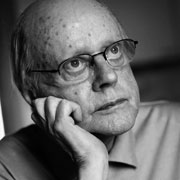
Arne Nevanlinna. Photo: Veikko Somerpuro/WSOY.
Marie Myhrborgh was born in Strasbourg on the last day of the 19th century. A hundred years later she is living her last days in a Finnish nursing home. Her mind wanders, searching for a vanished time in the landscapes of her childhood and her later life in Finland, where she was brought by a hasty marriage, formed amid the clamor of the First World War.
In his first novel Marie (WSOY, 2008) Arne Nevanlinna follows his protagonist’s associations and reminiscences, creating comic and ironic, as well as tragic parallels between the eras and the cultures that it describes.
With her marriage, Marie’s life as a Frenchwoman under the authority of the Germans changes to that of an outsider in the narrow social circles of the Finland-Swedish gentry, which her outsider’s eyes see in an ironic light. More…
A day at the zoo
23 December 2009 | Children's books, Fiction
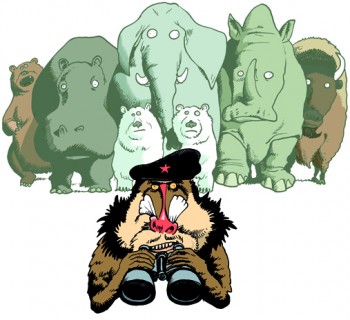
Extracts from the children’s book Zoo – eläimellinen tarina (‘Zoo – a bestial story’, WSOY, 2009, illustrated by Pertti Jarla)
The place: A zoo, once the property of the city, now privatised and accountable to corporate stockholders
The characters: The animals of the zoo, in particular Gandhi, a Sumatran tiger (false-teeth, poor vision, pacifist), Che, a male mandrill baboon (militant), and Mother Teresa, a hammer-headed bat (elderly); the zookeeper Sihvonen (stands up for the animals, recently fired); the new zoo director (whose main goal is to maximise profits); the shareholders’ committee (awaiting their earnings)
The action: after a demonstration in which all the animals played dead, the animals are staging a revolution to demand that Sihvonen be reinstated
The animals crowded into the foyer. The hallway was full of every kind of creature, with all of their skin, fur and feathers steaming in the warm indoor air. Che stood at the top of the the stairs, looked down at his troops, and gave the order in mime for everybody to be quiet.
‘Reconnaissance?’ he said, his voice subdued.
‘Ready!’ the leaf-tailed geckos announced.
‘Head in!’ Che commanded. More…
Not a day without pen and paper
14 March 2013 | This 'n' that
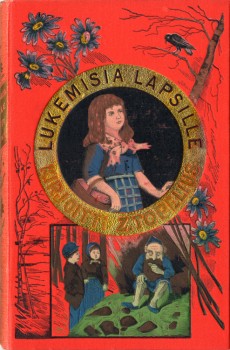
For use and fun: stories for children by Z. Topelius
Zacharias Topelius wrote every day for almost 70 years. His published works contain almost 16,000 pages.
As he was also the editor of the Swedish-language newspaper Helsingfors Tidningar which he published twice a week for 20 years, his output, counted in pages, is enormous.
Author, journalist, historian, critic and pedagogue Topelius (1818–1898) wrote poetry, hymns, travelogues, serials, articles, short stories, fairy tales, textbooks and plays.
As for Finnish translations, his historical serial Fältskärns berättelser (‘The barber-surgeon’s tales’, 1853–1867) and Läsning för barn (‘Reading for children’) are probably his most popular works.
In a bilingual (Swedish and Finnish), text-critical, annotated (and illustrated) project, entitled ‘Zacharias Topelius Skrifter’ (‘Z. T. writings’), Svenska Litteratursällskapet i Finland (the Society of Swedish Literature in Finland) will publish a large number of Topelius’s works in digital facsimile form. The selection grows continually.