

Search results for "Riikka/2010/10/mikko-rimminen-nenapaiva-nose-day"
Onward, downward!
31 March 1994 | Archives online, Fiction, Prose
Lauri Viita (1916–1965) was one of the self-taught writers who made his debut after the Second World War. His extensive, realist novel Moreeni (‘Moraine’, 1950) taking place in Viita’s native Tampere, begins with this prose poem
…over wolds, hummocks, ridges, between boulders, under branches, from cabin to cottage to manor, from coppice to fen, and ditch to puddle – down it drew us, the sloping earthcrust, southward the magnificent granite ploughland slanted.
Paths linked to paths, brooks joined brooks. Onward, downward! The roads widened, the currents strengthened. Bigger and bigger, heavier and heavier were the loads they could sustain. More and more trees, bread, potatoes, butter, meat, people and gravestones, huge boulders, rocks, went into the maw of those channels, and the hunger only redoubled. From channel to strait, from hour to hour, the lines of barges crawled along; from day to day the broad rafts of logs passed their sleepless summer on the long blue strip of Lake Näsijärvi. Spruce, pine, birch, aspen – different pieces for different purposes. How vast the supply and how vast the need! The months and days went by; in the depths of the lake, layer after layer, there wandered the shades of clouds, ships, faces. More…
‘ware bears!
30 September 1988 | Archives online, Children's books, Fiction
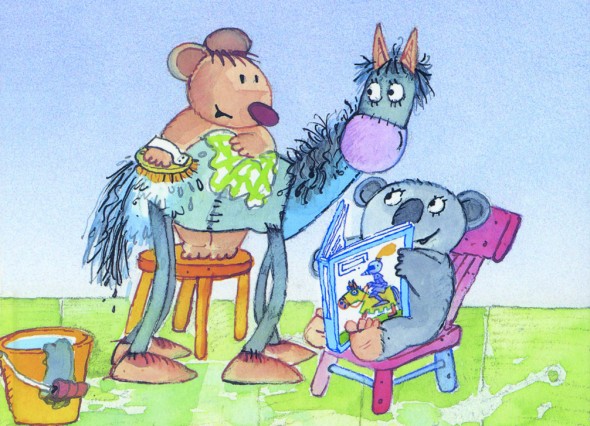
Illustration: Jukka Lemmetty
Urpo and Turpo are a pair of teddy bears. Their family – mother, father and three children – cannot imagine who it is that makes such a mess; the bears live their own absorbing lives in house. Hannele Huovi’s text and Jukka Lemmetty’s illustrations describe the bears’ antics in a way that appeals to the sense of humour of readers of all ages.
In the green house an ordinary family are living a perfectly ordinary life. There’s father, mother, The Big Daughter, The Son, and also The Baby as well. Mother keeps running back and forth all day long shouting, ‘Goodness gracious! Who’s responsible for this?’ For very funny things keep going on in the house. Who on earth is it – always getting up to some sort of hanky-panky?
Father harrumphs and says to The Big Daughter:
‘It was you, wasn’t it?’ But The Big Daughter shakes her head. Father turns to The Son:
‘So it must have been you, then?’ But the son shakes his head. No use asking The Baby. He shakes his head anyway, because he’s always imitating the others. Father and mother are completely stumped. More…
Breton without tears
31 March 1994 | Archives online, Fiction, Prose
Extracts from Euroopan reuna (‘The edge of Europe’, Otava, 1982). Introduction by H. K. Riikonen
I am reading a book, it says pour l’homme latin ou grec, un forme correspond à un être; pour le Celte, tout est metamorphose, un même individu peut prendre des apparences diverses, so it says in the book. A strange claim, considering that the word metamorphosis is Greek, and that the best-known book about metamorphoses, Ovid’s Metamorphoseon libri XV was written in Latin. In the myths of all peoples, at least the ones whose oral poetry was recorded in time, such as the Greeks, Serbs, Slavs, Finns, or Aztecs, metamorphoses play a very important part, the Celts are not an exceptional tribe in this respect. The author must mean that the Celts still live in mythical time, the time of metamorphoses when the human being assumed shapes, was able to fly as a bird, swim as a fish, howl as a wolf, and to crown his career by rising up into the sky as a constellation. Brittany is part of the Armorica Joyce tells us about in Finnegans Wake, that book is incomprehensible if one does not know Ireland, and now I see that Brittany is the key to one of the book’s locked rooms. I thought I already had keys to all the rooms after Dublin, the Vatican, and Athens, but one door was and remained closed, the key is here now, in my hand, I can get into all the rooms in the book, and I am home even if I should happen to get lost. The room creates the person, she becomes another when she goes from one room to another, this is metamorphosis, and when she leaves the house she disappears, she no longer exists. The legend on the temple at Delphi, gnothi seauton, know thyself, has led Occidentals onto the false track that is now becoming a dead end, polytheistic religions correspond to the order of nature, but as soon as the human starts to imagine that she knows herself, as soon as the metamorphic era ends, monotheism is born, the human being creates god in her own image, and that is the source of all evil. Planted like traffic signs at the far end of this cul-de-sac stand the hitlers and brezhnevs and reagans and thatchers, new leaves are appearing on the trees, the sun is shining. Landet som icke är* är en paradox: landet blev befintligt därigenom att Edith Södergran sade att det icke är. On the sea sailed a silent ship*, as I tracked my shoeprints across the sand on the beach, it was like walking on a street made out of salty raw sugar, I felt desolate. The wind bent the grasses, the sun warmed the back of my sweater, of course the sun always has the last word, I thought, things should be as they are, this thought gave me peace of mind. I walked past the cows, two of them already chewing the cud, the others still grazing, they stood in a line and raised their heads, stood at attention, as it were, as I walked past. I was not entirely sure that I was heading in the right direction, but then I saw the boucherie and knew that there was a café nearby. Madame greeted me in a friendly fashion, brought me a calvados and a beer and sat down for a chat, wanted to know if I liked the countryside here. I said that things looked the same here as in Ireland, she said that was true, but she had never been to Ireland. I finished my drinks and paid, left, decided to walk along the beach. I saw gun emplacements and two bunkers. I crawled into a bunker. Inside, it was dark and damp. I looked through the embrasure at the sea. I thought of the boys who had been incarcerated here. They had been given a death sentence. I examined a rusty object, what was it, I looked at it more closely, it was an axle from a gun’s undercarriage. As I arrive in my home yard, I note that the lilacs are beginning to bloom. More…
Leena Lander: Liekin lapset [Children of the flames]
23 June 2010 | Mini reviews, Reviews
 Liekin lapset
[Children of the flames]
Helsinki: Siltala, 2010. 419 p.
ISBN 978-952-231-022-1
€ 27.30, hardback
Novels by Leena Lander (born 1959) have been translated into more than 20 languages. Liekin lapset is a family saga, told in two parallel timelines. One is a portrait of a small coastal community in south-western Finland from the turn of the 20th century up to the end of the Finnish civil war in 1918 and the years following it. Life in the area is governed by a sawmill and a manor, socially dividing the community in two. Saida, Joel, Anders and Arvi grow up together, the future workers dreaming of socialism and the sons of the manor playing warlords. In the contemporary strand of the story, Sakari Salin, Saida’s grandson, begins researching his grandmother’s life. The documents reveal some rather remarkable events: here, the author defends the rights of those who were on the losing side in the civil war and creates a lively – as well as historically grounded – portrait of the times. The dialogues and characters in this novel work well, and the structure supports a complex system of psychosocial interconnections, in which the present finds an explanation in the past.
Toivo Flink: Kotiin karkotettavaksi: Inkeriläisen siirtoväen palautukset Suomesta Neuvostoliittoon [Exiled home: The return of Ingrian emigrants from Finland to the Soviet Union]
15 October 2010 | Mini reviews, Reviews
 Kotiin karkotettavaksi: Inkeriläisen siirtoväen palautukset Suomesta Neuvostoliittoon 1944–1955
[Exiled home: The return of Ingrian emigrants from Finland to the Soviet Union, 1944–1955]
Helsinki: Finnish Literature Society, 2010. 320 p., ill.
ISBN 978-952-222-183-4
33 €, paperback
It has been 65 years since the Allied Commission operation to repatriate Finnic Ingrian emigrants from Finland to the Soviet Union was completed. During the Continuation War (1941–1944), 63,000 Ingrian civilians fled to Finland to avoid the war; 56,000 of them were returned to the Soviet Union at the order of the Russian-dominated Allied Commission. It is estimated that half of those remaining in Finland secretly fled to Sweden. Ingrians continued to be returned from Finland to the Soviet Union for ten more years. The Ingrians had been promised they would be returned to their former home areas around St Petersburg, but they were actually transferred to more remote parts of the Soviet Union. In this first study to deal exclusively with the travails of the Ingrians, Flink has used Russian archives to uncover how and where the population was moved. This subject has long been a sensitive issue both in domestic and foreign affairs. According to Flink, his research would not have been possible if the return of Ingrians to Finland had not begun in 1990. (There have been about 30,000 immigrants since, and now the state is planning to terminate the right of return.)
Matti Yrjänä Joensuu: Harjunpää ja rautahuone [Harjunpää and the iron room]
19 November 2010 | Mini reviews, Reviews
 Harjunpää ja rautahuone
[Harjunpää and the iron room]
Helsinki: Otava, 2010. 302 p.
ISBN 978-951-1-24742-5
€ 26, hardback
This book’s shocking opening scene, a cot death, is not followed by anything that lightens the tone. Finland’s best-selling crime writer, Matti Yrjänä Joensuu (born 1948) – whose work has been translated into nearly 20 languages – focuses here on a criminal investigation conducted by Inspector Timo Harjunpää into the murderer of several wealthy women. The victims are linked via their purchases of sex; the detective’s attention soon falls on Orvo, a masseur who also turns tricks as a gigolo. Nearly every scene is shot through with themes of lovelessness, exploitation and the connection between malice and sex. Harjunpää is an empathetic, slightly rumpled cop who has an ambitious yet somewhat downbeat attitude to his job. Joensuu’s Harjunpää ja pahan pappi (Priest of Evil) was published in English in 2006. Joensuu himself is a retired police officer; his particular strength as an author is his extraordinarily precise, realistic portrayal of police work. But it’s not just about who did what; why they did it is equally important. One reason for Joensuu’s popularity is his extremely well-developed understanding of human nature. He observes and analyses, but never judges.
Tapani Bagge: Maalla [In the country]
31 January 2011 | Mini reviews, Reviews
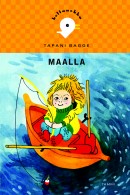 Maalla
[In the country]
Kuvitus [ill. by]: Hannamari Ruohonen
Helsinki: Tammi, 2010. 64 p.
ISBN 978-951-31-4748-8
€9.50, hardback
There have been plenty of books for beginning readers with action-packed plots full of breathtaking twists and turns. Fortunately there are still books that leave room for a more ‘easy does it’ reading style. One of them is this, the sixth title in Tapani Bagge’s series about a girl called Kaisa. Kaisa travels to the countryside with her father and her father’s partner Sirkka. Their journey is overshadowed by the death of Kaisa’s grandmother, and the little girl believes that nothing at her grandma’s place will ever be the same again. Bagge’s extensive work on this material is evident in his spare, finely tuned prose. He portrays the grieving girl’s differing shades of emotion beautifully. Kaisa believes that her grandma has changed into a butterfly following her death. So the butterfly fluttering around in the attic needs to be saved – but this of course has further-reaching consequences…. Hannamari Ruohonen’s black-and-white illustrations provide a lovely depiction of care and protection in the family.
Translated by Ruth Urbom
Asko Sahlberg: He [They]
28 June 2010 | Mini reviews, Reviews
 He
He
[They]
Helsinki: WSOY, 2010. 120 p.
ISBN 978-0-36170-2
€ 24.10, hardback
The Finland-Swedish author Asko Sahlberg (born 1964), who lives in Gothenburg in Sweden, has had an interesting, if uneven, career over the past decade. Sahlberg’s particular strengths lie in his precise use of language and the rhythm of his prose. Since his debut novel, Pimeän ääni (‘The sound of darkness’, 2000), part of Sahlberg’s output has been concerned with meditations on existence and the purging of emotions, with the rest delving into historical themes, such as his 2004 novel Tammilehto (‘Oak Grove’) which is set in the year 1918, and He, his ninth book, which takes place in 1809. (An extract from his novel Eksyneet (‘The lost’) was published in Books from Finland, 2/2002.) In He Sahlberg uses a first-person narrative technique with multiple narrators, which feels justified in this highly distilled portrait of a family. The plot is set against the backdrop of the Finnish War (1808–1809), waged by King Gustav IV Adolf of Sweden and Alexander I, Emperor of Russia. Henrik and Erik are brothers fighting on opposite sides, their mother drowns her sorrows hard liquor, and Anna, the neighbour’s daughter, ends up with the wrong brother. The end of this novella is surprising, dealing with the anatomy of revenge and deceit.
Jansson’s temptations
27 November 2009 | This 'n' that
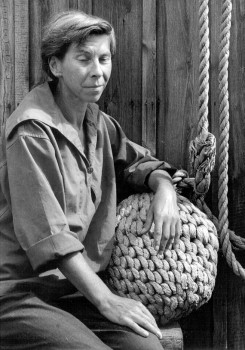
Tove Jansson (c. 1950)
If Tove Jansson’s Moomin books are, as we certainly believe here at Books from Finland, strangely little known in the wider world, the same is even truer of her books for adults.
Incredibly, the Moomins celebrate their 65th birthday in 2010, and have been translated into 40 languages. Jansson (1914–2001) wrote her last Moomin book – there are nine altogether – in 1970. Over the last thirty years of her life, she also wrote a total of 11 volumes – novels and short stories – for grown-ups. (Books from Finland published stories from many of them as they appeared. They will become available again as our digitisation project gets underway; meanwhile, here’s a story from Dockskåpet [‘The doll’s house’, 1978].)
Back out there in the wider world, the tiny, Hampstead-based press Sort Of Books has since 2001 been introducing Jansson’s lesser-known works to British readers. Latest to appear is her bleakly unsettling novel The True Deceiver (Den ärliga bedragaren, 1982), the story of a strange young woman, Katri, who breaks into an elderly artist’s house and attempts to befriend her, for reasons of her own. More…
Winning stories of alternative realities
10 February 2011 | In the news
 The Runeberg Prize for fiction, awarded this year for the twenty-fifth time, went to a collection of short stories by Tiina Raevaara.
Her En tunne sinua vierelläni (‘I don’t feel you beside me’, Teos, 2010) mixes fantasy and realism, dealing with, for example, animal kingdom, human mind and artificial intelligence. See the introduction and translation of a story which we ran here on the Books from Finland website.
Raevaara (born 1979) holds a doctorate in genetics; the prizewinner is her second work of fiction. The prize, worth €10,000, was awarded on 5 February – the birthday of the poet J.L Runeberg (1804–1877) – in the southern Finnish city of Porvoo.
The jury – representing the prize’s founders, the Uusimaa newspaper, the city of Porvoo, both the Finnish and Finland-Swedish writers’ associations and the Finnish Critics’ Association – chose the winner from a shortlist of eight books: a collection of poetry, Vagga liten vagabond (‘Swing, little wanderer’, Söderströms) by Eva-Stina Byggmästar, the novel Poikakirja (‘Boys’ Own Book’, Otava) by Olli Jalonen, the novel Kiimakangas (WSOY) by Pekka Manninen, two collections of essays, Kuka nauttii eniten (‘Who enjoys most’) by Tommi Melender and Halun ja epäluulon esseet (‘The essays of desire and suspicion’) by Antti Nylén (both publlished by Savukeidas), a collection of poetry, Texas, sakset (‘Texas, scissors’, Otava) by Harry Salmenniemi and another collection of short stories, Apatosauruksen maa (‘The land of the apatosaurus’, WSOY) by Miina Supinen.
Jean Sibelius kodissaan. Jean Sibelius, i sitt hem. Jean Sibelius at home
19 August 2011 | Mini reviews, Reviews
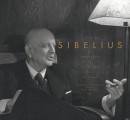 Jean Sibelius kodissaan. Jean Sibelius, i sitt hem. Jean Sibelius at home
Toimittanut [Edited by] Jussi Brofeldt
Helsinki: Teos, 2010. 103 p., ill.
ISBN 978-951-851-364-6
€ 29, hardback
The composer Jean Sibelius (1865–1957) disliked being photographed. This book contains 50 stills selected from the documentary film Jean Sibelius at home, a compilation of cinematographic material in which the composer is seen at home in 1927 and 1945. Some of the shots were originally cut, and have not been previously published. The film was made by the brothers Heikki Aho and Björn Soldan, who were neighbours of Sibelius in their childhood – their father was the author Juhani Aho, a friend of the Sibelius family. Founded in the 1920s, the film company Aho & Soldan was influenced by the experimental spirit of the Bauhaus and became known for its commissioned work aimed at spreading the image of Finland abroad. The Sibelius film offers a rare peek into the composer’s home life at his villa of Ainola. In addition to the photographs, the trilingual book also contains seven articles on Sibelius and the film. Heikki Aho’s daughter, the pioneer photographer Claire Aho relates her own memories of the 1945 filming. Jussi Brofeldt, the book’s editor, is her son.
Translated by David McDuff
Siri Kolu: Me Rosvolat [Me and the Robbersons]
27 January 2011 | Mini reviews, Reviews
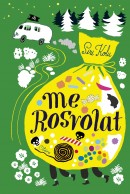 Me Rosvolat
[Me and the Robbersons]
Kuvitus [ill. by]: Tuuli Juusela
Helsinki: Otava, 2010. 222 p.
ISBN 978-951-1-24393-9
€13.80, hardback
Me Rosvolat by Siri Kolu (born 1972), winner of the Finlandia Junior prize, is a clever combination of the spirit of the Norwegian children’s classic When the robbers came to Cardamom Town by Thorbjørn Egner and the fashionable road movie genre. A ramshackle gang of robbers kidnaps ten-year-old Vilja, who is in the middle of a holiday with her family. The Robbersons like to pounce, Robin Hood-like, on petty bourgeois types who ‘think they’re just regular people, but who’ve got plenty of nice things, like a car, good eats and clothes.’ In a carnival style that appeals to children’s sense of justice – and is reminiscent of Astrid Lindgren’s Pippi Longstocking – Kolu describes the Robberson family’s innocent-seeming raids on kiosks selling old-fashioned treats and the pick ‘n’ mix sections of video rental shops. Vilja and the Robberson family’s summer-long jaunt is filled with humour, sticky situations and thoughts on family relationships.
Translated by Ruth Urbom
Liisa Kallio: Pikku Papu [Little Papu]
31 January 2011 | Mini reviews, Reviews
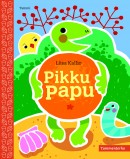 Pikku Papu
[Little Papu]
Kuvitus [Ill. by]: Liisa Kallio
Helsinki: Tammi, 2010. 31 p.
ISBN 978-951-31-5242-0
€10.30, hardback
In 2009, Finnish publisher Tammi launched its Tammenterho (‘Acorn’) series of picture books written by established Finnish authors to run along its Tammen Kultaiset kirjat (Tammi Golden Books series, modelled after a US imprint dating back to the 1940s). Pikku Papu is a jolly wandering tale for the smallest children. Papu the Tortoise notices that his shell, which he left on the beach while he went for a swim, has shrunk. In his search for a solution to his problem, he encounters a number of animals. Papu tries to cover himself with a glove he finds on the beach, but it proves to be too warm, and an eggshell he is given by a bird cracks. Fortunately, of course, everything works out in the end. This gentle story lets children identify colours and shapes and recognise various animals. The collage illustrations are attractive, and the text is simple, calmly told and appropriately short.
Translated by Ruth Urbom
Laura Lähteenmäki: Aleksandra Suuri [Alexandra the Great]
1 February 2011 | Mini reviews, Reviews
 Aleksandra Suuri
[Alexandra the Great]
Helsinki: Tammi, 2010. 180 p.
ISBN 978-951-0-36522-9
€18, hardback
Laura Lähteenmäki’s novel for young people is a rare, rollicking tale of independence whose treatment of even heavy topics is guaranteed to make readers laugh, sometimes through their tears. Tim, a Dutch exchange student, shakes things up in 16-year-old Alexandra’s family when he comes to stay. She is used to being the centre of attention in her family and circle of friends, but self-confident Tim brings Alexandra’s status into question. As in her previous novels for young people, Laura Lähteenmäki presents a briskly paced drama of interpersonal relationships. Events are filtered through Alexandra’s eyes as the first-person narrator. Readers can easily get behind her point of view: Tim is truly a jerk. The portrayal of complex family relationships following a traumatic divorce makes this book worthwhile reading for adults as well, even if Lähteenmäki does resort to somewhat clichéd solutions in her portrayal of minor adult characters.
Translated by Ruth Urbom
Markus Majaluoma: Hulda kulta, luetaan iltasatu! [Hulda dear, let’s read a bedtime story!]
27 January 2011 | Mini reviews, Reviews
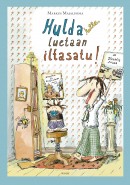 Hulda kulta, luetaan iltasatu!
[Hulda dear, let’s read a bedtime story!]
Helsinki: WSOY, 2010. 24 p., ill.
ISBN 978-951-0-36284-6
€ 23.20, hardback
Since 1996, illustrator Markus Majaluoma (born 1961) has written and illustrated 17 children’s books. His picture books have been translated into six languages. In this, the third book of its series, Jalmari reads a bedtime story chosen by his strong-willed baby daughter Hulda – one that they’ve read a hundred times before, children being famously conservative in this regard. In the story, a wasp stings a bear. Jalmari falls asleep, but as clever little Hulda knows how the story ends, there will be a surprise for the snoring dad. The stripped-down little narrative is fleshed out with plenty of details in Majaluoma’s highly original illustrations (the wasp playfully stings with its snout) often standing in humorous counterpoint to the text, an amusing bonus for the adult reading it as a bedtime story.
Translated by Ruth Urbom