

Search results for "Riikka/2010/10/mikko-rimminen-nenapaiva-nose-day"
When I’m ninety-four
14 November 2013 | Fiction, Prose
An extract from the novel Kuolema Ehtoolehdossa (‘Death in Twilight Grove’, Teos, 2013). Minna Lindgren interviewed by Anna-Leena Ekroos
At the Health Clinic, Siiri Kettunen once more found a new ‘personal physician’ waiting for her. The doctor was so young that Siiri had to ask whether a little girl like her could be a real doctor at all, but that was a mistake. By the time she remembered that there had been a series of articles in the paper about fake doctors, the girl doctor had already taken offence.
‘Shall we get down to business?’ the unknown personal physician said, after a brief lecture. She told Siiri to take off her blouse, then listened to her lungs with an ice-cold stethoscope that almost stopped her heart, and wrote a referral to Meilahti hospital for urgent tests. Apparently the stethoscope was the gizmo that gave the doctor the same kind of certainty that the blood pressure cuff had given the nurse.
‘I can order an ambulance,’ the doctor said, but that was a bit much, in Siiri’s opinion, so she thanked her politely for listening to her lungs and promised to catch the very next tram to the heart exam. More…
Things
31 March 1997 | Archives online, Fiction, Prose
A short sory from Kaunis nimi (‘A lovely name’, Otava, 1996). Raija Siekkinen’s limpid prose is at its best when she explores the complex feelings that lie behind the events of everyday life. Here objects are indicators of emotions, memory and loss, and what is most important is left unsaid
And where was the pen, the fountain pen, black, chubby; the one which pumped the ink straight up from the bottle?
There were three gold-coloured bands on the cap of the pen, and its nib, too, was golden, It had been given to her in a case lined with black velvet, and there was a groove for the pen, and a depression for the ink-bottle; and the bottle was narrow -necked, with curving sides, and the ink in it was not bright blue, but dark, so that words written in it looked old, written a long time ago; one forgot that one had written them oneself, one read them like the words of a stranger.
She remembered the pen, and began slowly to wake up. More…
Nine lives
30 September 1994 | Archives online, Fiction, Prose
Entire lives flash by in half a page in this selection of very short short stories. Extracts from Elämiä (‘Lives’, Otava, 1994)
Silja
Silja was born in 1900. The home farm had been sub-divided many times. Silja threw a piece of bread on the floor. ‘Don’t sling God’s corn,’ said grandmother. Silja got up to go to school at four. In the cart, her head nodded; when the horse was going downhill its shoes struck sparks in the darkness. Silja’s brother drove to another province to go courting. Silja sat in the side-car. ‘The birches were in full leaf there,’ she said at home. Silja went to Helsinki University to read Swedish. She saw the famous Adolf Lindfors playing a miser on the big stage at the National Theatre. Silja got a senior teaching post at the high school. With a colleague, she travelled in Gotland. Silja donated her television set to the museum. It was one of the first Philips models. ‘Has this been watched at all?’ they asked Silja. Silja learned to drive after she retired. She called her car ‘The Knight’. The teachers’ society made a theatre trip to Tampere. Silja looked up her colleague in the telephone directory in the interval. There was no one of that name. More…
Lest your shadow fade
31 March 1987 | Archives online, Fiction, Prose
An extract from the novel Jottei varjos haalistu (‘Lest your shadow fade’, 1987). Interview by Erkka Lehtola
‘… learn, then, to like yourself.
Dancing beside your shadow, laugh and play.
Dance always in the sunlight, lest your shadow fade.’J. Fr. Erlander, 1876 (Erika Kuovinoja’s grandfather)
‘Tis in life’s hardness that its splendour lies.’
J. Fr. E., 1890
Three days before the date fixed for the funeral, the minister directed his steps towards the home of the deceased, trying, as he walked, to compose his thoughts, which were full of righteous Lutheran anger. There were many good reasons for this. On the other hand, nothing that had happened in the past ought to make any difference, now that he was on his way to visit a house of mourning. A visit that called for the exercise of understanding, and even, if possible, kindness. It was a lot for anyone to expect, even of a clergyman. It was not by his own desire that he was paying this call: it was a matter of duty. And this time he was the protagonist. Petulantly, his shoes crunched the gravel. More…
A door to the other side
7 September 2012 | Extracts, Non-fiction
Building bird-houses is author Jyrki Vainonen’s hobby: he has crafted dozens of nesting boxes and hung them on trees for winged tenants. Roaming in the woods may be bring surprises, though: the bird-house man suddenly finds the world underfoot opening up or a moment… An extract from the collection of stories Linnunpöntön rakentaja (‘Builder of bird-houses’, Atena, 2012)
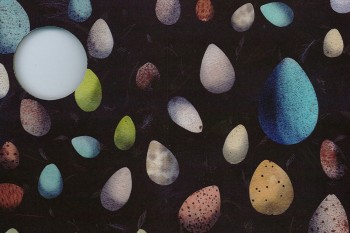
Birds coming up… Inside front cover of Linnunpöntön rakentaja by Elina Warsta/Solmu
The hinge was rusty, but after a cleaning and oiling it seemed to work, and didn’t even squeak. I had found it in a piece of board that was lying beside the road on the way to the dump. The board may have once served as part of a door frame.
The next day I rode my bike there again and unscrewed the hinge from the board, and now it looked quite handsome attached to the side wall of the birdhouse. I set the still floorless, roofless box upright and tried the door, opening the clasp and lifting the side wall on its hinges. It worked well, didn’t jam or make any sound. Next I attached the pieces of wood I’d already cut to form the roof and floor of the birdhouse. I inserted the floor and nailed through the three walls of the box – all except the wall that formed the door. Then I nailed the roof in place with several nails.
Now I had a box that would make it easy to watch the life inside. It would doubtless be wonderful to be able to see the nest from so close, and from the side rather than the top, as I usually had before. I could take photos, too. More…
The magic box: childhood revisited
25 December 2014 | Essays, Non-fiction
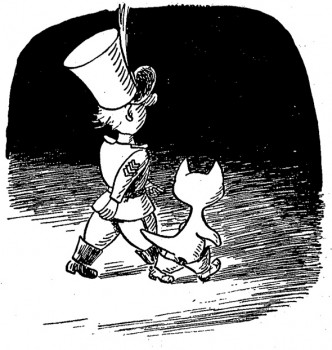
The tin soldier and the Blue Cat. Illustration: Usko Laukkanen
A tribute to Oiva Paloheimo’s children’s novel Tinaseppä ja seitsemän (‘The Tinsmith and the Seven’, illustrated by Usko Laukkanen, WSOY, 1956)
I’ve happened upon this (Christmassy) text of mine – first published in Books from Finland back in 1995 – when sorting through my papers as I begin to contemplate my retirement. With it I would like to offer my goodbyes, and many thanks, to you – to our readers, for whom I have been commissioning, editing and writing texts for the past thirty-one years – it’s time to do other things; time to read the books that still remain unread…
A dusky winter’s afternoon. Outside, soft and grey, a little snow is falling. I am sitting in our living-room, in an armchair covered in a pale yellow boucle fabric, my legs curled up, eating a carrot. In my lap is a book which I have fetched from the library after school. Conversation, the faint clattering of crockery, a singing kettle, the smell of food: grandmother and mother are cooking supper in the kitchen. My little sister is asleep.
But these sounds and the room around me do not really exist: there is only the world of make-believe in which Tiina sets off on her adventures with the Blue Cat, the Tinsmith, the St Bernard dog, the star and the spider: that world is a magic box which is able to contain all of childhood. More…
What does the neighbour think?
26 April 2013 | Essays, Non-fiction
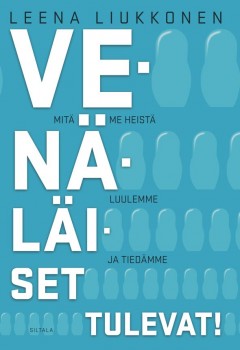 For more than 20 years journalist Leena Liukkonen has been thoroughly involved with Russian culture, commerce, language and psyche. The subtitle of her new book of essays Venäläiset tulevat! (‘The Russians are coming!’) is ‘What we think and know about them’, and refers to the fact that the Finns do not really know their eastern neighbours very well. Liukkonen writes with insight about the differences in history, mentality and world view
Extracts (under original subtitles) from Venäläiset tulevat! Mitä me heistä luulemme ja tiedämme (Siltala, 2013)
WAR, REMEMBERING AND FORGETTING
In café conversations with other visitors to Russia, we often react with exasperation to the fact that discussions in Finland only ever start with the Winter War. Sometimes we wonder why the threshold between us and our neighbour to the east is still so high. My own living contact with the past, however, makes it clear to me that everything the elderly carry round with them could not have been simply shaken off with the passage of time. Nor can the next generation just break away from it. My own experience also reminds me how distant our eastern neighbour was during peacetime. After all, a very few have made the long journey to the country next door. To many people, the old story was the only story there was about Russia. More…
The fox and the bear
30 December 2008 | Children's books, Fiction
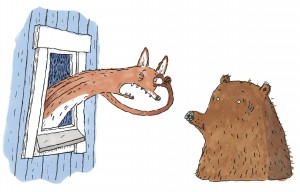
A story from the children’s book Sorsa norsun räätälinä (‘The mallard as tailor to the elephant’, Otava, 2008; illustrated by Christel Rönns. Introduction by Päivi Heikkilä-Halttunen
Back in the days when mallard still had horns, earthworms, claws, and the bear had a long tail, a bear was trudging dejectedly along the road.
Up drove a fox in his van, studded tires crunching, for it was winter and freezing cold. The fox was coming from fishing and his van was bursting with fresh fish. When he saw the bear, the fox stopped, rolled down the window and called, ‘Why hi there, old honey snout! Where’re you coming from?’
‘I was playing cards at Badger’s. I lost all my money and now I’m starving,’ the bear replied.
‘Jump in. No need to suffer in the grip of this cold,’ the fox said. The fox and the bear were good friends. However, the fox envied the bear, because Mr Honeypaws had a much longer, more handsome tail than the fox did. The bear clambered into the fox’s car and saw the enormous catch of fish.
‘Wherever did you get such an incredible amount of fish?’ the bear marvelled.
‘The lake. That’s where you get fish,’ the fox replied. ‘Last week I caught such a big pike that I made snow shovels out of its scales.’ More…
Last flamenco in Seville
5 November 2010 | Fiction, poetry
The tragic story of a gypsy woman, famously transformed into an opera by Georges Bizet, inspired Saila Susiluoto to write about freedom in the contemporary world: her new collection of poems, entitled Carmen, is set in the shopping centre of an asphalt city. But is this classic femme fatale really a human being – or a cyborg, perhaps? Introduction by Teppo Kulmala
She was made of plastic strips, metal bits, artificial skin, implants, circuit boards. Her heart pumped blood like a real one, her eyes watered as necessary. She was made free and loving, and almost soulful. But the soul is a quirk, said the Creator, a human mistake causing pain and death. And confusion. And the degradation of this world. They left out what they couldn’t say, what they were unable to say. They said: your name is Carmen, go forth, find your balance on threads across the world, you are a meek machine, built to love everything except just one man. You are glowing wires, bright shiny strips of plastic, a mind made of images and tones, your step is light, go, go.
The mall’s scintillating youth choir
(gesticulating in the manner of a musical)
Mother-loves
31 March 1994 | Archives online, Fiction, Prose
Extracts from the novel Ihon aika (‘The time of the skin’, WSOY, 1993). Introduction by Suvi Ahola
In the hospital they stare at us, enquiringly, as if we are abandoning her. They look in turn at our mother’s half-conscious, ulcerous body, at the nurse who, curling her lip, cuts mother’s knickers, housecoat and apron off her, at us, the exhausted ones, who are now only at the beginning of our real work. They fill in their forms and ask their official questions; they do not know how anguished and relieved we shall be in a moment when we may leave our mother to them, that ironically smiling, wounded woman who is still, with her last strength, attempting to kick the nurse who is pouring warm water on her bloody feet.
I gaze at mother’s battered body with something like greed; I feel the same kind of curiosity toward this shocking sight as when I was four and we were in the bathroom together. I was shy, I tried to spy on mother’s fleshy body, her luxuriantly curving skin, through the mirror, but I was always left with the feeling that I had seen too little, I had been able to understand only a small part of what my eyes had registered. More…
The Blinking Doll
30 June 1988 | Archives online, Fiction, Prose
A short story from Metsästys joulun alla (‘The hunt before Christmas’, 1982). Introduction by Erkka Lehtola
There was a strong bond between Juutinen and Multikka: both their lives, from their beginnings, had been fragmented and scattered, lacking any solid, reliable points of support. Even their marriages had come and gone; they had left no residue worth remembering. As in the old parable, their lives resembled the trail a skier leaves in fresh snow in a blizzard: behind him, it disappears in a few moments without a trace, and ahead and on either side there is only pristine density and no one or nothing one might follow. More…
Paris match
30 June 2011 | Articles, Non-fiction
In 1889 the author and journalist Juhani Aho (1861–1921) went to Paris on a Finnish government writing bursary. In the cafés and in his apartment near Montmartre he began a novella, Yksin (‘Alone’), the showpiece for his study year. Jyrki Nummi introduces this classic text and takes a look at the international career of a writer from the far north
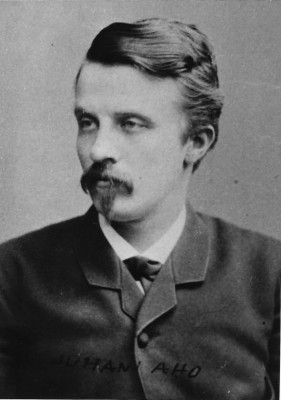
Juhani Aho. Photo: SKS/Literary archives
Yksin is the tale of a fashionable, no-longer-young ‘decadent’, alienated from his bourgeois circle, and with his aesthetic stances and social duties in crisis. He flees from his disappointments and heartbreaks to Paris, the foremost metropolis at the end of the 19th century, where solitude could be experienced in the modern manner – among crowds of people. Yksin is the first portrayal of modern city life in the newly emerging Finnish prose, unique in its time.
Aho’s story has parallels in the contemporary European literature: Karl-Joris Huysmans’s A Rebours (1884), Knut Hamsun’s Hunger (1890) and Oscar Wilde’s The Portrait of Dorian Gray (1890). More…
In the land of the living
31 December 1996 | Archives online, Fiction, poetry
Poems by Arto Melleri. Introduction by Maris Gothóni
The airship Italia
Farewell, darlings,
General Nobile's sailing in his airship
to a glittering death...
whoever knows the journey's end
as he sets out is there already,
wafted on his wing-stubs;
farewell, doubters smiles on your lips
                                          like the imprints of horse-bits:
'he'll never get there this way'
'get there' – as if 'there' were
some place;
in one day you can only manage a day's journey,
it's more realistic, far more, to get the measure
                                          of Perdition;
farewell, darlings,
I'm off with him, his scrivener, I'm stretching
over the verge of tears towards boundless laughter,
the dignified business of tarring and feathering,
I'm making notes: this is a dream, a single night's
                                         eternity,
a sound mind's storming of the Bastille;
farewell, you who always know better
                                   what should be done than the doers, and how,
you don't do, you know, you put your hat on a shelf
called History,
General Nobile's flying over the craters of history
northwards, northwards, and the sun's
                                   scoopful of molten tin
is about to splash in the cold ocean,
and the moon's a ball of camphor-soaked cotton wool
wiping the smoking sky,
farewell, darlings, there, flashing ahead,
are the crystal shores of Ultima Thule
From Ilmalaiva Italia (‘Airship Italia’, 1980) More…
The matchstick
31 March 1998 | Archives online, Children's books, Fiction
A fairy-tale, first published in the literary yearbook Svea (Stockholm) in 1879. Introduction by Esa Sironen
The matchstick lay for the first time in its new box on the factory table and thought about what had happened to it so far during its short life. It could still dimly remember how the big aspen tree had grown on the river bank, how it had been felled, sawed, and finally planed into many thousand small splinters of which the match was one. After that, it had been sorted into piles and rows with its friends, dipped in horrible melting pans, put out to dry, dipped again and finally placed in the box. This was not really a remarkable fate, nor a great heroic deed. But the match had acquired a burning desire to do something in the world. Its body was made from the timorous aspen, which is constantly a-quiver because it is afraid that the faint evening breeze might grow into a gale and tear it up by the roots. It so happened, however, that the match’s head had been dipped in stuff that makes one ambitious and want to shine in the world, and so a struggle developed, as it were, between body and head. When the inflammable head, fizzing in silence, cried: ‘Rush out now and do something!’ the cautious body always had an objection ready, and whispered: ‘No, wait a little, ask and find out if it’s time yet!’ More…
Jacob’s Dream
30 September 1986 | Archives online, Fiction, Prose
An extract from Hänen olivat linnut (‘Hers were the birds’, 1967). Introduction by Pirkko Alhoniemi
‘It was Jacob’s Dream, Alma.’
How could she put it so Alma wouldn’t get hurt. Alma had ruined the surface of the painting. The pastor’s widow stood nervously in front of the window and tried to say what she’d had on her mind for several days but couldn’t quite come out with. When Alma went out of the house, the pastor’s widow would wander through the rooms and check on things. And the painting wasn’t the only object in danger, but also the birds. Their feathers were ruffled because Alma kept wiping them with a wet rag. How could she put it.
‘Alma.’
Alma turned to look at her.
‘It’s called Jacob’s Dream.’ More…