

Search results for "Riikka/2010/10/mikko-rimminen-nenapaiva-nose-day"
Compelled to write
30 June 2000 | Authors, Interviews

Photo: Marica Rosengård
Kjell Westö (born 1961) is one of a generation of younger, urban Swedish-language writers who are at home in both Swedish and Finnish. An extract from his novel Vådan av att vara Skrake (‘The perils of being Skrake’, Söderströms, 2000), which traces the fortunes of the Helsinki family of Skrake from the 1910s to the present day. Here, Westö is interviewed by his alter ego, the discontented poet Anders Hed, editor of the cultural journal Bokassa (now sadly extinct)
Anders Hed: So, to get us going: do you write any poetry at all nowadays?
Kjell Westö: No. The last poem I wrote comes at the end of the title story in Fallet Bruus (‘The Bruus case’). And that book came out in 1992.
It’s a poem about human face and the search for ‘the Thou’, isn’t it?
Exactly. More…
Weird calm
31 March 1998 | Archives online, Fiction, poetry
A selection of poems, translated by Herbert Lomas and Anselm Hollo. Interview by Tarja Roinila
Agnosis IV
Set your altar up in the evening,
 in the morning clear it away:
 the wandering goes on. Don't persuade yourself
             of anything, or anyone else:
 fearful forces are epidemic,
 no place is sacred
 for long.
                                 Again and again
                                 the sacred
 starts.
                                                If you happen to be
 there don't refuse to see.
(1989)

a light wind
            stirring a treetop:
 a shoal of fish
            in blue abyss
From Hiidentyven (‘Weird calm’, Otava, 1984) More…
Mother-days
30 June 2006 | Fiction, poetry
Poems from Yhtä juhlaa (‘It’s all a big celebration’, WSOY, 2006)
(a square metre, 3.)
Now for the-kick-of-being-the-good-mum:
after the rye porridge
after the sons washed with camomile foam
and slipped into clean sheets
with mummy singing a sweet song.
Something about shadowed snow
and how at the blue twilit-moment one can
go inwards. If you’re up to looking. All that garbage and slag:
ash from the too-small days, clotted with
non-combustible blots, even though here
the sky’s clear
and the windows open to the winds.
Good grief, here we’re making new people.
But all I’d time for
was the track from the dishcloth to the nappy bin,
and back from the children’s painting-table
to the sink. No job
for spoilt girls, this: the prissiest minx
would soon turn woman in this fix:
kids coming next after next,
years of full-time labour
in a square metre where
you make no point about peccadilloes,
because so much is at stake.
You’re no longer a rose,
pimpinella, rosabella,
but subsoil: loam
and spots of unrottable compost.
A feebler person would have reversed on
the first tantrum;
the child’s learnt to say things
and is saying things
I never thought would come. More…
Thunder in the east
31 December 1991 | Archives online, Fiction, Prose
Extract from the novel Colorado Avenue (Söderström & Co, 1991). Introduction by Pia Ingström
Come. We are going to look at schoolmaster Johansson’s photographs.
It is true that Johansson himself died of TB back in 1922, and the collection of glass negatives he left behind – several dozen boxfuls – was destroyed in a peculiar manner. This, however, constitutes no hindrance to us. Where reality falls short, fantasy must intervene. By expanding realistic style beyond the scope of the possible we create a new reality.
To seek to grasp at Time and hold her fast is a dangerous and hopeless undertaking; Time wreaks a terrible revenge on those who seek to rise up against it. Thus, too, was schoolmaster Johansson’s dream of eternity with the help of silver nitrate and glass frustrated. In the spring of 1926 schoolmaster Johansson’s household effects were finally sold by auction. A certain Eskil Holm from Blaxnäs snapped up the glass negatives for a small sum. More…
Still alive
31 March 2000 | Fiction, Prose
Extracts from the novel Maa ilman vettä (‘A world without water’, Tammi, 1999)
The window opened on to a sunny street. Nevertheless, there was a pungent, sickbed smell in the room. There were blue roses on a white background on the wallpaper and, on the long wall, three landscape watercolours of identical size: a sea-shore with cliffs, a mountain stream, mountaintops. The room was equipped with white furniture and a massive wooden table. The television had been lifted on to a stool so that it could be seen from the bed.
The bed had been shifted to the centre of the room with its head against the rose-wall, as in a hospital. Between white sheets, supported by a large pillow, Sofia Elena lay awake in a half-sitting position. More…
The life of a lonely friend
30 September 1986 | Archives online, Fiction, Prose
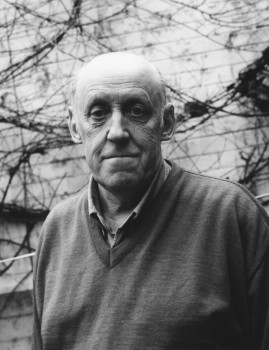
Bo Carpelan. Photo: Charlotta Boucht
Extracts from Bo Carpelan‘s novel Axel, ‘a fictional memoir’ (1986). In his preface to the novel Bo explains how he ‘found’ Axel.
Preface
In the 1930s I came across the name of Axel Carpelan (1858-1919), my paternal grandfather’s brother, in Karl Ekman’s Jean Sibelius and His Work (1935). In the bibliography, the author briefly mentions quotes from letters in the book addressed to Axel Carpelan, ‘who belonged to the Master’s most intimate circle of friends, and in musical matters was his constant confidant. Sibelius commemorated their friendship by dedicating his second symphony to him’. I had never heard Axel’s name mentioned in my own family.
Many years after Karl Ekman, the original incentive for the novel about Axel arose through Erik Tawaststjerna’s biography of Sibelius, in which Axel is portrayed in the second volume (1967) of the Finnish edition, and whose life came to an end in Part IV (1978). From early 1970s onwards, I started notes for Axel’s fictional diary from to 1919. It is not known whether Axel himself ever kept a diary. I relied as muchas possible on all the available facts. These increased when I was given access to letters exchanged between Axel and Janne from the year 1900 onwards. It became the story of the hidden strength a very lonely and sick man, and of a friendship in which the give and take both sides was far greater than Axel himself could ever have imagined.
Hagalund, June 1st, 1985
Bo Carpelan

1878, Axel’s diary
15.1.
On my twentieth birthday, I remember the young Wolfgang; ‘Little Wolfgang has no time to write because he has nothing to do. He wanders up and down the room like a dog troubled by flies’. However, that dog achieved a paradise. I have learnt yet one more piece of wisdom: ‘It is my habit to treat people as I find them; that is the most rewarding in the long run’. More…
The Paradox Archive
30 September 1991 | Archives online, Fiction, Prose
Extracts from the novel Umbra (WSOY, 1990). Introduction by Soila Lehtonen
The Paradox Archive
Umbra was a man of order. His profession alone made him that, for sickness was a disorder, and death chaos.
But life demands disorder, since it calls for energy, for warmth – which is disorder. Abnormal effort did perhaps enhance order within a small and carefully defined area, but it squandered considerable energy, and ultimately the disorder in the environment was only intensified.
Umbra saw that apparent order concealed latent chaos and collapse, but he knew too that apparent chaos contained its own order. More…
Meetingplace the year
30 June 1978 | Archives online, Fiction, poetry
Poems from Kohtaamispaikka vuosi (‘Meetingplace the year’, 1977). Introduction by Mirjam Polkunen
1.
I look in from the gateway
                         there are children, there in the yard playing.
They look small from here, remote.
                                              From the years
I have walked past this gateway,
there they are: five, six.
                                              The same number.
They have a ball in the air, they yell at it.
Silly that I still here too
                                              remember you,
I could be the same age now.
More…
The height of the night
15 October 2009 | Letter from the Editors
 The autumnal equinox is past; and as we tilt towards the winter solstice, here in these northerly latitudes, the darkness expands palpably from day to day, giving more space for introspection – high on the list of Finnish national pastimes – and for reading.
We want to make our website primarily a place for reading – not, in other words, for clicking, going on to the next thing. To think to the end what cannot be thought to the end elsewhere, as the Russian poet Osip Mandelstam said of his experience of staying in what was, at the turn of the 20th century, still Finnish Karelia. So you will not find our texts littered with links; for the most part, links appear at the end of a piece, not in it. More…
Once upon a time
27 February 2014 | Children's books, Fiction
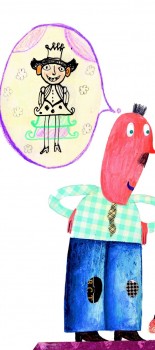 Stories from Kirahviäiti ja muita hölmöjä aikuisia (‘The giraffe mummy and other silly adults’, Teos, 2013), illustrated by Martina Matlovičová. Interview of Alexandra Salmela by Anna-Leena Ekroos
The monkey princess
Adalmiina’s life was not an easy one. Her parents decided to prepare her for her career as a princess when she was a little girl: when Adalmiina was three she was sent to ballet school, at four she started taking lute lessons and at five she went on a course in magic-mirror gazing.
When Adalmiina turned six, she received a giant suitcase full of princess clothes and shoes.
‘Put them on, darling, we want to see you in all your lovely beauty!’ her mother sparkled, waving a muslin veil.
‘I want to go to the jungle!’ Adalmiina demanded. ‘Without any clothes!’
‘Will we have to force you to dress in all your glory?’ her parents snapped.
‘You’ll have to catch me first!’ Adalmiina announced, running into the garden. More…
An end and a beginning
31 March 1982 | Archives online, Fiction, Prose
An extract from Det har aldrig hänt (‘It never happened’, 1977). Translated and introduced by W. Glyn Jones
There they are!
Over the ice they ride. The hoofs in rhythmical movement kick up the snow. The trail points north west. The sound of the hoofs is absorbed in the blue twilight of a March evening. The two horsemen push on, close together, passing one tiny island after another. Their eyes are fixed on a trail which has lain before them throughout the day. They are hunting like wolves. Yes, like wolves they are.
Or are they?
The twilight gives way to darkness and the black of night. The riders lean low over their horses in an attempt to follow the trail, but at last one of them raises his hand. The hunt is called off. The horses snort and toss their heads so their manes dance. Clouds of steam rise from them, enveloping the men as they dismount and lead their horses to an islet where the dark and deserted profile of a fisherman’s cabin can be glimpsed. Heaven knows who the hut belongs to, but it is a good thing that it is there with its walls and a roof, a shelter against the night. More…
Adam, Eve and vegetarianism
30 September 2006 | Archives online, Fiction, Prose
Short prose from En god Havanna. Besläktad (‘A good Havana. Kith and kin’, Söderströms, 2006). Introduction by Bror Rönnholm
Ode
My alter ego has relatives who have bad teeth and the names of Greek gods. They live in ramshackle houses in suburbs which the taxi drivers can’t find, dangerous ex-no man’s lands in a rapid metastasis into concrete. They are wild and threatened with extinction, they are Finland-Swedish working class. Disorganised, of course they’re disorganised, my alter ego’s relatives never organise themselves. They don’t form part of any community other than their own. They go to sea and they breed, they buy shuteye dolls in whore ports and return home in grand style, always at night, always one surprising night when no one is expecting them. The women raise a cry of joy, the children go leaping barefoot, and the dog, which is called Zeus-Håkan, is quite beside himself. There’s a party. There’s no school that day. At twilight the women travel to their jobs in key factories and warehouses. When they come home the party continues and in the outside toilet there are new pictures of new places. My alter ego’s relatives have dyed hair and prominent busts in tight-fitting silver nylon jumpers. They pay for my alter ego’s father’s education so he can become middle class. They are proud of him. When we go to visit them they dress up. They clap their hands and the nail varnish peels as they loudly, just a shade too loudly, shout OH, oh splendid, such fine guests! My alter ego’s father is grateful and confused. He has long ago paid it back, paid the money back, and now what’s left is only what cannot be repaid.
With the passage of the years my alter ego’s working-class relatives are disappearing from my alter ego’s life. I miss them. More…
Disintegration
31 December 1992 | Archives online, Fiction, Prose
From Pythonin yö (‘Night of the python’, Gummerus, 1992). Introduction by Kaija Valkonen
I feel as if the disintegration has already started. I do not want it, I am not yet ready. And I do not want to discuss it with the doctors; I know that they would not understand, and the thing I am talking about has nothing to do with my state of health. It is not an illness; it is something more insidious. It occurs under the cover of health. It is a deception.
It is hard to say when it started, but whenever I try to remember, a certain day comes into my mind. It can hardly be the beginning, how could disintegration start with joy? But it was a day that contained many elements of dissolution: a strong wind, the ice breaking, quickly moving clouds. At one point I picked up an old tub in the corner of the shed, its hoops fell off and it collapsed, ringing. More…
Why translate?
28 January 2015 | Essays, Non-fiction
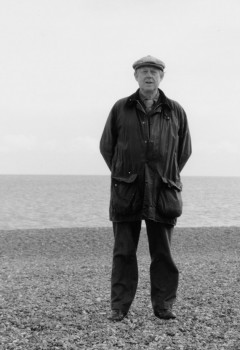
Down by the sea: Herbert Lomas in Aldeburgh. – Photo: Soila Lehtonen
‘People do not read translations to encourage minor literatures but to rediscover themselves in new imaginative adventures‚’ says the poet and translator Herbert Lomas in this essay on translation (first published in Books from Finland 1/1982). ‘Translation is a thankless activity,’ he concludes – and yet ‘you have the pleasure of writing without the agony of primary invention. It’s like reading, only more so. It’s like writing, only less so.’ And how do Finnish and English differ from each other, actually?
Any writer’s likely to feel – unless he’s a star, a celebrity, a very popular and different beast – that the writer is a necessary evil in the publisher’s world, but not very necessary. How much more, then, the translator from a ‘small’ country’s language.
Why do it? The pay’s absurd, you need the time for your own writing, it’s very hard to please people, and translation is, after all, the complacent argument goes, impossible. I’m convinced by all these arguments, and really I can’t afford to go on; but I don’t regret what I’ve done and, looking back, I can find two reasons for translating Finnish writing, one personal, the other cultural. More…
Emotional transgressions
31 December 1985 | Archives online, Fiction, Prose
Three extracts from the novel Harjunpää ja rakkauden lait (‘Harjunpaa and the laws of love’). Introduction by Risto Hannula
It was a few minutes to two, and Harjunpää was still awake, lying so close to Elisa that he could feel her warmth. He kept his eyes open, staring into the night through the crack between curtains. Once again the boiler of the central heating plant started up, and the smoke began to rise like a stiff column in the cold. Another fifteen minutes had passed, and morning was a quarter of an hour closer. He squeezed his eyes shut and tried to concentrate on Elisa’s breathing and the sleepy snuffling of the girls, but his thoughts still wouldn’t leave him in peace. Inexplicably, he felt there was something wrong, that the darkness exuded some kind of threat, that he’d left something undone or had made some kind of mistake.
He swung his feet onto the floor and got up as quietly as he could. But all his care was wasted, he should have known that.
‘What’s the matter?’ Elisa asked sleepily.
‘I just can’t get to sleep.’
‘Again … ‘
‘I can’t help it. I wonder if there’s a bottle of brew left.’
‘Sure. But listen …’
Pipsa turned over in her crib, rattling the sides, groped around a bit and began to suck her pacifier so you could hear the quiet sucking noises.
‘Yeah?’
‘Maybe you could see a doctor. You could ask for some mild … ‘ More…