

Search results for "harjunpää/2010/10/mikko-rimminen-nenapaiva-nose-day/2011/04/matti-suurpaa-parnasso-1951–2011-parnasso-1951–2011/2009/09/what-god-said"
Star-Eye
31 March 1984 | Archives online, Children's books, Fiction
A story from Läsning för barn (‘Reading for children’,1884). Introduction by George C. Schoolfield
There was once a little child lying in a snowdrift. Why? Because it had been lost.
It was Christmas Eve. The old Lapp was driving his sledge through the desolate mountains, and the old Lapp woman was following him. The snow sparkled, the Northern Lights were dancing, and the stars were shining brightly in the sky. The old Lapp thought this was a splendid journey and turned round to look for his wife who was alone in her little Lapp sledge, for the reindeer could not pull more than one person at a time. The woman was holding her little child in her arms. It was wrapped in a thick, soft reindeer skin, but it was difficult for the woman to drive a sledge properly with a child in her arms.
When they had reached the top of the mountain and were just starting off downhill, they came across a pack of wolves. It was a big pack, about forty or fifty of them, such as you often see in winter in Lapland when they are on the look-out for a reindeer. Now these wolves had not managed to catch any reindeer; they were howling with hunger and straight away began to pursue the old Lapp and his wife. More…
The miracle of the rose
30 June 1997 | Archives online, Fiction, Prose
Extracts from the novel Naurava neitsyt (‘The laughing virgin’, WSOY, 1996). The narrator in this first novel by Irja Rane is an elderly headmaster and clergyman in 1930s Germany. In his letters to his son, Mr Klein contemplates the present state of the world, hardly recovered from the previous war, his own incapacity for true intimacy – and tells his son the story of the laughing virgin, a legend he saw come alive. Naurava neitsyt won the Finlandia Prize for Fiction in 1996
28 August
My dear boy,
I received your letter yesterday at dinner. Let me just say that I was delighted to see it! For as I went to table I was not in the conciliatory frame of mind that is suitable in sitting down to enjoy the gifts of God. I was still fretting when Mademoiselle put her head through the serving hatch and said:
‘There is a letter for you, sir.’
‘Have I not said that I must not be disturbed,’ I growled. I was surprised myself at the abruptness of my voice.
‘By your leave, it is from Berlin,’ said Mademoiselle. ‘Perhaps it is from the young gentleman.’
‘Bring it here,’ I said. More…
Relative values
31 March 2004 | Archives online, Fiction, Prose
Extracts from the autobiographical novel Nurinkurin (‘Upside down, inside out’, WSOY, 2003). Interview by Anna-Leena Nissilä
The soldier rides on a scarf
waving a donkey
‘Now it’s your turn to go on,’ says my brother on the back seat, turning his head toward the window so that he can concentrate on his poetic muse.
Father looks in the mirror, wrinkling his face in pain. ‘The object, in other words, is of no significance to you. What happened to your case endings and your grammar?’
From the back seat we shout eagerly: ‘The poet has special privileges which are not accorded to others.’
Father shakes his head: ‘You can be creative, but silly content and broken language do not make poetry.’
‘Oh yes they do. Don’t disturb our creative spirit. When you speak, our connection with her is broken. Don’t cut off the source of our inspiration.’ More…
On Matti Rossi
31 March 1978 | Archives online, Authors
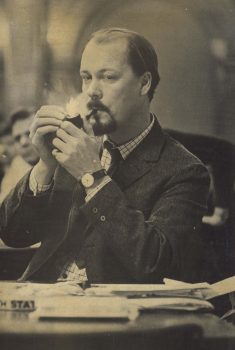
Matti Rossi. Photo: SKS archives
The appearance in 1965 of Matti Rossi’s (born 1934) first work in Finnish, Näytelmän henkilöt (‘Dramatis personae’, Tammi), brought him immediate recognition as an important writer. It confirmed him as a skillful translator – he had already ten important translations to his name – and revealed a new but already mature poet. Näytelmän henkilöt contains biting political parody, highly original myth verse and the Finnish version of a series of poems on Vietnamese themes, which he had first published in English.
Rossi has always worked in many styles and genres. Leikkeja kahdelle (‘Games for two’, Tammi, 1966) is a magnificent collection of sensual love poems; his fantasy poem for the stage, Tilaisuus (‘The occasion’, Tammi, 1967), examines the nature and causes of violence; the events in Czechoslovakia are the subject of his analytical political satire Käännekohta (‘Turning-point’), written as a play for television in 1969. These were followed by a long period in which Rossi’s poetry reflects his political commitment to the far left. He brought out a book about his experiences during a visit of more than a year to South America, and his scathing poetry has always played its part in political controversy. He has composed songs for the stage, and an outstanding ballad narrative, Puulintujen vuolija (The carver of wooden birds’, 1975). More…
Ville Hytönen & Matti Pikkujämsä: Hipinäaasi, apinahiisi [Donkeymonkey]
9 January 2014 | Mini reviews, Reviews
 Hipinäaasi, apinahiisi
[Donkeymonkey]
Kuvitus [Ill. by]: Matti Pikkujämsä
Helsinki: Tammi, 2013. 32 pp., ill.
ISBN 978-951-31-7043-1
€24.90, hardback
In Ville Hytönen’s gently educational tale, some woodland creatures poke fun at a wheezy donkey and an oddball monkey. In the end, the animals who were the target of derision turn their unusual characteristics into strengths. Then they all make up, all the residents of the forest launch into an exuberant dance, and the earlier teasing is forgotten. Matti Pikkujämsä has been an extraordinarily productive in recent years: his illustrations have appeared in numerous newspapers and magazines as well as children’s books. Hipinäaasi, apinahiisi, which is his first solo picture book, features rhythm and movement; sometimes he creates extremely elaborate ornamentation, while other images calm the eye with spare yet colourful scraffito techniques.
Translated by Ruth Urbom
Matti Klinge: Pääkaupunki – Helsinki ja Suomen valtio 1808–1863 [Capital City – Helsinki and the Finnish government 1808–1863]
27 June 2012 | Mini reviews, Reviews
 Pääkaupunki – Helsinki ja Suomen valtio 1808–1863
[Capital city — Helsinki and the Finnish government 1808–1863]
Kuvitussuunnitelma [Pictorial design by] Matti Klinge and Yrjö Klinge
Helsinki: Otava, 2012. 509p., ill.
ISBN 978-951-1-26235-0
€ 53, hardback
As a result of the war between Sweden and Russia in 1808–1809, Finland became an autonomous Grand Duchy of the Russian Empire. In 1812 Helsinki was made Finland’s new capital, being more suitable than Turku, the administrative city of the time, as it boasted features such as the coastal fortress of Sveaborg (Suomenlinna), which was important to Russia. In his new book, Emeritus Professor Matti Klinge gives an account of the development of Helsinki as a capital city. Between 1808 and 1843 the Grand Duchy established its central administrative office, its civil service and the University in Helsinki. Tsars Alexander I and Nicholas I wanted Finland to have a monumental capital; Klinge describes the implementation of the carefully detailed city plan and the key buildings. He portrays the work of the individuals who contributed to Helsinki’s development as well as the city’s political, social and cultural life – Helsinki’s history is essentially the history of Finland. Also published in Swedish, this extensive work, which owes its origin to the Historical Commission of the City of Helsinki, is illustrated in a rich and informative manner.
Translated by David McDuff
The funeral
31 December 1988 | Archives online, Fiction, Prose
Hannu Salama’s short story Hautajaiset (‘The funeral’) – taking place in Pispala, Tampere – in the volume Kesäleski, ‘Summer widow’, was published in 1969. Introduction by Pekka Tarkka
On Tuesday Venla came round: as Sulo was being lowered into the grave Vihtori had had a heart attack. The next day a letter arrived from father: funeral on Sunday, and Gunilla and Timo want you to speak at the grave. I telegraphed back: ‘Vikki too close to me. Unable to speak.’ Outside the post office I realised I could have sent fifty words for the same money.
Irma ordered a flower arrangement. Did I want to put an inscription? Part of the last stanza of a revolutionary song went through my head:
Sowing makes the corn come into ear:
Hundredfold higher that happier age will be.
I said not to put anything, I’d say something at the grave if it seemed the thing to do. I told her to put mother’s, father’s and Heikki’s names on, and we’d take these off if they’d sent their own wreath. More…
Kristiina Kalleinen: Kansallisen tieteen ja taiteen puolesta. Kalevalaseura 1911–2011 [On behalf of national science and art. The Kalevala Society 1911–2011]
10 June 2011 | Mini reviews, Reviews
 Kansallisen tieteen ja taiteen puolesta. Kalevalaseura 1911–2011
[On behalf of national science and art. The Kalevala Society 1911–2011]
Helsinki: Finnish Literature Society, 2011. 314 p., ill.
ISBN 978-952-223-256-5
€ 37, hardback
In 1911, the Finnish national epic Kalevala (1835, 1849), compiled by Elias Lönnrot and based on Finnish folk poetry, inspired the artist Akseli Gallen-Kallela, the sculptor Alpo Sailo, Professor E.N. Setälä and the folklorist Väinö Salminen to found the Kalevala Society (established in 1919), aimed at uniting Finland’s national science and art into a harmonious whole. As Russia tightened its grip on the Grand Duchy during the latter part of the nineteenth century, it awakened a desire to demonstrate the vitality of the Finnish language and national spirit. This book maps out the effect of the changing social and political situation on the Society’s activities. In the 1920s and 1930s the Kalevala Society remained largely outside the political and linguistic conflicts of the time. This was a period of extreme Finnish nationalism, but in the Society there was little inclination towards ‘Greater Finland’ thinking or anti-Russian or anti-Swedish sentiment. During Finland’s wars with the Soviet Union some members nonetheless had hopes of a Greater Finland, as many of the regions where the Kalevala poems originated lay on the Soviet side of the border. In recent years the Society has participated with other organisations in projects devoted to the regeneration of Russian Karelian villages and the protection of the last traditional Finnish landscapes.
Translated by David McDuff
Cruising
30 September 1993 | Archives online, Fiction, Prose
An extract from the novel Vieras (‘The stranger’, Otava 1992). Introduction by Pekka Tarkka
I lay there for a moment, motionless, eyes closed.
The bunk was damp. It felt damp around my thighs; I slid down lower – and there, it was really wet.
My sleeping bag was obviously soaked, and that meant that the mattress was soaked, too. Oh, rats. I couldn’t imagine having wet myself. Or – worse – had the boat sprung a leak, the water already rising up to the floorboards? I bounded to my feet: the rugs were dry. So was the cabin floor. I raised the boards, peered down: two fingers of water in the forward bilge, as usual. So, where the –? In the course of yesterday’s rough sailing, some water had seeped in below the windowframe. No more than a cupful, but it had trickled down inside the panel and then onto the mattress. I tried the other side of the bunk. It was dry. Well, I would just have to pick up the mattress and set it on its side. More…
Matti Yrjänä Joensuu: Harjunpää ja rautahuone [Harjunpää and the iron room]
19 November 2010 | Mini reviews, Reviews
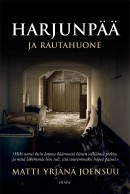 Harjunpää ja rautahuone
[Harjunpää and the iron room]
Helsinki: Otava, 2010. 302 p.
ISBN 978-951-1-24742-5
€ 26, hardback
This book’s shocking opening scene, a cot death, is not followed by anything that lightens the tone. Finland’s best-selling crime writer, Matti Yrjänä Joensuu (born 1948) – whose work has been translated into nearly 20 languages – focuses here on a criminal investigation conducted by Inspector Timo Harjunpää into the murderer of several wealthy women. The victims are linked via their purchases of sex; the detective’s attention soon falls on Orvo, a masseur who also turns tricks as a gigolo. Nearly every scene is shot through with themes of lovelessness, exploitation and the connection between malice and sex. Harjunpää is an empathetic, slightly rumpled cop who has an ambitious yet somewhat downbeat attitude to his job. Joensuu’s Harjunpää ja pahan pappi (Priest of Evil) was published in English in 2006. Joensuu himself is a retired police officer; his particular strength as an author is his extraordinarily precise, realistic portrayal of police work. But it’s not just about who did what; why they did it is equally important. One reason for Joensuu’s popularity is his extremely well-developed understanding of human nature. He observes and analyses, but never judges.
Matti Klinge: Suomalainen ja eurooppalainen menneisyys [The Finnish and European past]
8 April 2011 | Mini reviews, Reviews
 Suomalainen ja eurooppalainen menneisyys. Historiankirjoitus ja historiankulttuuri keisariaikana
[The Finnish and European past. Historiography and history culture in the Imperial era]
Helsinki: Suomalaisen Kirjallisuuden Seura, 2010. 360 p., ill.
ISBN 978-952-222-208-4
€ 34, hardback
The term ‘Imperial era’ in Finnish history refers to Finland’s period as a Grand Duchy of Russia, 1809–1917. This work is a study of the shaping of Finland’s national culture of history. ‘History culture’ refers to the ways in which ideas about the past are generated, utilised and modified. The brief essays in this book look at the way the past, the events and people involved in historiography are treated in academic research – including those who did not hold high-level academic posts and were therefore absent from previous works. Matti Klinge, an emeritus professor of history, maintains that Finnish historiography has been characterised by an emphasis on nationalism and national development and has focused chiefly on historical writing about Finland. Historians have often been viewed as following in their predecessors’ footsteps, without demonstrating influences acquired from contemporary foreign research. The author emphasises the multilingual intellectual world of the Imperial era; at that time in Finland, people were able to read more foreign languages than nowadays.
Translated by Ruth Urbom
Rainer Knapas: Kunskapens rike. Helsingfors universitetsbibliotek – Nationalbiblioteket 1640–2010 [In the kingdom of knowledge. Helsinki University Library – National Library of Finland 1640–2010]
9 August 2012 | Mini reviews, Reviews
 Kunskapens rike. Helsingfors universitetsbibliotek – Nationalbiblioteket 1640–2010
Helsingfors: Svenska litteratursällskapet i Finland, 2012. 462 p., ill.
ISBN 978-951-583-244-3
€54, hardback
Tiedon valtakunnassa. Helsingin yliopiston kirjasto – Kansalliskirjasto 1640–2010
[In the kingdom of knowledge. Helsinki University Library – National Library of Finland 1640–2010]
Suomennos [Finnish translation by]: Liisa Suvikumpu
Helsinki: Finnish Literature Society, 2012. 461 p., ill.
ISBN 978-952-222-272-5
€54, hardback
The National Library of Finland was founded in 1640 as the library of Turku Academy. In 1827 it was destroyed by fire: only 828 books were preserved. In 1809 Finland was annexed from Sweden by Russia, and the collection was moved to the new capital of Helsinki, where it formed the basis of the University Library. The neoclassical main building designed by Carl Ludwig Engel is regarded as one of Europe’s most beautiful libraries and was completed in 1845, with an extension added in 1906. Its collections include the Finnish National Bibliography, an internationally respected Slavonic Library, the private Monrepos collection from 18th-century Russia, and the valuable library of maps compiled by the arctic explorer Adolf Erik Nordenskiöld. Renamed in 2006 as Kansalliskirjasto – the National Library of Finland – this institution, which is open to general public, now contains a collection of over three million volumes as well as a host of online services. This beautifully illustrated book by historian and writer Rainer Knapas provides an interesting exposition of the library’s history, the building of its collections and building projects, and also a lively portrait of its talented – and sometimes eccentric – librarians.
Translated by David McDuff
How to peel an orange
30 December 2002 | Fiction, Prose
Extracts from the novel Auringon asema (‘The position of the sun’, Otava, 2002)
There are times when God rules. Then logic is burned on bonfires and left to rot in damp prisons with rats. There are times when logic rules. Then God is burned in the squares and his houses are made into schools. There are times when attempts are made to demonstrate that God and logic can live in the same place and that they are, in fact, the same thing, but those times are truly strange times. And there are times when God and logic live side by side but in different places, like adult siblings who cannot live in the same place but nevertheless get on well together. When my father and my mother loved each other, they were ruled by God, and there was no logic in it, none at all. More…
Snowbirds
2 November 2011 | Extracts, Non-fiction
The short winter days of the northerly latitudes are made brighter by snow cover, which almost doubles the amount of available light. Reflection from the snow is an aid for photographers working outdoors in winter conditions. A new book, entitled Linnut lumen valossa (‘Birds in the light of snow’), presents the best shots by four professionals, Arto Juvonen, Tomi Muukkonen, Jari Peltomäki and Markus Varesvuo, who specialise in patiently stalking the feathered survivors in the cold
The photographs and texts are from the book Linnut lumen valossa (‘Birds in the light of snow’, edited by Arno Rautavaara. Design and layout by Jukka Aalto/Armadillo Graphics. Tammi, 2011)
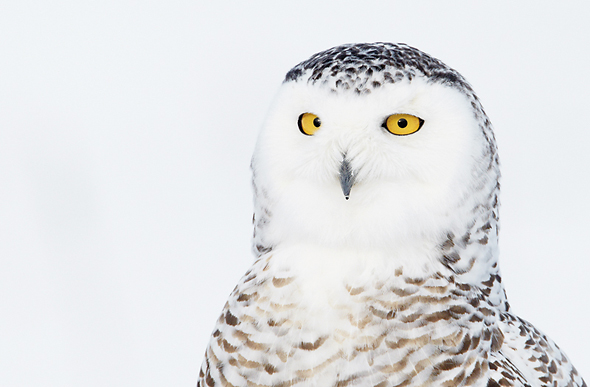
Snowy owl. Photo: Markus Varesvuo, 2010
Jarkko Laine Prize 2011
1 June 2011 | In the news
Juha Kulmala. Photo: Lotta Djupsund
The Jarkko Laine Literary Prize (see our news from 6 May), worth €10,000, was awarded to Juha Kulmala (born 1962) on 19 May for his collection of poems entitled Emme ole dodo (‘We are not dodo’, Savukeidas, 2009).
The prize is awarded to a ‘challenging new literary work’ published during the previous two years. Shortlisted were also two novels, Kristina Carlson’s Herra Darwinin puutarhuri (‘Mr Darwin’s gardener’, Otava, 2009) and Erik Wahlström’s Flugtämjaren (‘Fly tamer’, Finnish translation Kärpäsenkesyttäjä, Schildts, 2010).
Jarkko Laine (1947–2006) was a poet, writer, playwright, translator, long-time editor of the literary journal Parnasso and chair of the Finnish Writers’s Union.