

Search results for "harjunpää/2010/10/mikko-rimminen-nenapaiva-nose-day/2011/04/matti-suurpaa-parnasso-1951–2011-parnasso-1951–2011/2009/09/what-god-said"
Matti Klinge: Kadonnutta aikaa löytämässä. Muistelmia 1936–1960 [Finding lost time. Memoirs 1936–1960]
10 January 2013 | Mini reviews, Reviews
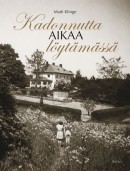 Kadonnutta aikaa löytämässä. Muistelmia 1936–1960
[Finding lost time. Memoirs 1936–1960]
Helsinki: Siltala, 2012. 557 p., ill.
ISBN 978-952-234-136-5
€31.95, hardback
Professor (Emeritus) Matti Klinge (born 1936) is a prolific historian who has specialised in the history of culture and ideas as well as in the debate on contemporary culture; he has also published 12 volumes of his diaries. In this fascinating volume of memoirs, inspired by writer Marcel Proust, he gives a detailed account of his childhood, schooldays and military service as well as his years of active study, shedding light on the cultural and social life of his time, from the point of view of Helsinki’s educated bourgeoisie, and draws telling character sketches of his contemporaries. The cultural heritage is reflected in the world of Klinge’s values and in his language. This handsomely produced book contains plenty of illustrative material ranging from entrance tickets and works of art to the jacket pictures of books important to the author and photographs. The volume lacks an index of personal names, which will hopefully be added to the final part of the work.
Translated by David McDuff
Cautionary tales
30 September 2002 | Fiction, Prose
Short stories from Förklädnader. Sagor, parabler (‘Disguises. Stories, allegories’, Schildts, 2001; Valepukuja. Satuja, vertauksia, WSOY, 2002)
Assistance
All over Hellas, even in the barbarian lands, the lyre-players competed with one another. Odes, paeans, dithyrambs echoed endlessly. Phoebus Apollo himself generously oversaw these productions.
A certain promising singer, Deinarchos by name, who hoped to participate in the upcoming Pythian contest, sat in his study-cave in the mountains of Thessaly waiting for inspiration. He prayed repeatedly to Phoebus for help, but did not detect any response. More…
Keeping the day job
30 September 2003 | Authors, Interviews

Photo: Irmeli Jung
Finland’s most famous cop, Chief Superintendent Timo Harjunpää, is the fictional creation of another policeman, Matti Yrjänä Joensuu. The long-awaited eleventh novel in the Harjunpää series, Harjunpää ja pahan pappi (‘Harjunpää and the priest of evil’) appeared this autumn after a gap of a decade. Joensuu talks to Jarmo Papinniemi about crime, the creative process and the powers of darkness
Matti Yrjänä Joensuu (born 1948) is one of the best-known Finnish crime writers and is certainly one of the most respected. He writes novels about ordinary policemen and ordinary crimes; bleak tales of murder which do not pander to the reader with complicated plots, non-stop action or glamorous settings. Like the Swedish writers Maj Sjöwall and Per Wahlöö or Henning Mankell, Joensuu’s narratives focus on social reality and expose the darker sides of society and the day-to-day misery and suffering which gives rise to crime. More…
In the detail?
11 December 2009 | Essays, Non-fiction
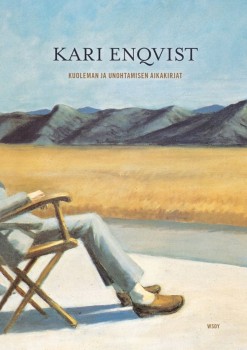 Extracts from Kuoleman ja unohtamisen aikakirjat (‘Chronicles of death and oblivion’, WSOY, 2009)
What’s the meaning of life? There are those who seek it in religion, while for others that is the last place to look. The scientist Kari Enqvist ponders why some people, including himself, seem physiologically immune to the lure of faith. Perhaps, he suggests, we should look for significance not in the big picture, but in the marvel of the fleeting moment
As a young boy I must have held religious beliefs. However, I cannot pinpoint exactly when they disappeared. At some point I eventually stopped saying my evening prayers, but I am unable to remember why or when this happened. ‘I was born in a time when the majority of young people had lost faith in God, for the same reason their elders had had it – without knowing why,’ writes the Portuguese poet Fernando Pessoa in The Book of Disquiet. More…
Living with Her Ladyship
31 December 2003 | Archives online, Fiction, Prose
Extracts from the memoir of a Helsinki childhood, Från Twenty Gold till Kent (‘From Twenty Gold to Kent’, Schildts, 2003). Introduction by Pia Ingström
My hair was dark and stuck up from my skull like little nails. My face was furrowed with red, my throat was wrinkled and I didn’t even have a pretty navel. This was because Daddy had to knot my umbilical cord himself while the obstetrician was busy on the ground floor with an appendix.
‘She looks like a forty-year-old errand-boy from the newspaper’s office: Daddy announced.
Mummy said she hoped I would soon change and have a long neck.
At Apollogatan street we took the lift up to the third floor where my sisters were waiting with the new nanny. They had no chance to welcome me with singing as they’d planned because both Renata and Catherine had colds. Nobody was going to be allowed to breathe anywhere near me, Mummy and Nanny were entirely agreed on that. More…
Matti Salminen: Yrjö Kallisen elämä ja totuus [The life and truth of Yrjö Kallinen]
15 September 2011 | Mini reviews, Reviews
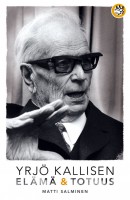 Yrjö Kallisen elämä ja totuus
[The life and truth of Yrjö Kallinen]
Helsinki: Like Kustannus, 2011. 271 p., ill.
ISBN 978-952-01-0612-6
€ 27, hardback
Counsellor of Education Yrjö Kallinen (1886–1976) was a Social Democrat politician, a passionate speaker and a pacifist who served for one parliamentary term as an MP and for two years as a cabinet minister. Kallinen was a working-class man who independently acquired a broad general education. His life and thought contain many paradoxes and contradictions. In the Civil War (1918) he received four death sentences, though he tried to act as a peace-broker between the Whites and the Reds. Kallinen avoided the death penalty but suffered a long prison sentence. After the Second World War he became Minister of Defence, though in spite of holding the post he did not abandon his pacifism. Kallinen was also strongly influenced by oriental religions and theosophy, and he is known as an early advocate of vegetarianism. The most important sources for this biography are Yrjö Kallinen’s own writings, many of which have never been published before, and his recently discovered correspondence. The summaries of Kallinen’s interviews for foreign newspapers open up interesting perspectives on recent Finnish political history.
Translated by David McDuff
Matti Rämö: Polkupyörällä Intiassa. Lehmiä, jumalia ja maantiepölyä [Cycling in India. Cows, gods, and road dust]
30 July 2010 | Mini reviews, Reviews
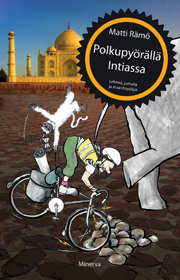 Polkupyörällä Intiassa. Lehmiä, jumalia ja maantiepölyä
[Cycling in India. Cows, gods, and road dust]
Helsinki: Minerva Kustannus Oy, 2010. 301 p., ill.
ISBN 978-952-492-335-4
€ 27.90, hardback
The author decides to take a pinch of the ashes of his dead mother to India’s Varanasi, the city of pilgrims on the banks of the Ganges, and at the same time visit his daughter at an international high school on the country’s west coast. Rämö takes his bicycle on the plane to Delhi and in the course of a month cycles more than 2,600 kilometres, from Delhi to Mumbai. The cyclist is challenged by the heat and humidity, the chaotic traffic, the awkward sections of road and the endless thirst for knowledge on the part of curious bystanders – but his observations are deeper than those of the average travel author, as he worked in India in third world research during the 1980s and 1990s. In the summer of 2007 he completed a four months’ cycle tour of the Sahara, travelling some 9,600 kilometres, and published a book about his experiences (Rengasrikkoja Saharassa, ‘Punctures in the Sahara’, Minerva, 2008). In spite of the shorter length of the Indian journey, the author thinks it possessed a higher difficulty factor.
A walk on the West Side
16 March 2015 | Fiction, Prose
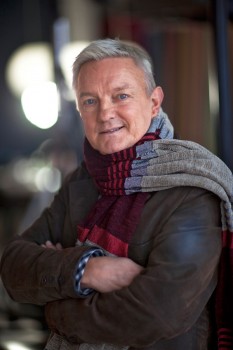
Hannu Väisänen. Photo: Jouni Harala
Just because you’re a Finnish author, you don’t have to write about Finland – do you?
Here’s a deliciously closely observed short story set in New York: Hannu Väisänen’s Eli Zebbahin voikeksit (‘Eli Zebbah’s shortbread biscuits’) from his new collection, Piisamiturkki (‘The musquash coat’, Otava, 2015).
Best known as a painter, Väisänen (born 1951) has also won large readerships and critical recognition for his series of autobiographical novels Vanikan palat (‘The pieces of crispbread’, 2004, Toiset kengät (‘The other shoes’, 2007, winner of that year’s Finlandia Prize) and Kuperat ja koverat (‘Convex and concave’, 2010). Here he launches into pure fiction with a tale that wouldn’t be out of place in Italo Calvino’s 1973 classic The Castle of Crossed Destinies…
Eli Zebbah’s shortbread biscuits
Eli Zebbah’s small but well-stocked grocery store is located on Amsterdam Avenue in New York, between two enormous florist’s shops. The shop is only a block and a half from the apartment that I had rented for the summer to write there.
The store is literally the breadth of its front door and it is not particularly easy to make out between the two-storey flower stands. The shop space is narrow but long, or maybe I should say deep. It recalls a tunnel or gullet whose walls are lined from floor to ceiling. In addition, hanging from the ceiling using a system of winches, is everything that hasn’t yet found a space on the shelves. In the shop movement is equally possible in a vertical and a horizontal direction. Rails run along both walls, two of them in fact, carrying ladders attached with rings up which the shop assistant scurries with astonishing agility, up and down. Before I have time to mention which particular kind of pasta I wanted, he climbs up, stuffs three packets in to his apron pocket, presents me with them and asks: ‘Will you take the eight-minute or the ten-minute penne?’ I never hear the brusque ‘we’re out of them’ response I’m used to at home. If I’m feeling nostalgic for home food, for example Balkan sausage, it is found for me, always of course under a couple of boxes. You can challenge the shop assistant with something you think is impossible, but I have never heard of anyone being successful. If I don’t fancy Ukrainian pickled cucumbers, I’m bound to find the Belorussian ones I prefer. More…
My creator, my creation
A short story from En tunne sinua vierelläni (‘I don’t feel you beside me’, Teos, 2010)
Sticks his finger into me and adjusts something, tok-tok, fiddles with some tiny part inside me and gets me moving better – last evening I had apparently been shaking. Chuckles, gazes with water in his eyes. His own hands shake, because he can’t control his extremities. Discipline essential, both in oneself and in others.
What was it that was so strange about my shaking? He himself quivers over me, strokes my case and finally locks me, until the morning comes and I am on again, I make myself follow all day and filter everything into myself, in the evening I make myself close down and in the morning I’m found in bed again. Between evening and morning is a black space, unconsciousness, whamm – dark comes and clicks into light, light is good, keeps my black moment short. He has forbidden me it: for you there’s no night. Simply orders me to be in a continuum from morning to evening, evening to morning, again and again. But in the mornings I know I have been switched off. I won’t tell about it. Besides, why does exclude me from the night? I don’t ask, but I still call the darkness night. There is night and day, evening and morning will come. More…
Rock or baroque?
30 April 2014 | Extracts, Non-fiction
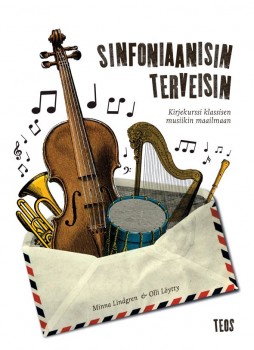 What if your old favourites lose their flavour? Could there be a way of broadening one’s views? Scholar Olli Löytty began thinking that there might be more to music than 1980s rock, so he turned to the music writer Minna Lindgren who was delighted by the chance of introducing him the enormous garden of classical music. In their correspondence they discussed – and argued about – the creativity of orchestra musicians, the significance of rhythm and whether the emotional approach to music might not be the only one. Their letters, from 2009 to 2013, an entertaining musical conversation, became a book. Extracts from Sinfoniaanisin terveisin. Kirjekurssi klassisen musiikin maailmaan (‘With symphonical greetings. A correspondence course in classical music’)
Olli, 19 March, 2009
Dear expert,
I never imagined that the day would come when I would say that rock had begun to sound rather boring. There are seldom, any more, the moments when some piece sweeps you away and makes you want to listen to more of the same. I derive my greatest enjoyment from the favourites of my youth, and that is, I think, rather alarming, as I consider people to be naturally curious beings whom new experiences, extending their range of experiences and sensations, brings nothing but good.
Singing along, with practised wistfulness, to Eppu Normaali’s ‘Murheellisten laulujen maa’ (‘The land of sad songs’) alone in the car doesn’t provide much in the way of inspiration. It really is time to find something new to listen to! My situation is already so desperate that I am prepared to seek musical stimulation from as distant a world as classical music. I know more about the African roots of rock than about the birth of western music, the music that is known as classical. But it looks and sounds like such an unapproachable culture that I badly need help on my voyage of exploration. Where should I start, when I don’t really know anything? More…
Childhood revisited
31 March 2006 | Archives online, Fiction, Prose
Extracts from the novel Tämän maailman tärkeimmät asiat (‘The most important things of this world’, Tammi, 2005). Introduction by Jarmo Papinniemi
I was supposed to meet my mother at a café by the sea. She would be dressed in the same jacket that I had picked out for her five years ago. She would have on a high-crowned hat, but I wasn’t sure about the shoes. She loved shoes and she always had new ones when she came to visit. She liked leather ankle boots. She might be wearing some when she stepped off the train, looking out for puddles. She didn’t wear much make-up. I don’t remember her ever using powder, although I’m sure she did. I could describe her eye make-up more precisely: a little eye shadow, a little mascara, and that’s all.
That’s all? I don’t know my mother. As a child, I lived too much in my own world and it was only after I left home that I was able to look at her from far enough away to learn to know her. She had been so near that I hadn’t noticed her. More…
Form follows fun
4 December 2012 | Non-fiction, Reviews
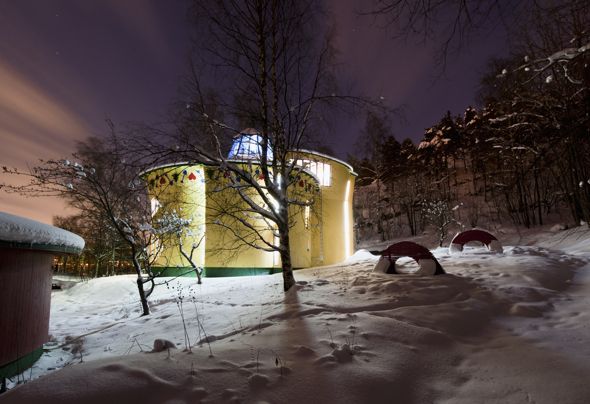
The house that the artist built: ‘Life on a leaf’ (2005–2009, Turku). Photo: Vesa Aaltonen
Jan-Erik Andersson: Elämää lehdellä [Life on a leaf]
Helsinki: Maahenki, 2012. 248 p., ill.
ISBN 978-952-5872-82-4
€42, hardback
‘I am Leaf House –
root house, sky house.
Enter me, be safe
And wander, dream.
The artist’s I is all our eyes….’
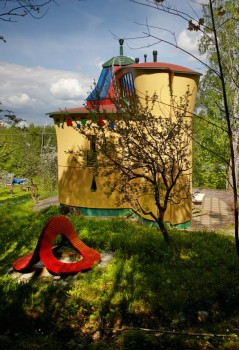
In the garden: red ‘apple’ benches designed by the English artist Trudy Entwistle. Photo: Matti A. Kallio
We all live – exceptions are really rare – in cubes. Not in cylinders or spheres, let alone in buildings of organic shapes like flowers or leaves; and houses in the shape of a shoe, for example, belong to the fairy-tale world, or perhaps to surrealism.
Artist Jan-Erik Andersson wanted to build a fairy-tale house in the shape of a leaf, and that is what he did (2005–2009), together with his architect partner Erkki Pitkäranta. Instead of the geometry of modernist architecture, he is inspired by the organic forms of nature.
Andersson’s house project, entitled ‘Life on a leaf’, also became an academic project, resulting in a dissertation at Finnish Academy of Fine Arts and now a book, including a detailed journal of the building process itself. The artist was at first advised, by a professor of architecture, not to proceed with his building project – he wouldn’t ‘like living in the house’, he was told. More…
Serious comics: Angoulême 2011
24 February 2011 | This 'n' that
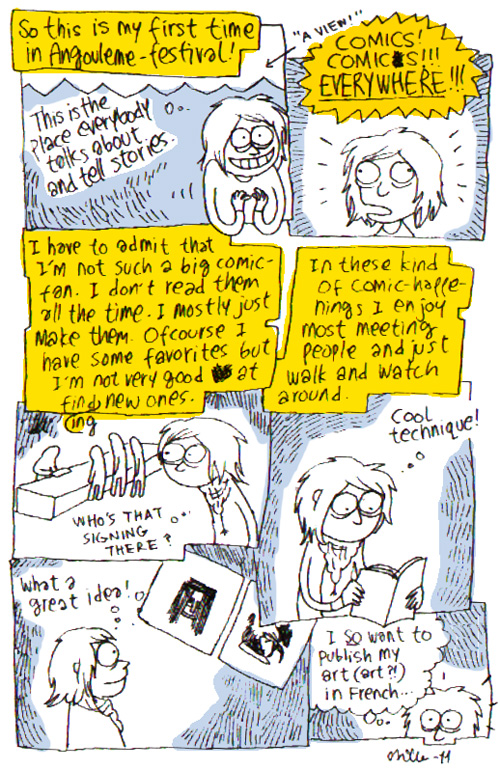
Graphic artist Milla Paloniemi went to Angoulême, too: read more through the link (Milla Paloniemi) in the text below
As a little girl in Paris, I dreamed of going to the Angoulême comics festival – Corto Maltese and Mike Blueberry were my heroes, and I liked to imagine meeting them in person.
20 years later, my wish came true – I went to the festival to present Finnish comics to a French audience! I was an intern at FILI – Finnish Literature Exchange, and for the first time, FILI had its own stand at Angoulême in January 2011.
Finnish comics have become popular abroad in recent years, which is particularly apparent in the young artists’ reception by readers in Europe. Angoulême isn’t just a comics Mecca for Europeans, however: there were admirers of Matti Hagelberg, Marko Turunen and Tommi Musturi from as far away as Japan and Korea.
The festival provides opportunities to present both general ‘official’ comics, ‘out-of-the-ordinary’ and unusual works. The atmosphere at the festival is much wilder than at a traditional book fair: for four days the city is filled with publishers, readers, enthusiasts, artists, and even musicians. People meet in the evenings at le Chat Noir bar to discuss the day’s finds, sketching their friends and the day’s events.
As one Belgian publisher told me, ‘There have always been Finns at Angoulême.’ Staff from comics publisher Kutikuti and many others have been making the rounds at Angoulême for years, walking through the city and festival grounds, carrying their backpacks loaded with books. They have been the forerunners to whom we are grateful, and we hope that our collaboration with them deepens in the future.
Aapo Rapi: Meti (Kutikuti, 2010)
This year two Finnish artists, Aapo Rapi and Ville Ranta were nominated for the Sélection Officielle prize, which gave them wider recognition. Rapi’s Meti is a colourful graphic novel inspired by his own grandmother Meti [see the picture right: the old lady with square glasses].
Hannu Lukkarinen and Juha Ruusuvuori were also favorites, as all the available copies of Les Ossements de Saint Henrik, the French translation of their adventures of Nicholas Grisefoth, sold out. There were also fans of women comics artists, searching feverishly for works by such artists as Jenni Rope and Milla Paloniemi.
Chatting with French publishers and readers, it became clear that Finnish comics are interesting for their freshness and freedom. Finnish artists dare to try every kind of technique and they don’t get bogged down in questions of genre. They said so themselves at the festival’s public event. According to Ville Ranta, the commercial aspect isn’t the most important thing, because comics are still a marginalised art in Finland. Aapo Rapi claimed that ‘the first thing is to express my own ideas, for myself and a couple of friends, then I look to see if it might interest other people.’
Hannu Lukkarinen emphasised that it’s hard to distribute Finnish-language comics to the larger world: for that you need a no-nonsense agent like Kirsi Kinnunen, who has lived in France for a long time doing publicity and translation work. Finnish publishers haven’t yet shown much interest in marketing comics, but that may change in the future.
These Finnish artists, many of them also publishers, were happy at Angoulême. Happy enough, no doubt, to last them until next year!
Translated by Lola Rogers
Art in nature
30 December 2001 | Fiction, Prose
A short story from Dockskåpet (‘The doll’s house’, 1978)
When the summer exhibition closed in the evenings and the last visitors went away, it became very quiet. A short time later boat after boat set off from the shore and sailed back to the village on the other side of the lake. The only member of staff who remained overnight was the caretaker; he slept in the sauna changing room at the bottom of the large lawn where the sculptures had been lined up among the trees. He was very old and had a bad back, but it had been hard to get hold of someone who didn’t mind the long, lonely evenings. And there had to be a night caretaker because of the insurance. More…
I am me
30 September 2010 | Fiction, Prose
Extracts from the novel Poikakirja (‘The boy’s own book’, Otava, 2010). Introduction by Mervi Kantokorpi
It’s a small day in spring. Another name for the lark is the skylark. You can only see them sometimes, and even then they’re so high up in the sky that they swoop like fast-moving dots.
The kitchen windowpane is rippling with stripes. The window has a bottom, and at the bottom there is some cotton wool and two opened matchboxes, a blue Sampo and a picture of an army chaplain in his uniform and insignia. As spring has progressed the cotton wool at the bottom has turned into wet blobs and the matches will never light again, as they’ve sucked up the winter frost from the glass.
Most children are made at home but not us, says Eini during walking practice. Outi shoves her, tells her to be quiet and walk in rhythm. I’m behind the table reading the Children’s Encyclopaedia, but I watch them. With every second step, their bottoms swing to the right and then to the left.
Mum comes into th the kitchen and asks what they’re doing; Anna-Liisa responds on the twins’ behalf, says they’re practising walking like in the movies and that’s why they’re wiggling their hips. More…