

Search results for "harjunpää/2010/10/mikko-rimminen-nenapaiva-nose-day/2011/04/matti-suurpaa-parnasso-1951–2011-parnasso-1951–2011"
Living with a genius
23 June 2015 | Extracts, Non-fiction
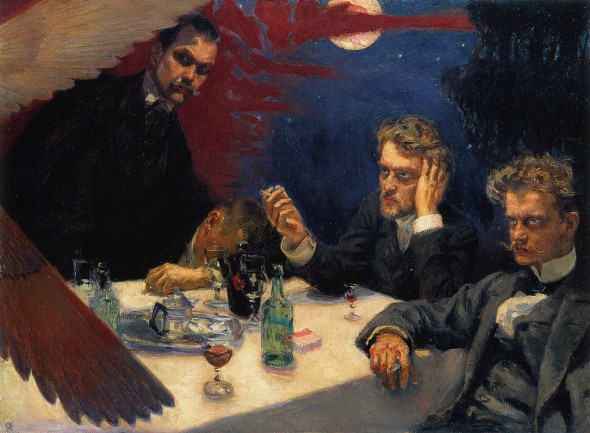
Akseli Gallen-Kallela’s painting Symposium (1894). From left: Akseli Gallen-Kallela, the composer Oskar Merikanto, the conductor Robert Kajanus and Jean Sibelius. Aino Sibelius was not pleased with this depiction of her husband depicted during a drinking session with his buddies
It is 150 years since the birth of Finland’s ‘national’ composer, Jean Sibelius. Much has been written about his life; Jenni Kirves’s new book casts light on his wife, Aino (1871–1969), and through her on the composer’s emotional and family life.
Aino, Kirves remarks in her introduction, has often been viewed as an almost saintly muse who sacrificed her life for her husband. But she was flesh and blood, and the book charts the difficulties of life with her brilliant husband from the very beginning – his unfaithfulness during their engagement, how to deal with a sexually transmitted infection he had contracted, his alcohol problem, the death of a child. It was Aino’s choice, time and again, to stand by her man; she felt it was her privilege to support her husband in his work in every possible way. ‘For me it is as if we two are not alone in our union,’ she wrote, far-sightedly, as a young bride. ‘There is also an equally rightful third: music.’
Aino’s own family, the Järnefelts, were a considerable cultural force in Finland, supporters of Finnish-language education and the growing independence movement. Her brothers included the writer Arvid Järnefelt, the artist Erik Järnefelt and the composer Armas Järnefelt. It was Armas who introduced her to his friend Jean Sibelius.
Aino bore Sibelius – known in family circles as Janne – six daughters, and offered her husband her unfailing support through 65 years of married life. ‘I must have you,’ Sibelius wrote, ‘in order for my innermost being to be complete; without you I am nothing… For this reason you are as much an artist as I am – if not more.’
As an old lady, Aino remarked of her own life that it had been ‘like a long, sunny day.’

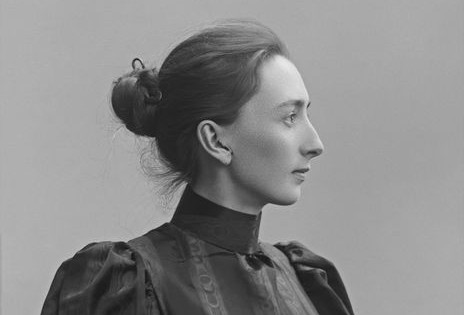
Aino Sibelius, 1891. Photo: National Board of Antiquities – Musketti.
An excerpt from Aino Sibelius: Ihmeellinen olento (‘Aino Sibelius: wondrous creature’, Johnny Kniga, 2015). We join the young couple in 1892 as they prepare for their long-awaited wedding.
At last, the wedding!
In the spring of 1892 the wedding really began to seem possible, as Janne’s symphonic poem Kullervo was very favourably received and Janne finally began to believe that he could support Aino. His financial situation was still, however, far from brilliant, and there were only two weeks to the wedding, as Janne wrote on 27 May 1892: ‘All the same, we must really be very careful about money. You will keep the cashbox and we will decide on everything together.’ The wedding grew closer and three days later Janne wrote triumphantly:
Do you understand, Aino, that we shall be man and wife in 1 ½ weeks – that we shall be able to kiss each other however we like and wherever we like (!) – and live together and have a household together – eat and make coffee together – it’s just so lovely.
A couple of weeks before the wedding, however, Janne wrote to Aino about some wishes for Aino in the future:
A skill with which a married artist can be protected from regressing is that the ‘wife’ understands to make him as little as possible into a model citizen. The man must not be allowed to be a paterfamilias with a pipe in his mouth, drowsy and docile; he must continually seek as many impressions as before, that’s clear, isn’t it? The kind of marriage whose main goal is the bringing of children into the world is repugnant to me – there are most certainly other things to do for those who work in the arts. More…
Speaking with silence
26 September 2013 | Reviews
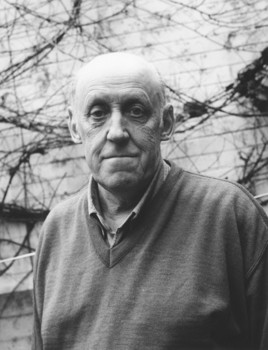
Bo Carpelan. Photo: Charlotta Boucht / Schildts & Söderströms
Bo Carpelan
Mot natten
[Towards the night. Poems 2010]
Helsinki: Schildts & Söderströms, 2013. 69 p.
ISBN 978-951-52-32-20-5
€21, paperback
‘Don’t change, grow deeper ,’ wrote Bo Carpelan: over the years he broadened his poetic range and his personal idiom evolved, but it happened organically, without sudden upheavals of style or idea.
Mot natten (‘Towards the night’) is Carpelan’s last collection of poems. This is underlined by the book’s subtitle, Poems 2010. By then Carpelan (1926–2011) was already marked by the illness that took his life in early 2011. It doesn’t show in the quality of the poems, but knowing it may make it harder for the reader to approach them with unclouded eyes. When a great poet concludes his work one wants to seek a synthesis or a concluding message, and that may encumber one’s reading. So is there such a message? In some ways there is, but Carpelan was not a man of pointed formulations. His ideals emerged without much fuss. More…
Hatefully yours
23 December 2011 | Non-fiction, Tales of a journalist
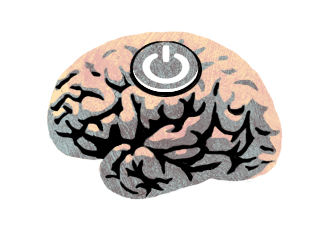
Illustration: Joonas Väänänen
In the new media it’s easy for our pet hatreds to be introduced to anyone who is interested. And of course everyone is interested, how else could it be? Jyrki Lehtola investigates
Twitter, Facebook, Twitter, Twitter, Twitter, Facebook, Twitter, how can we get the revenue model to work by using our old media, Twitter, Facebook, Twitter, Twitter, hey, what about that revenue model of ours, Twitter.
The preceding is a poignant summary of what the Finnish media was like in 2011 when the rules of the game changed like they have changed every year. And we still don’t even fully understand what the game is supposed to be. More…
Best-selling books in September
15 October 2010 | In the news
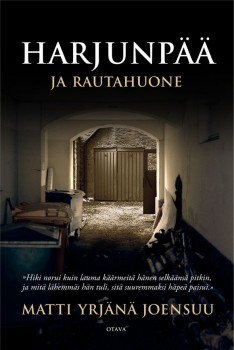 In September, Finns read crime novels. Matti Yrjänä Joensuu’s latest book featuring his police protagonist Timo Harjunpää, Harjunpää ja rautahuone (‘Harjunpää and the iron room’, Otava), topped the Booksellers’ Association of Finland’s best-seller list.
Joensuu’s Harjunpää ja pahan pappi was published in English in 2006 and reissued in 2008 under the title Priest of Evil. A film adaptation will be released in Finland in late October, directed by Olli Saarela and starring Peter Franzén in the title role.
Number two was the latest thriller from the pseudonymous Ilkka Remes, Shokkiaalto (‘Shock wave’, WSOY), and number three was Leena Lehtolainen’s Minne tytöt kadonneet (‘Where have all the young girls gone’, Tammi).
Sofi Oksanen’s record-breaking seller and critical success Puhdistus (WSOY; English edition: Purge, Atlantic Books) held strong in fourth place.
In translated fiction, Paul Auster, Diana Gabaldon ja Paulo Coelho headed the list.
The non-fiction list was topped by a study of sociability and social skills by Liisa Keltikangas-Järvinen (Sosiaalisuus ja sosiaaliset taidot, WSOY). Readers seem to be interested in survival, as the number two book was in a similar vein, Lilli Loiri-Seppä’s Selviämistarinoita (‘Stories of coping’ – also translatable as ‘Stories about getting sober’, Gummerus), about how to stop drinking.
Walt Disney was missing again from the top of the children’s list, the number one and number two spots being taken by Finnish picture books, Tatu ja Patu supersankareina (‘Tatu and Patu as superheroes’, Otava) by Aino Havukainen and Sami Toivonen, and Hurja-Harri ja pullon henki (‘Scary Harry and the genie in the bottle’, Otava) by the veteran graphic artist and children’s book author Mauri Kunnas. A new installment of the Ella storybook series by Timo Parvela, Ella ja Yön ritarit (‘Ella and the Knights of the Night’, Tammi) held the number three spot. In September, Finns read crime novels. Matti Yrjänä Joensuu’s latest book featuring his police protagonist Timo Harjunpää, Harjunpää ja rautahuone (‘Harjunpää and the iron room’, Otava), topped the Booksellers’ Association of Finland’s best-seller list.
The Finlandia prizes: Non-fiction, Junior
28 November 2013 | In the news

Ville Kivimäki. Photo: Pertti Nisonen
The Finlandia Prize for Non-Fiction 2013, worth €30,000, was awarded on 21 November to the historian Ville Kivimäki for his book Murtuneet mielet. Taistelu suomalaissotilaiden hermoista 1939–1945 (‘Broken minds. The battle ofor the nerves of Finnish soldiers 1939–1945’, WSOY).
The other works on the shortlist of six were as follows: 940 päivää isäni muistina (‘940 days as my father’s memory’, Teos; a book on Alzheimer’s disease) by Hanna Jensen, Kokottien kultakausi: Belle Epoquen mediatähdet modernin naiseuden kuvastimina (‘The golden era of the cocottes: the media stars of Belle Epoque as mirrors of modern femininity’, Finnish Literature Society) by Harri Kalha, Viipuri 1918 (‘Vyborg 1918’, Siltala) by Teemu Keskisarja, Suomi öljyn jälkeen (‘Post-oil Finland’, Into) by Rauli Partanen, Harri Paloheimo and Heikki Waris and Vapaalasku – tieto, taito, turvallisuus (‘Freestyle – knowledge, skill, safety’, Kustannus Oy Vapaalasku) by Matti Verkasalo, Jarkko-Juhani Henttonen and Kai Arponen.
The prize-winner was chosen by the director of the Ateneum Art Museum, Maija Tanninen–Mattila. In her celebratory speech she said: ‘The symptoms of many psychologically disturbed soldiers remained untreated during the war. For many, their symptoms appeared only after the war. Their experiences have remained unexpressed in language, the history of those who lack history. Ville Kivimäki has given voice to these experiences… and succeeded in writing a book that speaks across the generations.’
In his acceptance speech Ville Kivimäki (born 1976) commented: ‘The great majority of the war generation is now dead, and the words of a youngish scholar cannot, even when successful, reach those traumatic experiences whose depth we can never fully understand. But all the same, I would like to take this opportunity to say something that should have been said years ago: the psychological injuries of the war were war wounds in exactly the same sense as physical ones. In the end anyone could suffer a psychological breakdown.’

Kreetta Onkeli. Photo: Jouni Harala
The Finlandia Junior Prize 2013 was awarded on 26 November, also worth €30,000. It went to Kreetta Onkeli for her book Poika joka menetti muistinsa (‘The boy who lost his memory’, Otava).
Arto, 12, gets such a massive fit of laughter that he loses his memory and needs to find his identity and his home in contemporary Helsinki.
The winner was chosen from the shortlist of six by Jarno Leppälä, a media personality and member of the popular stunt group Duudsonit, the Dudesons. At the award ceremony he said:
‘Poika joka menetti muistinsa is, in my opinion, a well-written story about how young people in society are put on the same starting line and expected to do equally well in all circumstances – often irrespective of the fact that their starting points may actually be very different, and completely independent of the young people themselves.’
Kreetta Onkeli (born 1970) explained in her award speech how her aim was to write a proper, old-fashioned novel for children: ‘Not hundreds of pages of magic tricks but ordinary, real contemporary life that children could identify with.’ In her opinion the current, massive trend of fantasy has narrowed the scope of children’s literature.
The following five books made it on to the shortlist: Poika (‘The boy’, Like), about a boy who feels he was born in the wrong gender by Marja Björk, Hipinäaasi, apinahiisi (onomatopoetic pun, ‘Donkeymonkey’, Tammi), about bullying and friendship, written by Ville Hytönen and illustrated by Matti Pikkujämsä, Isä vaihtaa vapaalle (‘Father on his own time’, WSOY), an illustrated story about children with too busy parents, written by Jukka Laajarinne and illustrated by Timo Mänttäri, Aapine (‘ABC’, Otava), an illustrated primer written by Heli Laaksonen in her own south-western dialect and illustrated by Elina Warsta and Vain pahaa unta (‘Just a bad dream’, WSOY) by graphic designer and writer Ville Tietäväinen and his daughter Aino, a book on a child’s nightmares.
Finlandia literary prizes are awarded by Suomen Kirjasäätiö, The Finnish Book Foundation, established in 1983.
The first Finlandia Prize for Fiction was awarded in 1984. This year it will be announced on 3 December.
Thrills and spills
23 October 2009 | This 'n' that
In September the comic strip Viivi & Wagner by Juba, number two in August on the list of best-selling books (Mitä Suomi lukee, ‘What Finland reads’ – in Finnish only), gave way to Jari Tervo’s political satire Koljatti (‘Goliath’) and to a new thriller by Ilkka Remes (Isku ytimeen, ‘Strike to the core’).
Number three was Kjell Westö’s novel Älä käy yöhön yksin (in Finnish; the original, Gå inte ensam ut i natten, was published in Swedish, Westö’s mother tongue; ‘Don’t go out into the night alone’) and number four Kari Hotakainen’s novel Ihmisen osa (‘The human condition’).
Numbers eight and nine were new thrillers / crime novels by Leena Lehtolainen and Matti Rönkä. Historical novels by Kaari Utrio and Laila Hirvisaari took the fifth and sixth places.
Not surprisingly, the international bestsellers Paulo Coelho, Henning Mankell, Donna Leon and Patricia Cornwell led the translated fiction list.
As for non-fiction, the doings of Finnish Security Police interests people greatly: a history of it from 1949 to 2009 (edited by Matti Simola), entitled Ratakatu 12 (‘Ratakatu street 12’, WSOY) made its way to the top. It was followed by a biography of the industrial magnate Pekka Herlin of the Kone elevator company, Koneen ruhtinas (‘The prince of Kone’) – and Hitler by Ian Kershaw.
The way to heaven
30 June 1996 | Archives online, Fiction
Extracts from the novel Pyhiesi yhteyteen (‘Numbered among your saints’, WSOY, 1995). Interview with Jari Tervo by Jari Tervo
The wind sighs. The sound comes about when a cloud drives through a tree. I hear birds, as a young girl I could identify the species from the song; now I can no longer see them properly, and hear only distant song. Whether sparrow, titmouse or lark. Exact names, too, tend to disappear. Sometimes, in the old people’s home, I find myself staring at my food, what it is served on, and can’t get the name into my head. The sun came to my grandson’s funeral. It rose from the grave into which my little Marzipan will be lowered. I don’t remember what the weather did when my husband was buried.
A plate. Food is served on a plate. There are deep plates and shallow plates; soups are ladled into the deep ones. More…
Growing together. New Finnish children’s books
28 January 2011 | Articles
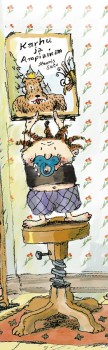
Hulda knows what she wants! From the cover of a new picture book by Markus Majaluoma (see mini reviews*)
What to choose? A mum or dad buys a book hoping it will be an enjoyable read at bedtime – adults presume a book is a ‘good’ one if they themselves genuinely enjoy it, but children’s opinions may differ. Päivi Heikkilä-Halttunen reviews the trends in children’s literature published in Finland in 2010, and in the review section we’ve picked out a handful of the best on offer
Judging by the sheer number and variety of titles published, Finnish children’s and young people’s fiction is alive and well. If I had to describe the selection of books published in 2010 in just a few words, I would have to point to the abundance of titles and subject matters, and the awareness of international trends.
Since 2000 the number of books for children and young people published in Finland each year – including both translated and Finnish titles – has been well in excess of 1,500, and increasing, and this growth shows no signs of slowing down.
Little boys, ten-year-olds who don’t read very much and teenage boys, however, were paid very little attention last year. Although gender-specificity has never been a requirement of children’s fiction, boys are notably pickier when it comes to long, wordy books, especially those that might be considered ‘girly’. More…
High above the years
23 September 2011 | Fiction, poetry
In Gösta Ågren’s poetry austere aphorisms alternate with concrete observations of life in a small village that was and again is his home, and with portraits of people he has met on his journey in the world. Introduction by David McDuff
Poems from the collection I det stora hela (’On the whole’, Söderströms, 2011)
Father’s hands
(1945)
Father’s hands were like stiff
gloves; a furious
kettle had bewitched them
in his childhood. We ride
from the church’s tall letter
along the river’s long sentence
to the parenthesis of the bridal house,
and the thunder of three hundred hooves
fills the space beneath the clouds.
I saw father driving through
his life with those numbly
gripped reins, and later,
right now, I think of the
life-long body in which a man
comes, is wounded, and goes. More…
Animals, thy neighbours
30 March 2005 | Authors, Reviews

Sirkka Turkka. Photo Tomi Kontio
‘Everyone’s always in a hurry. In the grave it stops.’
In her new volume Sirkka Turkka (born 1939) appears as an even greater and more pitiless poet. Niin kovaa se tuuli löi (‘So bitterly the wind struck’, Tammi, 2004) – her twelfth volume, the first having being published in 1973 – is an unadorned and searching portrayal of death and the grief that accompanies it. It takes a thoroughly mature poet to handle major feelings as uninhibitedly as she does, and without letting the empathetic glow fade under the documentation.
Animals have always played an important role in Turkka’s somewhat melancholy but vital verse, with its highly individualised concrete language. In 1987 she received the Finlandia Literature Prize for her Tule takaisin, pikku Sheba (‘Come back, little Sheba’, Tammi, 1986; see Books from Finland 4/1988). Little Sheba was a small dog, one of the poet’s dearest friends. Turkka has worked as a stable manager, and horses are frequently central in her work. Domestic and farm animals are always a presence, and here they appear as tokens of the fragility of life and mortality. A hare, a horse, a dog and a lamb are among the animals whose deaths are dramatised. More…
Writers meet again in Lahti
14 May 2009 | In the news
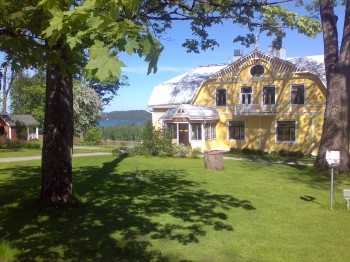
In other words: LIWRE at Messilä Manor
The Lahti International Writers’ Reunion (LIWRE; www.liwre.fi) will be held this year between 14 and 16 June.
In the politically and culturally active 1960s, marked by the confrontation between East and West, an idea was born to found an international, bi-annual rendezvous where writers from all over the world could freely engage in discussions on various themes.
Crème de la crème
31 January 2013 | Fiction, Prose
Such straining and pasteurising is going on in the city that Arabs and other Muslims, the unemployed, drunkards, poor people and lunatics have been eliminated. By chance I became a cultural figure, and I was invited to a cultural evening whose invitation had been personally written by the Anarchist. At the restaurant table sat the Anarchist, the Psychoanalyst and the Psychologist’s boyfriend, 20 years younger, the Journalist, the Gift-Shop Owner, a Librarian and the Deputy Rector of a community college. Accompanying me to the restaurant, too, were the Wolf and the Deer, who hadn’t been invited. Sparse white fur grew on the Wolf’s narrow muzzle and there were teeth missing from his mouth. The Deer was beautiful, with huge eyes. And of course both of them were drunk. I asked them to come along because I believed that intellectuals are warm-hearted and open-minded. A really dumb idea. More…
New from the archives
19 February 2015 | This 'n' that
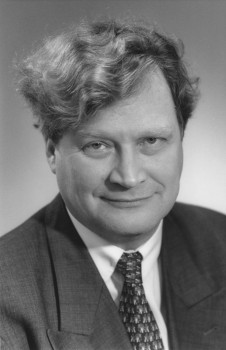
Jarkko Laine. Photo: Kai Nordberg
Our archive find this week is ‘The 101 year anniversary celebration’, a short story by Jarkko Laine.
‘Child of Marx and Coca-Cola’, ‘Nordic beatnik’, Jarkko Laine (1947-2006) published his first work, a volume of poetry entitled Muovinen Buddha (‘Plastic Buddha’) in the 1960s and was immediately hailed as the mouthpiece of his generation. He went on to make his career as a literary all-rounder – poet, writer, playwright, translator, long-time editor of the literary magazine Parnasso and chair of the Finnish Writers’ Union. His wryly ironic story, ‘The 101 year anniversary celebration’ tells the story of what every writer must dread: a guest appearance in a local library where literature from the local town, let alone further afield, is regarded with suspicion.
We’ve also unearthed a 1989 interview, by our late, genial editor-in-chief Erkka Lehtola with a grey-suited Laine who looks more like a civil servant than a 1960s radical – but still doesn’t let a day go by without writing.
*
The digitisation of Books from Finland continues apace, with a total of 360 articles and book extracts made available online so far. Each week, we bring a newly digitised text to your attention.
In memoriam Kai Laitinen 1924–2013
14 March 2013 | In the news
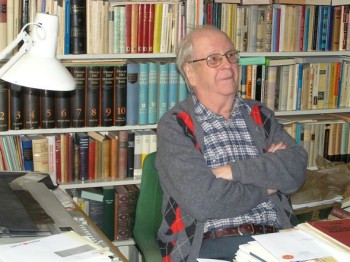
Kai Laitinen. Photo: Ilkka Välimäki (the literature archive/Finnish Literature Society, 2006)
The journalist, critic, author and professor Kai Laitinen died on 11 March in Helsinki, aged 88.
He began his literary career as a critic in the daily paper Helsingin Sanomat in 1950. As the Editor-in-Chief of the new literary journal Parnasso he was able to promote the new trends in modernist fiction and poetry which began to flourish in post-war Finland.
Laitinen’s academic career at Helsinki University involved serving as Associate Professor and Professor of Finnish literature (1975–1989). From the 1950s onwards he was actively involved in the work of dozens of literary societies, publications and organisations, both in Finland and abroad.
Among his publications are two collections of essays, a book of memoirs and two popular books on history of literature: Suomen kirjallisuus 1917–1967 (‘Finnish literature 1917–1967’) and a more concise work, Suomen kirjallisuuden historia (1981‚ Literature of Finland in Brief), which has been published in eleven languages.
Kai Laitinen was appointed Editor-in-Chief of Books from Finland in 1976 when the little magazine, then in its tenth year, began to take the form of a proper literary journal and to be published by Helsinki University Library. He held the job until 1989.
In issue 4/1977 of Books from Finland, on the theme of the 60th anniversary of Finland’s independence and the changing role of literature, Kai wrote in the editorial: ‘Literature is, and must be, much more than a chronicle of national and social history, or the mere accumulation of changing styles and genres. So often it is an author’s critical insight or his struggle against prevailing literary norms that gives birth to the works of the greatrest artistic importance. One of the main tasks of literature, both on a national and a human level, can be summed up succinctly in two lines from T.S. Eliot’s Little Gidding – “To purify the dialect of the tribe / And urge the mind to aftersight and foresight.” This comes close to describing what Finnish literature has achieved over the past sixty years.’
T.S. Eliot was the poet who perhaps had a permanent place in Kai’s personal literary cosmos – he introduced Eliot’s poetry to Finnish readership in the late 1940s. This passage, from Little Gidding, might well serve as his epitaph.
….We shall not cease from exploration
And the end of all our exploring
Will be to arrive where we started
And know the place for the first time.