

Search results for "harjunpää/2010/10/mikko-rimminen-nenapaiva-nose-day/2011/04/matti-suurpaa-parnasso-1951–2011-parnasso-1951–2011"
A portrait of Elmer Diktonius
30 June 1982 | Archives online, Authors
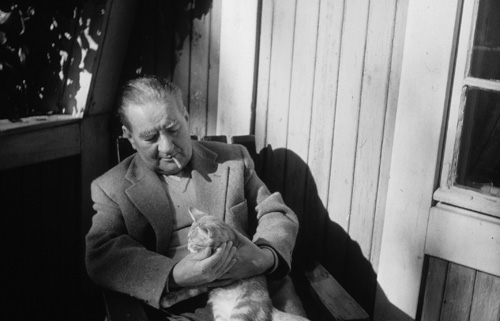
Elmer Diktonius at his home in Kauniainen (Grankulla). Photo: Wikimedia Commons / Public domain
Elmer Diktonius, one of the leading Finland-Swedish modernists of the 1920s, was a revolutionary poet, prose-writer and critic who also tried his hand at composing. Professor George Schoolfield, whose article on Diktonius appears below, appends his own translations of several of the lyrics: a filler selection is going to be published in the United States, Recently Professor Schoolfield has been working on a biography of Diktonius which he hopes to publish soon.
The literary fate of the Finland-Swedish modernist Elmer Diktonius (1896-1961) has not been an altogether happy one. Saluted early and late in his career as Finland’s Strindberg and as a possible rival to Mayakovsky in the contest for the greatest lyricist of the revolution, Diktonius would seem, surely, to deserve a place on the world’s literary stage. Yet the attention he has received outside the north has been mostly unwitting: the writers of program notes quote his description of the Silbelius Fourth, ‘the bark-bread symphony’ without knowing its source, the collected concert-reviews of Opus 12: Musik (1933). Surveys that might have introduced him to a larger public are silent. The chubby Pelican Guide to the European Literature of Modernism ignores him; the Penguin Book of Socialist Verse omits him from its 134 specimens of the lyric left; and Ulrich Weisstein’s volume of Expressionism as an International Literary Phenomenon does not have him in its chapter on ‘Expressionism in Scandinavia’, although he would qualify – as the Swedish scholar Bill Romefors has proved – as the major northern heir of German expressionism. More…
Challenged by colour
1 April 2010 | Authors, Interviews
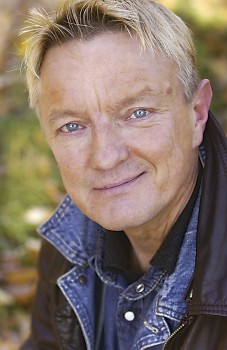
Hannu Väisänen. Photo: Paula Kukkonen
Interview with Hannu Väisänen, author of the novel Kuperat ja koverat (‘Convex and concave’, 2010)
For the painter and writer Hannu Väisänen, colour speaks volumes.
In the novel Toiset kengät (‘The other shoes’, 2007, Otava) awarded the Finlandia Prize for Fiction), teenage wannabe artist Antero manages to escape his grey northern hometown of Oulu; he is heading for the eastern Finnish town of Savonlinna, where he will go to art college. Triumphantly Antero dyes his blond hair black in the bus station toilet.
‘Perhaps it was all a question of the right colours and the right timing of colours,’ Antero thinks. In Kuperat ja koverat (‘Convex and concave’, 2010), he leaves for the capital, determined to get into the academy of art. His hair is still black. More…
Misery me
Extracts from the collection of short prose, Mielensäpahoittaja (‘Taking offense’, WSOY, 2010)
Past pushing up daisies
Well, yeah, so I took offense when the doctor said that considering my age I’m in tip-top shape. His theory was that my 25-kilometre ski circuits would keep an old coot like me in shape, if they didn’t kill me first. He said if I were to start just sitting on the couch and waiting, then the Reaper would be on my back in no time.
I don’t ski for my health. I ski because it’s pretty in the forest, and when a body is sweating he doesn’t think a whole lot. More…
A perfectly ordinary day
30 September 1997 | Archives online, Fiction, Prose
Extract from the novel Kello 4.17 (‘The time was 4.17’, WSOY, 1996). When time loses its meaning, real fear strikes like an iron glove. Aho writes about a man who is different but no outcast
I was lost to myself, if it is possible to be lost if you haven’t gone anywhere. Black birds curved through my mind and it felt as if no one needed me, no one or nothing: my mother bought clothes and make-up and did not seem to care; Uncle Lasse looked after the family business, steam coming out of his head, and kept shopkeepers and shopaholic customers happy; smiling bank managers slapped shy loan applicants encouragingly on the back, the gross national product grew without me having anything to do with it, or because I didn’t; and politics plodded onward as the mud squelched comfortingly. The machine of society hummed and ticked and Finland was as round and fat as a bomb. I looked at it and nothing changed, and on Sundays it was so quiet that you could look out of the window and see the Sahara.
The snake
31 March 1998 | Fiction, Prose
In this horror story by the Finland-Swedish author Kjell Lindblad (born 1951), a man believes he is wandering among art installations in an apartment block – but the reality he is experiencing turns out to be much more sinister. From the collection of short stories Oktober-mars (‘October-March’, Schildts, 1997)
I only noticed the poster on the notice board in the vegetarian restaurant because it was so obviously different from the rest of the colourful items there, with their large headlines offering everything from Atlantic meditation to Zen ping-pong, together with promises of a new and fulfilled life in harmony with the soul and the cosmos. Poster is perhaps an overstatement it was a white sheet of paper with an egg-shaped oval in the middle. Inside the oval there was a horizontal row of seven numbers. For some reason, perhaps because the row of numbers was the only information on the piece of paper, it stuck in my memory and when I got home I had a compulsive desire to find out if it was a phone number. So I dialled the number and a tape-recorded voice that could have belonged to a man but equally well to a woman, said:
‘We bid you welcome. Please don’t write down the address just memorise it….’ More…
Stars above
30 December 1998 | Fiction, Prose
Extracts from the novel Benjamins bok (‘Benjamin’s book’, Schildts, 1997)
There are people who feel they are in contact with the stars. Among those who carry their secret knowledge around with them are both the healthy and the ‘sick’. Now I remember Olli stretching his arm out towards the evening star and seeming to greet it. For others, for me, the starry heavens are a form of distant vertigo. All those milky ways and galaxies, how could they not be inhabited, have developed a culture far older than our own. Perhaps they have watched the development of our planet with distaste, and are waiting for its ruin, which according to their calculation of time will take place in a few years or days from now. If I listen closely I seem to be faintly approached by a celestial choir, composed of indistinct sounds; if I stand on a lonely road in the country, and look up at the sky, the light and faint murmur from a nearby town emerge, and can be separated from the faint voices of the starry heavens. It is probably just my imagination. Perhaps it is an extension of that voice – anonymous, quiet – that I hear when I read a book. A good book is audio-visual. And no harm is done if it gives the reader a mild sense of vertigo. More…
A roof with a view
27 August 2009 | Fiction, Prose
Extracts from the novel Mistä on mustat tytöt tehty? (‘What are black girls made of?’, Tammi, 2009) Introduction by Tuomas Juntunen
I’m a chimney sweep’s daughter, born October 1962 as a gift, a light to a darkened world. I’ve had lots of mothers, but none of them ever stuck around for good. One of them gave birth to me, so she’s Mother, not mother. Her name is Dewdrop, because water has spilled over the only photograph of My Mother and now her face has dissolved into a single translucent droplet; her nose, cheeks and chin are now a fat, shiny blob that looks like it’s about to fall out of the bottom of the picture. More…
What the snail thought
30 September 2005 | Fiction, Prose
Poems from Tapahtui Tiitiäisen maassa
(‘It happened in Tumpkin land’, WSOY, 2004)
Illustrations by Christel Rönns

Meritähti
Eli merenpohjassa Meritähti
tuhat tonnia vettä yllä.
      - Minä jaksan kyllä,
      sanoi Meritähti.
      - On terävät sakarat,
      ja litteät pakarat
ja paineenkestävät kakarat!
Scent of greenness
21 April 2011 | Fiction, poetry
‘Time the unstoppable’ features in the last collection of poems, Gramina, by Bo Carpelan (1926–2011), who reads timeless poetry while writing his own verses. In his introduction, Michel Ekman quotes the American poet and philosopher Ralph Waldo Emerson, who thought books should stimulate the reader’s thoughts instead of merely being devoured
Poems from the collection Gramina. Marginalia till Horatius, Vergilius och Dante (‘Gramina. Marginalia to Horace, Virgil and Dante’, Schildts, 2011)
Surf on the net –
in the net you are
with mouse and waiting spider

Fills life’s piggy bank
until it is emptied
The paved road of envy
where you stumble
Be sufficient unto oneself?
And who is this ‘self’
who doesn’t introduce himself? More…
Once upon a time…
13 January 2012 | Articles, Non-fiction
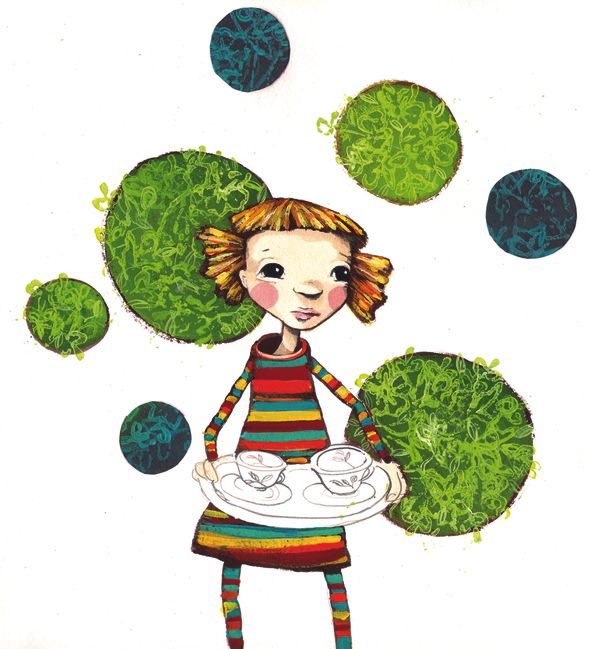
Sari Airola's illustration in Silva och teservisen som fick fötter (‘Silva and the tea set that took to its feet’, Schildts) by Sanna Tahvanainen
The future of book publishing is not easy to predict. Books for children and young people are still produced in large quantities, and there’s no shortage of quality, either. But will the books find their readers? Päivi Heikkilä-Halttunen takes a look at the trends of 2011, while in the review section we’ve picked out a selection of last year’s best titles
The supply of titles for children and young adults is greater than ever, but the attention the Finnish print media pays to them continues to diminish. Writing about this genre appears increasingly ghettoised, featuring only in specialist publications or internet chat rooms and blogs.
Yet, defying the prospect of a recession, Suomen lastenkirjakauppa, a bookshop specialising in children’s literature, was re-established in central Helsinki in autumn 2011, following a ten-year break. Pro lastenkirjallisuus – Pro barnlitteraturen ry, the Finnish society for the promotion of children’s literature, has been making efforts to found a Helsinki centre dedicated to writing and illustration for children. The society made progress in this ambition when it organised a pilot event in May 2011. More…
When the viewer vanishes
26 May 2015 | Essays, Non-fiction
 For the author Leena Krohn, there is no philosophy of art without moral philosophy
I lightheartedly promised to explain the foundations of my aesthetics without thinking at any great length about what is my very own that could be called aesthetics. Now I am forced to think about it. The foundations of my possible aesthetics – like those of all aesthetics – lie of course somewhere quite different from aesthetics itself. They lie in human consciousnesses and language, with all the associated indefiniteness.
It is my belief that we do not live in reality, but in metareality. The first virtual world, the simulated Pretend-land is inherent in us.
It is the human consciousness, spun by our own brains, which is shared by everyone belonging to this species. Thus it can be called a shared dream, as indeed I have done. More…
Petra Heikkilä: Pikku Nunuun löytöretki [Little Nunuu’s treasure hunt]
1 February 2011 | Mini reviews, Reviews
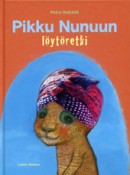 Pikku Nunuun löytöretki
[Little Nunuu’s treasure hunt]
Helsinki: Lasten keskus, 2010. 32 p., ill.
ISBN 978-951-627-829-5
€23.50, hardback
Petra Heikkilä (born 1976) is a visual artist and author. Her debut title, an illustrated children’s book entitled Mikko Kettusen pupupöksyt (‘Micky Fox’s bunny pants’, 2001), was nominated for the Finlandia Junior prize in 2001. Heikkilä’s practice of portraying children as animal characters is based on their facial expressions – particularly their luminous eyes. Typical features of all eight of her picture books published so far include a warm sense of humour, wordplay and the use of collage techniques in the illustrations. At the centre of this tale set in Africa is a kanga cloth, which can be twisted and wound in a variety of ways, and Nunuu, a little lion girl who learns about the inventive uses for kanga. The rich image textures utilise collage and photographs, as well as characters painted on Ugandan barkcloth.
Translated by Ruth Urbom
The bully
31 March 1996 | Archives online, Fiction, Prose
A short story from Tulen jano (‘Thirst for fire’, Gummerus, 1995); power relations between doctor and patient in a situation where the past will not leave either alone
Nurmikallio, an apparently ordinary middle-aged man, came back again and again, and it seemed as if there would be no end to his story.
I listened to him patiently at first. Repeatedly he returned to the same subject. The form and emphases of the story changed, new memories emerged, but the gist was the same: he had failed in his life and believed that the root cause of his failure was a particular person, a childhood class-mate, a bully.
On the basis of his first visit I wrote a short character-sketch:
Intellectually average. Talkative, but by his own account solitary. Difficulties in human relationships, separated, no children. Electrician by profession, says he likes his work. Biggest problem obsessive attachment to childhood traumas.
And that’s all, I thought. But he was not to be so easily dismissed.
The show must go on
30 June 2007 | Archives online, Fiction, Prose
Extracts from the novel Piru, kreivi, noita ja näyttelijä (‘The devil, the count, the witch and the actor’, Gummerus, 2007). Introduction by Anna-Leena Ekroos
‘I hereby humbly introduce the maiden Valpuri, who has graciously consented to join our troupe,’ Henrik said.
A slight girl thrust herself among us and smiled.
‘What can we do with a somebody like her in the group? A slovenly wench, as you see. She can hardly know what acting is,’ Anna-Margareta snapped angrily.
‘What is acting?’ Valpuri asked.
Henrik explained that acting was every kind of amusing trick done to make people enjoy themselves. I added that the purpose of theatre was to show how the world worked, to allow the audience to examine human lives as if in a mirror. Moreover, it taught the audience about civilised behavior, emotional life, and elegant speech. Ericus thought that the deepest essence of theatre was to give visible incarnation to thoughts and feelings. None of us understood what he meant by this, but we nodded enthusiastically. Anna-Margareta insisted that, say what you will, in the end acting was a childish game. Actors were being something they were not, just like children pretending to be little pigs or baby goats. More…