

Search results for "harjunpää/2010/10/mikko-rimminen-nenapaiva-nose-day/2011/04/matti-suurpaa-parnasso-1951–2011-parnasso-1951–2011"
Mishaps, perhaps
30 September 1976 | Archives online, Fiction, poetry
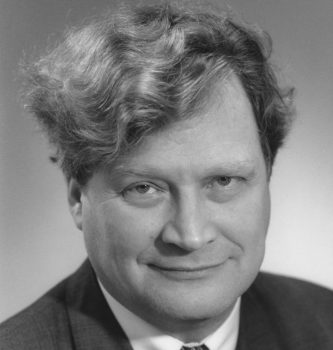
Jarkko Laine. Photo: Kai Nordberg
Jarkko Laine (born 1947) writes both prose and verse. He is the author of several hilarious and highly imaginative novels and a pioneer of the generation of Finnish underground poets. One of the most productive of younger Finland’s poets, he draws on the language and forms of mass commercial entertainment, comics, and pop music to write about people of today.
He is currently the editorial secretary of the literary periodical Parnasso. The poem below is from his latest collection Viidenpennin Hamlet (‘Fivepenny Hamlet’, Otava 1976)

1
In Turku again
the taxi’s travelling East Street
whose wooden sides have gone,
the radio’s laryngeal with static, VHF, the driver’s
telling me the tale,
the ice hockey season’s on us already,
even though there’s rain, green in the park,
I’m staring at the lifted houses
stuffed with sleeping persons,
the landmarks are going out one by one, all of them,
you might as well be
in the middle of the sea in a rubber dinghy,
soon I shan’t recognize anything here but
the cathedral, the castle,
my own name in the telephone directory. More…
Tchotchkes for the tsar
11 August 2011 | Reviews
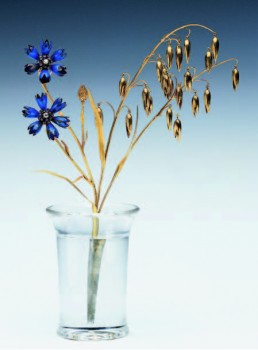
Cornflower and ear of oats: one of the several Fabergé gemstone ornaments now owned by Queen Elizabeth of England (gold, rock crystal, diamonds, enamel, ca 18 cm)
Ulla Tillander-Godenhielm
Fabergén suomalaiset mestarit
[Fabergé’s Finnish masters]
Design: Jukka Aalto/Armadillo Graphics
Helsinki: Tammi, 2011. 271 p., ill.
ISBN 978-951-31-5878-1
€57, hardback
In its online shop, the Hermitage Museum in St Petersburg sells a copy of a most delicate, enchanting little nephrite-and-opal lily of the valley that perfectly imitates nature, sitting in a vase made of rock crystal that looks like a glass of water.
These small flowers made of gold and gemstones were manufactured by the jeweller Fabergé a hundred years ago. The lily of the valley was the most frequently used floral motif in the Fabergé workshops – it was the favourite flower of Empress Alexandra (1872–1918), and the imperial family was the the foremost client of the world’s foremost jeweller.
The replica (13.5 centimetres high) is available at the Hermitage as a ‘luxury gift’ for the price of mere $3,300. (N.B. Since we published this review, the ‘luxury gift’ items seem to have disappeared from the Hermitage online shop selection, so we have removed the link. Several Fabergé egg replicas are available though, ranging in price from $200 upwards – link below.)
For those who feel the price is excessive, there is also a rather modestly-priced little bay tree (original: gold, Siberian nephrite, diamonds, amethysts, pearls, citrines, agates and rubies as well as natural feathers, about 30 centimetres tall, featuring a little bird that emerges flapping its wings and singing when a small key is turned) at just $ 219,95. Despite its form, it is classified as one of the famous imperial Easter eggs. (However, as I write, this item is unfortunately sold out…) More…
Gustaf Mannerheim: Dagbok förd under min resa i Centralasien och Kina 1906–07–08 [Journal of my travels in Central Asia and China 1906–07–08]
11 February 2011 | Mini reviews, Reviews
 Dagbok förd under min resa i Centralasien och Kina 1906–07–08, Vol 1–3
[Journal of my travels in Central Asia and China 1906–07–08, Vol. 1–3]
Redaktör [Edited by]: Harry Halén
Bildredaktör [Photo editor]: Peter Sandberg
Helsingfors: Svenska litteratursällskapet i Finland, 2010. 1,128 p., ill.
ISBN 978-951-583-196-5 (complete set)
€ 80, hardback
Carl Gustaf Mannerheim (1867–1951), a Finnish officer in the Imperial Russian Army, later Commander-in-Chief of the Finnish Army and President of Finland, undertook a military reconnaissance mission, posing as an academic researcher, to Central Asia and China in 1906–1908. His journey on horseback across Asia to Peking also generated a wealth of ethnographic material: field notes, photographs and artefacts. In his travel diaries, Mannerheim describes the landscapes as well as his diverse encounters with the inhabitants of the areas he travelled through. During his visit to a Tibetan monastery, Mannerheim was pelted with stones by pilgrims. He gave the Dalai Lama an automatic pistol as a gift. These journals are now being published in full for the first time in their original language, Swedish, including Mannerheim’s own notes concerning his military mission. The photographs, some of which have never been published before, show that Mannerheim was a skilled photographer. Harry Halén, an expert in Central Asian languages and cultures, has contributed an extensive preface and copious notes.
Translated by Ruth Urbom
Winner of the Susan Sontag Prize
25 December 2010 | In the news
The Susan Sontag Foundation was established in New York in 2004 in memory of the celebrated author and cultural journalist Susan Sontag (1933–2004). The Foundation grants a prize to a young American who translates from other languages into English. In 2010 the prize was awarded for the third time.
Benjamin Mier-Cruz is currently pursuing his PhD in Scandinavian Languages and Literatures at University College Berkeley, with a particular interest in Finland-Swedish modernism and German expressionist poetry. His winning translation proposal is entitled Modernist Missives of Elmer Diktonius – Letters and Poetry of Elmer Diktonius.
Elmer Diktonius (1896–1961) was a rebellious Finland-Swedish avant-garde poet and composer, who was fluent in Finnish as well as his native Swedish. His letters to a wide range of European authors and critics, written between 1919 (the year of the Finnish Civil War) and 1951, reflect the political, artistic and personal developments in Finland and Europe.
The prize ceremony took place first in Helsinki on 5 November in a seminar at the Svenska litteratursällskapet i Finland (the Society of Swedish Literature in Finland), then at Scandinavia House, New York, on 12 November.
Between covers
31 December 1990 | Archives online, Children's books, Fiction
Extracts from Lastenkirja (‘Children’s book’, WSOY, 1990, illustrated by the Estonian animator and graphic artist Priit Pärn)
CHILDREN’S BOOK IS BORN
Children are wafting around the world: they come spilling out of the chimneys and clattering out of the pipes. They worm around cramped places in the nether regions, rise up through stiff roots into the treetops and muss up the clouds. Children just happen anywhere and bring the Adults along with them. More…
The son of the chimera
30 September 1999 | Fiction, Prose
A short story from Pereat mundus. Romaani, eräänlainen (‘Pereat mundus. A novel, sort of’, WSOY, 1998)
I was born, but not because anyone wanted it to happen. No one even knew it was possible, for my mother was a human being, my father a chimera. He was one of the first multi-species hybrids.
Only one picture of my father survives. It is not a photograph, but a water-colour, painted by my mother. My father is sitting in an armchair, book in hand, one cloven hoof placed delicately on top of the other. According to my mother, he liked to leaf through illustrated books, although he never learned to read. He is wearing an elegant, muted blue suit jacket, but no trousers at all. Thick grey fur covers his strong legs, right down to his hoofs. Small horns curve gracefully over his convex forehead. Striking in his face are his round, yellow eyes, his extraordinarily wide mouth, his tiny chin and his surprisingly large but flat nose. More…
In other words
21 June 2012 | This 'n' that
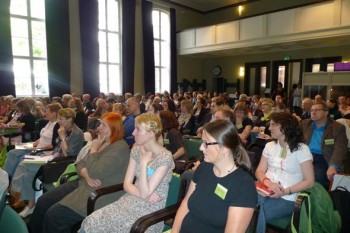
Wordworkers meet: the translators' congress in Helsinki, 11–14 June. Photo: Hannele Jyrkkä
From Finnish or Swedish into 32 languages: in mid June FILI (the Finnish Literature Exchange) held the biggest international meeting of translators of Finnish literature of all time.
The congress, entitled Kääntäjän sana/Översättarens ord (Translator’s word) was planned with one eye on the Finnish theme of the 2014 Frankfurt Book Fair.
The former Lisa Hagman School, now the House of Learning, offered the premises for workshops and lectures for 120 professional translators and almost 70 scholars of language and literature.
Participants translating from both Finnish and Finland-Swedish were offered opportunities to meet writers, listen to lectures from experts in language and literature and gain feedback from other active professional readers. More…
The Canada goose
31 December 2008 | Archives online, Fiction, Prose
A short story from Tapaus Sidoroff (‘The Sidoroff case’, WSOY, 2008). Introduction by Kristina Carlson
It was no use even trying the old cart track branching from the main road. I turned off the engine and glanced into the back seat. My aunt lifted the brim of her hat, her bright eyes peering at me questioningly.
‘We can’t get any farther by car. The road’s nothing but rough brush. What do you think, Aunt Alli, can you walk the rest of the way?’
My aunt shook her head and didn’t even bother to answer. She opened the car door and clambered out. A swarm of black flies wafted into the air from the brush at the bottom of the ditch.
‘For heaven’s sakes, there’s sure enough of these flies.’
She fanned at the air with her hat, straightened the hem of her dress and trudged across the ditch, without looking back, through the thicket of willows. In spite of her hip trouble, the old woman made her way in such a hurry that I had my work cut out keeping up with her. More…
Losing it
31 March 2002 | Archives online, Fiction, Prose
An extract from the novel Jalat edellä (‘Feet first’, Otava 2001). Introduction by Kanerva Eskola
Once he had sat in the car for a while Risto could feel his thoughts slowly becoming clearer. Tero had been killed by a lorry. He couldn’t think particularly actively about it but perhaps he could have said it out loud. After all, people often say all kinds of things that they don’t think. Maybe even too often, he wondered and decided to have a go.
‘Tero is dead,’ he said and the words tasted of preserved cherries.
In the changing room at the swimming pool Risto noticed that his swimming trunks and towel were mouldy. He had forgotten to hang them up to dry after the last time he went swimming. That was a thousand years ago and now a bluish grey fur was growing on them. He examined the bitter smelling mould on his trunks; the fur was beautiful, smooth and silky like a rabbit’s coat. He gently stroked his trunks. I can use these for ice swimming, he decided, and began to chuckle quietly to himself.
Green thoughts
Extracts from the novel Kuperat ja koverat (‘Convex and concave’, Otava, 2010)
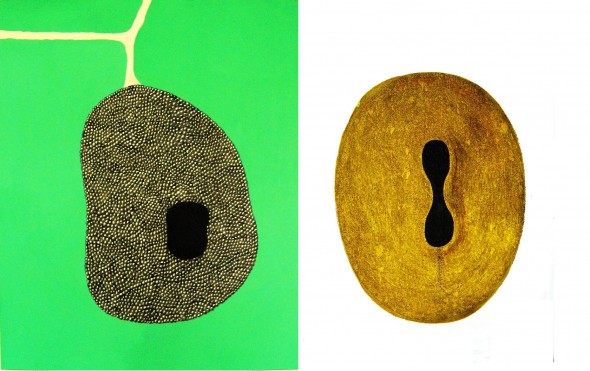
Hannu Väisänen: ‘Green and yellow in March’ (work in progress, oil on canvas, 130x193cm, 2010)
I decided to go to the Museum of Fine Arts.
After paying for my entrance ticket, I climbed the wide staircase to the first floor. There all I saw were dull paintings, the same heroic seed-sowers and floor-sanders as everywhere else. Why were so many art museums nothing more than collections of frames? Always national heroes making their horses dance, mud-coloured grumblers and overblown historical scenes. There was not a single museum in which a grandfather would not be sitting on a wobbly stool peering over his broken spectacles, interrogating a young man about to set off on his travels, cheeks burning with enthusiasm, behind them the entire village, complete with ear trumpets and balls of wool. The painting’s eternal title would be ‘Interrogation’ and it would be covered with shiny varnish, so that in the end all you would be able to see would be your own face.
I climbed up to the next floor. All I really felt was a pressing need to run away. No Flemish conversation piece acquired in the Habsburg era was able to erase a growing anxiety related to love. More…
Egg in a Cage?
17 August 2012 | This 'n' that

Noises off: the Chapel of Silence. Photo: Mika Huisman/Decopic
A windowless wooden construction with a timber interior sits on a busy route between the bus and railway stations in the middle of Helsinki. The egg-shaped Chapel of Silence contains simple wooden benches, offering a moment of peace and quiet for anyone passing by.
Almost 12 metres high, 270 square metres in overall footprint, it is a sacral space, with a small cross and an altar at the back, but it is not intended for liturgical purposes – however, social services are available for private conversation during opening hours.
Helsinki is this year’s World Design Capital – together with the neighbouring cities of Espoo, Vantaa, and Kauniainen, and Lahti, a hundred kilometres to the north. Every second year the International Council of Societies of Industrial Design recognises one global city `for its accomplishments in utilizing design as a tool to improve social, cultural, and economic life’. More…
Tutti frutti
20 November 2009 | In the news
 The chair of the jury for the Finlandia Prize for Non-Fiction 2009, Professor Pekka Puska, compared choosing a winner to the dilemma of choosing between oranges and bananas. The jury found that among the entries were at least 20 or 30 books that could have gone on the final shortlist of six titles. More…
Anu-Hanna Anttila & al.: Kuriton kansa [Unruly nation]
13 August 2010 | Mini reviews, Reviews
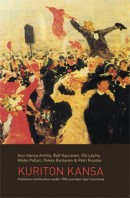 Anu-Hanna Anttila & Ralf Kauranen & Olli Löytty & Pollari Mikko Rantanen Pekka & Petri Ruuska
Kuriton kansa. Poliittinen mielikuvitus vuoden 1905 suurlakon ajan Suomessa
[Unruly nation. The political imagination of the 1905 general strike in Finland]
Tampere: Vastapaino, 2009. 317 p., ill.
ISBN 978-951-768-246-6
€ 33, paperback
In the beginning of the 20th century the Grand Duchy of Finland, a part of the Russian Empire, entered a period of crisis and began to turn into a nation with its own institutions. Universal and equal suffrage increased tenfold the number of those eligible to vote. A move to the granting of political rights was demanded during the 1905 general strike, which was both an internal political power struggle and a demonstration by Finns against the Russification measures being imposed by their rulers. The book examines the ideological currents of the strike period and investigates their definitions of ‘nation’ and ‘nationality’, with reference to literary research, historical sociology, cultural studies and women’s studies, making extensive use of contemporary documents. The book’s essays portray the spectrum of ideas, reflected in groups like the theosophists, Tolstoyans and anarchists.
Slowly does it
5 November 2009 | Reviews
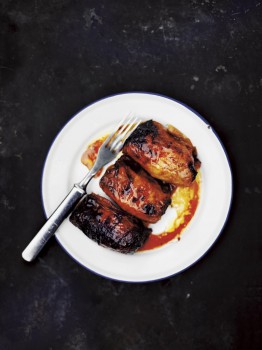
Straight from the oven: cabbage rolls. – Photo: Sami Repo
Mummola
[Grandma’s house]
(food: Hans Välimäki, photographs: Sami Repo, text: Mikko Takala, graphic design: Timo Numminen)
Helsinki: Otava, 2009. 224 p., ill.
ISBN 978-951-1-23930-7
€ 40
How paradoxical: in the past couple of decades, numerous internationally famous gourmet restaurants have sprung up in Finland, and at the same time it’s harder than ever to find ordinary, well-prepared ingredients for cooking at home.
It’s hard to get used to the fact that foods like beef and lamb kidneys, sweetbread, and cheaper cuts for use in stews and soups have made way for cheap Brazilian steaks on special offer, even at the largest stores’ meat counters. There’s no point in looking for whole chickens (and certainly not organic poultry), let alone whole, locally caught fish. The last time I asked at the fish counter of my local market if they might have any salmon heads and bones for chowder, the seller looked for a moment like she might summon security. The consumer wasn’t consulted when ‘taste’ and ‘variety’ were replaced by ‘ease’ and ‘speed’. More…
Verse and freedom
16 January 2014 | Articles, Non-fiction
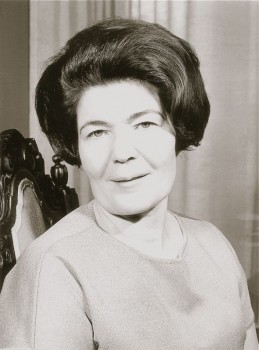
Aale Tynni (1913–1997). Photo: WSOY
Finnish poetic modernism, which with its freedom of rhythm came to dominate the literary mainstream of the 1950s, posed a particular challenge to the poets of the classical metrical and romantic poetic tradition. Aale Tynni (1913–1997) is not a poet of any one school or form, but rhythm is the deepest foundation of her poems, whether expressed in metre, free verse or the speech rhythms that characterise some of her poems of the 1950s and 60s, as well as those of her final years.
An Ingrian Finn, Tynni left Ingermanland near Petersburg for Finland as a refugee after the First World War, in 1919. The war and the period of uncertainty that followed it are present in her poems as an allegory, sometimes appearing as a dance of death or a carnival. At other times they emerge in the myth of Phaethon, who with his sun chariot is in danger of throwing Mother Earth off her axis, or as a game of chess in which God and the angel Gabriel play with the planets and moons as pieces. The poet makes use of mythic and cosmic references to widen her scope and to portray Man in the stages of history and the present age. More…