

Search results for "harjunpää/2010/10/mikko-rimminen-nenapaiva-nose-day"
Mind the gaffe
14 December 2012 | Non-fiction, Tales of a journalist
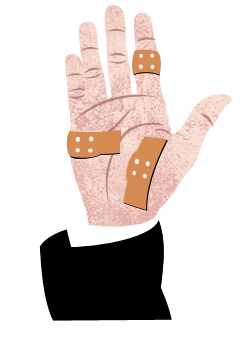
Illustration: Joonas Väänänen
Celebrating Finnish Independence Day is a serious business involving lots of handshakes and plenty of pitfalls for the unwary, observes columnist Jyrki Lehtola. But luckily there’s plenty of fun to be had for ordinary Finns in complaining about it all
When Finland makes the news, it’s usually because of a national tragedy or something odd we do. The latter ripe fodder for filling the blank pages of the international media on slow news days includes such things as the Finnish penchant for competitions in such sporting events as Wellington boot /mobile phone tossing (saappaan- / kännykänheitto) and wife carrying (akankanto).
We have another odd national tradition, although it has never received as much international recognition as the fact that we carry our wives competitively. This time- honoured custom repeats annually on the sixth of December, when we close our shops and barricade ourselves gloomily within our homes. Its name is Independence Day. More…
If grief smoked
31 March 1989 | Archives online, Fiction, poetry
Poems from six collections of poetry. Introduction by Herbert Lomas
The City
How the houses have ascended in this city,
the abysses deepened, the water blackened,
soon to be creeping along the streets.
The railings are rusting through,
the water table’s rising,
the cellars are slopping.
Fear is rising, or being covered up
behind strangling discretion,
outbreaks of crime.
Goodbye darling
30 March 2005 | Fiction, poetry
Poems from Niin kovaa se tuuli löi (‘So bitterly the wind struck’, Tammi, 2004)
Lord, you've promised to come, don't hang back.
     Here we are already, sitting, me and the dogs,
   and the others that have to go.

Jesus, poor thing, didn't know whom to bloom for,
  just kept on lugging his cross, pretty as a pony.
    He came and shot us down,
   bullets flying without his even noticing.
      The night was gifted with roses
        full of love.
 Through a woman we came here, through a man
    we leave.
A greater solitude
30 December 2004 | Fiction, Prose
Extracts from the novel Runoilijan talossa (‘In the house of the poet’, Tammi, 2004)
Images of love
The double door to the patio is tightly swollen into the framework, so tight I’m chary of using force to prize it open. The windows might break. The lower part remains stuck, as if screwed to a carpenter’s bench, while the upper part gapes – leans out as if longing to liberate itself from its lintel. That’s an image of love: one part longs to be free, the other part holds on fast. I get a toolbox from the cleaning cupboard and try to hammer a chisel into the space between the bottom edge and the threshold. I succeed, but the chisel marks the door, defacing it. That’s an image of love too. More…
Time difference
30 December 2003 | Fiction, Prose
A short story from Kalliisti ostetut päivät (Dearly bought days, Otava, 2003)
She arrived at the airport too early, as always. The reason was not that connections from the small town in which she lived were slow and difficult, or even that she liked the airport’s atmosphere of swift departures and long waits. No; she wanted to spend time at the airport to see that the planes took off and landed without anything awful happening. She wanted to see that a departing plane’s acceleration was rapid, that the plane left the asphalt of the runway elegantly, that its tail did not hit the ground as it rose, break, the plane explode, catch fire, but that, like an arrow fired into the air, following its flight path, it curved upward and, sunlight glancing off the metal of the body, disappeared from view. She wanted to see that the landing gear of a descending plane was out, as it should be, that a tyre did not burst as it hit the ground, at that there was no ice or oil on the runway; that the brakes worked, and that the fire engines at the edge of the airfield stayed in place as a sign that all was well. More…
Close encounters
31 March 1999 | Fiction, Prose
Viimeinen syli (‘The last embrace’, Otava, 1998)
The hospital looked as if a child had been given a big pile of building blocks and told to make a house, a big house. And then, when the building was ready, more bricks had been brought, and the child had been forced to pile them up over a wider and wider area, to spread rows of blocks across the adults’ routes and over the edge of the carpet until at last it had grown bored and left the last blocks higgledy-piggledy next to its creation.
Around the hospital ran a road from which the whole mess was revealed. Wing after wing, corridors and windows from which no one really ever looked out. The hospital was full of window views that did not belong to anyone, which did not open up from anyone’s office or day-room, but varied meaninglessly like a motorway landscape from the window of an accelerating car. Viivi had been born there, on the sixth floor of the old part of the hospital. As Mikael waited in the tiled fathers’ room next to the room where the Caeserean section was being carried out for his child to be brought to him, the view out had been breathtaking. More…
Wo/men at war
9 February 2012 | Essays, Non-fiction
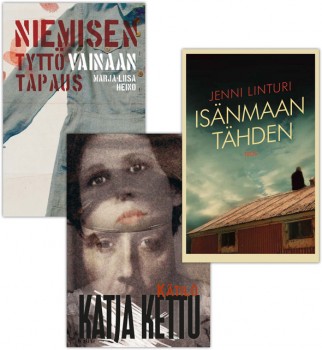 The wars that Finland fought 70 years and a couple of generations ago continue to be a subject of fiction. Last year saw the appearance of three novels set during the years of the Continuation War (1941–44), written by Marja-Liisa Heino, Katja Kettu and Jenni Linturi
In reviews of Finnish books published this past autumn, young women writers’ portraits of war were pigeonholed time and again as a ‘category’ of their own. This gendered observation has been a source of annoyance to the writers themselves.
Jenni Linturi, for instance, refused to ruminate on the impact of her sex on her debut novel Isänmaan tähden (‘For the fatherland’, Teos), which describes the war through the Waffen-SS Finnish volunteer units and the men who joined them [1,200 Finnish soldiers were recruited in 1941, and they formed a battalion, Finnische Freiwilligen Battaillon der Waffen-SS].
The work received a well-deserved Finlandia Prize nomination. Tiring of questions from the press about ‘young women and war’, Linturi (born 1979) was moved to speculate that some critics’ praise had been misapplied due to her sex. The situation is an apt reflection of the waves of modern feminism and the reasoning of the so-called third generation of feminists, who reject gender-limited points of view on principle. More…
The last melody
30 September 1995 | Archives online, Fiction, Prose
Extracts from the novel Kadotettu puutarha (‘The lost garden’, WSOY, 1995). Introduction by Riina Katajavuori
Their sojourn at the villa extended into the autumn of 1944; the schools did not go back as usual on the first of September. Repair of the university buildings progressed rapidly; the work had begun immediately after the bombing. The Doctor went to town from time to time, but nothing bound the family to it, and he returned to his desk in the attic room and to his solitary walks by the lake. His heart troubled him from time to time. It did not like these walks, did not like exertion; but he had succeeded in concealing the matter from Elisabet. After one particular attack, he had secretly seen a doctor in town, and now, instead of camphor tablets, he always had those little buttons in his pocket, the breast pocket of his waistcoat. He swallowed one from time to time on these expeditions, a pain in his wrists and his eyes staring dimly at a clump of ferns that seemed to have become hazy, or a tree-top that seemed to be falling toward him. He did not wish Elisabet to know. Not this, in Elisabet’s world, not this, in air that was suffused with grief for their dead son Leo, with well controlled and beautifully expressed emotion, with concern for the remaining boy, who was there, on the frontier, with the burdensome and universal tragedy that filled the air as light filled it in daytime. More…
How to peel an orange
30 December 2002 | Fiction, Prose
Extracts from the novel Auringon asema (‘The position of the sun’, Otava, 2002)
There are times when God rules. Then logic is burned on bonfires and left to rot in damp prisons with rats. There are times when logic rules. Then God is burned in the squares and his houses are made into schools. There are times when attempts are made to demonstrate that God and logic can live in the same place and that they are, in fact, the same thing, but those times are truly strange times. And there are times when God and logic live side by side but in different places, like adult siblings who cannot live in the same place but nevertheless get on well together. When my father and my mother loved each other, they were ruled by God, and there was no logic in it, none at all. More…
Across Europe
30 June 1990 | Archives online, Fiction, Prose
Mika Waltari (1908–1979) was a prolific writer, journalist and translator. In addition to historical novels, he wrote short stories, travel books, thrillers, plays, books for children, film scripts and poetry. The newly independent Finland of the 1920s, as it emerged from a traumatic period of civil war, declared that its windows were open to Europe, and Waltari’s first novel Suuri illusioni (‘The great illusion’), written in Paris when he was only 19, represents urban romanticism and the world of European capitals.The optimism and enthusiasm for modern life of the 1920s are strongly present in Waltari’s travelogue, Yksinäisen miehen juna, (‘Lonely man’s train’; 1929), an account, both ironic and engagingly naïve, of a great adventure in Europe after the post-1918 redrawing of the continent’s map. The book’s motto is a phrase from Paul Morand, a writer Waltari admired: ‘How is it possible to remain stationary when time slips like ice through our hot hands.’ This work of Waltari’s youth has never before been translated. The author travels by ship and train as far as Turkey; in the following extract, he has reached Hungary
Yksinäisen miehen juna (‘Lonely Man’s train’)
How adorable express trains are – the mighty engines, the rhythm of the rails, the sway of the carriages, the flashing-by of the milestones, the gravel embankments contracting into speeding lines. A train is the only place you can be completely at ease, free from heartache, free from longing, free from tormenting thoughts. Whenever I die, I hope it will be on a train flashing towards some unknown town at eighty miles an hour, with mountains looming on the horizon, and the points lighting up in the descending dusk…. More…
Findians, Finglish, Finntowns
16 May 2013 | Extracts, Non-fiction
Workers, miners, loggers, idealists, communists, utopians: early last century numerous Finns left for North America to find their fortune, settling down in Michigan, Minnesota, Wisconsin and Ontario. Some 800,000 of their descendants now live around the continent, but the old Finntowns have disappeared, and Finglish is fading away – that amusing language cocktail: äpylipai, apple pie.
The 375th anniversary of the arrival of the first Finnish and Swedish settlers, in Delaware, was celebrated on 11 May. Photographer Vesa Oja has met hundreds of American Finns over eight years; the photos and stories are from his new book, Finglish. Finns in North America

Drinking with the workmen: The Työmies Bar. Superior, Wisconsin, USA (2007)
The Työmies Bar is located in the former printing house of the Finnish leftist newspaper, Työmies (‘The workman’). The owners, however, don’t know what this Finnish word means, or how to pronounce it.
The Työmies Society, which published the newspaper of the same name, Työmies, was founded in Worcester, Massachusetts in 1903 as a socialist organ. It moved to Hancock, Michigan the following year. More…
Cool, not ice-cool
17 October 2013 | This 'n' that
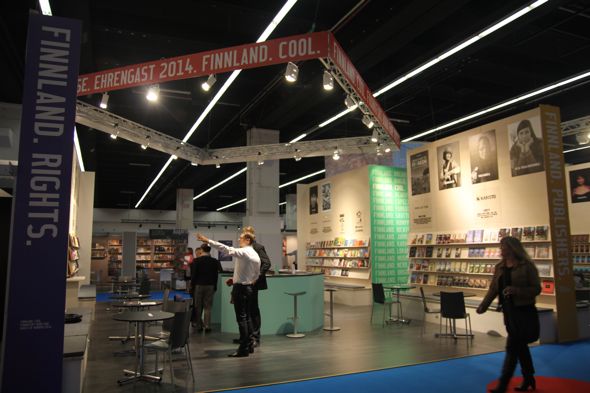
Getting ready: book fair scenery, 2013. Photo: FILI
The Finnish book world is preparing for the big event of ‘F14’: Finland will appear as Guest of Honour at the Frankfurt Book Fair in October next year.
The slogan for this enterprise is Finnland. Cool.
The coordinating organ is FILI, the Finnish Literature Exchange, a part of the Finnish Literature Society. Co-operating with FILI are three ministries, literary organisations and publishers, the Finnish Embassy and Finnland-Institut in Berlin and the Goethe-Institut in Helsinki.
Last week a large proportion of the FILI staff – who now need to keep their cool for the next busy year – went to Frankfurt, and on 10 October (aptly, the memorial day of the national author Aleksis Kivi and also Finnish Literature Day) the press conference was opened by the Finnish Minister of Culture and Sport, Paavo Arhinmäki. On 13 October the 2013 Guest of Honour, Brazil, passed the baton to Finland. (More photographs here.)
The world’s largest book fair, Frankfurt, attracts some 300,000 visitors each year. Accessible to both professionals and the general public, the fair is also the biggest cultural event in Germany.
The Guest of Honour countries receive a vast amount of attention in the media, and the number of new translations from the respective languages into German, as well as other languages, will increase.
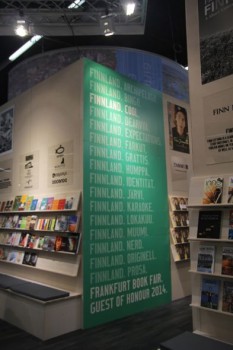
Finnland: arktik. Blondi. Cool. Demokratia. Einsam. Formula 1. Girji. Heimat. Ihminen. Joy…. Photo: FILI
The total Finnish budget for the years 2010–2015 is approximately four million euros, half of it money from the government. And the mission? Here are some warm words from the cool FILI agenda:
‘Why are Finns reading so much? Why are Finns so good at reading? Because we love it. Because reading plays such an important role in everyday life.
‘And because it is so important in Finland that everybody has access to reading – regardless of whether you are male or female, where you live, where you work, what your education or talent is. Fun, everyday life and for everyone – these are the main themes of the satellite programme for the Guest of Honour at the Frankfurt Book Fair 2014.’
A light shining
28 July 2011 | Essays, Non-fiction
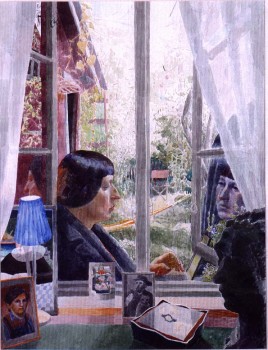
Portrait of the author: Leena Krohn, watercolour by Marjatta Hanhijoki (1998, WSOY)
In many of Leena Krohn’s books metamorphosis and paradox are central. In this article she takes a look at her own history of reading and writing, which to her are ‘the most human of metamorphoses’. Her first book, Vihreä vallankumous (‘The green revolution’, 1970), was for children; what, if anything, makes writing for children different from writing for adults?
Extracts from an essay published in Luovuuden lähteillä. Lasten- ja nuortenkirjailijat kertovat (‘At the sources of creativity. Writings by authors of books for children and young people’, edited by Päivi Heikkilä-Halttunen; The Finnish Institute for Children’s Literature & BTJ Kustannus, 2010)
What is writing? What is reading? I can still remember clearly the moment when, at the age of five, I saw signs become meanings. I had just woken up and taken down a book my mother had left on top of the chest of drawers, having read to us from it the previous day. It was Pilvihepo (‘The cloud-horse’) by Edith Unnerstad. I opened the book and as my eyes travelled along the lines, I understood what I saw. It was a second awakening, a moment of sudden realisation. I count that morning as one of the most significant of my life.
Learning to read lights up books. The dumb begin to speak. The dead come to life. The black letters look the same as they did before, and yet the change is thrilling. Reading and writing are among the most human of metamorphoses. More…
Best foot forward
14 May 2010 | This 'n' that
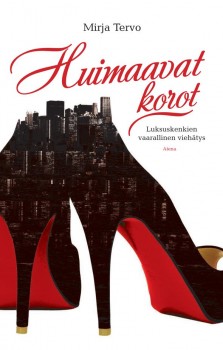 C’est moi. Tribute. Eliza. Muse. Monica. Very Privé, Super Private.
These are names of shoes that women buy in luxury shops on New York’s Fifth Avenue. Six inches or more of heels that cost anything between 500 and 5,000 dollars, make walking torture; but pain is tolerated, as along with the shoes a woman acquires a deeply satisfying feeling of being envied, beautiful and sexy (her toe cleavage has to be clearly visible).
Mirja Tervo (born 1971) is an ethnologist who spent a year and a half selling luxury shoes in Manhattan. Among her fellow sales personnel were a medical doctor, a musician, an actor and a retired baseball pro.
The shoe salon paid no salary, just commission of ten per cent, and the required minimum sale per week was 3,500 dollars. If a sales person failed to sell merchandise worth this sum, he or she was given a loan of 300 dollars, payable immediately when the results improved, and they quickly had to. More…
I am me
30 September 2010 | Fiction, Prose
Extracts from the novel Poikakirja (‘The boy’s own book’, Otava, 2010). Introduction by Mervi Kantokorpi
It’s a small day in spring. Another name for the lark is the skylark. You can only see them sometimes, and even then they’re so high up in the sky that they swoop like fast-moving dots.
The kitchen windowpane is rippling with stripes. The window has a bottom, and at the bottom there is some cotton wool and two opened matchboxes, a blue Sampo and a picture of an army chaplain in his uniform and insignia. As spring has progressed the cotton wool at the bottom has turned into wet blobs and the matches will never light again, as they’ve sucked up the winter frost from the glass.
Most children are made at home but not us, says Eini during walking practice. Outi shoves her, tells her to be quiet and walk in rhythm. I’m behind the table reading the Children’s Encyclopaedia, but I watch them. With every second step, their bottoms swing to the right and then to the left.
Mum comes into th the kitchen and asks what they’re doing; Anna-Liisa responds on the twins’ behalf, says they’re practising walking like in the movies and that’s why they’re wiggling their hips. More…