

Search results for "harjunpää/2010/10/mikko-rimminen-nenapaiva-nose-day"
Northern exposure
3 September 2005 | Archives online, Fiction, Prose
Extracts from the novel Valon reunalla (‘At the edge of light’, Teos, 2005). Introduction by Kristina Carlson
Kari
The village despised all those who left. They hated us too, though we were still only planning our final escape.
We used to escape the village. We would hide from its gaze in the forest or the cemetery where the gravestones were so close together that there was no room for the trees to grow. We knew why the freight train brought the village so many dead and so few living. It was the village’s fault. It had a wicked soul. The grown-ups didn’t know it. We knew it, but no one asked us. Death was within us; it was alive. Asking would have been too dangerous….
On the backs of the headstones we carved our own marks with the end of a knife. We blew out the candles laid at the graves of suicide victims. We worshipped them in the dark and no new candles were ever brought to their graves. The parents of those who died so young drove south. They were looking for stations with real waiting rooms and staff that made announcements. They sat on the hard benches waiting, waiting for the trains to come, at the right time; hoping the years wouldn’t wreak havoc after all, hoping they’d roll slowly back along the tracks, to brighten as they approached the village, giving life once again to their children. And everything could start over. More…
Wolf-eye
30 June 2004 | Archives online, Fiction, Prose
Extracts from the novel Käsky (‘Command’, WSOY, 2003). Introduction by Jarmo Papinniemi
Only once he had led the woman into the boat and sat down in the rowing seat did it occur to Aaro that it might have been advisable to tie the woman’s hands throughout the journey. He dismissed the thought, as it would have seemed ridiculous to ask the prisoner to climb back up on to the shore whilst he went off to find a rope.
It was a mistake.
After sitting up all night, being constantly on his guard was difficult. Sitting in silence did not help matters either, but they had very few things to talk about. More…
The house in Silesia
31 December 1989 | Archives online, Fiction, Prose
A short story from Talo Šleesiassa (‘ The house in Silesia’, 1983). Read the interview
We set off, my brother-in-law and I, at the beginning of September. The tourist season was already over, and on the Gdansk ferry there was stacks of room for my brother-in law’s Volvo and the two of us.
We’d driven from his home on the shore of Lake Mälar to the ferry port at Nynäshamn, about fifty miles south of Stockholm. We’d driven in an atmosphere of cheerful resolution, accelerator down, but going steadily. The resoluteness was due to my brother-in-law’s decision after forty years’ absence to visit his childhood home. If it was still standing, that is – or whatever of it was.
‘Oh the house is definitely still in place there all right,’ he said: ‘I’ve got that sort of tickly feeling in my arse.’ It was a direct translation from the German – German humour of the vulgar variety centring round the bottom. More…
What God said
3 September 2009 | Fiction, Prose
Extracts from the novel Herra Darwinin puutarhuri (Otava, 2009; Mr Darwin’s Gardener, Peirene Press, 2013). Interview by Soila Lehtonen
The congregation sits in the church pews and the jackdaws caw in the belfry.
We smell of wet dog, the rain made us wet and it is cold but the singing warms us, the hymn rises to the roof and above the roof dwells God, Amen.
We saw Thomas Davies on the hill, he is working in Mr Darwin’s garden,
the atheist and lunatic, he stood in the field alone and the water lashed his face
an irreligious pit pony wandering in the darkness he is from Wales
does the godless man think he can stand in the rain without getting wet did he get an umbrella or bat wings from the devil
perhaps Thomas imagines that he can hold back the rain and the rain not hold him back, he thinks he is more exalted than God with his head in the clouds
The church’s hard pews press into posteriors, the poor man will not grow fatter, for there are no fat and lean years but only lean ones, and thin are the poor man’s sheep and cows and children too, but the rich man cultivates weeds for his amusement as Mr Darwin did and earns money and fame! More…
Country matters
30 June 2001 | Archives online, Fiction, Prose
A short story from Peili (‘Mirror’, Tammi, 2000). Introduction by Suvi Ahola
I’m getting so old, my Master and Mistress no longer take note of when I’m on Heat. They don’t even notice when some moisture comes dripping out of my innards, as a sign of it, like they did in the good old days. Anyway, this time I really boobed, I dirtied my Mistress’s Christmas slippers with my secretions. So what could I do? – if it drips it drips. I happened to be lying on my Mistress’s feet at the time, she’d invited me there herself. ‘Spot, Spot, come and warm my feet,’ she said. Of course I went, I always have done when I’m called, it’s rather nice. Your belly gets nice and warm there, and if you’re lucky your Mistress scratches your back now and then with her knitting needle. I sleep and snore a little – it amuses my Mistress and Master. But then the warming of my belly led to this boob – a big dose of this wetness slurped onto my Mistress’s feet. It caused a sudden departure. My Mistress yelled, and my Master flung me out into the yard. I’d scarcely managed a squeak before I found myself in the snow. I shan’t forgive them, no. It’s beyond my comprehension.
In pursuit of a conscience
19 March 2012 | Drama, Fiction
‘An unflinching opera and a hot-blooded cantata about a time when the church was torn apart, Finland was divided and gays stopped being biddable’: this is how Pirkko Saisio’s new play HOMO! (music composed by Jussi Tuurna) is described by the Finnish National Theatre, where it is currently playing to full houses. This tragicomical-farcical satire takes up serious issues with gusto. In this extract we meet Veijo Teräs, troubled by his dreams of Snow White, who resembles his steely MP wife Hellevi – and seven dwarves. Introduction by Soila Lehtonen
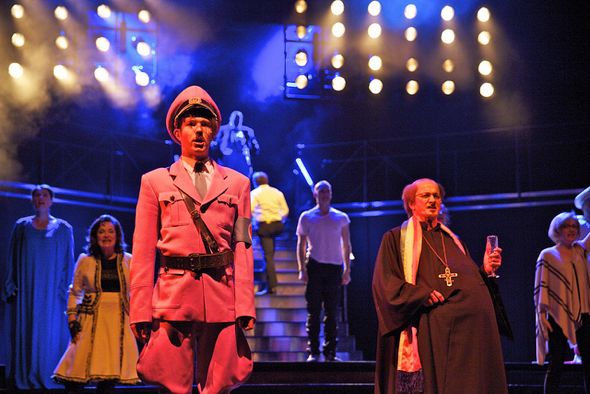
Dictators and bishops: Scene 15, ‘A small international gay opera’. Photographs: The Finnish National Theatre / Laura Malmivaara, 2011
CAST OF CHARACTERS
Veijo Teräs
Hellevi, Veijo’s wife and a Member of Parliament
Hellevi’s Conscience
Rebekka, Hellevi and Veijo’s daughter
Moritz, Hellevi and Veijo’s godson
Agnes af Starck-Hare, Doctor of Psychiatry
Seven Dwarves
Tom of Finland
Atik
The Bishop of Mikkeli
Adolf Hitler
Albert Speer
Josef Stalin
Old gays: Kale, Jorma, Rekku, Risto
Olli, Uffe,Tiina, Jorma: people from SETA [the Finnish LGBT association]
Second Lieutenant, Private Teräs, the men in the company
A Policeman
Big Gay, Little Gay, Middle Gay
William Shakespeare
Hermann Göring
Hans-Christian Andersen
Teemu & Oskari, a gay couple
The Apostle Paul
Father Nitro
Winston Churchill
SCENE ONE
On the stage, a narrow closet.
Veijo Teräs appears, struggling to get out of the closet.
Veijo Teräs is dressed as a prince. He is surprised and embarrassed to see that the audience is already there. He seems to be waiting for something.
He speaks, but continues to look out over the audience expectantly.
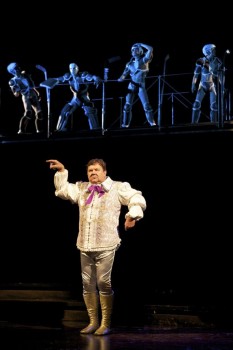
Snow White's spouse, Veijo (Juha Muje), and the dwarves. Photo: Laura Malmivaara, 2011
VEIJO
This outfit isn’t specifically for me, because… I mean, it’s part of this whole thing. This Snow White thing. I’m waiting for the play to start. Just like you are. My name is Veijo Teräs and I’m playing the point of view role in this story. Writers put point of view roles like this in their plays nowadays. They didn’t use to.
Just to be clear – this isn’t a ballet costume. I’m not going to do any ballet dancing, but I won’t mind if someone dances, even if it’s a man. Particularly if it’s a man. But I don’t watch. Ballet, I mean. Not at the opera house, or on television, or anywhere, and I have no idea why we had to bring up ballet – or I had to bring it up – because this is a historical costume, so it’s appropriate. This is what men used to wear, real men like Romeo and Hamlet, or Cyrano de Bergerac. But we in the theatre these days have a hell of a job getting an audience to listen to what a man has to say when he’s standing there saying what he has to say in an outfit like this. People get the idea that it’s a humorous thing, but this isn’t, this Snow White thing, where I play the prince. Snow White is waiting in her glass casket, she died from an apple, which seems to have become the Apple logo, Lord knows why, the one on the laptops you see on the tables of every café in town. More…
No place to go
30 March 2008 | Archives online, Fiction, Prose
Extracts from the novel Lakanasiivet (‘Linen wings’, Otava, 2007)
The clothesline swayed in the wind. Helvi closed her eyes and felt herself flutter into the air with the laundry. She flapped her white linen wings, straining higher, now seeing below the whole small peninsula city, its damp rooftops glittering in the morning sun, the blue sighs of the chimneys, the steamboats toiling on the lake and the trains chugging on their tracks. The whole of heaven was clear and blue; only far off in the east were there white pillars roiling – whether smoke or clouds, Helvi could not tell.
She flew north on her linen wings and saw the great bridges leading to the city, on whose flanks the hidden anti-aircraft batteries gasped the fumes of gun oil and iron, and continued her journey over the land, following the straight lines of the telephone wires. She flew over wooded hills and deep green fields, finally arriving on the slope of the great hill where her daughter now lived, in hiding from the war. More…
Dog days
30 September 2008 | Fiction, Prose
A story from Avantgarderob ja muuta irtaimistoa (‘Avantgarderobe and other moveables’, Tammi, 2008). Introduction by Soila Lehtonen
The air between the old dog’s teeth cuts like a crosscut saw.
There is a furious rhythm in her bark.
She’s been left out of the moose-hunting pack.
The more decrepit her body is, the stiffer her joints, the more her bark is filled with passion for the hunt. But she shows no sign of nostalgia, she’s not hankering after some long-ago days of glory, when she was the leader of the pack. This is clearly a bark of command. Even from kilometres away, she tells the other dogs where to go — not that way — a little more to the left — behind that stump, you blockheads! More…
Stories in the stone
2 December 2010 | Extracts, Non-fiction
Extracts from Jägarens leende. Resor in hällkonstens rymd (‘Smile of the hunter. Travels in the space of rock art’, Söderströms, 2010)
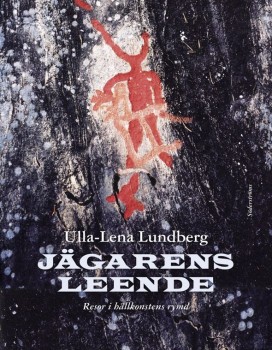 ‘Why do some people choose to expend what is often a great deal of effort hammering images in the bedrock itself, while others conjure up, in the blink of an eye, brilliantly radiant pictures on a rock-face that was empty yesterday but is now peopled by mythological animals, spirits and shamans?
‘I think about this often – I who love painting but who still chose a career that involves me sitting and hammering away, day in and day out, like a true rock-carver,’ writes author and ethnologist Ulla-Lena Lundberg in her new book on the art of the primeval man
When the children of Israel went into Babylonian captivity, hanging up their harps on the willow-trees and weeping as they remembered Zion, my sister and I were already sitting by the rivers of Babylon. We knew how they felt. Our father was dead and we had been sent away from our home. We sat there clinging to each other, or rather I was the one clinging to Gunilla, and she had to try to rouse herself and find something for us to do, to give us something else to think about. More…
Nature’s not my thing
A short story from Hommes (Tammi, 2006)
Lying unemployed on my sofa I hear a lot of stuff on the radio almost every day you hear some children’s choir chanting the same songs over and over about our country’s blue lakes the sky and all our trees and their white trunks. They’ve all finally worked their way into my subconscious. After hearing enough of these songs my subconscious rears its head and commands my idle body: go to the forest. In a situation like that it’s hard to put up a fight or struggle against something you can’t see or hear or smell that all of a sudden pops into your head.
The great debate was over so quickly that hardly anyone managed to get a word in I think to myself as I lie in bed at night just before falling asleep. More…
It takes a life to say
31 December 2007 | Archives online, Fiction, poetry
Poems, published in You go the words (Action Books, Scandinavian Series, Indiana, 2007). Introduction by Trygve Söderling
|
We go and search it is not words * You go the * And spread out To only * The song * One time I have a name * a longing * A morning’s * Words are words But word’s image Alas stay not * Fly out, my day
fly, fly day to meet
fly, fly, you the wretched's
their, everyone's
in all times
peace and day
on ground's floor
floor ground
o you
in man's name
* Suneveningspring * Dog bolts happy * And to not speak more it takes a life to say but – as the everyday moment O no beauty But your light – a smile what and to know * And allthesame The white day * |
Vi går och söker det är ej ord * Du går de * Och bredd ut Att endast * Sången * En gång Jag har ett namn * en längtan * En morgons * Ord är ord Men ords bild Ack stanna ej * Flyg ut, min dag
flyg, flyg dag till möte
flyg, flyg, du de armas
deras, allas
i alla tider
lugn och dag
på marks golv
golv mark
o du
i människans namn
* Solaftonvår * Hund skenar glad * Och att ej tala mer det tar ett liv att säga men – som vardagens stund O ingen skönhet Men ditt ljus – ett leende vad och att veta * Och alltjämt Den vita dag * |
Translated by Fredrik Hertzberg
Daughter of Cain
30 June 1985 | Archives online, Fiction, Prose
An extract from the novel Kainin tytär (‘Daughter of Cain’, 1984). In the following extract Anna and Risku spend a single night recalling the early days of their relationship; Anna is in the country, Risku is in the city. Introduction by Soila Lehtonen
Anna
The moon hangs before the bosom of the sky, a slender crescent, but giving light all the same.
On the horizon a black, glimmering line emerges from the water. It is the skerry, a low, lone rock.
I shut off the motor. The sea laps minutely against the side of the boat. This far out there are no longer any birds.
The silence here is deeper than even that of an empty room.
The skerry is as black and glistening as the back of a pike.
Light is matter, it’s never steady.
Whatever is understood in life is understood in a sudden blue illumination, like lightning cleaving the night to expose the landscape – shadows, hollows and all. More…
How love begins
31 March 1992 | Archives online, Fiction, Prose
A short story from Kuinka rakkaus syntyy (‘How love is born’; Otava, 1991)
All that day the words of the song ran through Annika’s mind.
‘How love begins, nobody knows’: those were the words with which the clock radio had woken her this morning.
They had bought a clock radio so as not to have to listen to the ticking of a clock in the dark, echoing room, or its ear-splitting alarm, like the screaming of a small wounded animal.
They had bought other things, too, to make their lives easier: a dish-washer, and a washing machine that also dried the clothes, and a microwave oven, and a second telephone, because the flat was a big one. Life went on; there was plenty of time to be, and to think about what had been, and what could have been, and what would come to be. More…
Images of isolation
31 March 1992 | Archives online, Fiction, poetry
Poems by Helvi Juvonen, commentary by Soila Lehtonen
Little is known of the circumstances of Helvi Juvonen’s life. Her fame rests on five collections of poetry – mixing humility and celebration with an uncompromising rigour – published in the ten years before her death at the age of 40 (a sixth appeared posthumously). Her existence, in the drab surroundings of post-war Helsinki, was modest: after studies at Helsinki University, and posts as a bank clerk and proof-reader, she lived by writing and translation, including some brilliant renderings into Finnish of the poems of the 19th-century American poet Emily Dickinson.
Helvi Juvonen’s universe is crowded with ostensibly insignificant phenomena: her eye discerns a mole, lichen, dwarf-trees, a shrew; she studies tones of stone and moss; she ‘doesn’t often dare to look at the clouds’.
Us
Rocks, forgotten within themselves,
have grown dear to me.
The trees’ singing, so useless,
is my friend.
Silver lichen,
brother in beggary,
please don’t hate my shadow
on the streaked rock. More…