

Search results for "harjunpää/2010/10/mikko-rimminen-nenapaiva-nose-day"
Irma-Riitta Järvinen: Kalevala Guide
10 September 2010 | Mini reviews, Reviews
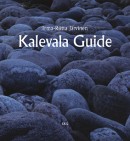 Kalevala Guide
Helsinki: Finnish Literature Society, 2010. 127 p., ill.
ISBN 978-952-222-193-3
€ 24.90, paperback
This book is a brief but comprehensive English-language guide to the Finnish national epic, which was based on the archaic oral, sung folk poetry of Karelia, but collected and personally compiled by the scholar and writer Elias Lönnrot (1802–1884). The epic (first edition 1839, complemented in 1849) is set in a mythic past; technically speaking, the metre is an unrhymed, non-strophic trochaic tetrametre, characterised by alliteration. Contents, characters, places and themes are explained in the Guide, which also explores myths of origin and the significance of the epic. On his eleven trips to Archangel and North Karelia, Lönnrot met some 70 singers. The Kalevala, now translated, at least in part, into more than 60 languages, has inspired artists the world over (J.R.R. Tolkien was a fan, while Henry Wadsworth Longfellow’s Hiawatha imitates the metre and style of the Kalevala). The composer Jean Sibelius and the artist Akseli Gallen-Kallela are perhaps the best known Finnish Kalevala artists. And the inspiration continues: for instance, rock musicians and visual artists make use of Kalevala themes, stories and characters in their work. The book includes a list of relevant websites and a select bibliography.
Maria Turtschaninoff: Underfors [Underville]
28 January 2011 | Mini reviews, Reviews
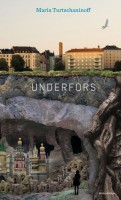 Underfors
[Underville]
Helsingfors: Söderströms, 2010. 342 p.
ISBN 978-951-52-2739-3
€16 , hardback
This highly original fantasy novel by the Swedish-speaking author Maria Turtschaninoff (born 1977) is evidence of the innovative thinking that Finnish authors for young people bring to the international fantasy genre, particularly the currently fashionable vampire and werewolf themes associated with the borderline between life and death. The protagonist, Alva, is an adopted teenage girl who has some black holes in her memory of early childhood. A young man called Nide leads Alva to a land situated beneath Helsinki, where Alva learns that she is the heir to the shadow king. This novel is teeming with goblins, sprites, kelpies, pixies and sorceresses. Events come to a head on Midsummer Night, when magic spells can come true. Underfors is a classic story of a person’s search for her identity: Alva constructs her shattered self using fragments she finds from her past. She is liberated from guilt, longing and her inexplicable anguish, but becoming free requires sacrifices and struggles with ethical issues.
Translated by Ruth Urbom
Sodan kasvattamat [Brought up by war]
6 May 2011 | Mini reviews, Reviews
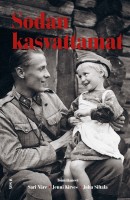 Sodan kasvattamat
[Brought up by war]
Toimittaneet [Ed. by]: Sari Näre, Jenni Kirves and Juha Siltala
Helsinki: WSOY, 2010. 464 p., ill.
ISBN 978-951-0-36733-9
€ 34, hardback
This volume is a collection of personal historical accounts relating to child-rearing and youth during the Finnish Winter and Continuation Wars (1939–1944). In the war years, 60,000 children were orphaned and nearly 80,000 were evacuated abroad, mainly to Sweden; in relative terms, this was a greater proportion of the nation’s children than were similarly affected anywhere else in the world. Some 150,000 children lost their homes in bombing raids or in the Finnish evacuation from the region of Karelia. Finland’s agrarian society taught these children to be obedient and to get by without assistance from adults. The Finnish civil war of 1918 had its effects as well: people did not talk much about their emotions. In circumstances where disciplined sacrifice was emphasised, young people found solace in games, sport and working. Researcher Ville Kivimäki speculates that the widespread experience of an unprotected childhood may have led, at least in part, to Finland’s establishing a social welfare state after the Second World War, as a kind of compensation. The material draws on earlier research, archived personal accounts and memoirs as well as numerous new in-depth interviews.
Translated by Ruth Urbom
Heikki Hiilamo: Kuoleman listat. Suomalaisten salainen apu Chilen vainotuille [Death lists. Secret assistance of the Finns to Chilean dissidents]
17 September 2010 | Mini reviews, Reviews
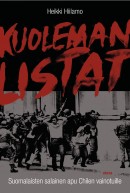 Kuoleman listat. Suomalaisten salainen apu Chilen vainotuille
[Death lists. Secret assistance by Finns to Chilean dissidents]
Helsinki: Otava, 2010. 362 p., ill.
ISBN 978-951-1-24003-7
€ 32, hardback
The 1973 Chilean coup that ousted President Salvador Allende, and the subsequent persecution of dissidents, forced Allende’s supporters to seek asylum in foreign embassies. A number of refugees climbed over the wall of the Santiago home of Finland’s chargé d’affaires, Tapani Brotherus. As the Finnish official line of neutrality was to avoid interfering in the internal affairs of other countries, Brotherus was taking a great personal risk, by allowing this, and keeping it secret from the Finnish Ministry of Foreign Affairs. With the help of the embassy’s undersecretary and the East German diplomat Arnold Voigt, he and his wife succeeded in helping some 2, 200 people to leave Chile. Brotherus also helped 182 political refugees to obtain asylum in Finland. Heikki Hiilamo, who is now Research Professor at Kela, the Social Insurance Institution of Finland, describes the background of the Chilean dictatorship and the development of the broad-based solidarity movement, which has been characterised as one of the central formative experiences of the generation that grew up in 1970s Finland. The movement’s activists included future Finnish presidents Mauno Koivisto and Tarja Halonen, as well as the future Nokia CEO Jorma Ollila.
Anja Snellman: Parvekejumalat [Balcony gods]
30 September 2010 | Mini reviews, Reviews
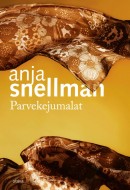 Parvekejumalat
[Balcony gods]
Helsinki: Otava, 2010. 316 p.
ISBN 978-951-1-22756-4
€ 31.80, hardback
The theme of this novel is delicate and still largely silenced: the collision between the cultures of Muslim immigrants and the local population. Immigration into historically homogeneous Finland is a comparatively newer phenomenon than in many other European countries. Like other teenage girls, the Somali girl Anis dreams about partying, boys and a future, which completely deviaties from the customs and ideals of her patriarchal Muslim family. Her counterpart, the Finnish girl Alla, wishes to convert to Islam, because she has found herself suffering at home from the consequences of Western ‘freedom’ and is left with a feeling of devastating insecurity. Islamic culture’s halal and haram (strictly ‘good’ and ‘bad’) crushes or is crushed in Finnish life. The provocative contrasts and solutions presented in Snellman’s novel (her 19th) appear occasionally overemphasised. In defending the right of women to determine their own lives, Snellman (born 1954) deals Anis an extraordinarily tragic fate.
The naked truth
18 January 2011 | This 'n' that
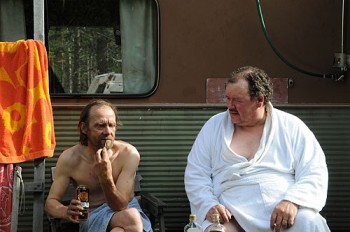
Out with the truth: sauna camaraderie in the film Steam of Life. Photo: Oktober
Finnish men don’t usually open up about much, it’s generally thought, as they don’t like to speak about feelings.
But in the sauna, it’s different. Intimacies are revealed in its soft steam, by men who sit there quietly and give voice to the sorrows of their lives.
In Miesten vuoro / Steam of Life, a full-length documentary film by two directors, Joonas Berghäll and Mika Hotakainen which premiered in March 2010, Finnish men both talk and weep. They have gained considerable popularity among audiences in Finland and abroad.
A naked guy sits on a wooden bench in the steam or outside the sauna building (which could be an old wooden hut in the countryside, a modern city sauna or some odd construction serving the purpose) with a bottle of beer in his hand, and tells the man sitting next to him in earnest about his dead child, new wife, or the death of his mother: the great sorrows or joys of his life.
Water, fire, bare skin and no ornaments: vulnerability. He can be a war veteran or a younger man, lonely or happily married. But he talks, cleansing himself both physically and mentally.
Steam of Life has so far been seen by approximately 50,000 people in Finland, and the DVD has sold more than 28,000 copies. It is the first Finnish documentary to compete for the Academy Award for Best Foreign Language Film. The Oscar nominees will be published on 25 January, with the award ceremony taking place at the end of February.
Steam of Life has won prizes both in Finland and abroad: in Tel Aviv, Warsaw, Pärnu in Estonia, Germany (DOK Leipzig where it won a Silver Dove) and Portugal. It received a Special Jury Mention at the Silverdocs documentary film festival in the United Sates and the Prize of the Interreligious Jury at the Visions du Réel festival in Switzerland. It will continue its tour of film festivals this year; see the trailer here.
The DOK Leipzig jury commented: ‘The film, deliberately set in an original Finnish situation – a sauna, opens a door into the intimate and hidden world of men’s fragility and vulnerability, turning the sauna into a place where naked truth is told by naked men. The film bends together tragic and comic….’
Mies ei puhu eikä pussaa is a saying; we’d translate this as ‘a Finn neither speaks nor snogs’, Finn referring to a male person. But the times, they are a-changing, it seems.
Praise and prize for theatre on the edge of Europe
29 April 2011 | In the news
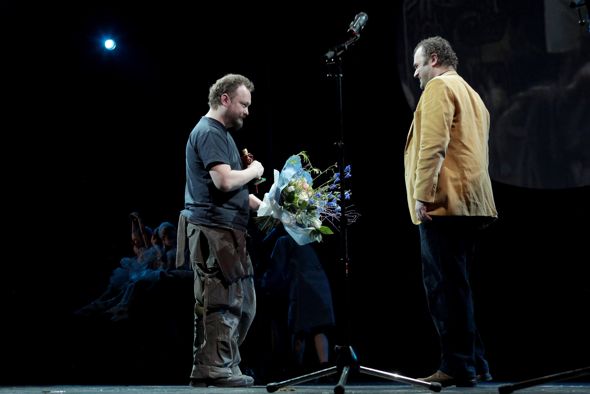
Kristian Smeds is awarded the XII Europe Prize of New Theatrical Realities in St Petersburg on 17 April, presented by a previous prize-winner, Italian theatremaker Pippo Delbono. Photo: rossetti/phocusagency
Theatremaker Kristian Smeds (born 1970) was awarded the XII Europe Theatre Prize for New Theatrical Realities in St Petersburg on 17 April. The prize, worth 30,000 euros, was – this time – divided between six prominent theatremakers or theatre groups. (For more information, see the Premio Europa website.)
The international prize jury consists of representatives of many institutions of the field. Since 1986 the main prize, the Europe Theatre Prize (worth 60,000 euros), has been awarded to 14 European theatremakers considered influential – among them, the directors and/or writers Ariane Mnouchkine, Peter Brook, Heiner Müller, Lev Dodin, Harold Pinter, and now, the German director Peter Stein. More…
Life through the lens
22 December 2010 | Extracts, Non-fiction
Let’s go on a little pictorial journey in time with the photographer Erik Hägglund, whose camera went on clicking for 50 years: gentlefolk, peasants, children, old people and village views, beginning almost a hundred years ago in rural western Finland
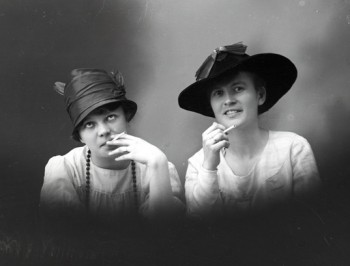
Ladies in hats: in the 1920s Vörå hats were only used by gentlewomen (and smoking was perhaps a little risqué). Photo: Erik Häggblom
Blickfång. En tidsresa med Vöråfotografen Erik Hägglund (‘In focus. A journey in time with the photographer Erik Hägglund from Vörå’. Red. [Ed. by] Katja Hellman, Meta Sahlström & Monica West. Helsingfors: Svenska litteratursällskapet i Finland, 2010
Old photographs may prove that what is utterly local can be perfectly universal.
That’s certainly the impression the reader gets by looking at the pictures taken by Eric Hägglund between 1910 and 1960.
The village of Vörå (in Finnish, Vöyri) on the west coast of Finland, near the Ostrobothnian city of Vasa (in Finnish, Vaasa) is traditionally mostly a Swedish-speaking community. Erik Hägglund, born 1884, lived, photographed and died there in 1962. More…
Government prize for translation 2012
14 September 2012 | In the news
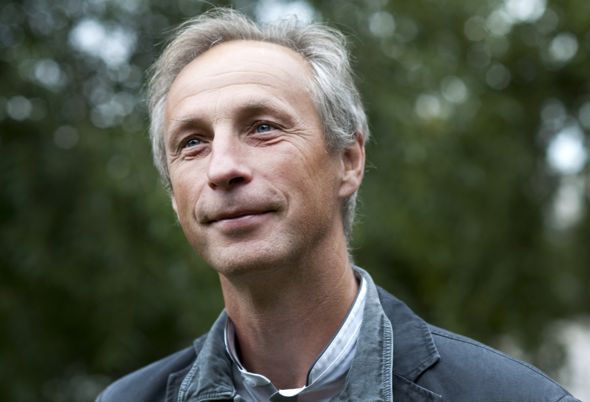
Vladimír Piskoř. Photo: Charlotta Boucht
The Finnish Government Prize for the Translation of Finnish Literature of 2012 – worth €15,000 – was awarded to the Czech translator Vladimír Piskoř.
Piskoř (born 1960), graduated from the Charles University of Prague in 1984, majoring in Finnish. Since the early 1990s he has translated almost 30 titles, most by contemporary authors, including Kristina Carlson, Kari Hotakainen, Leena Krohn, Rosa Liksom, Asko Sahlberg, Juha Seppälä, Petri Tamminen and Maria Peura.
‘I personally am fond of the novels by Kari Hotakainen: I sometimes play with the idea of becoming a writer myself, and I find his style and themes particularly interesting. Kristina Carlson’s latest novel Herra Darwinin puutarhuri (‘Mr Darwin’s gardener’, 2010) is a truly inspiring work both as a reader and a translator,’ he says.
Piskoř is currently working on Kari Hotakainen’s novel Jumalan sana (‘The word of God’) and Leena Lander’s historical novel Käsky (‘Command’). In 2006 he was awarded the Czech translators’ special prize for the novel Höyhen (‘Feather’) by Asko Sahlberg.
Vladimír Piskoř received his award in Helsinki on 10 September from State Secretary Jarmo Lindén; he thanked Piskoř for the work he has done for the last twenty years, particularly in the field of contemporary Finnish fiction.
The prize has been awarded – now for the 38th time – by the Ministry of Education and Culture since 1975 on the basis of a recommendation by FILI – Finnish Literature Exchange.
Solzhenitsyn and Silberfeldt: Sofi Oksanen publishes a best-seller
25 April 2012 | In the news
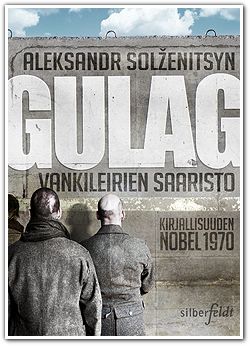
Nobel Prize 1970: Aleksandr Solzhenitsyn
After falling out with her original publisher, WSOY, in 2010, author Sofi Oksanen – whose third novel, Puhdistus (Purge, 2008), has become an international best-seller – has founded a new publishing company, Silberfeldt, in 2011, with the aim of publishing paperback editions of her own books. Its first release was a paperback version of Oksanen’s second novel, Baby Jane.
Oksanen’s new novel, Kun kyyhkyset katosivat (‘When the pigeons disappeared’), again set in Estonia, will appear this autumn, published by Like (a company owned by Finnish publishing giant Otava).
However, in April Silberfeldt published a new, one-volume edition of the autobiographical novel The Gulag Archipelago by the Nobel Prize-winning author Alexandr Solzhenitsyn. This massive book was first published in the West in 1973, in the Soviet Union in 1989.
A Finnish translation was published between 1974 and 1978. Back in those days of Cold War self-censorship, Finnish publishers felt unable to take up the controversial book, and the first volume was eventually printed in Sweden. The work, finally published in three volumes, has long since been unavailable.
This time the 3,000 new copies of Solzhenitsyn’s tome sold out in a few days; a second printing is coming up soon. Oksanen regards the work as a classic that should be available to Finnish readers.
Markku Kuisma: Sodasta syntynyt [Born of war]
8 April 2011 | Mini reviews, Reviews
 Sodasta syntynyt. Itsenäisen Suomen synty Sarajevon laukauksista Tarton rauhaan 1914–1920
[Born of war. The birth of independent Finland, from the shots fired in Sarajevo to the Treaty of Tartu, 1914–1920]
Helsinki: WSOY, 2010. 273 p.
ISBN 978-951-0-36340-9
€ 35, hardback
Professor Markku Kuisma investigates the route to Finland’s independence in the years from the outbreak of the First World War to the Treaty of Tartu in 1920. He disproves some commonly held beliefs about that era, which he maintains were adopted for reasons of political expediency – such as the idea that Finnish independence was the result of focused struggles by patriots. Kuisma claims that Finland in 1917–1918 was adrift, and the actions of the industrial barons around the time of the First World War had a greater impact on Finland’s status in the world than did the unfocused policies of the Finnish Senate. That was when the corporate structures that would shape Finland’s long-term future arose and trade agreements were set up. Bankers and business leaders were in the Senate as well, and the Finnish representatives who negotiated the Treaty of Tartu were chosen from the top ranks of Finnish commerce.
Translated by Ruth Urbom
Finland goes German
17 July 2009 | In the news
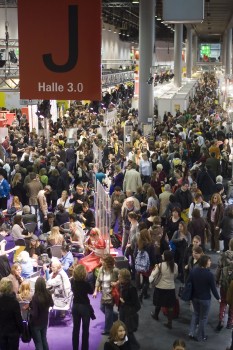
World of books: hustle and bustle at the Frankfurt Book Fair, 2008 - Photo: Fernando Baptista
Competition is hard in the book world, both nationally and internationally, so it’s big news that five years from now Finland will be the theme country at Frankfurt Book Fair, the world’s biggest encounter of those who work in the book publishing business.
Tuomas Kyrö: Mielensäpahoittaja ja ruskeakastike [Taking offence: brown sauce]
25 April 2012 | Mini reviews, Reviews
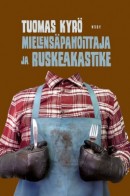 Mielensäpahoittaja ja ruskeakastike
[Taking offence: brown sauce]
Helsinki: WSOY, 2012. 130 p., ill.
ISBN 978-951-0-39079-5
€23.90, hardback
The most popular book by Tuomas Kyrö (born 1974), so far, has been his sixth novel, Mielensäpahoittaja (‘Taking offence’: literally ‘He who takes offence’, 2010). It has sold nearly 65,000 copies as a book and audiobook. The protagonist is a 80-something man, a sturdy old bear who lives in the countryside, now alone, because his demented wife has been taken into care and the children have long since left home. Kyrö inserts genuine humour into the monologues of his stubborn – but by no means simple – character, defiantly critical, opposing new gadgets, fads and all sorts of silly stuff of the contemporary society. In this sequel Kyrö still manages to entertain the reader with his detailed portrait: now Mr Grumpy has to learn to cook, because the food a paid helper brings in just isn’t good enough. With the potato as the cornerstone of his diet, he finally learns how to make good, fatty and salty meals of meat and veg. ‘One must remember what’s important in life, marriage and prostate problems. Time and patience.’ Illustrations remind the reader of the old times: photographs of television programmes and printed recipes from the 1960s and 1970s.
Matti Klinge: Suomalainen ja eurooppalainen menneisyys [The Finnish and European past]
8 April 2011 | Mini reviews, Reviews
 Suomalainen ja eurooppalainen menneisyys. Historiankirjoitus ja historiankulttuuri keisariaikana
[The Finnish and European past. Historiography and history culture in the Imperial era]
Helsinki: Suomalaisen Kirjallisuuden Seura, 2010. 360 p., ill.
ISBN 978-952-222-208-4
€ 34, hardback
The term ‘Imperial era’ in Finnish history refers to Finland’s period as a Grand Duchy of Russia, 1809–1917. This work is a study of the shaping of Finland’s national culture of history. ‘History culture’ refers to the ways in which ideas about the past are generated, utilised and modified. The brief essays in this book look at the way the past, the events and people involved in historiography are treated in academic research – including those who did not hold high-level academic posts and were therefore absent from previous works. Matti Klinge, an emeritus professor of history, maintains that Finnish historiography has been characterised by an emphasis on nationalism and national development and has focused chiefly on historical writing about Finland. Historians have often been viewed as following in their predecessors’ footsteps, without demonstrating influences acquired from contemporary foreign research. The author emphasises the multilingual intellectual world of the Imperial era; at that time in Finland, people were able to read more foreign languages than nowadays.
Translated by Ruth Urbom
Kari Tarkiainen: Ruotsin Itämaa. Esihistoriasta Kustaa Vaasaan [Sweden’s Eastland. From prehistoric times to Gustav Vasa]
18 April 2013 | Mini reviews, Reviews
 Ruotsin Itämaa. Esihistoriasta Kustaa Vaasaan
[Sweden’s Eastland. From prehistoric times to Gustav Vasa].
[Finlands svenska historia del 1: Sveriges Österland. Från forntiden till Gustav Vasa, 2008; Finland’s Swedish history vol. 1, translated into Finnish by the author]
Helsingfors: Svenska litteratursällskapet i Finland, 2010. 331 p., ill.
ISBN 978-951-583-212-2
€39.90, hardback
The historian and archivist Kari Tarkiainen is starting a four-volume series with the general title ‘Finland’s Swedish history’: it forms part of a project funded by Finland’s Swedish-language cultural organisations. This book examines Finland’s prehistoric, medieval and early modern periods, with special emphasis on the two-way relations between Swedes and Finns, and their mutual influence. Initially Finland’s annexation by Sweden from the 12th to the 14th century as ‘Österland’ (Eastland) was a process that involved many stages and also some belligerence, as the Republic of Novgorod in the east also laid claim to the region. Settlements of Swedish-speakers were established on the Åland islands and the coasts; the Swedish Catholic Church (replaced during the Reformation by the Lutheran Church) and the Swedish-language administrative and social system extended their influence on the country, even though Finnish remained the principal language of Finns. Finland remained part of Sweden until the early 19th century. Ruotsin Itämaa is a fascinating book, which draws on archeology, linguistics and onomastics, and is beautifully illustrated.
Translated by David McDuff