

Search results for "tommi+musturi/2010/05/song-without-words/2009/09/what-god-said"
Being God
30 September 2006 | Fiction, Prose
Extracts from the novel Gud (‘God’, Schildts, 2006)
Side by side, wolves and antelopes graze on the juicy grass.
A deer playfully chases a lion through the bushes.
‘Can you do this?’
Adam crosses his arms in front of his chest and folds his hands back to front so that the right hand is on the left and the left hand is on the right. With his hands folded he twists them downwards and holds them out. Now they point to Eve, still folded, and still with the right hand on the left.
Eve tries. She succeeds, and laughs with delight.
A gentle breeze is blowing from the east, just strongly enough for the couple not to be troubled by the heat, but not so they would feel the need for clothes to keep them warm. More…
Lucky strikes
12 August 2010 | This 'n' that

Stumbled upon: readers find Tommi Musturi's comic strip (June 10–June 18)
When Books from Finland was a printed journal, it was relatively easy to define its readership – now it is different: we are a part of the internet’s ecosystem, its surging and multifarious mass of knowledge.
Those who visit our pages may have the most diverse motives for wanting to read our articles – and they may travel surprising itineraries before arriving on Books from Finland’s pages, as we found out recently: StumbleUpon is still a fairly little-known service in Finland. Thus it took a while before we realised why so many of the comments about our piece on Tommi Musturi’s wordless comic strip, on colour and friendship, began with the words ‘I stumbled upon’… More…
Serial fun, or comics celebrated
24 January 2011 | In the news
The art of comics celebrates its first centenary in Finland this year. The first Finnish picture story was a book called Professori Itikaisen tutkimusretki (‘Professor Itikainen’s expedition’, WSOY), by Ilmari Vainio, published in 1911; see our post on the Books from Finland website.
By the way, comics in Finnish is sarjakuva, ‘serial picture’, covering the modern usage of ‘comics’ – including serious, graphically impressive stuff such as the newish genre of the graphic novel.
The annual Helsinki Comics Festival, organised by Finnish Comics Society (founded 1971), is the biggest event in the field in northern Europe; this year’s festival will take place in September. In 2011 comics exhibitions will take place at the Finnish Design Museum, the Finnish Post Museum and the National Library of Finland.
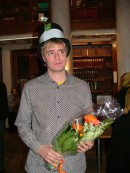
Tommi Musturi. Photo: the Finnish Comics Society
The Society awarded its Puupää prize 2011 to Tommi Musturi (born 1975) – take a look at an extract from his Walking with Samuel which we ran on the Books from Finland website in May 2010.
Among Musturi’s publications are ten anthologies entitled Glömp; he has also worked for Kuti magazine and Huuda Huuda publisher. The jury remarked, in particular, on their appreciation of Musturi’s highly original, often wordless, stories and their graphic brilliance.

The prize: Puupää's hat
The prize is not money but a honorary hat, and is named after a classic Finnish cartoon character, Pekka Puupää (‘Pete Blockhead’), created by Ola Fogelberg and his daughter Toto. The Puupää comic books were published between 1925 and 1975, and some of the stories were made into film.
The engineer’s story
30 June 1981 | Archives online, Fiction, Prose
A short story from Maailman kivisin paikka (‘The stoniest place in the world’, 1980). Introduction by Pekka Tarkka
Coffee was going to be served down by the river. The engineer took my elbow and led me across his paved courtyard and over his lawn; we settled ourselves down in cane chairs under the trees. Mirja came out of the house with a tray of coffee and coffee-cups, a loaf of sweet bread, already cut, some marble cake and some biscuits. The engineer said nothing. My eye wandered over the ample weeping birches by the river, the mist creeping up in the cool of the evening and shifting in the cross-pull of the breeze and the current, and I watched Mirja moving under the trees back to the house and then down again to the riverbank.
As we sipped our coffee we spoke about chance, and the part it plays in life, about my husband – for I was able to speak about him now: enough time had gone by. The engineer eased himself into a comfortable position, gave me a quick look and then launched off into an account of his own, about his trip abroad:
I spotted the news item as I was going through the morning paper on the plane. I sat more or less speechless all of the first leg, listening to Kirsti and her husband confabulating. I didn’t say anything during the stop-over in Copenhagen, either, where they wanted to get some schnapps and, of course, some chocolate ‘if Kirsti would really like some’. We came rushing back into the plane just as the last English, German and Danish announcements were coming over, and then we sat waiting for the take-off. That was delayed too because of a check-up (not announced), and then we were off again for Zurich, me without a word and they whispering together. Then it was the bus as far as the terminal, and after that a taxi to the hotel. Quite clearly Kirsti hadn’t heard a thing about it yet, and probably hadn’t had much contact with Erkki for quite some time, her new husband even less. More…
Song without words
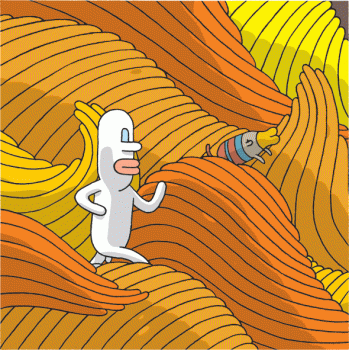
The episode we feature here is from Samuelin matkassa (‘Walking with Samuel’, Huuda Huuda, 2009; the book has been also published in Germany, Belgium, Sweden and Portugal)
Our lives are now more surrounded with images – moving or still, narratives or icons, emblems and symbols – than ever before – but do we know how to interpret them? How well can we read pictures?
Try this: Samuel is a cartoon character, created by Tommi Musturi, who wanders through time and a fantastically colourful universe of his own. His story is told in pictures, not words – and the details speak volumes. It tells, as you will find if you ‘read’ it carefully, about friendship between man and… another creature. More…
Blind man’s buff
31 March 2002 | Fiction, Prose
An extract from the novel Laituri matkalla mereen (‘A jetty to the sea’, WSOY, 2001)
Ten steps along the path marked out by the poet
In a gravel pit illegally dug by the sand-king Gropius and later abandoned, the colonel and Henry were shooting at tin cans with pistols. The pit neighboured the Colonel’s home, and he was in the habit of carrying out target practice there with the help of Jovan, to keep his hand in.
The cans were placed at twenty-metre intervals in front of a sandbank and were raised on coil springs, so they swayed freely in the air. Each of them was attached to a long line; this, when pulled, swayed the cans, rattling stones inside them. Following the sound, the colonel identified the can’s position, aimed and fired. The hits he heard himself, the misses usually struck the pieces of hardboard behind the cans. These were divided up dartboard-fashion into sectors and rings, and Jovan used binoculars to spot the hits on them and announce the points of impact as clock-numbers and distances from the can’s central position, enabling the colonel to correct his aim. This he did with the aid of a rake. He held the rake upright, prongs downwards, so that its handle stood roughly perpendicular to the ground. Moving the handle sideways with careful estimation, and sliding his pistol hand up or down on the handle, he was able to make corrections with reasonable accuracy and determine his aim. More…
Human Freedom
30 June 1986 | Archives online, Fiction, Prose
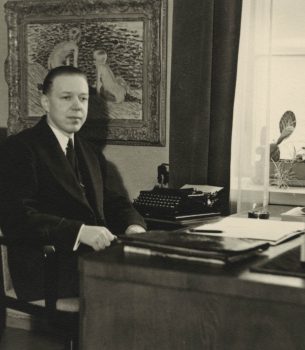
Mika Waltari. Photo: SKS Archives
Extract from lhmisen vapaus (‘Human Freedom’, 1950)
‘Where are we?’ Yvonne asked. ‘This isn’t the right street either. Somewhere between Alma and Georges V, they said. But there’s no sign of an aquarium.’
‘Talking of aquariums’, I suggested, ‘there’s a dog shop near here where they wash dogs in the back room. If you like, I’ll take you to see how they wash a dog. It’s a very soothing experience.’
‘You’re crazy’, said Yvonne.
My feelings were hurt. ‘I may sleep badly’, I admitted, ‘but I love you. I walk up and down the embankments all night. My heart aches, my brain is on fire. Then comes blissful intoxication, and for a little while I can be happy. And all you can do is to keep nagging, Gertrude.’
She wrinkled her brow, but I went on impatiently, ‘Look, Rose dear, just at present I have the whole world throbbing in my temples and in my finger-tips. Age-old poems are bubbling up within me. I am grieving for lost youth. I am boggling at the future. For just this one moment it is given to me to see life with the living eyes of a real human being. Why won’t you let me be happy?’
‘I have walked two hundred kilometres’, said a low, timid voice at my elbow. I stopped. Yvonne had stuck her arm through mine. She, too, stopped. We both looked down and saw a little man. He doffed a ragged cap and bowed. Flushed scars glowed through a grey stubble of beard. He was wearing a much-patched battle-dress from which the badges had long since disappeared. His face was wrinkled, but the little eyes were animated and sorrowful. More…
Summer child
30 September 1988 | Archives online, Fiction, Prose
A short story from Resa med lätt bagage (‘Travelling light’, 1987). Introduction by Marianne Bargum
From the very beginning it was quite clear no one at Backen liked him, a thin gloomy child of eleven; he looked hungry somehow. The boy ought to have inspired a natural protective tenderness, but he didn’t at all. To some extent, it was his way of looking at them, or rather of observing them, a suspicious, penetrating look, anything but childish. And when he had finished looking, he commented in his own precocious way, and my goodness, what that child could wring out of himself.
It would have been easier to ignore if Elis had come from a poor home, but he hadn’t. His clothes and suitcase were sheer luxury, and his father’s car had dropped him off at the ferry. It had all been arranged over the phone. The Fredriksons had taken on a summer child out of the goodness of their hearts, and naturally for some compensation. Axel and Hanna had talked about it for a long time, about how town children needed fresh air and trees and water and healthy food. They had said all the usual things, until they had all been convinced that only one thing was left in order to do the right thing and feel at ease. Despite the fact that all the June work was upon them, many of the summer visitors’ boats were still on the slips, and the overhaul of some not even completed. More…
How to peel an orange
30 December 2002 | Fiction, Prose
Extracts from the novel Auringon asema (‘The position of the sun’, Otava, 2002)
There are times when God rules. Then logic is burned on bonfires and left to rot in damp prisons with rats. There are times when logic rules. Then God is burned in the squares and his houses are made into schools. There are times when attempts are made to demonstrate that God and logic can live in the same place and that they are, in fact, the same thing, but those times are truly strange times. And there are times when God and logic live side by side but in different places, like adult siblings who cannot live in the same place but nevertheless get on well together. When my father and my mother loved each other, they were ruled by God, and there was no logic in it, none at all. More…
The Othello of Sand Alley
31 March 1989 | Archives online, Drama, Fiction
Eeva-Liisa Manner’s Woyzeck is an independent ending to Georg Büchner’s fragmentary play. Introduction by Riitta Pohjola
PROLOGUE
(Dawn in the market square of Leipzig. A gallows looms, dimly visible in the distance. Brisk rumble of drums.)
1st WOMAN
What’s going on here?
1st MAN
They’re getting ready for an execution. Some villain’s going to be executed in public.
1st WOMAN
Who?
2nd WOMAN
Franz Woyzeck. I guess you know him, the barber. More…
Animal crackers
30 June 2004 | Children's books, Fiction
Fables from the children’s book Gepardi katsoo peiliin (‘A cheetah looks into the mirror’, Tammi, 2003). Illustrations by Kirsi Neuvonen
Rhinoceros
 The rhinoceros was late. She went blundering along a green tunnel she’d thrashed through the jungle. On her way, she plucked a leaf or two between her lips and could herself hear the thundering of her own feet. Snakes’ tails flashed away from the branches and apes bounded out of the rhino’s path, screaming. The rhino had booked an afternoon appointment and the sun had already passed the zenith.
When the rhinoceros finally arrived at the beautician’s, the cosmetologist had already prepared her mud bath. The rhino was able to throw herself straight in, and mud went splattering all round the wide hollow. More…
What God said
3 September 2009 | Fiction, Prose
Extracts from the novel Herra Darwinin puutarhuri (Otava, 2009; Mr Darwin’s Gardener, Peirene Press, 2013). Interview by Soila Lehtonen
The congregation sits in the church pews and the jackdaws caw in the belfry.
We smell of wet dog, the rain made us wet and it is cold but the singing warms us, the hymn rises to the roof and above the roof dwells God, Amen.
We saw Thomas Davies on the hill, he is working in Mr Darwin’s garden,
the atheist and lunatic, he stood in the field alone and the water lashed his face
an irreligious pit pony wandering in the darkness he is from Wales
does the godless man think he can stand in the rain without getting wet did he get an umbrella or bat wings from the devil
perhaps Thomas imagines that he can hold back the rain and the rain not hold him back, he thinks he is more exalted than God with his head in the clouds
The church’s hard pews press into posteriors, the poor man will not grow fatter, for there are no fat and lean years but only lean ones, and thin are the poor man’s sheep and cows and children too, but the rich man cultivates weeds for his amusement as Mr Darwin did and earns money and fame! More…
No place to go
30 March 2008 | Archives online, Fiction, Prose
Extracts from the novel Lakanasiivet (‘Linen wings’, Otava, 2007)
The clothesline swayed in the wind. Helvi closed her eyes and felt herself flutter into the air with the laundry. She flapped her white linen wings, straining higher, now seeing below the whole small peninsula city, its damp rooftops glittering in the morning sun, the blue sighs of the chimneys, the steamboats toiling on the lake and the trains chugging on their tracks. The whole of heaven was clear and blue; only far off in the east were there white pillars roiling – whether smoke or clouds, Helvi could not tell.
She flew north on her linen wings and saw the great bridges leading to the city, on whose flanks the hidden anti-aircraft batteries gasped the fumes of gun oil and iron, and continued her journey over the land, following the straight lines of the telephone wires. She flew over wooded hills and deep green fields, finally arriving on the slope of the great hill where her daughter now lived, in hiding from the war. More…
Relative values
31 March 2004 | Archives online, Fiction, Prose
Extracts from the autobiographical novel Nurinkurin (‘Upside down, inside out’, WSOY, 2003). Interview by Anna-Leena Nissilä
The soldier rides on a scarf
waving a donkey
‘Now it’s your turn to go on,’ says my brother on the back seat, turning his head toward the window so that he can concentrate on his poetic muse.
Father looks in the mirror, wrinkling his face in pain. ‘The object, in other words, is of no significance to you. What happened to your case endings and your grammar?’
From the back seat we shout eagerly: ‘The poet has special privileges which are not accorded to others.’
Father shakes his head: ‘You can be creative, but silly content and broken language do not make poetry.’
‘Oh yes they do. Don’t disturb our creative spirit. When you speak, our connection with her is broken. Don’t cut off the source of our inspiration.’ More…
The funeral
31 December 1988 | Archives online, Fiction, Prose
Hannu Salama’s short story Hautajaiset (‘The funeral’) – taking place in Pispala, Tampere – in the volume Kesäleski, ‘Summer widow’, was published in 1969. Introduction by Pekka Tarkka
On Tuesday Venla came round: as Sulo was being lowered into the grave Vihtori had had a heart attack. The next day a letter arrived from father: funeral on Sunday, and Gunilla and Timo want you to speak at the grave. I telegraphed back: ‘Vikki too close to me. Unable to speak.’ Outside the post office I realised I could have sent fifty words for the same money.
Irma ordered a flower arrangement. Did I want to put an inscription? Part of the last stanza of a revolutionary song went through my head:
Sowing makes the corn come into ear:
Hundredfold higher that happier age will be.
I said not to put anything, I’d say something at the grave if it seemed the thing to do. I told her to put mother’s, father’s and Heikki’s names on, and we’d take these off if they’d sent their own wreath. More…