

Search results for "tommi+musturi/2010/05/song-without-words/2009/09/what-god-said"
The miracle of the rose
30 June 1997 | Archives online, Fiction, Prose
Extracts from the novel Naurava neitsyt (‘The laughing virgin’, WSOY, 1996). The narrator in this first novel by Irja Rane is an elderly headmaster and clergyman in 1930s Germany. In his letters to his son, Mr Klein contemplates the present state of the world, hardly recovered from the previous war, his own incapacity for true intimacy – and tells his son the story of the laughing virgin, a legend he saw come alive. Naurava neitsyt won the Finlandia Prize for Fiction in 1996
28 August
My dear boy,
I received your letter yesterday at dinner. Let me just say that I was delighted to see it! For as I went to table I was not in the conciliatory frame of mind that is suitable in sitting down to enjoy the gifts of God. I was still fretting when Mademoiselle put her head through the serving hatch and said:
‘There is a letter for you, sir.’
‘Have I not said that I must not be disturbed,’ I growled. I was surprised myself at the abruptness of my voice.
‘By your leave, it is from Berlin,’ said Mademoiselle. ‘Perhaps it is from the young gentleman.’
‘Bring it here,’ I said. More…
Daddy’s girl
30 September 2004 | Archives online, Fiction, Prose
Extracts from the novel Maskrosguden (‘The dandelion god’, Söderströms, 2004). Introduction by Maria Antas
The best cinema in town was in the main square. The other was a little way off. It was in the main square too, but you couldn’t compare it to the Royal. At the Grand there was hardly any room between the rows, the floor was flat and there was a dance-hall on the other side of the wall, so that Zorro rode out of time with waltzes, in time with oompahs, out of time with the slow steps of tangos and in time with quick numbers. The Royal was different and had a sloping floor.
Inside, the Royal was several hundred metres long. You could buy sweets on one side and tickets on the other. From Martina Wallin’s mum. She was refined. So was everyone except us: Mum, Dad and me. More…
Star-Eye
31 March 1984 | Archives online, Children's books, Fiction
A story from Läsning för barn (‘Reading for children’,1884). Introduction by George C. Schoolfield
There was once a little child lying in a snowdrift. Why? Because it had been lost.
It was Christmas Eve. The old Lapp was driving his sledge through the desolate mountains, and the old Lapp woman was following him. The snow sparkled, the Northern Lights were dancing, and the stars were shining brightly in the sky. The old Lapp thought this was a splendid journey and turned round to look for his wife who was alone in her little Lapp sledge, for the reindeer could not pull more than one person at a time. The woman was holding her little child in her arms. It was wrapped in a thick, soft reindeer skin, but it was difficult for the woman to drive a sledge properly with a child in her arms.
When they had reached the top of the mountain and were just starting off downhill, they came across a pack of wolves. It was a big pack, about forty or fifty of them, such as you often see in winter in Lapland when they are on the look-out for a reindeer. Now these wolves had not managed to catch any reindeer; they were howling with hunger and straight away began to pursue the old Lapp and his wife. More…
Pop song lyrics
A ‘short special’: a previously unpublished text (written in the 1960s) from Luonnonkierto (‘Nature’s circle’, Siltala, 2012). Introduction by Jarmo Papinniemi
The pop song is a wide, mysterious world. It is like an ocean. Like a snow-covered desert. Like a rose garden. Like a perfume factory. The pop song is as mysterious as spring. The pop song is as whimsical as the restroom of the city hotel in Samarkand. The pop song is as coarse as your father’s eldest brother. Pop songs snag everyone, especially the young and the old. The best pop songs are foreign, because the words make no sense. Pop stars rise into the sky. Lovely young women step into the arena smelling of perfume and sing about love or tell playful stories about animals or nursery rooms. And then on the other end of life the stars go out and start to look for a place to be buried. But before dying they drone on in their gruff voices about the temptations of the big city, and love, which in a certain sense tortured and wore out those concerned…
Up here in Finland, we write and set pop songs to music as well. But I have to say that they aren’t any good. We also translate and water down a lot of foreign hits as well. Well, of course they’re all popular and people hum them in parishes in the city and in the country, but from a critical perspective they stink. Usually the weak point of a pop song is its execrable lyrics. More…
Cruising
30 September 1993 | Archives online, Fiction, Prose
An extract from the novel Vieras (‘The stranger’, Otava 1992). Introduction by Pekka Tarkka
I lay there for a moment, motionless, eyes closed.
The bunk was damp. It felt damp around my thighs; I slid down lower – and there, it was really wet.
My sleeping bag was obviously soaked, and that meant that the mattress was soaked, too. Oh, rats. I couldn’t imagine having wet myself. Or – worse – had the boat sprung a leak, the water already rising up to the floorboards? I bounded to my feet: the rugs were dry. So was the cabin floor. I raised the boards, peered down: two fingers of water in the forward bilge, as usual. So, where the –? In the course of yesterday’s rough sailing, some water had seeped in below the windowframe. No more than a cupful, but it had trickled down inside the panel and then onto the mattress. I tried the other side of the bunk. It was dry. Well, I would just have to pick up the mattress and set it on its side. More…
Rainer Knapas: Kunskapens rike. Helsingfors universitetsbibliotek – Nationalbiblioteket 1640–2010 [In the kingdom of knowledge. Helsinki University Library – National Library of Finland 1640–2010]
9 August 2012 | Mini reviews, Reviews
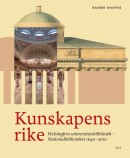 Kunskapens rike. Helsingfors universitetsbibliotek – Nationalbiblioteket 1640–2010
Helsingfors: Svenska litteratursällskapet i Finland, 2012. 462 p., ill.
ISBN 978-951-583-244-3
€54, hardback
Tiedon valtakunnassa. Helsingin yliopiston kirjasto – Kansalliskirjasto 1640–2010
[In the kingdom of knowledge. Helsinki University Library – National Library of Finland 1640–2010]
Suomennos [Finnish translation by]: Liisa Suvikumpu
Helsinki: Finnish Literature Society, 2012. 461 p., ill.
ISBN 978-952-222-272-5
€54, hardback
The National Library of Finland was founded in 1640 as the library of Turku Academy. In 1827 it was destroyed by fire: only 828 books were preserved. In 1809 Finland was annexed from Sweden by Russia, and the collection was moved to the new capital of Helsinki, where it formed the basis of the University Library. The neoclassical main building designed by Carl Ludwig Engel is regarded as one of Europe’s most beautiful libraries and was completed in 1845, with an extension added in 1906. Its collections include the Finnish National Bibliography, an internationally respected Slavonic Library, the private Monrepos collection from 18th-century Russia, and the valuable library of maps compiled by the arctic explorer Adolf Erik Nordenskiöld. Renamed in 2006 as Kansalliskirjasto – the National Library of Finland – this institution, which is open to general public, now contains a collection of over three million volumes as well as a host of online services. This beautifully illustrated book by historian and writer Rainer Knapas provides an interesting exposition of the library’s history, the building of its collections and building projects, and also a lively portrait of its talented – and sometimes eccentric – librarians.
Translated by David McDuff
In Darwin’s garden
3 September 2009 | Authors, Interviews
Interview with Kristina Carlson, author of Herra Darwinin puutarhuri(‘Mr Darwin’s gardener’, 2009)
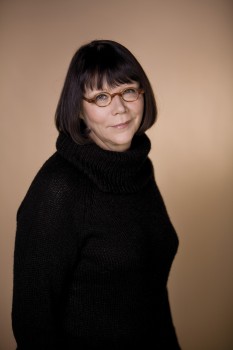
Kristina Carlson. Photo: Tommi Tuomi
Time: late 1870s. November. Place: the village of Downe, Kent, England. Villagers gather in the church on a rainy Sunday. Thomas Davies stays at home with his two children.
After the death of his wife, Thomas has been unable to get over his grief and anxiety. The villagers don’t approve of Thomas’s way of living – he isn’t sociable, keeps to himself, doesn’t go to church, and reads too many books. His employer is Charles Darwin: a famous – or notorious – man who writes too many books. ‘Mr Darwin lives here, and atheism is a worse threat than in the neighbouring villages,’ says Stuart Wilkes, voicing the views of the villagers.
Thomas is the central character in Kristina Carlson’s new novel, Herra Darwinin puutarhuri (‘Mr Darwin’s gardener’, Otava, 2009). Ten years ago her previous novel, Maan ääreen (‘To the end of the earth’), set in 19th-century Siberia, won the Finlandia Prize for Fiction.
As 2009 is the second centenary of Charles Darwin, the author of On the Origin of Species (published in 1859), the first question that comes to mind is whether this is coincidental or not… More…
Funny peculiar
9 December 2011 | Articles, Comics, Non-fiction
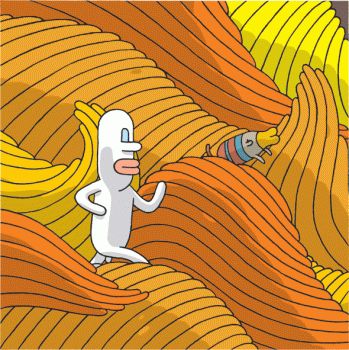
Samuel, the creation of Tommi Musturi (featured in Books from Finland on 7 May, 2010, entitled ‘Song without words’)
Comics? The Finnish word for them, sarjakuva, means, literally, ‘serial picture’, and lacks any connotation with the ‘comic’. The genre, which now also encompasses works called graphic novels, has been the subject of celebrations this year in Finland, where it has reached its hundredth birthday. Heikki Jokinen takes a look at this modern art form
Comics are an art form that combines image and word and functions according to its own grammatical rules. It has two mother tongues: word and image. Both of them carry the story in their own way. Images and sequences of images have been used since ancient times to tell stories, and stories, for their part, are the common language of humanity. The long dark nights of the stone age were no doubt enlivened by storytellers.
One of the pioneers of comics was the Swiss artist Rodolphe Töpffer. As early as 1837, he explained how his books, combinations of images and words, should be read: ‘This little booklet is complex by nature. It is made up of a series of my own line drawings, each accompanied by a couple of lines of text. Without text, the meaning of the drawings would remain obscure; without drawings, the text would remain without content. The whole gives birth to a sort of novel – but one which is in fact no more reminiscent of a novel than of any other work.’ More…
Cautionary tales
30 September 2002 | Fiction, Prose
Short stories from Förklädnader. Sagor, parabler (‘Disguises. Stories, allegories’, Schildts, 2001; Valepukuja. Satuja, vertauksia, WSOY, 2002)
Assistance
All over Hellas, even in the barbarian lands, the lyre-players competed with one another. Odes, paeans, dithyrambs echoed endlessly. Phoebus Apollo himself generously oversaw these productions.
A certain promising singer, Deinarchos by name, who hoped to participate in the upcoming Pythian contest, sat in his study-cave in the mountains of Thessaly waiting for inspiration. He prayed repeatedly to Phoebus for help, but did not detect any response. More…
Losing it
31 March 2002 | Archives online, Fiction, Prose
An extract from the novel Jalat edellä (‘Feet first’, Otava 2001). Introduction by Kanerva Eskola
Once he had sat in the car for a while Risto could feel his thoughts slowly becoming clearer. Tero had been killed by a lorry. He couldn’t think particularly actively about it but perhaps he could have said it out loud. After all, people often say all kinds of things that they don’t think. Maybe even too often, he wondered and decided to have a go.
‘Tero is dead,’ he said and the words tasted of preserved cherries.
In the changing room at the swimming pool Risto noticed that his swimming trunks and towel were mouldy. He had forgotten to hang them up to dry after the last time he went swimming. That was a thousand years ago and now a bluish grey fur was growing on them. He examined the bitter smelling mould on his trunks; the fur was beautiful, smooth and silky like a rabbit’s coat. He gently stroked his trunks. I can use these for ice swimming, he decided, and began to chuckle quietly to himself.
In the detail?
11 December 2009 | Essays, Non-fiction
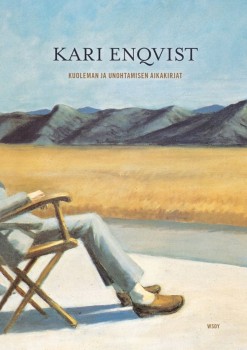 Extracts from Kuoleman ja unohtamisen aikakirjat (‘Chronicles of death and oblivion’, WSOY, 2009)
What’s the meaning of life? There are those who seek it in religion, while for others that is the last place to look. The scientist Kari Enqvist ponders why some people, including himself, seem physiologically immune to the lure of faith. Perhaps, he suggests, we should look for significance not in the big picture, but in the marvel of the fleeting moment
As a young boy I must have held religious beliefs. However, I cannot pinpoint exactly when they disappeared. At some point I eventually stopped saying my evening prayers, but I am unable to remember why or when this happened. ‘I was born in a time when the majority of young people had lost faith in God, for the same reason their elders had had it – without knowing why,’ writes the Portuguese poet Fernando Pessoa in The Book of Disquiet. More…
Serious comics: Angoulême 2011
24 February 2011 | This 'n' that
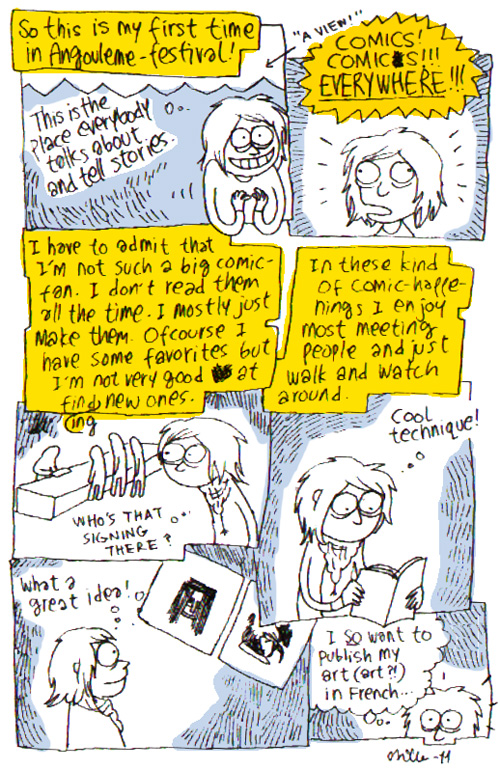
Graphic artist Milla Paloniemi went to Angoulême, too: read more through the link (Milla Paloniemi) in the text below
As a little girl in Paris, I dreamed of going to the Angoulême comics festival – Corto Maltese and Mike Blueberry were my heroes, and I liked to imagine meeting them in person.
20 years later, my wish came true – I went to the festival to present Finnish comics to a French audience! I was an intern at FILI – Finnish Literature Exchange, and for the first time, FILI had its own stand at Angoulême in January 2011.
Finnish comics have become popular abroad in recent years, which is particularly apparent in the young artists’ reception by readers in Europe. Angoulême isn’t just a comics Mecca for Europeans, however: there were admirers of Matti Hagelberg, Marko Turunen and Tommi Musturi from as far away as Japan and Korea.
The festival provides opportunities to present both general ‘official’ comics, ‘out-of-the-ordinary’ and unusual works. The atmosphere at the festival is much wilder than at a traditional book fair: for four days the city is filled with publishers, readers, enthusiasts, artists, and even musicians. People meet in the evenings at le Chat Noir bar to discuss the day’s finds, sketching their friends and the day’s events.
As one Belgian publisher told me, ‘There have always been Finns at Angoulême.’ Staff from comics publisher Kutikuti and many others have been making the rounds at Angoulême for years, walking through the city and festival grounds, carrying their backpacks loaded with books. They have been the forerunners to whom we are grateful, and we hope that our collaboration with them deepens in the future.
Aapo Rapi: Meti (Kutikuti, 2010)
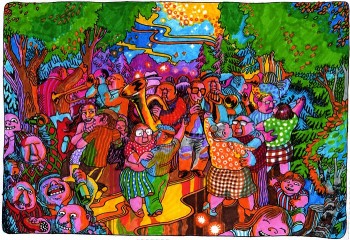
This year two Finnish artists, Aapo Rapi and Ville Ranta were nominated for the Sélection Officielle prize, which gave them wider recognition. Rapi’s Meti is a colourful graphic novel inspired by his own grandmother Meti [see the picture right: the old lady with square glasses].
Hannu Lukkarinen and Juha Ruusuvuori were also favorites, as all the available copies of Les Ossements de Saint Henrik, the French translation of their adventures of Nicholas Grisefoth, sold out. There were also fans of women comics artists, searching feverishly for works by such artists as Jenni Rope and Milla Paloniemi.
Chatting with French publishers and readers, it became clear that Finnish comics are interesting for their freshness and freedom. Finnish artists dare to try every kind of technique and they don’t get bogged down in questions of genre. They said so themselves at the festival’s public event. According to Ville Ranta, the commercial aspect isn’t the most important thing, because comics are still a marginalised art in Finland. Aapo Rapi claimed that ‘the first thing is to express my own ideas, for myself and a couple of friends, then I look to see if it might interest other people.’
Hannu Lukkarinen emphasised that it’s hard to distribute Finnish-language comics to the larger world: for that you need a no-nonsense agent like Kirsi Kinnunen, who has lived in France for a long time doing publicity and translation work. Finnish publishers haven’t yet shown much interest in marketing comics, but that may change in the future.
These Finnish artists, many of them also publishers, were happy at Angoulême. Happy enough, no doubt, to last them until next year!
Translated by Lola Rogers
I am me
30 September 2010 | Fiction, Prose
Extracts from the novel Poikakirja (‘The boy’s own book’, Otava, 2010). Introduction by Mervi Kantokorpi
It’s a small day in spring. Another name for the lark is the skylark. You can only see them sometimes, and even then they’re so high up in the sky that they swoop like fast-moving dots.
The kitchen windowpane is rippling with stripes. The window has a bottom, and at the bottom there is some cotton wool and two opened matchboxes, a blue Sampo and a picture of an army chaplain in his uniform and insignia. As spring has progressed the cotton wool at the bottom has turned into wet blobs and the matches will never light again, as they’ve sucked up the winter frost from the glass.
Most children are made at home but not us, says Eini during walking practice. Outi shoves her, tells her to be quiet and walk in rhythm. I’m behind the table reading the Children’s Encyclopaedia, but I watch them. With every second step, their bottoms swing to the right and then to the left.
Mum comes into th the kitchen and asks what they’re doing; Anna-Liisa responds on the twins’ behalf, says they’re practising walking like in the movies and that’s why they’re wiggling their hips. More…
Living with Her Ladyship
31 December 2003 | Archives online, Fiction, Prose
Extracts from the memoir of a Helsinki childhood, Från Twenty Gold till Kent (‘From Twenty Gold to Kent’, Schildts, 2003). Introduction by Pia Ingström
My hair was dark and stuck up from my skull like little nails. My face was furrowed with red, my throat was wrinkled and I didn’t even have a pretty navel. This was because Daddy had to knot my umbilical cord himself while the obstetrician was busy on the ground floor with an appendix.
‘She looks like a forty-year-old errand-boy from the newspaper’s office: Daddy announced.
Mummy said she hoped I would soon change and have a long neck.
At Apollogatan street we took the lift up to the third floor where my sisters were waiting with the new nanny. They had no chance to welcome me with singing as they’d planned because both Renata and Catherine had colds. Nobody was going to be allowed to breathe anywhere near me, Mummy and Nanny were entirely agreed on that. More…
The way to heaven
30 June 1996 | Archives online, Fiction
Extracts from the novel Pyhiesi yhteyteen (‘Numbered among your saints’, WSOY, 1995). Interview with Jari Tervo by Jari Tervo
The wind sighs. The sound comes about when a cloud drives through a tree. I hear birds, as a young girl I could identify the species from the song; now I can no longer see them properly, and hear only distant song. Whether sparrow, titmouse or lark. Exact names, too, tend to disappear. Sometimes, in the old people’s home, I find myself staring at my food, what it is served on, and can’t get the name into my head. The sun came to my grandson’s funeral. It rose from the grave into which my little Marzipan will be lowered. I don’t remember what the weather did when my husband was buried.
A plate. Food is served on a plate. There are deep plates and shallow plates; soups are ladled into the deep ones. More…