

Search results for "tommi+musturi/2010/05/song-without-words/2009/09/what-god-said/2011/04/matti-suurpaa-parnasso-1951–2011-parnasso-1951–2011"
Intelligent living
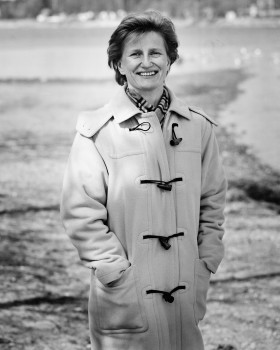
Minna Lindgren. Photo: Ville Palonen.
In Ehtoolehdon tuho [‘The decline of Twilight Grove’, Teos, 2015), the final novel in a trilogy about life in an assisted living home, employing human staff has become too expensive and the old folk are part of a pilot project in which they are cared for by electronic devices, monitors, cameras, ‘smartwalls’ and cleaning robots: ‘there was intelligence everywhere, masses of it, just a hiccup and something terribly intelligent would happen.’
The aged lady residents don’t like their new life, but they’re resilient; they’re not about to let the new technology defeat them…
Minna Lindgren’s mordantly satirical, often hilariously funny writing has earned her a wide readership. Translations of the trilogy are soon to appear in English, German and French.

An excerpt from Ehtoolehdon tuho [‘The decline of Twilight Grove’, Teos, 2015). Review by Soila Lehtonen
‘You’re 97 today! Your wakeup call service today congratulates!’
As if she wouldn’t have remembered. Ninety-seven was almost a hundred. She and Irma had decided that they would refuse to turn one hundred. It would only make trouble. One lady, in the bottom apartment of the A staircase, had received an invitation to the health centre on her birthday. Apparently all five-year-olds were called in for monitoring of their motor and psychological development, and when this lady turned 105, the computer system thought she was a toddler. The computer didn’t recognise numbers over one hundred. Siiri thought the lady should have kept the appointment; she would have done, for the tests were fun. You had to draw a triangle and walk along a straight line. Not that easy for someone of 105. But the lady didn’t go, she just made a terrible fuss about it and complained to everyone, until she died before her complaints reached the right official. More…
Three prose poems
30 September 1986 | Archives online, Fiction, poetry, Prose
Prose poems from Runot ja proosarunot (‘Poems and prose poems’,1966) and Maan ja veden välillä (‘Between land and water’, 1955 ). Introduction by Pirkko Alhoniemi
Underground
I went underground, I was looking for my brother’s grave, and I saw him lying under a transparent slab of marble. His face was like gold, death had passed from it, and I knew I no longer mourned him. I came above ground. At the edge of the graveyard there was a round tower made of stone and I was high up in the top of the tower. There stood my brother in dark trousers, white shirt, looking exactly the same, in the same position as in the dim photograph someone, I don’t remember who, took of him when he was about to go fishing, hands in his pockets, head held high, he was looking up at something, not at me. And I asked him: ‘Did it hurt when the bullet went through your head, when the exploding bullet went through your head in the battle of Karhumäki, and you were still alive at the first aid station and you said something they told us about in a letter.’ He answered, ‘Yes, it did hurt.’ ‘What’s your life like now, tell me.’ I said. He raised a hand and pointed to the sky. The sky was blue, and white clouds were scudding across it. More…
A good day
30 June 2001 | Archives online, Fiction, poetry
From Juomarin päiväkirjat (’A drunkard’s journals’, edited by Pekka Tarkka, Otava, 1999). Introduction by Claes Andersson
Iceland, Summer 1968
I don’t know how to describe what I see,
           the lava’s colors; the afternoon green of the grass,
      and I can’t tell if that white is buildings or snow.
The mountains are fortresses of the gods, and if
      people’s construction projects irritate them
          too much, they let the ground shake, volcanos
erupt and tum everything upside down, assign new sites
      to houses and different routes for cars.
      The gods’ noses itch when their breath
          is caught in pipelines and
      channeled into radiators and greenhouses.
Sheep tear the grass but horses
                                             browse in a civilized manner.
Jónas does not believe in the gods, but he
                             is afraid of them, the gods are not pleased
      with the Americans, who do not know
          anything about the gods or history yet come here
                 and start interfering with the land
                                                            as if it were theirs.
*** More…
Government prize for translation 2012
14 September 2012 | In the news
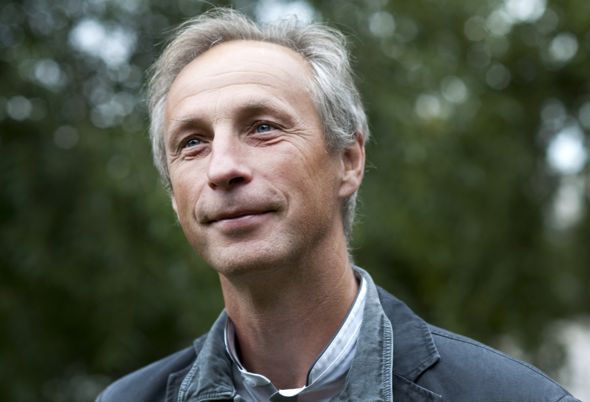
Vladimír Piskoř. Photo: Charlotta Boucht
The Finnish Government Prize for the Translation of Finnish Literature of 2012 – worth €15,000 – was awarded to the Czech translator Vladimír Piskoř.
Piskoř (born 1960), graduated from the Charles University of Prague in 1984, majoring in Finnish. Since the early 1990s he has translated almost 30 titles, most by contemporary authors, including Kristina Carlson, Kari Hotakainen, Leena Krohn, Rosa Liksom, Asko Sahlberg, Juha Seppälä, Petri Tamminen and Maria Peura.
‘I personally am fond of the novels by Kari Hotakainen: I sometimes play with the idea of becoming a writer myself, and I find his style and themes particularly interesting. Kristina Carlson’s latest novel Herra Darwinin puutarhuri (‘Mr Darwin’s gardener’, 2010) is a truly inspiring work both as a reader and a translator,’ he says.
Piskoř is currently working on Kari Hotakainen’s novel Jumalan sana (‘The word of God’) and Leena Lander’s historical novel Käsky (‘Command’). In 2006 he was awarded the Czech translators’ special prize for the novel Höyhen (‘Feather’) by Asko Sahlberg.
Vladimír Piskoř received his award in Helsinki on 10 September from State Secretary Jarmo Lindén; he thanked Piskoř for the work he has done for the last twenty years, particularly in the field of contemporary Finnish fiction.
The prize has been awarded – now for the 38th time – by the Ministry of Education and Culture since 1975 on the basis of a recommendation by FILI – Finnish Literature Exchange.
Kari Kuula: Paholaisen biografia [The biography of the Devil]
13 May 2011 | Mini reviews, Reviews
 Paholaisen biografia. Pahan olemus, historia ja tulevaisuus
[The biography of the Devil. The essence of evil, history and future]
Helsinki, Kirjapaja, 2010. 381 p.
ISBN 978-951-607-837-6
€ 38, hardback
This book is a chronological study of the Devil, seen through the history of ideas and cultural history. As the Devil is mainly a concept in Christian theology, the most profound studies of his essence have been carried out by experts of this field. The book also studies the Devil’s ‘disciples’, demons, and beliefs related to them. The main theme of the work consists of the history of diabology and demonology, from the Old Testament to contemporary theology. Another central theme is the theological dilemma of why God allows evil and suffering. In the cultural history section the author concentrates on the practical implications of belief in the Devil in different ages as well as parallel phenomena such as possession and belief in witchcraft. Folk tales about the Devil and descriptions of his putative looks as well as some classic works of fiction featuring the Devil are discussed. Kari Kuula is doctor of theology and priest who has published several non-fiction books on the Bible and Christianity.
Panu Rajala: Lasinkirkas, hullunrohkea [Glass-clear, daredevil]
20 May 2010 | Mini reviews, Reviews
 Lasinkirkas, hullunrohkea. Aila Meriluodon elämästä ja runoudesta
[Glass-clear, daredevil]
Helsinki: WSOY, 2010. 417 p., ill.
ISBN 978-951-0-35488-9
€39, hardback
Aila Meriluoto (born 1924) is a poet, author and translator whose first collection of poems, entitled Lasimaalaus (‘Stained glass’), sold more than 25,000 copies in 1946. She became a celebrity of her time, as her young, fresh voice expressed post-symbolist visions and, after the long, cruel years of the war, spoke defiantly about the death of God. Hailed as a youthful prodigy, she was favoured by the dominant poet and professor of literature, V.A. Koskenniemi. Meriluoto has published ten collections of poems, as well as novels, children’s books, diaries, memoirs, and a book about her first husband, the poet and author Lauri Viita (1916–1965). She has translated works by Rainer Maria Rilke, Harry Martinson and Astrid Lindgren. This biography tends to concentrate on the writer’s personal history rather than on her works. The author and scholar Panu Rajala and Meriluoto became acquainted in the 1970s, and he calls his biography ‘a subjective testimonial’. Rajala has written plays, novels and film scripts as well as biographies, among them one of the classic author Mika Waltari (1908–1979).
Nature’s not my thing
A short story from Hommes (Tammi, 2006)
Lying unemployed on my sofa I hear a lot of stuff on the radio almost every day you hear some children’s choir chanting the same songs over and over about our country’s blue lakes the sky and all our trees and their white trunks. They’ve all finally worked their way into my subconscious. After hearing enough of these songs my subconscious rears its head and commands my idle body: go to the forest. In a situation like that it’s hard to put up a fight or struggle against something you can’t see or hear or smell that all of a sudden pops into your head.
The great debate was over so quickly that hardly anyone managed to get a word in I think to myself as I lie in bed at night just before falling asleep. More…
Things
31 March 1997 | Archives online, Fiction, Prose
A short sory from Kaunis nimi (‘A lovely name’, Otava, 1996). Raija Siekkinen’s limpid prose is at its best when she explores the complex feelings that lie behind the events of everyday life. Here objects are indicators of emotions, memory and loss, and what is most important is left unsaid
And where was the pen, the fountain pen, black, chubby; the one which pumped the ink straight up from the bottle?
There were three gold-coloured bands on the cap of the pen, and its nib, too, was golden, It had been given to her in a case lined with black velvet, and there was a groove for the pen, and a depression for the ink-bottle; and the bottle was narrow -necked, with curving sides, and the ink in it was not bright blue, but dark, so that words written in it looked old, written a long time ago; one forgot that one had written them oneself, one read them like the words of a stranger.
She remembered the pen, and began slowly to wake up. More…
Out of the body
13 January 2011 | Reviews
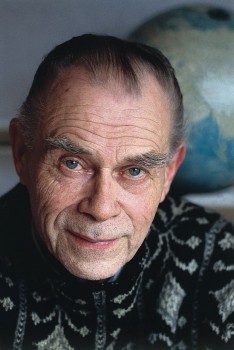
Veikko Huovinen. Photo: Irmeli Jung
‘Where will you be spending your eternity?’ ‘A spot of transmigration’, a short story by Veikko Huovinen (1927–2009), immediately confronts its main character, a man named Leevi Sytky, with this ultimate question.
Behind it is the sense of sin and fear of damnation typical of the religious life of northern Finland. Anyone who has made it as far as this final short story of Huovinen’s 1973 collection, Rasvamaksa (‘Fatty liver’) will, however, not make the mistake of taking the question too seriously; something diverting is clearly once again on offer.
Soon Leevi Sytky takes his leave of life in slightly sinful circumstances, but in the hereafter it turns out that these are not looked upon with disapproval. More…
Noah’s progeny
30 October 2009 | Fiction, Prose
Graphic design: M-L Muukka
Extracts from the novel Puupää (‘Blockhead’, Teos, 2009)
In these ‘shavings’ hewn from the block in constructing the storyline of his new novel, Juha Hurme offers us four unique glimpses into the Finnish psyche
The rune singer of Nokia
Three years ago I purchased a used mobile phone when its predecessor took an overdose of sea water and went mute on a rowing trip in a broken-down loaner of a fibreglass boat in a gale-force nor’wester. This three-year-old phone has been a thoroughly satisfactory implement and indispensable contact link. The power button got stuck a year ago, but the gadget is still fully operational with the aid of a match stick or something similar. It is my belief and hope that it will continue to fulfil the role of telephone for seven more years, because I prefer not to own, let alone purchase, anything that withstands fewer than ten years of use. More…
Word-flames
1 March 2012 | Fiction, poetry
Harri Nordell breaks up grammar, invents words and leaves sentences unfinished. His poems are like minimalist, language-shattering sculptures of words. In her introduction Tarja Roinila compares Nordell’s poems to windows on to another world
Poems from Sanaliekki äänettömyydessä. Valitut runot 1980–2006 (‘Word-flame in silence. Selected poems 1980–2006’, WSOY, 2011)
You are beautiful
light-cupola-ecstasy of the eye
I look at you
from I-silence
daughter, bringer of the Word
involvement has been inscribed
with the name’s black reed
Girl, salt-grain of light
the mighty river of blood rinses memory,
otherness has come through us
An end and a beginning
31 March 1982 | Archives online, Fiction, Prose
An extract from Det har aldrig hänt (‘It never happened’, 1977). Translated and introduced by W. Glyn Jones
There they are!
Over the ice they ride. The hoofs in rhythmical movement kick up the snow. The trail points north west. The sound of the hoofs is absorbed in the blue twilight of a March evening. The two horsemen push on, close together, passing one tiny island after another. Their eyes are fixed on a trail which has lain before them throughout the day. They are hunting like wolves. Yes, like wolves they are.
Or are they?
The twilight gives way to darkness and the black of night. The riders lean low over their horses in an attempt to follow the trail, but at last one of them raises his hand. The hunt is called off. The horses snort and toss their heads so their manes dance. Clouds of steam rise from them, enveloping the men as they dismount and lead their horses to an islet where the dark and deserted profile of a fisherman’s cabin can be glimpsed. Heaven knows who the hut belongs to, but it is a good thing that it is there with its walls and a roof, a shelter against the night. More…
Landscape
30 June 2006 | Archives online, Fiction, Prose
(Landskap, 1919). Introduction by Juha Virkkunen
12 March
To begin with, there’s a great white field. The field is criss-crossed with low slender fences and little patches of yellow-green stubble peering up through the snow, and hare-tracks slanting away towards the stubble. But we won’t notice the fences and the stubble and the hare tracks. Because we’re going to take a wider, more sort of decorative view.
So we see the great white field. And where the field ends a dark green screen has been drawn. The screen has been cut short rather amusingly in the middle, so one can see yet another white held. This belongs to another village. And this other village itself has crept up timidly to the forest-clad hill and lies close to it, so we don’t notice this other village. Because we want to take a wider view of things. More…
Verse and freedom
16 January 2014 | Articles, Non-fiction
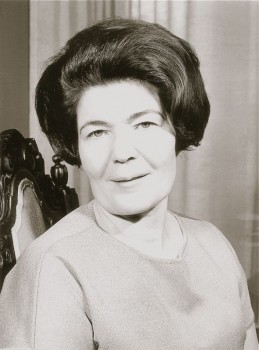
Aale Tynni (1913–1997). Photo: WSOY
Finnish poetic modernism, which with its freedom of rhythm came to dominate the literary mainstream of the 1950s, posed a particular challenge to the poets of the classical metrical and romantic poetic tradition. Aale Tynni (1913–1997) is not a poet of any one school or form, but rhythm is the deepest foundation of her poems, whether expressed in metre, free verse or the speech rhythms that characterise some of her poems of the 1950s and 60s, as well as those of her final years.
An Ingrian Finn, Tynni left Ingermanland near Petersburg for Finland as a refugee after the First World War, in 1919. The war and the period of uncertainty that followed it are present in her poems as an allegory, sometimes appearing as a dance of death or a carnival. At other times they emerge in the myth of Phaethon, who with his sun chariot is in danger of throwing Mother Earth off her axis, or as a game of chess in which God and the angel Gabriel play with the planets and moons as pieces. The poet makes use of mythic and cosmic references to widen her scope and to portray Man in the stages of history and the present age. More…