

Search results for "tommi+musturi/2010/05/song-without-words/2009/09/what-god-said/2011/04/matti-suurpaa-parnasso-1951–2011-parnasso-1951–2011"
Life is
16 February 2012 | Letter from the Editors
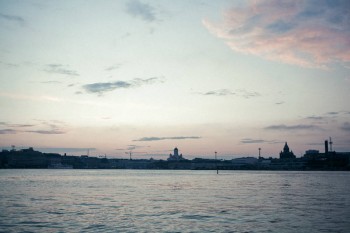
Helsinki silhouette. Photo: Valtteri Hirvonen, Eriksson&Company / World Design Capital Helsinki, 2011
Where is Books from Finland located?
In the old days, the answer was simple, although not unambiguous. Books came from its office in central Helsinki; it was written in various locations in Finland and abroad, and translated mainly in England and the United States; and it was published in the small town of Vammala, about 200 kilometres north of Helsinki.
It spread, in multiple paper copies, to readers throughout the world, to find its place on desks, on bedside tables, in briefcases and handbags, propping up table-legs or holding doors open – in London, England, Connecticut, New England, with a few in Paris, France, and Paris, Texas, maybe. More…
Poetry written aloud
20 May 2011 | Reviews
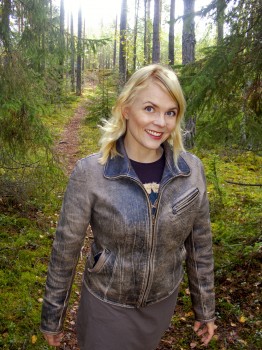
Heli Laaksonen. Photo: Otava/Irmeli Jung
In the 21st century, poetry written in various dialects has drawn new audiences to poetry readings. A common feature of, for example, Sinikka Nopola’s short prose about the family, written in the dialect of the Tampere area, and Heli Laaksonen’s poetry, which is written in the dialect of south-west Finland, is the enormous popularity of live performances by the authors. Their audiences love to hear them read in dialect, because the texts are funny, and they sound even funnier when read aloud.
Heli Laaksonen (born 1972) has, ever since her first collection, Pulu uis (‘Pigeon swimming’, 2000), been Finland’s best-selling poet. Her three collections and audio books have achieved sales figures that are astonishing in the Finnish context – tens of thousands of copies. Her fourth collection, Peippo vei (‘The chaffinch took it’, Otava, 2011), has been at the head of bookseller’s sales lists throughout March and April. More…
Piranesi
30 August 2013 | Fiction, Prose
An extract from the novel För många länder sedan (‘Many lands ago’ Schildts & Söderströms, 2013; Finnish edition: Monta maata sitten; Otava, 2013). Introduction by Pia Ingström
‘I assume your father wanted you to become a doctor?’ asked Igor at the beginning of our life together. My parents did indeed want me to become a doctor. Not a pathologist, but a general practitioner. I became an art historian instead. There was a time when my area of research aroused curiosity in Igor.
‘Why Piranesi?’ he wondered.
‘As a child I devoured classic novels about pale, emaciated families living in a cellar,’ I explained jokingly. ‘I became interested in catacombs and vaults. That’s why I wanted to study the history of drawing.’
I’ve always had a fascination for underground spaces. I’m drawn to them like a homing missile. This interest of mine must have genetic roots. My mother was born in a bomb shelter during the first German air raid over Leningrad. More…
Speaking about the heart
30 June 1991 | Archives online, Articles
New Finnish poetry, translated and introduced by Herbert Lomas
The ‘modernist’ revolution in Finnish poetry is now 40 years old, and the art must be ripe for changes.
Of course, the modernism of post-war Finnish poetry was not – except in Haavikko and to some extent in Saarikoski – extremely modernist. The poets were more interested in their content than their experiments. They were perhaps closer to ancient Chinese poets and early Pound than to Eliot in their elided brief juxtapositions and meditations on nature, society and moment-to-moment transience. The poets picked up a few liberties that unshackled them from metrical and rhyming formalities uncongenial to Finnish stress, syntax and phonemics; and they took off to speak about the heart. That is the strength of this poetry, and its originality, since all originality consists in being oneself – which includes one’s national self, and ultimately other people’s selves. And every generation still has to make a new start, admittedly in new circumstances, with the experience of its forefathers from birth to death. More…
Letters from Klara
31 March 1992 | Archives online, Fiction, Prose
A short story from Brev från Klara (‘Letters from Klara’, Söderström & Co, 1991)
Dear Matilda,
you are hurt because I forgot your ancient birthday: that is unreasonable of you. To put it bluntly, you have expected my particular devotion all these years merely because I am three years younger. But let me now at last tell you that the passage of the years An Sich is no feather in one’s hat.
You pray for Higher Guidance – excellent. But until you receive it, it might perhaps be as well to discuss certain bad habits which are, as a matter of fact, not foreign to me, either. More…
Finlandia Prize for Non-Fiction 2012
5 December 2012 | In the news
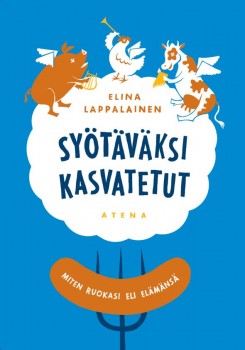 ‘It is one of the rules of quality journalism that writers aim for even-handed and impartial reporting, but at the same time challenge their respondents to account for their actions. Writers should also have the capacity for in-depth reporting and analysis,’ said Janne Virkkunen, former Editor-in-Chief of Helsingin Sanomat newspaper on 8 November, as he announced the winner of this year’s Finlandia Prize for Non-Fiction, worth €30,000.
The winner, Syötäväksi kasvatetut. Miten ruokasi eli elämänsä (‘Grown to be eaten. How your food lived its life’, Atena) by the young journalist Elina Lappalainen, is her first book.
‘The book could have fallen prey to the sensationalism of which we all probably have experience in the media, at least. This writer was able to avoid the temptation,’ Janne Virkkunen said.
The other works on the shortlist of six were as follows: Arabikevät (‘The Arab spring’, Avain), a study of spring 2011 in the Arab world by Lilly Korpiola and Hanna Nikkanen, Norsusta nautilukseen. Löytöretkiä eläinkuvituksen historiaan (‘From the elephant to the nautilus. Explorations into the illustration of animals’, John Nurminen Foundation) by Anto Leikola, Kevyt kosketus venäjän kieleen (‘A light touch to the Russian language’, Gaudeamus) by professor of Russian Arto Mustajoki, Karhun kainalossa. Suomen kylmä sota 1947–1990 (‘Under the arm of the Bear. Finland’s Cold War 1947–1990’, Otava) by Jukka Tarkka and Markkinat ja demokratia. Loppu enemmistön tyrannialle (‘Market and democracy. The end of the tyranny of the majority’, Otava) by banker Björn Wahlroos.
Face, book
23 June 2011 | Letter from the Editors
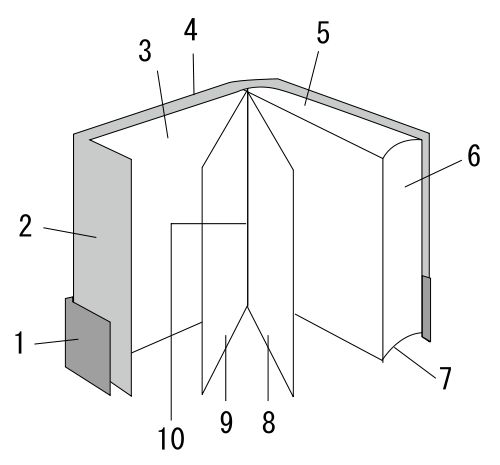
What are books made of? Picture: Wikipedia
‘The worst of all is if the writer forgets writing and starts turning out books.’
This thought is from the poet Vilja-Tuulia Huotarinen’s introductory talk at the Lahti International Writers’ Reunion (LIWRE), which took place at Messilä Manor between 19 and 22 June. ‘There’s too much talk of the stunting of the book’s lifespan and the economic life of the publishers,’ she continues. A writer ‘must not forget that he or she is responsible to the work of art, nobody else, not even the readers.’
Today, book publishers are responsible to capital and productivity, and a work of literature resembles a product with an invisible best-before marker. Is its life a couple of months, like ice cream? Books delivered to the shop in September are already old-hat in February, and are best put on sale. More…
1968
30 March 2005 | Fiction, Prose
A short story from Lugna favoriter (‘Quiet favourites’, Söderströms, 2004)
We were in the space age, the age that came and went, the age of space and great dreams, when space was what we talked about and space was what the papers wrote about, and about Vietnam and protests and revolution, in articles precocious and prematurely old children spelled their way through, children living in the mixed forests of the North which had recently been transformed into gleaming suburbs where ink-caps, puffballs and parasol mushrooms still grow in the backyards of high-rise tower blocks. It says in the paper that we humans will soon have to move away, leave the Earth because our planet has become overcrowded and almost uninhabitable, and space and the eternity of space are waiting for us and we have engineers of the highest class who will soon solve such small problems as still remain. It’s not a question of forests of mixed trees or ink-caps or parasol mushrooms or other earthly things, it’s a question of it being too late now, that we must go further, first to the moon and then to Mars and Andromeda and further still, and here are some of the key words and phrases: space programme, space race, Apollo, Vostok, Tereshkova and Glenn. For humanity has dreams, dark mixed visions and a nagging and not easily extinguished sense of life’s inscrutability and greatness, but down here all goes on as before, we kill each other, we kill our fellow men in jungles and marshes, we kill them amid rugged mountains and in snow-clad forests, we poison them and blow them to pieces, we kill them in dark backstreets and in ramshackle wooden hovels and in mighty marble palaces where the bath-taps glitter with gold. Only a chosen few are able to escape, and to do this they have to set off upwards into a coolness, and seek out a darkness and solitude where there will be no anxiety or feelings of guilt. But before they can get there they must face opposition of a magnitude that can only be overcome by a fierce rush of power, and before the rocket can start it sits and breathes out smoke and gases and fire for a good thirty seconds before lifting off slowly and reluctantly as if unwilling to leave its home planet, as if it hasn’t the slightest desire to go, but when it gets under way it travels at incomprehensible speeds over unimaginable distances, it’s only 108 years since Lenoir invented the internal combustion engine and we are already up in space where it’s silent and cool and peaceful, just a little anxiety in case some instrument fails, in case some double safeguard shows itself insufficient, otherwise nothing, just weightlessness and silence, just the oceans and deserts and mountain-chains on the surface of our blue globe. Though let’s be fair: the Chinese, who haven’t been up in space, claim that the Great Wall of China must be visible from up there, but on the other hand they have nothing to say about the visibility of new-built suburbs in the miserable little capitals of small underpopulated countries with frosty climates. More…
The lady who could fly
30 June 1989 | Archives online, Fiction, Prose
A short story from Kenkää suurempi jalka (‘The foot bigger than the shoe’, 1992)
A day came when she felt she could fly. You used technological gear and gadgets for flying, or meteorological shifts in the air masses: rising currents gave you a weightless ecstasy with the lightest of equipment. But that wasn’t it.
To begin with it was one of those typical flying dreams, which gradually extended into the waking state: she could feel it coming in her sinews, her nervous system, her cortex. She was acquainted with Freud and Jung and the other dream-interpreters of today. Characters in the myths and fairytales flew; cruel princesses flew on the wings of the storm; Gogol’s overcoats, Chagall’s lovers, cows and cats flew; and vampires – those last leather-winged flutterings of the prehistoric archaeopterix in the mud of the gene pool. More…
Fair game
23 October 2009 | This 'n' that
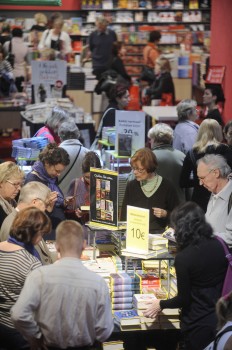
Words for sale: Helsinki Book Fair, 2009. - Photo: Suomen Messut / Kimmo Brandt
The Helsinki Book Fair opened yesterday (22 October), with the theme ‘What’s really happening’, at the Helsinki Exhibition and Convention Centre. Over four days there will be more than a thousand performers (mostly writers and their interviewers) and nearly 300 exhibitors. Last year’s Fair attracted 68,000 visitors.
The words of the theme are borrowed from a 1960s collection of poems (Mitä tapahtuu todella) by Pentti Saarikoski (1937–1983). According to the press release, the theme ‘sums up what literature is about’; moreover, ‘fiction and non-fiction reflect this very day, reinterpreting the past and present glimpses of what is to come’.
What’s really happening, it seems to us, is that inventing catchy titles for commercial purposes is an enterprise that should be undertaken with caution, as it may produce unintentional connotations for the delectation of those in the know… Mitä tapahtuu todella – its title borrowed in turn from none other than the Russian revolutionary Vladimir Ilyich Lenin – was a politically utopian collection in which Saarikoski expressed his belief in dialectical materialism and communism, contrasting American avant-garde art with the Marxist-Leninist utopia in which the writer wished to live.
In recognition of bicentennial 1809, the year in which Finland ceased to be part of the kingdom of Sweden and became an autonomous Grand Duchy of Russia, Sweden is under focus at the Book Fair, and is represented by 27 exhibitors and more than 30 performers. Writers from eight countries in all will visit the Fair, Russia taking part for the first time. Among the visitors are the writers Andrei Astvatsaturov and Herman Sadullajev and the translators Lyudmila Braude ja Anna Sidorova, who were awarded this year’s Finnish Government Prize for Translation.
The Fair is organised by The Finnish Fair Corporation in conjunction with the Finnish Book Publishers Association and the Organisation of the Booksellers Association of Finland.
Hiking through a poetic universe
30 March 2006 | Authors, Reviews

Lars Huldén. Photo: Charlotta Boucht
The gods decreed that Lars Huldén was born on the same date as Finland’s national poet Johan Ludvig Runeberg (1804–1877), who wrote the words of the Finnish national anthem – and who has turned into a dead classic. Lars Huldén will never be thought of as a member of the dead poets’ society.
A collected volume entitled Utförlig beskrivning av en bärplockares väg (‘A thorough description of a berry-picker’s path’, Schildts [Finnish translation, by Pentti Saaritsa: Erään marjamatkan seikkaperäinen kuvaus, WSOY]) containing work from the whole of Huldén’s literary career – from his first book all the way to new poems written in 2005 – has been published in honour of his 80th birthday in February 2006. He has published thirty-six collections of poetry in Swedish, and it is a generous, intelligent and (self-)ironic textual universe that unfolds through the volume’s 500 pages. More…
Kidult culture
4 April 2012 | Non-fiction, Tales of a journalist
Illustration: Joonas Väänänen
Life is hard, and then you grow up. Except that you don’t really, at least if you keep watching television. Jyrki Lehtola takes a look at entertainment for the Peter Pan generation – which, he argues, is pretty much all of us
When did we start making television for children? I mean, in theory for adults (believe me, advertises, believe me: for adults!) but in practice for children?
Theoretically television is a wonderful, flexible medium less dependent on big money than the film business. Why did we let it slip out of our hands as a form of expression?
Why did we start making adult programmes for children and children’s programmes for adults? In other words, why do we make exactly the same TV programmes for everyone? More…
A small lie
30 June 1987 | Archives online, Fiction, Prose
A short story from Pieni valhe (‘A small lie’). Introduction by Marianne Bargum
The white cat had started to hate her.
Only half a year ago, Marja remembered, it had been playing with the hems of her robe, while she had passed the morning reading and drinking coffee. Right now it was staring relentlessly at her from the bookcase where it was ensconced: out of reach, she thought. Its stare was green and mean. At night it attacked her ankles; it lurked in the crevices of the apartment and when it heard her approaching steps it leapt past her, screaming, and crossed the room to the curtains or the table. The curtains fell, books crashed to the floor, the cat stared with its eyes opened wide, the pupils like narrow slits. She would lock the cat into the other room for the night, hear it mew and feel the door with its paws; she fell asleep only after the cat had calmed down. When she approached it during the day, stroked it and called its name, it looked at her, motionless, as if it had seen and known everything, and then she withdrew her hand, backed off, started behaving as if there wasn’t even a cat in the apartment. More…