

Search results for "tommi+musturi/2010/05/song-without-words/2009/09/what-god-said/2011/04/matti-suurpaa-parnasso-1951–2011-parnasso-1951–2011"
Thunder in the east
31 December 1991 | Archives online, Fiction, Prose
Extract from the novel Colorado Avenue (Söderström & Co, 1991). Introduction by Pia Ingström
Come. We are going to look at schoolmaster Johansson’s photographs.
It is true that Johansson himself died of TB back in 1922, and the collection of glass negatives he left behind – several dozen boxfuls – was destroyed in a peculiar manner. This, however, constitutes no hindrance to us. Where reality falls short, fantasy must intervene. By expanding realistic style beyond the scope of the possible we create a new reality.
To seek to grasp at Time and hold her fast is a dangerous and hopeless undertaking; Time wreaks a terrible revenge on those who seek to rise up against it. Thus, too, was schoolmaster Johansson’s dream of eternity with the help of silver nitrate and glass frustrated. In the spring of 1926 schoolmaster Johansson’s household effects were finally sold by auction. A certain Eskil Holm from Blaxnäs snapped up the glass negatives for a small sum. More…
Notes from underground
30 September 2003 | Fiction, Prose
Extracts from the crime novel Harjunpää ja pahan pappi (‘Harjunpää and the priest of evil’, Otava, 2003)
Killing a person wasn’t difficult. No more of a problem than killing a pigeon. It only needed a slight push – at the right time, of course, and in the right place. He if anyone had the ability to scent out the time and place, or rather perhaps they were revealed to him in a certain way; and, hey presto, the flesh did come off the bones and the veins burst open on the macadam, and vertebrae and joints rolled about like beans, and the life departed from all that filth that had turned a person into a devil of greed. Of course he knew that. He’d seen it and smelt with his own nostrils the stench of raw human flesh that gave you that sweet shudder. More…
A perfectly ordinary day
30 September 1997 | Archives online, Fiction, Prose
Extract from the novel Kello 4.17 (‘The time was 4.17’, WSOY, 1996). When time loses its meaning, real fear strikes like an iron glove. Aho writes about a man who is different but no outcast
I was lost to myself, if it is possible to be lost if you haven’t gone anywhere. Black birds curved through my mind and it felt as if no one needed me, no one or nothing: my mother bought clothes and make-up and did not seem to care; Uncle Lasse looked after the family business, steam coming out of his head, and kept shopkeepers and shopaholic customers happy; smiling bank managers slapped shy loan applicants encouragingly on the back, the gross national product grew without me having anything to do with it, or because I didn’t; and politics plodded onward as the mud squelched comfortingly. The machine of society hummed and ticked and Finland was as round and fat as a bomb. I looked at it and nothing changed, and on Sundays it was so quiet that you could look out of the window and see the Sahara.
Saikansalo the racing cyclist
30 June 2005 | Archives online, Fiction, Prose
A short story from the collection Heta Rahko korkeassa iässä (‘Heta Rahko at a great age’, Otava, 1947). Introduction by Vesa Karonen
Saikansalo was a racing cyclist and the country’s best, unquestionably. His Achilles tendons were superlative.
So when he found no rival in his own country. the athletics bigwigs put their heads together and hinted at the idea of sending him abroad to win a further reputation somewhere in the south – France, Italy or the like. They warned him that he’d have to be in good trim because of the enervating heat in the southern climes.
‘Heat!’ Saikansalo said. ‘There’s an old saying “Heat never broke anyone’s bones”….’
‘But it melts you like lard,’ his chum kept claiming. ‘The sun climbs really high there – scorches right down on your topknot, and boils your brains….’ More…
Dreams so strong
31 March 1996 | Archives online, Fiction, poetry
Poems from Regnets uråldriga sätt att regna (‘The rain’s primordial way of raining’, Schildts, 1993)
the necessity of low tide
the necessity of still, mud-grey days
where the bird’s egg and your memory hide in the sand of the shy
the weak light
made of molten wind
and our faces deep inside the shadow.
we sleep: we dream a dream of sprouting shoots,
of the red heads of the newborn children
that palpitate beneath the ice –
In this room, or elsewhere
31 March 1994 | Archives online, Fiction, poetry
‘Some people play bridge; some people shoot pool; we read and write poems’, says Jouni Inkala (born 1966) of his generation of poets. These poems from his prize-winning first collection of poems, Tässä sen reuna (‘Here is its edge’, WSOY, 1992)
Behind the window, wet snowflakes rise and descend,
cold white insects.
In the summer, their brothers swirled in the sun’s low,
silent volleys,
as I sped on my bicycle through the dark gullet of spruce-rows some always filtered into my eyes, my mouth.
They were cool, even then.
Now I sacrifice toenails, relinquish some of my own warmth to the back of an armchair.
As a dark, painful spot in God’s brain,
which is unknown
as long as it isn’t troubled into truth,
pain made visible, known. More…
Perfect thing
31 December 2000 | Archives online, Fiction, Prose
Extracts from the novel Ennen päivänlaskua ei voi (‘Not before sundown’, Tammi, 2000). Interview and introduction by Soila Lehtonen
A youngster is asleep on the asphalt in the backyard, near the dustbins. In the dark I can only make out a black shape among the shadows.
I creep closer and reach out my hand. The figure clearly hears me coming, weakly raises its head from the crouching position for a moment, opens its eyes, and I can finally make out what it is.
It’s the most beautiful thing I’ve ever seen.
I know straight away that I want it. More…
A sense of order
30 June 1987 | Archives online, Authors, Reviews
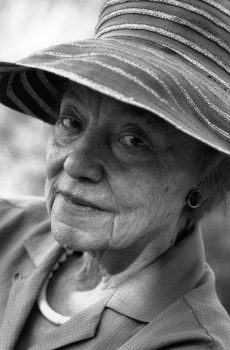
Solveig von Schoultz. Photo: Charlotta Boucht
That Solveig von Schoultz occupies the position of ‘grand old lady’ of Finland-Swedish poetry is beyond question; yet it is an epithet that fits her badly. It all too easily suggests the image of a stern and queenly poetess, an Edith Sitwell, Marianne Moore or Gabriela Mistral. The poetesses of Scandinavia are, by and large, less solemn – more gentle and down-to-earth, even when they grow older and wiser and ascend some of Parnassus’s more elevated thrones.
Solveig von Schoultz has, of course, had a long journey to the top. She has behind her twelve collections of poetry, at least fifteen volumes of prose, and an even greater number of plays for radio, television and theatre, spanning a good fifty years’ acitivity as a writer.
In this long artistic career there is both continuity and development. It might be said that the continuity is represented by the fact that from the very beginning she has preferred to describe women – their daily lives, their loves, thoughts, impulses, relationships. But since so much in the world of women and in women’s thinking has changed during the decades since her literary debut in the 1930s, both her themes and her outlook have necessarily altered, too. Among other things, she has had many of her early, then only half-developed ideas taken up by a later generation, and has thereby had them given back to her renewed. As a feminist she has always been one of the least militant, and for a short time some of her younger co-sisters were uncertain about the strength of her commitment to the Cause. More…
New from the archives
29 January 2015 | This 'n' that
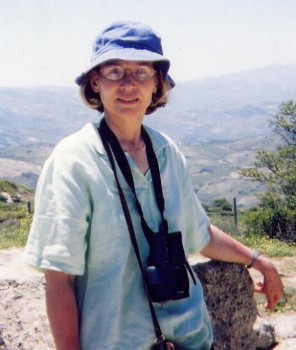
Ulla-Lena Lundberg
Low-lying, sea-girt pieces of rock strewn across the sea midway between Finland and Sweden, the Åland Islands – known in Finnish as Ahvenanmaa – are a world unto themselves. In mind and spirit they are separate from both Finland (to which they technically belong) and Sweden, giving their inhabitants, writers included, a fascinating outsider status.
This week’s archive find, an extract from Leo, the first volume of Ulla-Lena Lundberg’s trilogy set in 19th-century Åland, offers a compelling portrait of the potent mix of cosmopolitanism and (literal) isolation of the islands’ seafaring community, in which the men sail the seas and the women stay at home.
Born on Åland in 1947, Lundberg is a writer of novels, short stories, poems and other essays; her work, she says, derives from her habit of sitting under the table as a small child and listening to what the grown-ups said. She received the Finlandia Prize in 2012 for her novel Is [‘Ice’], and the Tollander Prize in 2011.
*
The digitisation of Books from Finland continues apace, with a total of 354 articles and book extracts made available online so far. Each week, we bring a newly digitised text to your attention.
Panu Rajala: Naisten mies ja aatteiden. Juhani Ahon elämäntaide [A ladies’ man of ideas. Juhani Aho’s art of living]
26 January 2012 | Mini reviews, Reviews
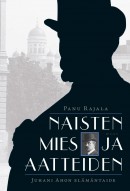 Naisten mies ja aatteiden. Juhani Ahon elämäntaide
[A ladies’ man of ideas. Juhani Aho’s art of living]
Helsinki: WSOY, 2011. 441 p., ill.
ISBN 9789510374412
€ 35, hardback
Of Juhani Aho (1861–1921) it is said that he created what have proved to be the most enduring descriptions of how traditional Finland began to be modernised; his most famous book is the novella Rautatie (‘The railway’, 1884) which portrays the arrival of the railway in the Finnish countryside. This new biography also shows once again how many international influences can be found in the work of Aho, who is often called a national author. Aho was active in student politics, and as a newspaper journalist. He was nominated for the Nobel Literature Prize twelve times, but for various reasons, some of them connected with language politics, lobbying on his behalf was not successful. Aho developed Finnish prose, bringing to it realism and impressionistic style. His experiences during a visit to Paris in 1889 form the basis of his novel Yksin (‘Alone’), which caused a stir in part because of its erotic flavour. This book by the author and literary scholar Panu Rajala provides a versatile insight into Aho’s personal story, the world of his ideas, his opinions on art, and his complex relationships.
Translated by David McDuff
Translation prize to Angela Plöger
23 October 2014 | In the news
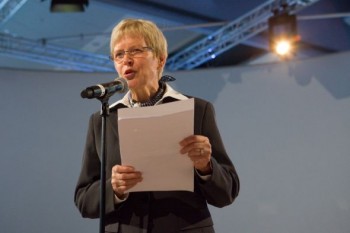
Angela Plöger, Frankfurt Book Fair, 8 October. Photo: Katja Maria Nyman
The 40th Finnish State Prize for the Translation of Finnish Literature of 2014 – worth €15,000 – was awarded to the German translator Angela Plöger at the Frankfurt Book Fair on 8 October.
Dr Angela Plöger (born 1942) studied Finnish and Fennistics in Berlin; she first came to Finland in the 1960s after having become interested in the Finnish language as a result of learning Hungarian.
‘I had been to the restaurant at the Helsinki Railway Station where Bertolt Brecht was thinking how the noblest part of a man is his passport, and how Finns are a people who keeps silent in two languages.’
Plöger then defected to West Germany, starting her career anew. She has also translated texts from Hungarian and Russian. In her speech in the Finnish Pavilion of the Book Fair Plöger said that in her opinion translating literature is the most fascinating profession in the world.
Her first translation of a Finnish novel was Tamara, by Eeva Kilpi, published in 1974. Among the most recent of the 40 novels Plöger has translated during the past five decades from Finnish are the novels Kätilö (‘Midwife’, 2011) by Katja Kettu and Kun kyyhkyset katosivat (‘When the doves disappeared’, 2012) by Sofi Oksanen. Among the other works Plöger has translated are novels by Leena Lander, Eeva-Kaarina Aronen, Anja Snellman, Kaari Utrio, Johanna Sinisalo, Risto Isomäki and Antti Tuuri, as well as a number of drama texts by Laura Ruohonen, Juha Jokela, Aki Kaurismäki, Pirkko Saisio and Sofi Oksanen.
The Minister for Culture and Housing, Pia Viitanen, thanked Plöger for her extensive and multi-faceted work in the field of language and literature and in promoting Finnish literary culture in Germany.
The prize, worth € 15,000, has been awarded by the Ministry of Education and Culture since 1975 on the basis of a recommendation by FILI – Finnish Literature Exchange.
Winner of the Nordic Council Literature Prize
6 November 2014 | In the news
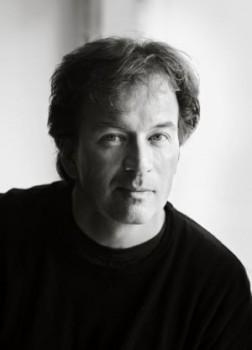
Kjell Westö. Photo: Kata Portin
The Nordic Council Literature Prize 2014 went to Kjell Westö and his novel Hägring 38 (‘Mirage 38’, 2013; in Finnish, Kangastus 38). The prize, awarded since 1962 and worth €47,000, was given on 29 October at a ceremony in Stockholm.
Among the 13 nominees was another Finn, the poet Henriikka Tavi with her collection Toivo (‘Hope’, 2011).
The jury said: ‘The Nordic Council Literature Prize goes to the Finnish writer Kjell Westö for the novel Mirage 38, the evocative prose of which breathes life into a critical moment in Finland’s history [the time before the Winter War, 1939–1940] – one that has links to the present day.’ Here, more on Westö and his winning novel.