

Search results for "tommi+musturi/2010/05/song-without-words/2009/09/what-god-said/2011/04/matti-suurpaa-parnasso-1951–2011-parnasso-1951–2011"
The Canada goose
31 December 2008 | Archives online, Fiction, Prose
A short story from Tapaus Sidoroff (‘The Sidoroff case’, WSOY, 2008). Introduction by Kristina Carlson
It was no use even trying the old cart track branching from the main road. I turned off the engine and glanced into the back seat. My aunt lifted the brim of her hat, her bright eyes peering at me questioningly.
‘We can’t get any farther by car. The road’s nothing but rough brush. What do you think, Aunt Alli, can you walk the rest of the way?’
My aunt shook her head and didn’t even bother to answer. She opened the car door and clambered out. A swarm of black flies wafted into the air from the brush at the bottom of the ditch.
‘For heaven’s sakes, there’s sure enough of these flies.’
She fanned at the air with her hat, straightened the hem of her dress and trudged across the ditch, without looking back, through the thicket of willows. In spite of her hip trouble, the old woman made her way in such a hurry that I had my work cut out keeping up with her. More…
Big-city blues
30 September 2005 | Fiction, Prose
Extracts from the novel Beige. Eroottinen kesä Helsingissä (‘Beige. An erotic summer in Helsinki’, Sammakko, 2005). Introduction by Tuva Korsström
Helsinki starts – where? Where a country girl will wear white corduroy pants if she’s eight and her pen pal tells her to. Where you’re allowed to jump in at the public swimming pool, and water splashes in your face no matter what you do, and it’s a long way to the bottom, you can’t touch. Unreal. That’s what Helsinki was like. Buildings that you recognized from pictures. A city where pictures were the starting point of your life, not experience. You step into the picture and begin your life. The step takes a long time. An entire youth. The first few days go well. You’re a tourist. The crowd of anonymous, noisy people is relaxed, you feel uninhibited. Nobody pays any attention to you. Then you start to want to feel. To talk. To say hi to somebody. The waiting begins, and there’s nothing you can do to speed it up. You have to live in the city. Ten years and you’re in, maybe, a little. Be there. Stay. You’ll circulate around the triangle formed by Sokos, Stockmann, and Forum department stores. They’re familiar from pictures, you’re wary of the others. The streetcar home. Home and downtown. The city. The lanes. Conduits. Lights. Trams. Taxis. Buses. The first negro. The first stop at a traffic light. The yellow stone building. The colorful cottages at the foot of the bridge. More…
Mikko Rimminen: Nenäpäivä [Nose day]
29 October 2010 | Mini reviews, Reviews
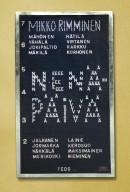 Nenäpäivä
[Nose day]
Helsinki: Teos, 2010. 339 p.
ISBN 978-951-327-1
€ 25.90, hardback
Female protagonists as sympathetic as this are rare in contemporary literature; in this third novel by Mikko Rimminen (born 1975), Irma is a solitary, slightly awkward outsider who gets badly tangled up in a muddle of her own making. She poses as a door-to-door market researcher – in order to meet people. Rimminen employs a more complex plot than in his previous novels (his 2004 debut work, Pussikaljaromaani, ‘A six-pack novel’, about idle young men, has been translated into five languages). The author is an acknowledged master of the slow narration: he is skilled at describing the sound of silence and giving a page-long description of the behaviour of a mobile phone in someone’s hand. All that passes unsaid and unseen between people is cleverly and hilariously put into words. Rimminen’s Finnish is highly original – he keeps creating new verbs and compounds – and his characters who stand on the margins hankering after ordinary life gain the reader’s genuine sympathy.
Cool, not ice-cool
17 October 2013 | This 'n' that
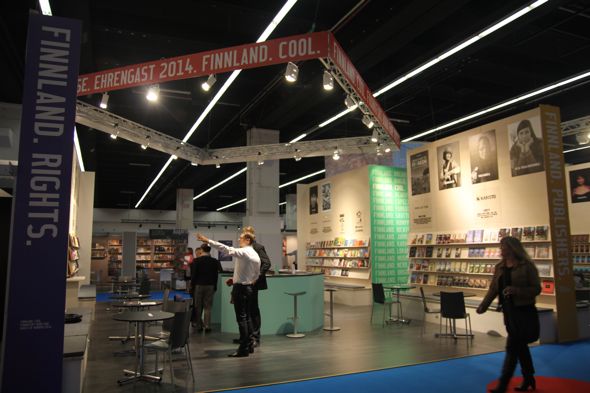
Getting ready: book fair scenery, 2013. Photo: FILI
The Finnish book world is preparing for the big event of ‘F14’: Finland will appear as Guest of Honour at the Frankfurt Book Fair in October next year.
The slogan for this enterprise is Finnland. Cool.
The coordinating organ is FILI, the Finnish Literature Exchange, a part of the Finnish Literature Society. Co-operating with FILI are three ministries, literary organisations and publishers, the Finnish Embassy and Finnland-Institut in Berlin and the Goethe-Institut in Helsinki.
Last week a large proportion of the FILI staff – who now need to keep their cool for the next busy year – went to Frankfurt, and on 10 October (aptly, the memorial day of the national author Aleksis Kivi and also Finnish Literature Day) the press conference was opened by the Finnish Minister of Culture and Sport, Paavo Arhinmäki. On 13 October the 2013 Guest of Honour, Brazil, passed the baton to Finland. (More photographs here.)
The world’s largest book fair, Frankfurt, attracts some 300,000 visitors each year. Accessible to both professionals and the general public, the fair is also the biggest cultural event in Germany.
The Guest of Honour countries receive a vast amount of attention in the media, and the number of new translations from the respective languages into German, as well as other languages, will increase.
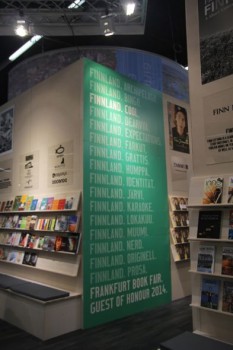
Finnland: arktik. Blondi. Cool. Demokratia. Einsam. Formula 1. Girji. Heimat. Ihminen. Joy…. Photo: FILI
The total Finnish budget for the years 2010–2015 is approximately four million euros, half of it money from the government. And the mission? Here are some warm words from the cool FILI agenda:
‘Why are Finns reading so much? Why are Finns so good at reading? Because we love it. Because reading plays such an important role in everyday life.
‘And because it is so important in Finland that everybody has access to reading – regardless of whether you are male or female, where you live, where you work, what your education or talent is. Fun, everyday life and for everyone – these are the main themes of the satellite programme for the Guest of Honour at the Frankfurt Book Fair 2014.’
Bright lights, small city
26 August 2010 | Articles, Non-fiction
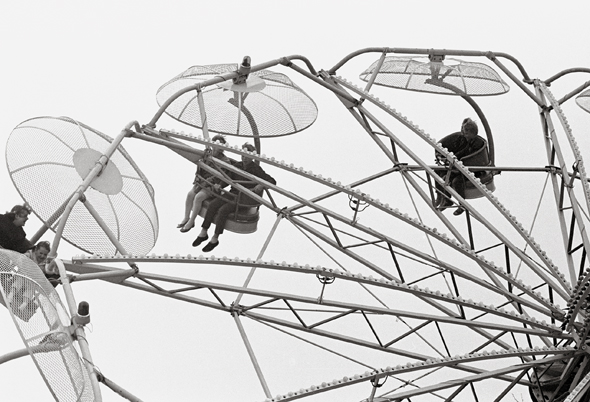
Helsinki people on the big wheel: Linnanmäki amusement park, 1968
Helsinki people on the big wheel: Linnanmäki amusement park, 1968
Photographs and excerpts from Helsinki 1968 by Claire Aho and Kjell Westö (text in Finnish, Swedish and English; WSOY, 2010)
A year that rocked the world: 1968. The Vietnam War, the Chinese cultural revolution, the invasion of Czechoslovakia, hunger in Biafra. Helsinki that year: a quiet little city, in a quiet little country. But Finland’s baby-boomers, born after the war, were now coming of age, resulting in the beginnings of a change of generation in politics; and the students of Helsinki University joined the global student unrest of this ‘crazy year’. Photographer Claire Aho takes a series of photographs of her home town, participating in an exhibition in Kiel, Germany. Forty-two years later her photos are published in Helsinki 1968, together with reflections by Kjell Westö, whose novels are deeply rooted in his native city. Here are words and images of Helsinki that mirror the past – and the present
Both the city and its people carry their past with them, find it hard to let go, and don’t really want to. Many of us are reluctant to embrace the new. Hence there is often something ambivalent, something enigmatic in the frozen moment of the photograph…. More…
Peter von Bagh: Sodankylä ikuisesti [Sodankylä forever]
11 June 2010 | Mini reviews, Reviews
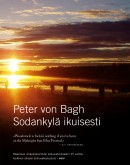 Sodankylä ikuisesti
[Sodankylä forever]
Helsinki: WSOY, 2010. 308 p., ill.
ISBN 978-951-0-36290-7
€ 52, hardback
The Midnight Sun Film Festival is the world’s northernmost film festival. Held in Sodankylä, Lapland, it is now 25 years old. This scrapbook includes the text of speeches given by filmmakers as well as a wealth of material about the films shown over the years. Much of this material is based on the morning discussion panels which the festival’s director, film historian and author Peter von Bagh, has chaired with his guests. More than one hundred film directors, from Samuel Fuller to Wim Wenders, talk about the background and influences in their work. Von Bagh has constructed dialogues between directors who did not actually attend the same sessions; he calls these conversations – sometimes between the living and the dead – ‘heavenly dialogues’. The Festival was founded by Finnish film directors Aki and Mika Kaurismäki and Anssi Mänttäri in collaboration with the municipality of Sodankylä. The light summer nights and laid-back atmosphere at the festival delight the speakers and audience members every year. In the words of the American filmmaker D.A. Pennebaker, ‘Woodstock is fuckin’ nothing if you’ve been at the Midnight Sun Film Festival.’
The pearl
30 December 1999 | Fiction, Prose
A short story from Tutkimusmatkailija ja muita tarinoita (‘The explorer and other stories’, Loki-kirjat, 1999)
My name is Jan Stabulas. I am one of the quietest and inconspicuous workers in our department store, this giant ant-heap swarming with people. No one really pays any attention to me, although I am on show all the time. My job is quite simple: to stand in the menswear department, dressed in fashionable clothes. Now that doesn’t take much, I have heard it said. Well, try it yourself. Try standing for ten hours, without moving, in an awkward, even an unnatural, position, wishing that the air conditioning would work when it was hot, or that it would be switched off when you can feel the draught cutting you to the marrow. Think how the customers stare at you as they pass by, like an object which they cannot buy, and consider your words once more. More…
Scenes from a life
30 September 2004 | Archives online, Fiction, Prose
Extracts from Muistelmat (‘Memoirs’, Otava, 2004). Introduction by Soila Lehtonen
1973, Mietoinen
The shot put circle
Great Grandma knew a lot. She could look over to the neighbor’s yard two kilometers away and told us she could see a broom there leaning against the door. I was practicing the shot-put with the boys by the gable end of the barn. The shot flew three meters. Great Grandma walked past: ‘So what are you boys up to?’ I stared at the ground and said: ‘We don’t know yet.’
1980, Turku
The people in the neighboring car
Reeds rustled against the sides of the boat. The car stood in the sun. We drove into town. At the end of the trip, traffic slowed. I sat in the back seat and got a good view of the people in the car next to us. When we started moving again, I knew I would never see them again. After thirty seconds, they were there, right next to us. More…
The Comb
30 September 1981 | Archives online, Fiction, Prose
A short story from Tilanteita (‘Situations’, 1962). Introduction by Vesa Karonen
The young man’s comb dropped behind the radiator under the window. The young man crouched down to look and felt with his fingers in between the pipes and along the floor. No trace of the comb.
Lose something on a train and it eludes you. A train ticket I left once – just placed it long enough on the window ledge for it, too, to fall behind the radiator. Couldn’t find it. The conductor came along, said “Any new fares! Tickets please.” I just sat still, totally unconcerned, until he’d gone. I’m sure there are little details which give the game away to conductors, they know who’s just got on.
New passengers are always somehow fresher, more alert. In winter, I hear, they look at the passengers’ feet. If there’s snow round the edges of the shoes, no need to hesitate. A lot of people are done for by looking straight in their eyes. Offenders always look straight back and then in the middle try to look somewhere else entirely. I was careful not to look steadily into the conductor’s eyes. It was easy when I concentrated on the way the long ventilator cords swung back and forth from the ceiling. They all swung in the same direction but some cords were a bit behind the others. Perhaps it was because the cords were all slightly different in weight and length. Now I remember – it’s not the weight that counts, just as it’s not weight that affects the way a pendulum swings. When the conductor had gone I began to look for my ticket again. I went on looking for it all the way to Tampere. The young man, too, would obviously go on looking for his comb until he got where he was going, without finding it. More…
The train
31 March 1995 | Archives online, Fiction, Prose
Extracts from the novel Koe (‘The experiment’; WSOY, 1994). Interview by Tuva Korrström
In the morning a wild rose tapped beseechingly at the window, the wind sighed in the shaft of the chimney, the entire house creaked, pregnant with so great a longing that they had to awaken.
And as soon as they began to speak to each other, the house settled.
‘I should like to see the train,’ Sari said.
‘Why?’
‘Because that is the reason why I am here.’
‘I didn’t plan it like that,’ Kari said. More…
The legacy of a self-made man
29 October 2010 | This 'n' that
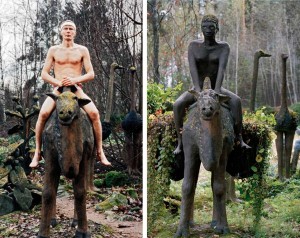
On camelback: in the exotic part of Veijo Rönkkönen’s concrete cosmos there are animals and palm trees, side by side with the living plants of the northerly latitudes. - Photo, left: Veijo Rönkkönen; photo, right: Veli Granö
Some of our readers may remember a story entitled ‘Self-made man’, published in Books from Finland in April 2009: Veijo Rönkkönen, who lived his entire life on a small, isolated farm in eastern Finland, built a garden inhabited by five hundred human and animal figures made of concrete.
Rönkkönen worked in a nearby pulp factory for 41 years. He lived in a small house in the middle of the garden, surrounded by his sculptures, which he had started making in the early 1960s.
Photographer and writer Veli Granö introduced the life and works of this self-made artist in his book Veijo Rönkkösen todellinen elämä / The real life of Veijo Rönkkönen (text in Finnish and English, Maahenki, 2007).
Contemporary folk art in Finland goes by the acronym ITE, from the words itse tehty elämä, ‘self-made life’. The French called it art brut; the English-language term is ‘outsider art’. The artists are ‘unschooled visionaries’ who make their art independent on any societal requirements or definitions.
The sculpture park became the most notable tourist attraction in Parikkala, visited by as many as 26,000 visitors every summer. Rönkkönen, however, refused to turn it into business. He never talked to visitors voluntarily either, but the park was open and free to all. He was awarded a state prize for artistic achievement, the Finland Prize, worth €30,000, in 2007, which he accepted.
Veijo Rönkkönen died last spring at the age of 66. The estate – Rönkkönen’s siblings, living elsewhere in Finland – offered the unique park to the county of Parikkala, which declined the offer because it’s upkeep was estimated to be too expensive.
In October businessman Reino Uusitalo bought the place for €140,000, with the intention of founding an administrative committee for the upkeep of the park. Rönkkönen’s extraordinary ‘total work of art’, will thus stay open – at least until nature – lichen, moss, creepers – claims what it considers it own. 500 sculptures: a self-made man’s open-air art
The painter who wrote
6 October 2014 | Non-fiction, Reviews
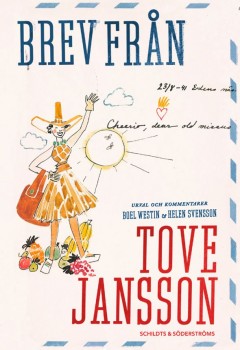 Brev från Tove Jansson
Urval och kommentarer Boel Westin & Helen Svensson
[Letters from Tove Jansson, selected and commented by Boel Westin & Helen Svensson]
Helsingfors: Schildts & Söderströms, 2014. 491 pp., ill.
ISBN 978-951-52-3408-7
€34.90
In Finnish (translated by Jaana Nikula):
Kirjeitä Tove Janssonilta
ISBN 978-951-52-3409-4
Nothing could be more mistaken than to describe Tove Jansson as ‘Moominmamma’. In her statements she was both cutting and complex – conflict-ridden and full of paradoxes. And she was nobody’s mamma.
Tove Jansson (1914–2001) became world famous (especially ‘big’ in Japan) with her Moomins – the characters of her illustrated books for children (1945–1970) – and her books for adults are a part of her work that is at least as interesting. Her training, ambition and artistic passion were, however, focused on painting.
Anyone who has read Boel Westin’s excellent biography – now available in English, Tove Jansson: Life, Art, Words – ‘knows’ all this, but to experience it through Jansson’s own letters, in an alternating process of reflection and recreation, brings the problems close to the reader in quite a different way: one that is shocking, but also deeply human. More…
Truths to tell
1 June 2011 | Authors, Interviews
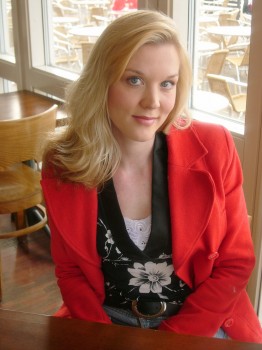
Johanna Holmström. Photo: Irmeli Jung
‘In my writing I try to give as many angles as possible, and my agenda is to show that there’s not just one truth, that there are always several ways of seeing what one perceives at first sight. So I often have more than one main narrator. I constantly aim to question accepted truths. My stories always begin with indignation about something I feel I must write about. Fiction is a way of distancing oneself. After all, books are literary, invented things. When you work on the subject of a literary text it becomes less personal.’
This is how Johanna Holmström (born 1981) describes her approach to writing. Since her first collection of short stories published in 2003 she has produced a book every two years: three short story collections and one novel. Her books have been variously described as imaginative, committed and uncomfortable. Her short story ‘Stormen’ (‘The storm’) is a precisely observed account of a day when everything changes for its young protagonist.
Just reading
18 June 2009 | Letter from the Editors
 The Books from Finland website has been live for two months, and we’re gradually settling in to our new mode of being. To say we were growing accustomed to our new environment, though, would be misleading. Since our last editorial, the Editor-in-Chief, the London Editor, the Web Editor and the Designer have actually spent physical time in the same room (yea, to cement the feeling of non-virtuality, they have even eaten pizza together). It would be fair to say that our reaction, jointly and severally, to publishing on line, could best be summarised as ‘Yay! This is great!’