

Search results for "tommi+musturi/2010/05/song-without-words/2009/09/what-god-said/2011/04/matti-suurpaa-parnasso-1951–2011-parnasso-1951–2011"
Risto Uimonen: Juha Sipilä. Keskustajohtajan henkilökuva. [Juha Sipilä. Portrait of a centrist leader.]
23 June 2015 | Mini reviews, Reviews
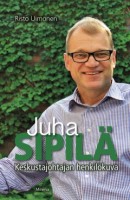 Risto Uimonen
Juha Sipilä. Keskustajohtajan henkilökuva. [Juha Sipilä. Portrait of a centrist leader.]
Helsinki: Minerva, 2015. 431pp., ill.
ISBN 978-952-312-125-6
€33,90, hardback
Juha Sipilä was an information technology millionaire and business entrepreneur when, in 2011, he became, at his first attempt, a member of parliament for the Finnish Centre Party, which represents principally country people, is considered conservative in its values and had lost support. The very next year this engineer from northern Finland was elected chairman of the party. Through, among other things, numerous interviews, the experienced non-fiction writer and journalist Risto Uimonen builds a nuanced portrait of a party leader with a strongly ethical value-system that lies on his Christian faith. Characteristic of Sipilä are informality, consideration of others, practicality and the ability to present issues clearly and pithily. In his party, he has focused on issues that are important to him, such as the promotion of biotechnology. Uimonen offers a fluent portrait of the background to Sipilä’s life and surprising career development, to which, as the book was being completed, a family tragedy brought darker tones. After the publication of the book, Sipilä led the Centre Party to victory in the parliamentary elections of April 2015. As chairman of the biggest party, he began to form a government and has already been praised for his efficiency.
Jouko Halmekoski: Orjamarkkinat. Huutolaislasten kohtaloita Suomessa [The slave market. The fate of auctioned pauper children in Finland]
17 November 2011 | Mini reviews, Reviews
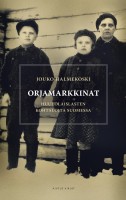 Orjamarkkinat. Huutolaislasten kohtaloita Suomessa
[The slave market. The fate of auctioned pauper children in Finland]
Helsinki: Ajatus Kirjat, Helsinki, 2011. 225 p., ill.
ISBN 978-951-20-8391-6
€ 26, hardback
Auctions of people were at their most widespread in Finland in the 1870s and 1880s; ‘auctioned paupers’ were entrusted for a year at a time to the one who put in the lowest bid for the pauper’s upkeep, then recompensed by the local authority. The people who were auctioned off included children, the elderly, disabled and mentally ill people. These auctions were banned in 1923, but they continued for some time thereafter. Although the practice was widely known about, the paupers’ shame prevented much discussion of the subject. Those who wished to provide help to people in need were probably greatly outnumbered by those who sought to benefit from their plight. In most cases, orphaned children ended up being auctioned off. Children born out of wedlock were another significant group. Jouko Halmekoski advertised in the newspapers in order to trace the lives and descendants of those who were auctioned off. Not all the auctioned paupers’ histories are tales of horror: this book, consisting of 25 of them, also includes stories of children who were treated well.
Translated by Ruth Urbom
Jaakko Blomberg: Vakauden kaipuu. Kylmän sodan loppu ja Suomi [Longing for stability. Finland and the end of the Cold War]
2 November 2011 | Mini reviews, Reviews
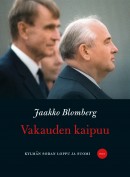 Vakauden kaipuu. Kylmän sodan loppu ja Suomi
[Longing for stability. Finland and the end of the Cold War]
Helsinki: WSOY, 2011. 696 p., ill.
ISBN 978-951-0-37808-3
€ 37, hardback
From Finland’s perspective, the termination of the Cold War era encompassed three significant processes: the Soviet Union’s policy of perestroika, or reform, and the disintegration of its empire; the end of the international arms race and the rise of joint security as a policy aim of the superpowers; and increasing European integration. This book devotes individual chapters to two phases of Finnish foreign policy – interpretation of the Paris Peace Treaty and Finland’s withdrawal from the Agreement of Friendship, Cooperation and Mutual Assistance, which it had signed with the Soviet Union in 1948. The second part of the book focuses on the years 1992–94, when Finland applied to become a member of the European Union and forged relations with the new Russia. Finland’s position in those years was defined by Mauno Koivisto, a cautious president, whose memoirs have served as a key source of material for Blomberg. The negotiations surrounding the region of Karelia, which was ceded to the Soviet Union after the war, are illuminated further here. As a Finnish ambassador, Blomberg served in key roles within the Ministry for Foreign Affairs from the late 1980s to the early 21st century.
Translated by Ruth Urbom
Jussi T. Lappalainen: Kuninkaan viimeinen kortti [The king’s last card]
28 October 2011 | Mini reviews, Reviews
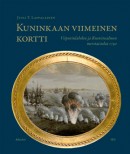 Kuninkaan viimeinen kortti. Viipurinlahden ja Ruotsinsalmen meritaistelut 1790
[The king’s last card. The naval battles of Viipurinlahti and Ruotsinsalmi 1790]
Helsinki: Suomalaisen Kirjallisuuden Seura, 2011. 214 p., ill.
ISBN 978-952-222-230-5
€ 44, hardback
The War of Gustav III (1788–1790) was a conflict between Sweden and Russia whose aim was to regain the Baltic lands and the eastern areas of Finland for Sweden. The war plan was based on a manoeuvre strategy considered ideal from the end of the15th century in which the aim was to achieve the desired outcome by deploying one’s own forces in such a way that the enemy was forced to surrender without fighting. A substantial part of the Swedish forces were made up of an impressive navy which was nevertheless surrounded by the Russians. The king’s trump card was his archipelago fleet, which managed to defeat the Russians completely on 9 July 1790. The battle of Ruotsinsalmi was, in terms of the number of vessels involved, one of the largest naval battles ever waged. Its anniversary is celebrated as the anniversary of the Finnish naval forces. The book traces the background of the reasons for the outbreak of the war and its consequences and describes the vessels weaponry and tactics. Included are numerous contemporary maps and battle paintings. Translated by Hildi Hawkins
Jari Tervo: Layla
28 October 2011 | Mini reviews, Reviews
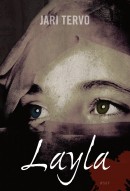 Layla
Layla
Helsinki: WSOY, 2011. 361 p.
ISBN 978-951-0-38277-6
31 €, hardback
Social reality has stepped firmly into contemporary Finnish literature. Many of the new novels deal with economic inequality, immigration, prostitution or human trafficking. In his 13th novel Jari Tervo (born 1959) deals with them all. Layla is a young Kurdish girl whose cruel fate is about to be decided by the men of her family in Turkey. When she flees, Layla ends up in faraway Finland as a prostitute. Another storyline portrays a Finnish woman, Helena, who sells herself in part voluntarily. Tervo shows himself to be a feminist; the men he describes are cold tyrants who see a woman’s body as an object of lust and as merchandise. The novel is tragic and defiant, but also amusing and lively. Tervo’s style involves surprises and ingenious tricks, of which towards the end of the book there are slightly too many. Layla contains a good deal of information about Turkey, Kurdish culture and the people smuggling that takes place on the outer borders of the European Union. Some of the details have already been shown to be inaccurate, but this does not reduce the distressing quality of this story of a human fate.
Translated by David McDuff
Allan Tiitta: Sinisten maisemien mies. J.G. Granön tutkijantie 1882–1956 [The man of blue landscapes. A biography of J.G. Granö, 1882–1956]
9 February 2012 | Mini reviews, Reviews
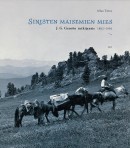 Sinisten maisemien mies. J.G. Granön tutkijantie 1882–1956
[The man of blue landscapes. A biography of J.G. Granö, 1882–1956]
Kuvatomittaja [Picture editor]: Taneli Eskola
Helsinki: Finnish Literature Society, 2011. 541 p., ill.
ISBN 978-952-222-292-3
€ 44, hardback
The man of blue landscapes describes the life and work of the Finnish geographer Johannes Gabriel Granö (1882–1956), whose career also reflected Finland’s development as a modern state. Granö was a scientific explorer, writer, a pioneer of Finnish photographic art and a professor of geography at the universities of Tartu (Estonia), Helsinki and Turku. In Estonia he applied scientific method to the study of local history and from Tartu brought the tradition of urban research. Granö spent much of his youth in Omsk in western Siberia, where his father worked as a priest among displaced and deported Finns and Estonians. From 1906 to 1916 Granö made an expedition to Mongolia and the Altai mountains, but his fieldwork remained unfinished when the 1917 revolution broke out; the area was then closed to Western scholars for 70 years. Among Granö’s most important works are the classic travel book Altai, vaellusvuosina nähtyä ja elettyä (‘The Altai, seen and experienced during my years of travel’, 1921) and his methodological masterpiece Puhdas maantiede (‘Pure geography’, 1930). In it Granö outlined a theory of landscapes, and the book was a pioneering work ahead of its time: landscape was examined in terms of the relation between human beings and their environment, as the sum of all the senses.
Translated by David McDuff
Hannele Huovi & Kristiina Louhi: Jättityttö ja Pirhonen [The giant girl and Mr Pirhonen]
17 January 2012 | Mini reviews, Reviews
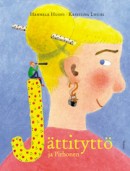 Jättityttö ja Pirhonen
[The giant girl and Mr Pirhonen]
Kuvitus [Ill. by]: Kristiina Louhi
Helsinki: Tammi, 2011. 31 p.
ISBN 978-951-31-5852-1
€ 19.95, hardback
Hannele Huovi and Kristiina Louhi, two eminent professionals in the field of children’s literature, have been collaborating for a long time. Their mutual trust is reflected in the way they grant each other artistic freedom, at times submitting to the text, at others to the illustrations. The depiction of the love story between a giant girl and a tiny man was an exceptional challenge for the illustrator; Tyyne’s tears nearly drown her tiny friend, and to see him properly, she needs a magnifying glass! Louhi has again kept her style economical, and she boldly paints large expanses of colour and forms. Alongside the unequal but happy love story, this picture book deals with tolerance. Tyyne’s enormous size effectively manifests her feeling that she is an outsider. The book also advocates a relaxed attitude to life and the avoidance of unnecessary strain. The example of the giant girl helps the reader to develop a sense of proportion and to realise the value of the everyday.
Translated by Fleur Jeremiah and Emily Jeremiah
Tuomas Heikkilä & Liisa Suvikumpu: Suomen Turku julistaa joulurauhan. Åbo kungör julfred [Finland’s Turku announces the Christmas peace]
9 December 2011 | Mini reviews, Reviews
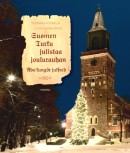 Suomen Turku julistaa joulurauhan. Åbo kungör julfred
[Finland’s Turku announces the Christmas peace]
Swedish translation: Malena Torvalds-Westerlund
Helsinki: Kirjapaja, 2011. 71 p., ill.
ISBN 978-952-247-229-8
€ 24, hardback
This bilingual book offers a broad interpretation of a unique Christmas tradition upheld by the Finns: at 12 on Christmas Eve a large proportion of the population falls silent to listen to the declaration of the Christmas peace from Turku cathedral. After its bells have rung noon, the deputy mayor ceremonially opens a manuscript prepared according to mediaeval tradition and reads the announcement in both Finnish and Swedish. After the announcement, the land settles down to celebrate Christmas following traditions dating from the 13th century. The Christmas peace has been announced in Turku almost without interruption since the Middle Ages. The last time it went unread was in 1939, during the Winter War. The Finnish Broadcasting Company broadcasts the occasion to all the member countries of the European Broadcasting Union EBU. The Christmas peace is also sent out into the world by Swedish radio, reaching a total of some 140 countries.
Translated by Hildi Hawkins
Vesa Puuronen: Rasistinen Suomi [Racist Finland]
6 July 2011 | Mini reviews, Reviews
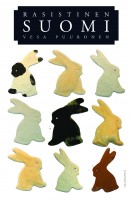 Rasistinen Suomi
[Racist Finland]
Helsinki: Gaudeamus, 2011. 286 p., ill.
ISBN 978-952-495-196-8
€ 36, paperback
Multiculturalism, immigration and racism have become more frequent subjects of discussion in Finland, particularly as a result of the 2008 local elections and the subsequent speeches and writings by people critical of immigration. This book aims to move the discussion forward by describing and defining racism, presenting developments in research into racism, racism perpetrated by Finns against Sámi and Russians, and the history of Finnish enmity towards Russians from the early 20th century to the present day. The author considers the use of shaming and subjugation as tools of exterminating Sámi culture, as well as linguistic discrimination and denial of land ownership rights against the Sámi. The book also examines the development of hate crimes since the 1990s, racism in Finnish politics and the politics of multiculturalism as practised in Finland, which studies have shown treat different minority groups in different ways. Vesa Puuronen is a sociologist and a researcher into racism who works at the University of Eastern Finland.
Translated by Ruth Urbom
Tuuve Aro: Korson purppuraruusu [The purple rose of Korso]
16 January 2012 | Mini reviews, Reviews
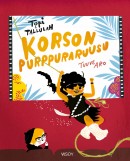 Korson purppuraruusu
[The purple rose of Korso]
Kuvitus [Ill. by]: Sanna Mander
Helsinki: WSOY, 2011. 109 p.
ISBN 978-951-0-38052-9
€ 25.70, hardback
Sometimes a book’s appearance is enough to win the reader over. The first children’s novel by writer and film critic Tuuve Aro (born 1973) encourages the belief that things will work out for the best. The book’s positive undertones are also reflected in Mander’s fresh illustrations, which exude retro-nostalgia for the 1950s and 1960s in shades of orange, black, and brown. Tallulah, a jungle princess, turns up unexpectedly to sort out the complicated affairs of Topi, a schoolboy who is being bullied. Tallulah comes into the suburb of Korso from the silver screen, out of Woody Allen’s film The Purple Rose of Cairo. The jungle princess helps Topi to see the bleak suburb as an exotic habitat where adventures are waiting just round the corner. The adult reader gets to enjoy a few carefully chosen references to major cinematic landmarks. Aro eschews problem-centred realism and angst, even though the children’s problems are an indirect result of decisions taken by adults. The Tallulah figure incorporates a hefty dose of anarchy, familiar from Astrid Lindgren’s Pippi Longstocking.
Translated by Fleur Jeremiah and Emily Jeremiah
Leena Krohn: Auringon lapsia [Children of the sun]
16 January 2012 | Mini reviews, Reviews
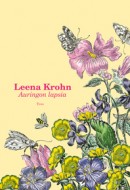 Auringon lapsia
[Children of the sun]
Kuvitus [Ill. by]: Inari Krohn
Helsinki: Teos, 2011. 32 p.
ISBN 978-951-851-311-0
€ 29.40, hardback
It is great news that Leena Krohn has not abandoned the young readership she first addressed through her first book Vihreä vallankumous (‘The green revolution’, 1970), an ecocritical title that also touched on active citizenship. This novel, too, is about the encounter between man and nature. Ten-year-old Orvokki (Violet) is a delivery girl for a florist; like her, the reader is incited to marvel with naive curiosity at life’s various wonders. Krohn is supremely good at writing literature that knows no age limits. Nothing here will go over a child’s head; the essence of the book is accessible to all. In this nicely old-fashioned children’s novel the measured language and expression are pleasing both to the eye and the ear. The hand-coloured graphic prints by the artist (and writer’s sister) Inari Krohn are a homage to Maria Sibylla Merian (1647–1717), the German natural scientist and illustrator who produced life-like paintings of insects and plants.
Translated by Fleur Jeremiah and Emily Jeremiah
Aamu Nyström: I.K. Inha – Valokuvaaja, kirjailija, kulttuurin löytöretkeilijä [I.K. Inha – Photographer, writer, cultural explorer]
3 August 2011 | Mini reviews, Reviews
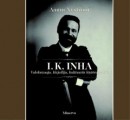 I.K. Inha – Valokuvaaja, kirjailija, kulttuurin löytöretkeilijä
[I.K. Inha – Photographer, writer, cultural explorer]
Jyväskylä: Minerva, 2011. 271 p., ill.
ISBN 978-952-492-441-2
€ 31, hardback
I.K. Inha (1865–1930) was a photographer, a writer, a translator and a journalist. He is known particularly for his photographic journeys in Finland and Russian Karelia. Both the texts and the photographs in Inha’s landscape and nature works are of a high aesthetic standard. This book focuses on Inha’s lesser-known works and the various phases of his life. Inha’s travel diary documents the cycle journey he made as a student in 1886 to Germany and Switzerland. In 1897 Inha was appointed Finland’s first-ever foreign correspondent; from Athens he reported on events such as the Greco-Turkish War. In 1899 and 1901 Inha was posted to England, where he observed Queen Victoria’s funeral and the coronation of King Edward VII. Aamu Nyström, the niece of Inha’s brother, has had access to letters, photographs and written and oral recollections of family members.
Translated by Ruth Urbom
Vilja-Tuulia Huotarinen: Valoa valoa valoa [Light light light]
13 January 2012 | Mini reviews, Reviews
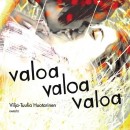 Valoa valoa valoa
[Light light light]
Hämeenlinna: Karisto, 2011. 125 p.
ISBN 978-951-23-5433-7
€ 19.95, paperback
Vilja-Tuulia Huotarinen’s novel for young adults demonstrates the author’s familiarity with classic books for girls, her skill in plotting, and, above all, her respect for youth on its own, unique terms. The novel is set in the summer and autumn of 1986. A nuclear explosion occurs at Chernobyl, Ukraine, in spring, and the fall-out worries 14-year old Mariia, who lives on the outskirts of Turku. She befriends Mimi, who has a dark secret in the attic. The friendship between the two girls soon deepens into love, and is described by Huotarinen (born 1977) beautifully and openly. Huotarinen’s language is colloquial, but nevertheless highly lyrical. Valoa valoa valoa promises a revival in the Finnish novel for young adults; it does not wallow in youthful angst or ‘issues’, although the story touches on these things, too. Self-conscious narration, metafiction, adds another intriguing twist to the story.
Translated by Fleur Jeremiah and Emily Jeremiah
Consume culture, live longer!
16 May 2013 | This 'n' that
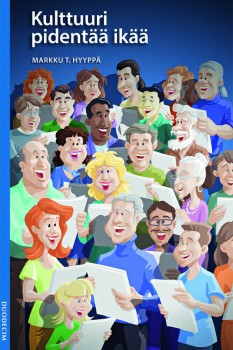 A culture freak (and you don’t have to be a vulture) will live longer than a couch potato.
This sounds pretty obvious, doesn’t it? Watching TV is a passive pursuit, attending choir rehearsals or line dancing class isn’t – and human beings are designed to be active.
But it is also a scientific fact. Neurologist and writer MD Markku T. Hyyppä has been researching the effects of cultural pursuits on health for decades. In his new book Kulttuuri pidentää ikää (‘Culture prolongs your life’) he sets out to prove the power of culture using scientific evidence from many countries.
Cultural capital is a concept that defines the ‘usefulness of culture’. Hyyppä disagrees with the famous sociologist Pierre Bourdieu who defines cultural capital as a means for the upper classes to increase their personal status and power. According to Hyyppä, cultural capital is immaterial, originates from cultural pursuits and the consumption of culture, and brings benefits to all who take part.
Learning the basics of culture in one’s education is vital: Finland has done well in the international PISA exams, but it’s not just because the children are bright. Learning how to educate is important: unlike in many other countries, the arts play a significant role in teacher training in Finland. And arts subjects are important in education: art has a positive effect on emotions and cognition, on emotional life as well as reason. Study arts subjects, and it will be easier to learn maths!
It’s a fact is that those who are socially active in clubs, associations and cultural pursuits in general, live longer than those who are not. Economic status is not a decisive factor here. The efficacy of cultural pursuits and cultural capital on prolonging an individual’s life appears to be based on networking. i.e. social capital. Social capital increases the chances of staying alive – almost as much as non-smoking and much more than the estimated extra time of exercise or losing weight. An individual’s cultural pursuits allow him at least a couple of years more in old age.
Hyyppä also examines and comments on the cultural policies of Finnish political parties. After the Perussuomalaiset – True Finns – party presented its manifesto in 2011, stating that contemporary art should not receive any public funding, as only art that ‘strengthens the national identity’ should be funded, other political parties began hastily to revise and update their dusty arts programmes. As it has been proved in international and Finnish medical research that culture definitely has a positive impact on developing society as a whole, political parties cannot afford to ignore dealing with the subject.
In conclusion, Hyyppä states that Finland would certainly benefit from the cultural added value that manifests itself in well-being, health and a longer life spans. When people live longer healthy, the national economy gains massively.
It’s not just opera, ballet and favouring the paintings of the Düsseldorf school that bring you cultural capital and prolong your existence; rock concerts or pottery classes are fine, too. But, notes Hyyppä, being active in politics in your free time, going to church and participating in spectator sports don’t seem to have a similar positive effect, so might it be better not to concentrate on those alone?
Markku T. Hyyppä
Kulttuuri pidentää ikää
(‘Culture prolongs your life’)
Helsinki: Duodecim, 2013. 132 p.
ISBN 978-951-656-479-4
Remains healthy
13 April 2011 | Non-fiction
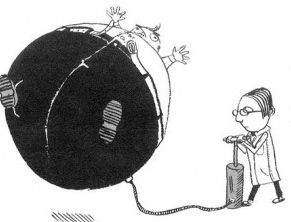
Case note: patient has coronary artery disease for which he was given a balloon. Illustration: Elina Warsta
In these samples from a collection of patient reports, Molemmista päistä tähystetty: päättömiä potilaskertomuksia (‘Examined at both ends: brainless patient reports’, Otava, 2011), human disorders appear bizarre, puzzling or just plain funny in case notes as dictation or transcription occasionally proves erratic
The patient was given instructions for his bowels.
Recommend milder aerobics, ie swimming on an exercise bicycle.
Patient is a healthy 70-year-old girl.
And a mental health evaluation is recommended for the designer of this form. More…