

Search results for "tommi+musturi/2010/05/song-without-words/2009/09/what-god-said/2011/04/matti-suurpaa-parnasso-1951–2011-parnasso-1951–2011"
Päivi Jantunen: Kaj & Franck. Esineitä ja lähikuvia / Designs & Impressions
6 July 2011 | Mini reviews, Reviews
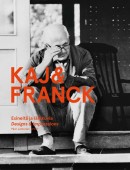 Kaj & Franck. Esineitä ja lähikuvia. / Designs & Impressions
English translations: Peter Herring and Esa Lehtinen
Helsinki: WSOY, 2011. 166 p., ill.
ISBN 978-951-0-36898-5
€ 42, hardback
This dual-language book showcases the work of one of Finland’s most widely known glass and ceramic designers in his centenary year. The unaffected designs and clean geometric shapes of the tableware designed by Kaj Franck (1911–1989) are well suited to a wide range of cultures. Franck’s guiding principle was to create anonymous, self-evident objects for everyday use. In the 1940s and 1950s, Franck updated tableware to match post-war changes in society; he wanted to get away from the sets of crockery that filled up smaller kitchen cupboards. His designs that emphasised environmental principles and equality were ahead of their time with their ideology of sustainable development. This book portrays Franck’s life and career, which centred on the oldest glassworks in Finland in the community of Nuutajärvi, where he worked from the early 1950s until his death. Interviews with local residents and Franck’s colleagues create a portrait of him as a colourful personality. Ample illustrations provide a cross-section of Franck’s design output. In addition to his mass-produced items, there are photos of Franck’s one-off artistic creations.
Translated by Ruth Urbom
Tero Tähtinen: Katmandun unet. Kirjoituksia idästä ja lännestä [Kathmandu dreams. Writings about East and West]
26 January 2012 | Mini reviews, Reviews
 Katmandun unet. Kirjoituksia idästä ja lännestä
[Kathmandu dreams. Writings about East and West]
Turku: Savukeidas, 2011. 332 p.
ISBN 978-952-268-005-1
€ 19.90, paperback
Tero Tähtinen’s second collection of essays is focused physically in the wilds of a Finnish national park and Nepal – where the author (born 1978), a literary scholar and critic, has frequently travelled – and mentally in the divergences of Western and Eastern thought, which Tähtinen, who is familiar with Zen and Buddhist philosophy, studies, occasionally by means of literary examples. The ‘Socratic ego’ of the Western egocentric, individual ‘I’, which strives in vain to understand the whole of reality by rationalising it, is his favourite bête noire. Tähtinen quickens the pace of his verbal virtuosity as he discusses both dogmatic, materialistic faith in science – as well as some of its representatives – and Christian faith: he considers that both, in their pursuit of an absolute and total explanation, end up in a metaphysical vacuum. Unlike them, Eastern philosophy, in which the individual ‘I’ is not the centre and measure of all things, does not give rise to the anxiety of compulsive cognition. The virtual narcissism of Facebook, a platform tailor-made for the Socratic ego, receives Tähtinen’s outright condemnation: ‘Facebook trivialises humanity,’ he declares. At the end of these passionate essays on the author praises silence.
Translated by David McDuff
Katja Hagelstam & Piëtke Visser: 20+12 design stories from Helsinki
4 April 2012 | Mini reviews, Reviews
 20+12 design stories from Helsinki
Helsinki: WSOY, 2011. 191 p., ill.
ISBN 978-951-0-38120-5
€35, hardback
In Finnish:
20+12 muotoilutarinaa Helsingistä
ISBN 978-951-0-38136-6
In celebration of Helsinki’s status as World Design Capital 2012 comes this volume of vignettes of the city’s designers. Twenty Helsinki designers and artists – from textile designers and animators to illustrators and industrial designers – are interviewed by Eva Lamppu about their work and the inspiration they find in their city. The result, handsomely illustrated with atmospheric photographs by Katja Hagelstam, is a fascinating composite portrait, a colourful patchwork of creative lives lived out against the compact and interconnected fabric of this small northerly capital, which – not unexpectedly – is revealed as both sympathetic and conducive to good design. The book is rounded off by suggestions from 12 people active in creative fields on the city’s future. A fascinating and heartwarming study.
Markku Kuisma: Saha. Tarina Suomen modernisaatiosta ja ihmisistä jotka sen tekivät [The sawmill. A story about Finnish modernisation and the people who realised it]
29 May 2012 | Mini reviews, Reviews
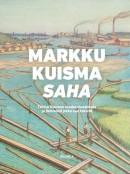 Saha. Tarina Suomen modernisaatiosta ja ihmisistä jotka sen tekivät
[The sawmill. A story about Finnish modernisation and the people who realised it]
Helsinki: Siltala, 2011. 235 p.
ISBN 978-952-234-069-6
€ 34.90, hardback
In his new book Professor Markku Kuisma, a specialist in economic history, approaches the modernisation of Finland in the 19th century from the perspective of the sawmill industry. In the mid 19th century, Finland’s forest reserves were, in relation to its population, among the greatest in Europe. The rise of the sawmill industry was made possible by Britain’s removal of taxation on industrial imports, the development of Finland’s railways and other means of transport, the removal of Finnish restrictions on the timber industry, the spread of steam saws and changes in society. The foundations of the breakthrough of the sawmill industry were laid in the 1860s, but it began to flourish gradually. Between the two world wars Finland became Europe’s biggest exporter of timber, and for a long time the country derived most of its export income from timber products. Kuisma also draws interesting portraits of the men who made the change possible both in government administration and economic life and laid the basis for industrial dynasties. Saha is a concise but illuminating and engrossing introduction to an important phase in the development of Finnish economic life.
Translated by Hildi Hawkins
A fleeting scent
24 October 2013 | Fiction, poetry
Poems from Öar i ett hav som strömmar (‘Islands in a flowing sea’, Schildts and Söderströms, 2013). Introduction by Michel Ekman
A fig wasp’s life
She squeezes in. The opening closes and the world overflows. She swims in the sweet flowing moisture. In the sycamore fig tree, a myriad of delicate white blossoms have burst out. For her eyes alone, a damp garden, alabaster-clear. The home she’s been longing for. There she lays her eggs, empties her pouches. Tiny little pollen grains for the tiny little blossoms. Membranes form round the eggs, they live off the sweetness, it rocks them gently. Fine, frail swaying thicket of embryos More…
Maria Vuorio: Kuningattaren viitta ja muita kiperiä kysymyksiä [The Queen’s cloak and other knotty issues]
19 January 2012 | Mini reviews, Reviews
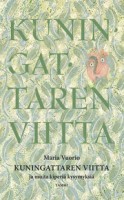 Kuningattaren viitta ja muita kiperiä kysymyksiä
[The Queen’s cloak and other knotty issues]
Kuvitus [Ill. by]: Virpi Talvitie
Helsinki: Tammi, 2011. 71 p.
ISBN 978-951-31-6252-8
€ 20.60, hardback
The style of Maria Vuorio’s books demands quiet concentration – but you could get quite hooked on their slow, thoughtful, gentle story-telling. Vuorio carries on the tradition of classic animal fables, following in the footsteps of Hans Christian Andersen, but with a personal twist. She is masterful in describing different emotional states – whether evoking the inner lives of humans or of anthropomorphised animals. Her stories and fairy tales hand the reader a magnifying glass that brings into view even the smallest, most insignificant creature or thing. The entire universe is present in the stories, for example when an earthworm ponders the meaning of life, a bear breaks into the National Museum, or a noxious insect imperils cultural exchange between Finland and Denmark. Talvitie has drawn an allegorical picture for each tale.
Translated by Fleur Jeremiah and Emily Jeremiah
New library for Helsinki
20 June 2013 | In the news

The new Helsinki library: Käännös by ALA Architects Ltd
The city of Helsinki will have a new Central Library in the near future: an architectural competition for a new building was completed in June. The winner, chosen out of 554 entries, foreign and Finnish, is entitled Käännös (‘Turn’ – or ‘Translation’), entered by the Finnish ALA Architects Ltd (architects Juho Grönholm, Antti Nousjoki, Janne Teräsvirta, Samuli Woolston). The entry was also one of the favourites with the public in an earlier stage of the competition.
The jury’s decision was unanimous: in their opinion, Käännös is ‘impressive’ and ‘casually generous’; it fits into the urban structure as an feasible, usable and ecological construction. The site could not be more central: close to the citys’ railway station, it faces the House of Parliament, next to the Museum of Contemporary Art Kiasma and the new Music Centre (opened 2011): literary art and literature will join the other art forms.
Peter von Bagh: Junassa [On the train]
26 August 2011 | Mini reviews, Reviews
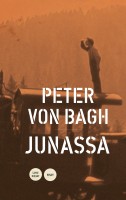 Peter von Bagh
Junassa
[On the train]
Helsinki: Love Kirjat / WSOY, 2011. 255 p., ill.
ISBN 978-951-0-37921-9
€18, hardback
Professor Peter von Bagh, a film director and academic, is the author of a wide range of books on the history of film and culture. In this small-scale volume of essays, he investigates the significant role played by trains and railways in cinematic plot structures since the days of silent film. The text chugs along in a series of snippets, reminiscent of a rail passenger’s experience of scenery zipping past. This book looks at classics of the film noir, Western and romance genres, along with films that have used trains as a deeper metaphor for life. von Bagh also considers the critically derided but widely loved Finnish popular culture from the 1940s and ’50s, as well as fiction. For example, author Juhani Aho’s first novel, Rautatie (‘The railway’, 1884), depicted an individual’s first experience of a train journey with a degree of authenticity that it can be compared to the uproar the Lumière brothers’ early films generated among the audiences. Unfortunately Junassa lacks an index of the works and people mentioned in the text.
Translated by Ruth Urbom
Reflections on light
24 September 2014 | Extracts, Non-fiction
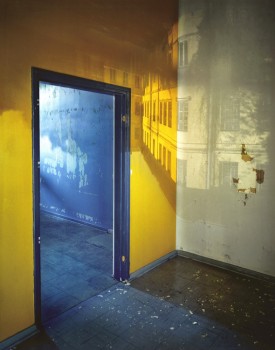
Speaking House #12, 2006. Photo: Marja PIrilä
A camera obscura (‘darkened room’) is the optical device that made photography possible; it is a box – or a room – with a hole in one side. Photographer Marja Pirilä has been using this method as a tool for almost 20 years. The book Carried by Light spans more than 30 years of her photography.
In the book artist and researcher Jyrki Siukonen notes in his essay ‘Eyes and Cameras’ that ‘in photographing spaces Pirilä also depicts people. The dreams continue on the walls of the empty building, as if after the people the house had become like them and were dreaming the dreams itself.’
Photographs and text extracts from Carried by Light by Marja Pirilä (Musta Taide, 2014)
In the shadow of the cathedral
6 November 2014 | Authors, Reviews

Satu Taskinen. Photo: Heini Lehväslaiho
In recent years the Finnish novel has been refreshed by central European tones in the work of authors including Kristina Carlson, Katri Lipson and Sofi Oksanen. Among these reforming powers is Satu Taskinen, whose first novel, Täydellinen paisti (‘The perfect roast’, 2011), won the Helsingin Sanomat prize for a debut work.
The novel, set over a day and describing a Viennese family’s All Saints’ Day lunch and, in particular, its demanding preparations, aroused admiration, but also wonderment at its slow, thoughtful monologue, in which absurdist humour and irony mixed with a melancholy atmosphere.
Satu Taskinen, who studied philosophy and German philology at Helsinki University, has lived and worked in Vienna for a long time. Her second novel, Katedraali (‘The cathedral’), is also a one-day novel describing a Viennese family. More…
New from the archive
9 April 2015 | This 'n' that
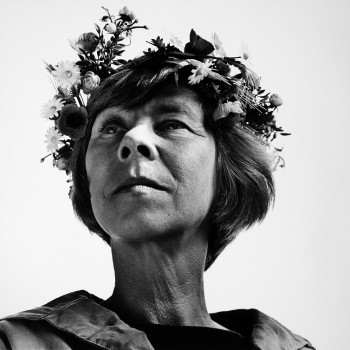
Tove Jansson. Photo: Hans Gedda
After she stopped writing the Moomin stories in 1970, Tove Jansson (1914-2001) began an entirely new career as the author of fiction for adults. This story, ‘Summer child’, comes from her third volume of short stories for adults, Resa med lätt baggage (Travelling light, 1988), where travelling – even if only by motor boat, between the islands of the archipelago that lies off Finland’s south-west coast – is the central theme.
‘Summer child’ tells the story of what happens when Elis, a morbidly serious little boy, spends the summer with a family in the Finnish archipelago. His gloomy world-view disquiets the cheerful Fredriksons to such a degree that in the end their differences can only be settled by violence….
*
The same story is republished, in a different translation, by Sort Of Books of London, with an introduction by the Scottish writer Ali Smith. For Smith, this tale of a young lad, ‘well-informed about everything that’s dying and miserable’, amid the idyllic landscapes of the Finnish summer, is ‘a fable about innocence and knowledge’; the book itself is ‘one of [Jansson’s] funniest, most unputdownably airy works’.
Ali Smith is far from being the only fan of Jansson’s work for adults. Sort Of Books has now published a total of seven volumes of her short stories, memoirs and novels, and her fame has also spread to the United States, where her Moomin books are much less well-known. Her The True Deceiver won the Best Translated Book Award in 2011, and has appeared on Publisher’s Weekly’s list of ‘The 20 Best Books in Translation You’ve Never Read’. It’s in good company – other books include Thomas Bernhard’s Concrete, Knut Hamsun’s Mysterie, Dubravka Ugresic’s The Museum of Unconditional Surrender and George Perec’s Life, A User’s Manual.
Fatherlands, mother tongues?
12 April 2013 | Letter from the Editors
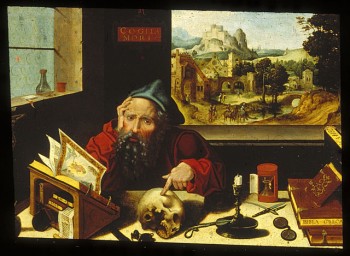
Patron saint of translators: St Jerome (d. 420), translating the Bible into Latin. Pieter Coecke van Aelst, ca 1530. Walters Art Museum, Baltimore. Photo: Wikipedia
Finnish is spoken mostly in Finland, whereas English is spoken everywhere. A Finnish writer, however, doesn’t necessarily write in any of Finland’s three national languages (Finnish, Swedish and Sámi).
What is a Finnish book, then – and (something of particular interest to us here at the Books from Finland offices) is it the same thing as a book from Finland? Let’s take a look at a few examples of how languages – and fatherlands – fluctuate.
Hannu Rajaniemi has Finnish as his mother tongue, but has written two sci-fi novels in English, which were published in England. A Doctor in Physics specialising in string theory, Rajaniemi works at Edinburgh University and lives in Scotland. His books have been translated into Finnish; the second one, The Fractal Prince / Fraktaaliruhtinas (2012) was in March 2013 on fifth place on the list of the best-selling books in Finland. (Here, a sample from his first book, The Quantum Thief, 2011, Gollancz.)
Emmi Itäranta, a Finn who lives in Canterbury, England, published her first novel, Teemestarin tarina (‘The tea master’s book’, Teos, 2012), in Finland. She rewrote it in English and it will be published as Memory of Water in England, the United States and Australia (HarperCollins Voyager) in 2014. Translations into six other languages will follow. More…
Vesa Heikkinen & Harri Mantila: Kielemme kohtalo [The fate of Finnish]
14 October 2011 | Mini reviews, Reviews
 Kielemme kohtalo
[The fate of Finnish]
Helsinki: Gaudeamus, 2011. 235 p.
ISBN 978-952-495-188-3
€ 32, paperback
This book sets out to examine the reasons behind concerns about the decay of the Finnish language. The authors maintain that linguistic immutability is too often taken to be a synonym for ‘good’ language, even though a living national language is capable of picking up new influences all the time without being in danger of destruction. The factor which the authors consider to be the greatest threat to Finnish is not youth slang, global English, or immigration but Finglish, the practice of using a mixture of Finnish and English, which has become widespread in research, commerce and government. The names of companies and public bodies are changed into opaque English-language abbreviations. Linguists are also concerned by the bureaucratisation of language that is often linked with public-sector reforms. Increasing linguistic inequality is the most serious threat described in this book: in the worst-case scenario, children’s and young people’s poor skills in Finnish could increase the gaps between classes in society and give rise to a growing mass of the excluded alongside an elite who are well-versed in the nuances of the language.
Translated by Ruth Urbom
Art online
23 May 2013 | In the news
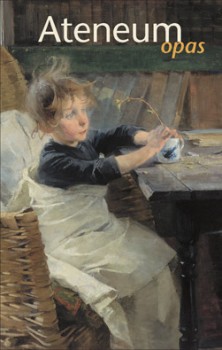
Helene Schjerfbeck’s The convalescent (1888) on the cover of the guidebook of the Ateneum Art Museum
Attention lovers of Finnish art: the Ateneum Art Museum in Helsinki has joined the international Google Art Project (begun in 2011), with 260 participating art institutes and more than 40,000 works of art as high-resolution images.
The website also includes information on the paintings. Among the 55 images from Ateneum on show now are many of the great works of the golden period of Finnish art (1880–1910), including Hugo Simberg’s darkly cute The Garden of Death, Albert Edelfelt’s heartbreakingly beautiful Conveying a Child’s Coffin, Akseli Gallen-Kallela’s classic portrayal of grief, Lemminkäinen’s mother, and – a personal favourite here at the Books from Finland office – Magnus von Wright’s evocative Annankatu Street on a Cold Winter’s Morning.
The Ateneum has few foreign works of art; in the Google Art collection now there are one Rodin, a Modigliani, a van Gogh and two Gauguins.
Johanna Sinisalo: Enkelten verta [Angels’ blood]
2 February 2012 | Mini reviews, Reviews
 Enkelten verta
[Angels’ blood]
Helsinki: Teos, 2011. 274 p.
ISBN 978-951-851-414-8
€ 32, hardback
The literary career of Johanna Sinisalo (born 1958) has embraced fiction, drama, sci-fi and children’s books. Her 2000 Finlandia Fiction Prize-winning fantasy novel Ennen päivänlaskua ei voi and the novel Linnunaivot (2008) have been published in English as Not before Sundown and Birdbrain respectively. In this new novel, set in the near future, the central role is played by bees: widespread beehive failures in the United States and the resulting drop in pollination have resulted in an enormous food shortage that threatens the world economy. Orvo is a loner, the father of Eero, his grown-up son. Sinisalo cleverly works in animal rights activist Eero’s controversial blog comments on animal rights and modern man’s flawed relation to nature. However, this is also the novel’s biggest problem, as the blogging starts to weaken the story, of three generations of men in a family. Both the mythic, parallel reality of the bees and the tough-and-tender relationship between father and son are strong indications of Sinisalo’s narrative skill.
Translated by David McDuff