

Search results for "tommi+musturi/2010/05/song-without-words/2009/09/what-god-said/2011/04/matti-suurpaa-parnasso-1951–2011-parnasso-1951–2011"
The situation in Narva
31 December 1993 | Archives online, Fiction, Prose
A short story from Pakosarja (‘Exhaust manifold’, WSOY, 1993)
We went into the building where Voroshilov said the waitress had disappeared. Inside was a big room lined with wooden benches. A tin-clad stove radiated heat. Someone had shut the dampers too early, probably out of meanness; it had that kind of smoky smell.
A corridor led from the room, with a few doors off it. We peered inside, but there was no one to be seen. There was nobody in the entire building. We left.
We walked across the railway yard in what I thought was the direction of the train. We heard the sound of the engine long before we could see anything through the snowstorm. At regular intervals the engine’s pressure valve let off steam. Voroshilov went for a leak. He leaned against the engine’s big back wheel and watered the lever, which had been left in the down position. The liquid ran down the engine’s rounded flank. The snowflakes melted as they fell on to the black casing of the water-tank. More…
In a class of their own
31 December 2006 | Children's books, Fiction
Extracts from the children’s book Ella: Varokaa lapsia! (‘Ella: Look out for children!’, Tammi, 2006). Interview by Anna-Leena Nissilä
There was a large van in the schoolyard with a thick cable winding its way from the van into the school. It was from the TV station, and the surprise was that they wanted to do a programme about our teacher, believe it or not.
The classroom was filled with lights, cameras, and adults.
‘Are you the weird teacher?’ a young man asked. He had a funny, shaggy beard and a t-shirt that said ‘errand boy’.
‘Not nearly as weird as your beard,’ our teacher answered.
‘Can we do a little piece about you?’ the errand boy asked.
‘Of course. A big one even. I’ve been expecting you, actually. Is it some educational programme?’
‘Not exactly.’
‘A substantive discussion programme, though?’
‘Not exactly.’
‘A documentary about our contemporary educators?’
‘Not quite.’ More…
Looking for Moominpappa
30 June 1994 | Archives online, Children's books, Fiction
Tove Jansson wrote the first Moomin book in the dark days of Finland’s Winter War in 1939. This extract, from Småtrollen och den stora översvämningen (‘The little trolls and the big flood’, Schildts, 1945, 1991), tells the story of how the Moomins found their home
It had become very hot late in the afternoon. Everywhere the plants drooped, and the sun shone down with a dismal red light. Even though Moomins are very fond of warmth, they felt quite limp and would have liked to rest under one of the large cactuses that grew everywhere. But Moominmamma would not stop until they had found some trace of Moomintroll’s Papa. They continued on their way, even though it was already beginning to get dark, always straight in a southerly direction. Suddenly the small creature stopped and listened. ‘What’s that pattering around us?’ he asked.
And now they could hear a whispering and a rustling among the leaves. ‘It’s only the rain,’ said Moominmamma. ‘Even so, now we must crawl in under the cactuses.’
All night it rained, and in the morning it was simply pouring down. When they looked out, everything was grey and melancholy. More…
The house in Silesia
31 December 1989 | Archives online, Fiction, Prose
A short story from Talo Šleesiassa (‘ The house in Silesia’, 1983). Read the interview
We set off, my brother-in-law and I, at the beginning of September. The tourist season was already over, and on the Gdansk ferry there was stacks of room for my brother-in law’s Volvo and the two of us.
We’d driven from his home on the shore of Lake Mälar to the ferry port at Nynäshamn, about fifty miles south of Stockholm. We’d driven in an atmosphere of cheerful resolution, accelerator down, but going steadily. The resoluteness was due to my brother-in-law’s decision after forty years’ absence to visit his childhood home. If it was still standing, that is – or whatever of it was.
‘Oh the house is definitely still in place there all right,’ he said: ‘I’ve got that sort of tickly feeling in my arse.’ It was a direct translation from the German – German humour of the vulgar variety centring round the bottom. More…
Comics come to Helsinki
7 September 2012 | In the news
 Comics are the ‘ninth art’, according to the organisers of the 27th Helsinki Comics Festival, which runs from 7 to 9 September.
This time, the special theme examines comics in relation to visual arts, and the main venue of the Festival is the Kiasma Museum of Contemporary Art in Helsinki. An exhibition entitled Eyeballing! and a concert series where comics meet music will take place there – artists improvise drawings inspired by live music.
Belgium is the country of focus; in the homeland of the classic Tintin the tradition and the experimental forms of comics live side by side. Among the guest artists will be Benôit Sokal and François Schuiten, Gert Meesters and Herr Seele from Belgium, Émile Bravo from France and Arne Bellstorf from Germany. Tommi Musturi and Amanda Vähämäki are the Finnish guests.
The ninth art? In Greek mythology, the Muses are nine goddesses personifying the fields of the arts. So nowadays Polymnia, Clio, Melpomene, Urania, Euterpe, Terpsichore, Calliope, Erato and Thalia inspire, respectively, painting (including drawing and photography), sculpture, theatre, architecture, music, dance, literature, cinema (as well as television & video) – and comics.
Thalia is ‘the amused muse’: in most languages the term for comics is a variant of ‘comic story’ or ‘amusing art’ – but the Finns call comics sarjakuva (serial pictures), which is what they mostly are.
Cause of death
30 June 1999 | Archives online, Fiction, Prose
A short story from Åtta kroppar (‘Eight bodies’, Söderströms, 1998). Introduction by Ann-Christine Snickars
It was a bailer, a blue one. There they were, he, she, the bailer and a stormtossed net on the stern board of a hired boat. The boat had come with the cottage and the cottage with ‘Autumn archipelago package. Now nature is aglow.’
And it was aglow.
Masses of foliage and apples, damson and shiny russula spread out around them in all their glory. It happened everywhere, that glowing. Wherever one turned one’s gaze there was something ready to be picked or ready to fall, ready in general. Those first days they had, at least to each other, she to him, feigned enthusiasm about all this ripe richness, but that time was over.
Their time of fire and flames was over. More…
Finlandia Prize for Non-Fiction 2011
24 November 2011 | In the news
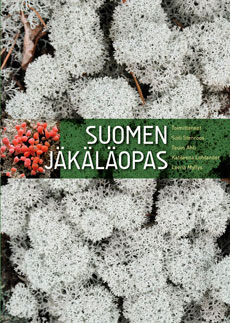 ‘Scientific, aesthetic, timely: the work is all of these. A work of non-fiction can be both precisely factual and emotional, full of both information and soul. A good non-fiction book will surprise. I did not expect to be enthused by lichens, their variety and colours,’ declared Professor Alf Reen in announcing the winner of this year’s Finlandia Prize for Non-Fiction on 17 November.
The winning work is Suomen jäkäläopas (‘Guidebook of lichens in Finland’), edited by Soili Stenroos & Teuvo Ahti & Katileena Lohtander & Leena Myllys (The Botanical Museum / The Finnish Museum of Natural History). The prize is worth €30,000.
The other works on the shortlist of six were the following: Kustaa III ja suuri merisota. Taistelut Suomenlahdella 1788–1790 [(‘Gustav III and the great sea war. Battles in the Gulf of Finland 1788–1790’, John Nurminen Foundation), written by Raoul Johnsson, with an editorial board consisting of Maria Grönroos & Ilkka Karttunen &Tommi Jokivaara & Juhani Kaskeala & Erik Båsk; Unihiekkaa etsimässä. Ratkaisuja vauvan ja taaperon unipulmiin (‘In search of the sandman. Solutions to babies’ and toddlers’ sleep problems’ ) by Anna Keski-Rahkonen & Minna Nalbantoglu (Duodecim); Operaatio Hokki. Päämajan vaiettu kaukopartio (‘Operation Hokki. Headquarters’ silenced long-distance patrol’), an account of a long-distance patrol strike in eastern Karelia during the Continuation War in 1944, by Mikko Porvali (Atena); Trotski (‘Trotsky’, Gummerus; biography) by Christer Pursiainen; and Lintukuvauksen käsikirja (‘Handbook of bird photography’) by Markus Varesvuo & Jari Peltomäki & Bence Máté (Docendo).
Renaissance man
30 September 1990 | Archives online, Fiction, Prose
An extract from the novel Bruno (WSOY, 1990)
Since her first collection of poems, which appeared in 1975, Tiina Kaila (born 1951 [from 2004, Tiina Krohn]) has published four children’s books and three volumes of poetry. Her novel Bruno is a fictive narrative about the Italian philosopher Giordano Bruno, who was burned at the stake in 1600. It is the conflict inherent in her main character that interests Kaila: his philosophical and scientific thought is much closer to that of the present day than, for example, that of Copernicus, and it is this that led him to the stake; and yet he did never abandon his fascination for magic.
The novel follows Bruno on his journeys in Italy; France, Germany and England, where he is accompanied by the French ambassador, Michel de Castelnau. Bruno finds England a barbaric place: ‘…These people believe that it is enough that they know how to speak English, even though no one outside this little island understands a word. No civilised language is spoken here’
In the extract that follows, Bruno, approaching the chalk cliffs of Dover by sea, makes what he feels to be a great discovery: ‘Creation is as infinite as God. And life is the supremest, the vastest and the most inconceivable of all.’

I was leaning on the foredeck handrail, peering into a greenish mist. The bow was thrashing between great swells, blustering and hissing and shuddering like some huge wheezing animal: Augh – aagh – ho-haugh! Augh – aagh – ho-haugh!
Plenty of space had been reserved for our use on this new two-master cargo boat. Castelnau was transferring his whole family from France – his wife, his daughter, his servants, his library, his furniture, his past and me – to London, where, as you know, he had been appointed Ambassador of France. More…
Childhood revisited
31 March 2006 | Archives online, Fiction, Prose
Extracts from the novel Tämän maailman tärkeimmät asiat (‘The most important things of this world’, Tammi, 2005). Introduction by Jarmo Papinniemi
I was supposed to meet my mother at a café by the sea. She would be dressed in the same jacket that I had picked out for her five years ago. She would have on a high-crowned hat, but I wasn’t sure about the shoes. She loved shoes and she always had new ones when she came to visit. She liked leather ankle boots. She might be wearing some when she stepped off the train, looking out for puddles. She didn’t wear much make-up. I don’t remember her ever using powder, although I’m sure she did. I could describe her eye make-up more precisely: a little eye shadow, a little mascara, and that’s all.
That’s all? I don’t know my mother. As a child, I lived too much in my own world and it was only after I left home that I was able to look at her from far enough away to learn to know her. She had been so near that I hadn’t noticed her. More…
The mistake
30 September 2008 | Archives online, Fiction, Prose
A short story (‘Erehdys’, 1956, last published in the collection Lukittu laatikko ja muita kertomuksia, ‘A locked box and other stories’, WSOY, 2003). Introduction by Markéta Hejkalová
My feet are smarter than my head. On an April night in Naples they carried me along the Via Roma past the royal palace and the giant illuminated dome of the church. The people of Naples walked up and down the immortal street like the cool of evening, looking at each other and at the brightly lit display windows. I had nothing against that, but at the comer of Via San Brigida my feet turned to the right. The snow-cold breath of my homeland radiated toward me from Saint Bridget Street.
When I had turned the corner I could see a restaurant window still lit, with its fruit baskets, dead fish and red lobsters. The most hurried diners had already finished their meals. I stepped into the long dining room of the restaurant, the sawdust on the floor stuck to my shoes, a frighteningly icy stare pierced me from behind the counter, but I gathered my courage and whispered bravely, ‘Buona sera, signora.’ More…
Findians, Finglish, Finntowns
16 May 2013 | Extracts, Non-fiction
Workers, miners, loggers, idealists, communists, utopians: early last century numerous Finns left for North America to find their fortune, settling down in Michigan, Minnesota, Wisconsin and Ontario. Some 800,000 of their descendants now live around the continent, but the old Finntowns have disappeared, and Finglish is fading away – that amusing language cocktail: äpylipai, apple pie.
The 375th anniversary of the arrival of the first Finnish and Swedish settlers, in Delaware, was celebrated on 11 May. Photographer Vesa Oja has met hundreds of American Finns over eight years; the photos and stories are from his new book, Finglish. Finns in North America

Drinking with the workmen: The Työmies Bar. Superior, Wisconsin, USA (2007)
The Työmies Bar is located in the former printing house of the Finnish leftist newspaper, Työmies (‘The workman’). The owners, however, don’t know what this Finnish word means, or how to pronounce it.
The Työmies Society, which published the newspaper of the same name, Työmies, was founded in Worcester, Massachusetts in 1903 as a socialist organ. It moved to Hancock, Michigan the following year. More…
Wolf-eye
30 June 2004 | Archives online, Fiction, Prose
Extracts from the novel Käsky (‘Command’, WSOY, 2003). Introduction by Jarmo Papinniemi
Only once he had led the woman into the boat and sat down in the rowing seat did it occur to Aaro that it might have been advisable to tie the woman’s hands throughout the journey. He dismissed the thought, as it would have seemed ridiculous to ask the prisoner to climb back up on to the shore whilst he went off to find a rope.
It was a mistake.
After sitting up all night, being constantly on his guard was difficult. Sitting in silence did not help matters either, but they had very few things to talk about. More…
Between two loves
31 December 1999 | Archives online, Fiction, Prose
From Se tapahtui täällä (’It happened here’, Otava, 1999). Introduction and interview by Nina Paavolainen
She thought of the period between two loves as a spacious room, full of light, outside whose windows the seasons change unhurriedly. On the walls are reflections of the morning light. There is the sound of piano music; and the number of rooms grows. Somewhere, far away, a young girl, dressed in white, is at the piano; the wind fans the curtains. Slow awakening, the soft rocking of time, the sound of bare feet on a wooden floor. In the air there is the scent of flowers, apples, and the gentle morning breeze, and perfume, and the scent of clean, ironed clothes and furniture wax. The afternoon shadows are long and cool; the pages of a book rustle slowly. Now the music pauses.
The business of war
30 September 2004 | Archives online, Fiction, Prose
Extracts from the novel Lahti (‘Slaughter’, WSOY 2004). Introduction by Jarmo Papinniemi
Major Tuppervaara put his plate down on a tree stump and walked over towards us. He had long legs and walked with a spring in his step. Twigs crunched beneath every step.
‘Okay, boys,’ he said. ‘Peckish?’
‘Yes.’
‘Take your time and listen carefully to what I’m about to tell you. The training exercise will begin soon. Your job is to help out here, you’ll be doing the medical officers’ jobs, all things you’re familiar with. During the course of this drill you will see things you have never seen before. You must not tell anyone about them. I repeat: no one. Not your father, not your mother’ not your girlfriend or your mates, not even the staff at your divisions. No one. That’s an order. Is that clear?’
‘Yes, Sir,’ said Äyräpää. Hiitola and I nodded. More…