

Search results for "tommi+musturi/2010/05/song-without-words/2009/09/what-god-said/2011/04/matti-suurpaa-parnasso-1951–2011-parnasso-1951–2011"
A day at the zoo
23 December 2009 | Children's books, Fiction
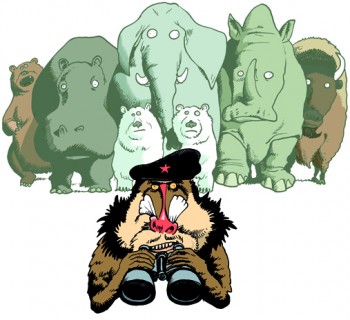
Extracts from the children’s book Zoo – eläimellinen tarina (‘Zoo – a bestial story’, WSOY, 2009, illustrated by Pertti Jarla)
The place: A zoo, once the property of the city, now privatised and accountable to corporate stockholders
The characters: The animals of the zoo, in particular Gandhi, a Sumatran tiger (false-teeth, poor vision, pacifist), Che, a male mandrill baboon (militant), and Mother Teresa, a hammer-headed bat (elderly); the zookeeper Sihvonen (stands up for the animals, recently fired); the new zoo director (whose main goal is to maximise profits); the shareholders’ committee (awaiting their earnings)
The action: after a demonstration in which all the animals played dead, the animals are staging a revolution to demand that Sihvonen be reinstated

The animals crowded into the foyer. The hallway was full of every kind of creature, with all of their skin, fur and feathers steaming in the warm indoor air. Che stood at the top of the the stairs, looked down at his troops, and gave the order in mime for everybody to be quiet.
‘Reconnaissance?’ he said, his voice subdued.
‘Ready!’ the leaf-tailed geckos announced.
‘Head in!’ Che commanded. More…
Stars above
30 December 1998 | Fiction, Prose
Extracts from the novel Benjamins bok (‘Benjamin’s book’, Schildts, 1997)
There are people who feel they are in contact with the stars. Among those who carry their secret knowledge around with them are both the healthy and the ‘sick’. Now I remember Olli stretching his arm out towards the evening star and seeming to greet it. For others, for me, the starry heavens are a form of distant vertigo. All those milky ways and galaxies, how could they not be inhabited, have developed a culture far older than our own. Perhaps they have watched the development of our planet with distaste, and are waiting for its ruin, which according to their calculation of time will take place in a few years or days from now. If I listen closely I seem to be faintly approached by a celestial choir, composed of indistinct sounds; if I stand on a lonely road in the country, and look up at the sky, the light and faint murmur from a nearby town emerge, and can be separated from the faint voices of the starry heavens. It is probably just my imagination. Perhaps it is an extension of that voice – anonymous, quiet – that I hear when I read a book. A good book is audio-visual. And no harm is done if it gives the reader a mild sense of vertigo. More…
Is this all?
10 October 2013 | Extracts, Non-fiction
Earth. Andrew Z. Colvin/Wikimedia
In today’s world, many people find that it is not the lack of something that is problematic, but excess: the same goes for knowledge. According to professor of space astronomy, Esko Valtaoja, knowledge should contribute to the creation of a better world. His latest book is a contribution to the sum of all knowledge; over the course of two hundred pages Valtaoja delves deep into the inner space of man by taking his reader on a brief tour of the universe. Extracts from Kaiken käsikirja. Mitä jokaisen tulisi tietää (‘A handbook to everything. What everybody should know’, Ursa, 2012)
Whatever god you bow down to, you’re probably worshipping the wrong god.
The above is almost the only completely certain thing that can be said about religion, and even it does not encompass any deep truth; it’s just a simple mathematical statement. The world’s biggest religion is Roman Catholicism, which is confessed, at least nominally, by 1.1 billion people. If the Roman Catholic god were the true god, the majority of people in the world are therefore worshipping a false god. (According to the official stance of the Catholic church, the other Christian denominations are heresies, and their believers will be condemned to perdition: extra ecclesiam nulla salus. This inconvenient truth is, understandably, politely bypassed in ecumenical debate. But even if all those who call themselves Christians were counted as worshipping the same god, two thirds of the world’s population are still knocking at the wrong door.)
If you’re a religious person, don’t worry; I’m not blaspheming. And if you’re a campaigning atheist, hang on a minute: all I want to do is to find a clear and undisputed starting point to consider what it is we’re talking about when we speak of religion. More…
Best Translated Book Award 2011
13 May 2011 | In the news
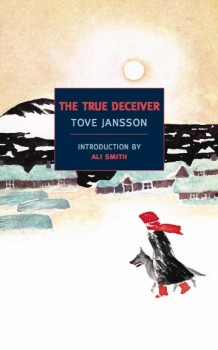 Thomas Teal’s translation from Swedish into English of Tove Jansson’s novel Den ärliga bedragaren (Schildts, 1982), entitled The True Deceiver (published by New York Review Books, 2009), won the 2011 Best Translated Book Award in fiction (worth $5,000; supported by Amazon.com). The winning titles and translators for this year’s awards were announced on 29 April in New York City as part of the PEN World Voices Festival.
Organised by Three percent (the link features a YouTube recording from the award ceremony, introducing the translator, Thomas Teal [fast-forward to 7.30 minutes]) at the University of Rochester, and judged by a board of literary professionals, the Best Translated Book Award is ‘the only prize of its kind to honour the best original works of international literature and poetry published in the US over the previous year’. ‘Subtle, engaging and disquieting, The True Deceiver is a masterful study in opposition and confrontation’, said the jury.
Tove Jansson (1914–2001), mother of the Moomintrolls, story-teller and illustrator of children’s books, translated into 40 languages, began to write novels and short stories for adults in her later years. Psychologically sharp studies of relationships, they are written with cool understatement and perception.
Quality writing will work its way into a wider knowledge (i.e. a bigger language and readership) eventually… even though occasionally it may seem difficult to know where exactly it comes from; in a review published in the London Guardian newspaper, the eminent writer Ursula K. Le Guin assumed Tove Jansson was Swedish.
Canberra, can you hear me?
31 March 1987 | Archives online, Fiction, Prose
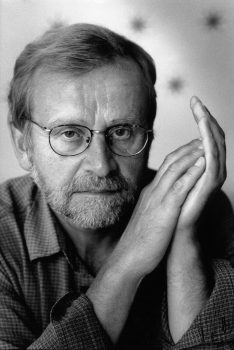
Johan Bargum. Photo: Irmeli Jung
A short story from Husdjur (‘Pets’, 1986)
Lena called again Sunday morning. I had just gotten up and was annoyed that as usual Hannele hadn’t gone home but was still lying in my bed snoring like a pig. The connection was good, but there was a curious little echo, as if I could hear not only Lena’s voice but also my own in the receiver.
The first thing she said was, ‘How is Hamlet doing?’
She’d started speaking in that affected way even before they’d moved, as if to show us that she’d seen completely through us.
‘Fine,’ I said. ‘How are you?’
‘What is he doing?’
‘Nothing special.’
‘Oh.’
Then she was quiet. She didn’t say anything for a long while.
‘Lena? Hello? Are you there?’
No answer. Suddenly I couldn’t stand it any longer. More…
Mary Bloom
31 December 1983 | Archives online, Drama, Fiction
Introduction by Väinö Vainio
‘Is Mary Bloom about a revivalist religious meeting, a party political conference at which a new leader is born, or a rock concert? These are among the things that have been suggested. I don’t know. I don’t hope for restraint in the imaginations of those who choose.to interpret my work, although I observe it myself. The work of a writer is a part of life, it is an individual and collective experience that seeks, finds, takes and uses its materials like a motor machine. For those who create it the drama is real, as in the theatre, for the duration of the performance.’ Jussi Kylätasku
Characters
Mary Bloom
Martha, a doctor
Otto, a preacher
Disabled veteran
Serenity, his wife
Alcoholic
Cold Cal, a prisoner
Blind man, Deaf Wife More…
Finlandia Prize candidates 2011
17 November 2011 | In the news
 The candidates for the Finlandia Prize for Fiction 2011 are Eeva-Kaarina Aronen, Kristina Carlson, Laura Gustafsson, Laila Hirvisaari, Rosa Liksom and Jenni Linturi.
Their novels, respectively, are Kallorumpu (‘Skull drum’, Teos), William N. Päiväkirja (‘William N. Diary’, Otava), Huorasatu (‘Whore tale’, Into), Minä, Katariina (‘I, Catherine’, Otava), Hytti no 6 (‘Compartment number 6’, WSOY) and Isänmaan tähden (‘For fatherland’s sake’, Teos).
Kallorumpu takes place in 1935 in Marshal Mannerheim’s house in Helsinki and in the present time. Laila Hirvisaari is a popular writer of mostly historical fiction: Minä, Katariina, a portrait of Russia’s Catherine the Great, is her 39th novel. Gustafsson’s and Linturi’s novels are first works; the former is a bold farce based on women’s mythology, the latter is about guilt born of the Second World War.
The jury – journalist and critic Hannu Marttila, journalist Tuula Ketonen and translator Kristiina Rikman – made their choice out of 130 novels. The winner, chosen by the theatre manager of the KOM Theatre Pekka Milonoff, will be announced on the first of December. The prize is worth 30,000 euros. It has been awarded since 1984, to novels only from 1993.
The fact that this time all the candidates are women has naturally been the object of criticism: why are the popular male writers’ books of 2011 missing from the list?
Another thing that these novels share is history: five of them are totally or partially set in the past – Finland in 1935, Paris in the 1890s, Russia/Soviet Union in the 18th century and in the 1980s, and 1940s Finland during the Second World War. Even the sixth, Huorasatu, bases its depiction of the present day in women’s prehistory, patriarchy and the ancient myths.
The jury’s chair, Hannu Marttila, commented: ‘This book year is sure to be remembered for a generational and gender change among those who write literature about the Second World War in Finland. Young woman writers describe the war with probably greater diversity than before. From the non-fiction writing of recent years it is clear that the struggles and difficulties of the home front are increasingly being recognised as part of the general struggle for survival, and on the other hand the less heroic aspects of war, the shameful and criminal elements, have also become acceptable as objects of study.’
Marttila concluded his speech: ‘When picking mushrooms in the forest, I have learned that it is often worth humbly peeking under the grass, and that the most glaring cap is not necessarily the best…. Perhaps it is time to forget the old saying that there is literature, and then there is women’s literature.’
Brighter than darkness
30 June 2002 | Archives online, Fiction, Prose
An extract from the novel Eksyneet (‘The lost’, WSOY, 2001). Interview by Markus Määttänen
It was a white tiled wall. Too white. Sterile. He wondered how long he had been looking at it. In any case long enough to have forgotten it was a wall. It had changed into a vacuum opening up before him and then shrunk into a tunnel through whose irresistible suction he had hurtled toward the painful images of the past. The past. Yesterday. Almost yesterday. He had stared at the nocturnal entrance, clearly divided in two by the street lamps, and not just that, but now saw only a lifeless and, in its lifelessness, repellant wall. He sighed, rubbed his numb face, pushed himself off the floor and stood up.
‘ware bears!
30 September 1988 | Archives online, Children's books, Fiction
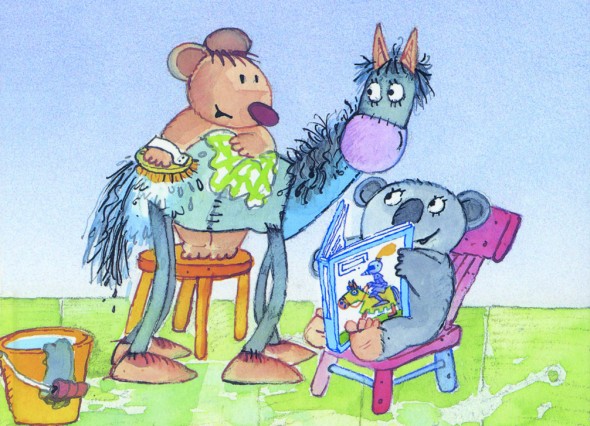
Illustration: Jukka Lemmetty
Urpo and Turpo are a pair of teddy bears. Their family – mother, father and three children – cannot imagine who it is that makes such a mess; the bears live their own absorbing lives in house. Hannele Huovi’s text and Jukka Lemmetty’s illustrations describe the bears’ antics in a way that appeals to the sense of humour of readers of all ages.
In the green house an ordinary family are living a perfectly ordinary life. There’s father, mother, The Big Daughter, The Son, and also The Baby as well. Mother keeps running back and forth all day long shouting, ‘Goodness gracious! Who’s responsible for this?’ For very funny things keep going on in the house. Who on earth is it – always getting up to some sort of hanky-panky?
Father harrumphs and says to The Big Daughter:
‘It was you, wasn’t it?’ But The Big Daughter shakes her head. Father turns to The Son:
‘So it must have been you, then?’ But the son shakes his head. No use asking The Baby. He shakes his head anyway, because he’s always imitating the others. Father and mother are completely stumped. More…
A policeman’s crimes
31 December 1985 | Archives online, Authors
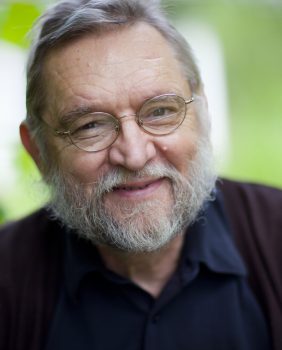
Matti Yrjänä Joensuu. Photo: Jouni Harala 2010
The Finnish section of the major Nordic Crime Novel Competition in 1976 was won by a newcomer, Matti Yrjänä Joensuu, with his Väkivallan virkamies (‘Civil servant in violence’). A realistic crime and police novel in the style of the Swedish writers Sjöwall and Wahlöö, the book represented something completely new in Finland. In the previous competition, held in 1939 as Europe hovered on the brink of war, the winner of the Finnish section was Mika Waltari’s Kuka murhasi Rouva Skrofin (‘Who killed Mrs Skrof?’); the novel is now regarded as one of the classics of Nordic detective fiction. But Waltari was, of course, a literary polymath; his Sinuhe, egyptiläinen (1945; English translation The Egyptian) is among the internationally best-known Finnish novels.
The detective novel and thriller tradition in Finland is both short and slight, and apart from Waltari’s book and its two sequels, many of its representatives – even those that have been most widely acclaimed and read at the time – are of little worth by any objective standards. Joensuu, therefore, has no living tradition to follow, and in interviews he has said that at the start of his career he was not familiar with the two Swedish writers to whom his work is most readily likened, Sjöwall and Wahlöö. This is not difficult to believe; in terms of both politics and social criticism Joensuu’s first novel, in particular, is much tamer than the Swedish writers’ – what all three writers have in common is the gravity with which they approach crime and the individuals who engage in it, and their realistic description of the work of the police. More…
Wo/men at war
9 February 2012 | Essays, Non-fiction
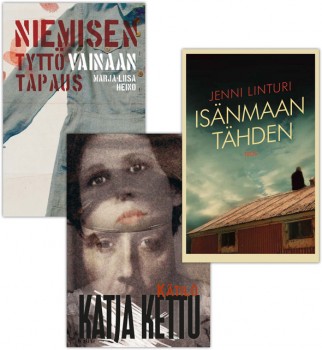 The wars that Finland fought 70 years and a couple of generations ago continue to be a subject of fiction. Last year saw the appearance of three novels set during the years of the Continuation War (1941–44), written by Marja-Liisa Heino, Katja Kettu and Jenni Linturi
In reviews of Finnish books published this past autumn, young women writers’ portraits of war were pigeonholed time and again as a ‘category’ of their own. This gendered observation has been a source of annoyance to the writers themselves.
Jenni Linturi, for instance, refused to ruminate on the impact of her sex on her debut novel Isänmaan tähden (‘For the fatherland’, Teos), which describes the war through the Waffen-SS Finnish volunteer units and the men who joined them [1,200 Finnish soldiers were recruited in 1941, and they formed a battalion, Finnische Freiwilligen Battaillon der Waffen-SS].
The work received a well-deserved Finlandia Prize nomination. Tiring of questions from the press about ‘young women and war’, Linturi (born 1979) was moved to speculate that some critics’ praise had been misapplied due to her sex. The situation is an apt reflection of the waves of modern feminism and the reasoning of the so-called third generation of feminists, who reject gender-limited points of view on principle. More…
On the make
31 December 2007 | Fiction, Prose
Extracts from the novel Benjamin Kivi (WSOY, 2007). Introduction by Lauri Sihvonen
Benjamin Kivi alias Into Penger, the 1930s
What was Kuihkä worth? What were this little man and his sons worth? What was I worth?
I drove where the little man told me to, with no lights, through a densely populated area. I could only see half a meter in front of me, trying to sense the bends and curves in the road and still keep Tallus’ car in good shape. When we got to the woods I turned on the lights and glanced at the little man sitting next to me. He was stuffing a handkerchief into his sleeve like an old housewife. The top of his head was sweating. He brushed his hair back and shoved his cap down on his head.
I had two hours to think as I drove, but it felt like a few minutes. If I didn’t drive the car, someone else would have, everything would happen just like the little man had planned, and I wouldn’t know anything about Kuihkä. What was I going to do, watch while he was thrown to the wolves? Kuihkä rescued me once. Was it meant to be that I should drive the car? Was I meant to change the course of events? How many coincidences can there be in one lifetime, and what do they signify? If events weren’t random, then what the hell was I supposed to do? More…
Mothers and sons
30 March 2008 | Archives online, Fiction, Prose
Extracts from Helvi Hämäläinen’s novel Raakileet (‘Unripe’, 1950. WSOY, 2007)
In front of the house grew a large old elm and a maple. The crown of the elm had been destroyed in the bombing and there was a large split in the trunk, revealing the grey, rotting wood. But every spring strong, verdant foliage sprouted from the thick trunk and branches; the tree lived its own powerful life. Its roots penetrated under the cement of the grey pavement and found rich soil; they wound their way under the pavement like strong, dark brown forearms. Cars rumbled over them, people walked, children played. On the cement of the pavement the brightly coloured litter of sweet papers, cigarette stubs and apple cores played; in the gutter or even in the street a pale rubber prophylactic might flourish, thrown from some window or dropped by some careless passer-by.
The sky arched blue over the six-and seven-storey buildings; in the evenings a glimmer could be seen at its edges, the reflection of the lights of the city. A group of large stone buildings, streets filled with vehicles, a small area filled with four hundred thousand people, an area in which they were born, died, owned something, earned their daily bread: the city – it lived, breathed….
Six springs had passed since the war…. Ilmari’s eyes gleamed yellow as a snake’s back, he took a dance step or two and bent over Kauko, pretending to stab him with a knife. More…
The books that sold
11 March 2011 | In the news
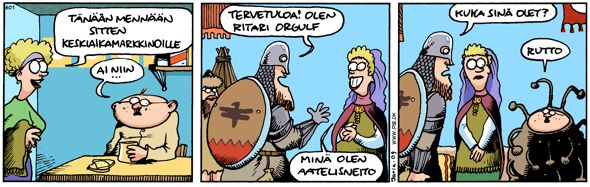
-Today we're off to the Middle Ages Fair. – Oh, right. - Welcome! I'm Knight Orgulf. – I'm a noblewoman. -Who are you? – The plague. *From Fingerpori by Pertti Jarla
Among the ten best-selling Finnish fiction books in 2010, according statistics compiled by the Booksellers’ Association of Finland, were three crime novels.
Number one on the list was the latest thriller by Ilkka Remes, Shokkiaalto (‘Shock wave‘, WSOY). It sold 72,600 copies. Second came a new family novel Totta (‘True’, Otava) by Riikka Pulkkinen, 59,100 copies.
Number three was a new thriller by Reijo Mäki (Kolmijalkainen mies, ‘The three-legged man’, Otava), and a new police novel by Matti Yrjänä Joensuu, Harjunpää ja rautahuone (‘Harjunpää and the iron room’, Otava), was number six.
The Finlandia Fiction Prize winner 2010, Nenäpäivä (‘Nose day’, Teos) by Mikko Rimminen, sold almost 54,000 copies and was fourth on the list. Sofi Oksanen’s record-breaking, prize-winning Puhdistus (Purge, WSOY; first published in 2008) was still in fifth place, with 52,000 copies sold.
Among translated fiction books were, as usual, names like Patricia Cornwell, Dan Brown and Liza Marklund.
In non-fiction, the weather, fickle and fierce, seems to be a subject of endless interest to Finns; the list was topped by Sääpäiväkirja 2011 (‘Weather book 2011’, Otava), with a whopping 140,000 copies. Number two was the Guinness World Records 2011, but with just 43,000 copies. Books on wine, cookery and garden were popular. A book on Finnish history after the civil war, Vihan ja rakkauden liekit (‘Flames of hate and love’, Otava) by Sirpa Kähkönen, made it to number 8 on the list.
The Finnish children’s books best-sellers’ list was topped by the latest picture book by Mauri Kunnas, Hurja-Harri ja pullon henki (‘Wild Harry and the genie’, Otava), selling almost 66,000 copies. As usual, Walt Disney ruled the roost in the translated fiction list.
The Finnish comics list was dominated by Pertti Jarla (his Fingerpori series books sold more than 70,000 copies, almost as much as Remes’ Shokkiaalto!) and Juba Tuomola (Viivi and Wagner series; both mostly published by Arktinen Banaani): between them, they grabbed 14 places out of 20!
Success after success
9 March 2012 | This 'n' that
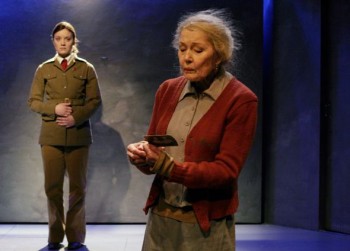
The women of Purge: Elena Leeve and Tea Ista in Sofi Oksanen's Puhdistus at the Finnish National Theatre, directed by Mika Myllyaho. Photo: Leena Klemelä, 2007
Sofi Oksanen’s Purge, an unparalleled Finnish literary sensation, is running in a production by Arcola Theatre in London, from 22 February to 24 March.
First premiered at the Finnish National Theatre in Helsinki in 2007, Puhdistus, to give it its Finnish title, was subsequently reworked by Oksanen (born 1977) into a novel – her third.
Puhdistus retells the story of her play about two Estonian women, moving through the past in flashbacks between 1939 and 1992. Aliide has experienced the horrors of the Stalin era and the deportation of Estonians to Siberia, but has to cope with the guilt of opportunism and even manslaughter. One night in 1992 she finds a young woman in the courtyard of her house; Zara has just escaped from the claws of members of the Russian mafia who held her as a sex slave. (Maya Jaggi reviewed the novel in London’s Guardian newspaper.) More…