

Search results for "tommi+musturi/2010/05/song-without-words/2009/09/what-god-said/2011/04/matti-suurpaa-parnasso-1951–2011-parnasso-1951–2011"
Year of the cat
13 November 2014 | Fiction, Prose
Extracts from the novel Kissani Jugoslavia (‘Yugoslavia, my cat’, Otava 2014). Introduction by Mervi Kantokorpi
I met the cat in a bar. And he wasn’t just any cat, the kind of cat that likes toy mice or climbing trees or feather dusters, not at all, but entirely different from any cat I’d ever met.
I noticed the cat across the dance floor, somewhere between two bar counters and behind a couple of turned backs. He loped contentedly from one place to the other, chatting to acquaintances in order to maintain a smooth, balanced social life. I had never seen anything so enchanting, so alluring. He was a perfect cat with black-and-white stripes. His soft fur gleamed in the dim lights of the bar as though it had just been greased, and he was standing, firm and upright, on his two muscular back paws.
Then the cat noticed me; he started smiling at me and I started smiling at him, and then he raised his front paw to the top button of his shirt, unbuttoned it and began walking towards me. More…
For the love of a city
31 December 2004 | Archives online, Fiction, Prose
Extracts from the novel I väntan på en jordbävning (‘Waiting for an earthquake’, Söderströms, 2004). Introduction by Petter Lindberg
Nonna Rozenberg lived quite near the special school where I was a boarder, in a block nine stories high with a bas-relief to the right of the door. This bas-relief featured a fairy-tale figure – the Firebird or the Bird Sirin.
I often saw Nonna stepping out of a tram carrying a large brown case. She moved carefully, as if afraid of falling.
She played the cello, and resembled that bulky, melodious instrument herself. Women’s figures are often compared to guitars. But Nonna’s appearance never hinted at parties at home with parents away or singsongs around the camp-fire.
She was no beauty. Her slow, precociously mature body was neither graceful nor girlishly delicate. If I’d met her later, when I was working at a gym, I’d have said she was overweight and lacking in self-discipline. More…
Tutti frutti
20 November 2009 | In the news
 The chair of the jury for the Finlandia Prize for Non-Fiction 2009, Professor Pekka Puska, compared choosing a winner to the dilemma of choosing between oranges and bananas. The jury found that among the entries were at least 20 or 30 books that could have gone on the final shortlist of six titles. More…
What about me?
30 September 2008 | Fiction, Prose
Extracts from the novel Mitä onni on (‘What happiness is’, Otava, 2008)
I was lying on the sofa watching Sports Roundup. The ski jumpers were flying at Zakopane. When I go one day, I want the cantor to play the Sports Roundup theme on the harmonium and the pallbearers to look on like skiing judges down into the pit.
‘I have an idea,’ Liisa said, sitting down at the other end of the sofa. I muted the television and adopted a focused expression. I focused on thinking about my expression.
‘Finnish happiness,’ Liisa pronounced solemnly. ‘I’ll illustrate, and you write.’
‘A book again,’ I said and turned the sound back on. They were reading off the women’s basketball scores now. Liisa waited patiently. I was disarmed enough by this that I turned the television off. More…
Love is the only song
7 August 2014 | Fiction, poetry
Poems from Helise, taivas! Valitut runot (‘Ring out, sky! Selected poems’, Siltala, 2014). Introduction by Marja-Leena Mikkola
Who will tell me?
Who will tell me why white butterflies
strew the velvet skin of the night?
Who will tell me?
While people walk, mute and strange
and they have snowy, armoured faces,
such snowy faces!
and the eyes of a stuffed bird.
Who will tell me why in the morning, on the grass,
the thrushes begin their secret game?
Who will tell me?
While black soldiers stand at the gate
in their hands withered roses
such withered roses!
and broken tiger lilies.
Who will tell me, quietly in the sun’s shadow
how to bare my heart?
Who will tell me?
Come to me over the fields
Come close and softly
so softly!
Open the clothes of my heart. More…
European Union literature prizes 2010
8 October 2010 | In the news
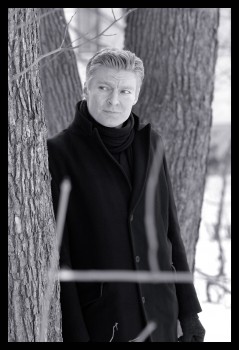
Riku Korhonen. Photo: Harri Pälviranta
With his novel Lääkäriromaani (‘Doctor novel’, Sammakko, 2009), Riku Korhonen (born 1972) is one of the 11 winners of the 2010 European Union Prize for Literature, worth €5,000 each. The winners were announced at Frankfurt Book Fair on 6 October.
The European Commission, the European Booksellers’ Federation (EBF), the European Writers’ Council (EWC) and the Federation of European Publishers (FEP) award the annual prize, which is supported through the European Union’s culture programme. It aims to draw attention to new talents and to promote the publication of their books in different countries, as well as celebrating European cultural diversity. Authors who have published two to four prose works during the last five years and whose work has been translated into two foreign languages at the most are eligible for the prize.
Korhonen has published two novels, a collection of short prose and a collection of poetry. Read translated extracts, published in Books from Finland in 2003, from his first novel, Kahden ja yhden yön tarinoita (‘Tales from two and one nights’, 2003) here. More…
Chronicles of crisis
31 December 1982 | Archives online, Fiction, Prose
Books from Finland presents here an extract from Dyre prins, a novel by the Finland-Swedish writer Christer Kihlman that is to be published in 1983 by Peter Owen of London under the title Sweet Prince, in a translation by Joan Tate.
Christer Kihlman (born 1930) first became known as a poet; but, after publishing two collections of poetry, he turned to novels. He has been branded a merciless scourge of the bourgeoisie. Equally important in his writing, however, are his masterly psychological analyses, his examination of the myriad aspects of the human personality, his sovereign disregard for taboos and his unflagging search for the truth. His books are about crises – the conflict between the generations, between the individual and society, between opposing political ideologies, between homosexual and heterosexual love. As Ingmar Svedberg remarked in an extensive appreciation of Kihlman’s work that appeared in Books from Finland 1-2/1976, ‘In his perceptive moral analyses, his exploration of the depths of human destructiveness and degradation, Kihlman is sometimes reminiscent of Faulkner.’ Since 1970, Kihlman has published three revealing autobiographical works, two of them dealing with his encounter with South America; Dyre prins, first published in 1975, represents a brief interlude of fiction.
The extract printed below is accompanied with a personal appreciation of the novel by its English translator, Joan Tate
Grandfather’s astonishing revelation gave me a new perspective on my life. I had suddenly been given a concrete, genuine foundation for both my hatred and my self-esteem. In a way I took the story of my origins as an extreme confirmation of the rightness of the Communist interpretation of reality, and at the same time it gave me a wonderful, dazzling sensation of being someone, despite everything, of having a place in a meaningful human perspective of time, despite everything, of being a link, however modest, in the historical family tradition. I did not need to found a dynasty; I already belonged to a dynasty, if only a minor branch. One was less important than the other, and even if the two experiences were irreconcilable and contradictory, they existed all the same in the same consciousness, contained within the same consciousness, my consciousness. I, Donald Blad! More…
Arska
30 September 1982 | Archives online, Fiction, Prose
A short story from Kaksin (‘Two together’). Introduction by Pekka Tarkka
A landlady is a landlady, and cannot be expected – particularly if she is a widow and by now a rather battered one – to possess an inexhaustible supply of human kindness. Thus when Irja’s landlady went to the little room behind the kitchen at nine o’clock on a warm September morning, and found her tenant still asleep under a mound of bedclothes, she uttered a groan of exasperation.
“What you do here this hour of day?” she asked, in a despairing tone. “You don’t going to work?”
Irja heaved and clawed at the blankets until at last her head emerged from under them.
“No,” she replied, after the landlady had repeated the question.
“You gone and left your job again?”
“Yep.” More…
A spot of transmigration
13 January 2011 | Fiction, Prose
A short story, ‘Sielunvaellusta’, from the collection Rasvamaksa (‘Fatty liver’, WSOY, 1973)
‘Where will you be spending Eternity?’ a roadside poster demanded as Leevi Sytky sped by in his car.
‘Hadn’t really thought about it,’ Leevi muttered , as if in reply, and lit a cigarette.
But at the next level crossing, a kilometre or so further on, he was run down by a train, whose approach he had failed to notice. His attention had been distracted by the sight of a young woman who was picking black currants by the side of the track, and who happened to be bending forward in his direction. Intent on obtaining a better view of her ample bosom by peering over the top of her blouse, Leevi neglected to look both ways, and death ensued. Damned annoying, to say the least.
In due course he secured an interview with God, who turned out to be a biggish chap, about a hundred metres tall, wearing thigh-boots and sitting behind a large desk.
‘Well, and how’s Leevi Sytky getting along?’ God asked, lighting his pipe.
‘Mustn’t grumble,’ said Leevi politely.
‘And how are you thinking of spending Eternity?’ God inquired, sucking at his pipe and puffing out his cheeks. More…
In the wars
31 March 2005 | Archives online, Fiction, Prose
A short story from Jussi ja Lassi (‘Jussi and Lassi’, WSOY, 1921). Introduction by Pekka Tarkka
One winter evening, Lassi, who was six, asked: ‘Can’t we go out, mother?’
‘It’s late already,’ she said.
‘We’ve been inside the whole day practically,’ said Jussi, who was seven. ‘It gets on my nerves.’
‘Gets on your nerves, does it? Well, boys, you’ll soon be off in bed,’ she said, ‘so you won’t need to get nervy.’
‘Not off to bed – not yet, it’s not yet, not…’ Lassi broke off, trying to work it out.
‘It’s not six yet,’ Jussi said.
‘No, it isn’t,’ their mother said; ‘but you’ll have to stay in your room and not go charging about here, because visitors are coming.’ More…
Finlandia Prize for Fiction 2011
1 December 2011 | In the news
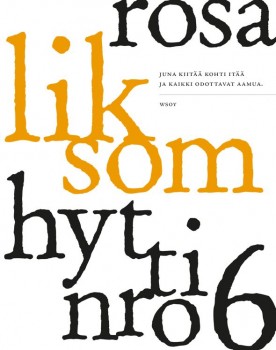 The winner of the Finlandia Prize for Fiction 2011, worth €30,000, is Rosa Liksom, for her novel Hytti no 6 (‘Compartment number 6’, WSOY): read translated extracts and an introduction of the author here on this page.
The prize was awarded on 1 December. The winner was selected by the theatre manager Pekka Milonoff from a shortlist of six.
‘Hytti nro 6 is an extraordinarily compact, poetic and multilayered description of a train journey through Russia. The main character, a girl, leaves Moscow for Siberia, sharing a compartment with a vodka-swilling murderer who tells hair-raising stories about his own life and about the ways of his country. – Liksom is a master of controlled exaggeration. With a couple of carefully chosen brushstrokes, a mini-story, she is able to conjure up an entire human destiny,’ Milonoff commented.
Author and artist Rosa Liksom (alias Anni Ylävaara, born 1958), has since 1985 written novels, short stories, children’s book, comics and plays. Her books have been translated into 16 languages.
Appointed by the Finnish Book Foundation, the prize jury (journalist and critic Hannu Marttila, journalist Tuula Ketonen and translator Kristiina Rikman) shortlisted the following novels: Kallorumpu (‘Skull drum’, Teos) by Eeva-Kaarina Aronen, William N. Päiväkirja (‘William N. Diary’, Otava) by Kristina Carlson, Huorasatu (‘Whore tale’, Into) by Laura Gustafsson, Minä, Katariina (‘I, Catherine’, Otava) by Laila Hirvisaari, and Isänmaan tähden (‘For fatherland’s sake’, first novel; Teos) by Jenni Linturi.
Rosa Liksom travelled a great deal in the Soviet Union in the 1980s. She said she hopes that literature, too, could play a role in promoting co-operation between people, cultures and nations: ‘For the time being there is no chance of some of us being able to live on a different planet.’
Helsinki Book Fair 2011
2 November 2011 | In the news
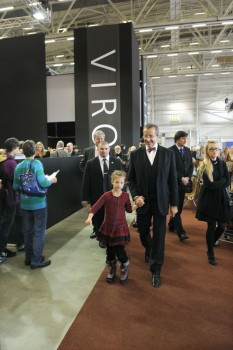
President Toomas Hendrik Ilves at the Book Fair: Viro is Estonia in Finnish. Photo: Kimmo Brandt/The Finnish Fair Corporation
The Helsinki Book Fair, held from 27 to 30 October, attracted more visitors than ever before: 81,000 people came to browse and buy books at the stands of nearly 300 exhibitors and to meet more than a thousand writers and performers at almost 700 events.
The Music Fair, the Wine, Food and Good Living event and the sales exhibition of contemporary art, ArtForum, held at the same time at Helsinki’s Exhibition and Convention Centre, expanded the selection of events and – a significant synergetic advantage, of course – shopping facilities. Twenty-eight per cent of the visitors thought this Book Fair was better than the previous one held in 2010.
According to a poll conducted among three hundred visitors, 21 per cent had read an electronic book while only 6 per cent had an e-book reader of their own. Twenty-five per cent did not believe that e-books will exceed the popularity of printed books, and only three per cent believed that e-books would win the competition.
Estonia was the theme country this time. President Toomas Hendrik Ilves of the Republic of Estonia noted in his speech at the opening ceremony: ‘As we know well from the fate of many of our kindred Finno-Ugric languages, not writing could truly mean a slow national demise. So publish or perish has special meaning here. Without a literary culture, we would simply not exist and we have known this for many generations, since the Finnish and Estonian national epics Kalevala and Kalevipoeg. – During the last decade, more original literature and translations have been published in Estonia than ever before. And we need only access the Internet to glimpse the volume of text that is not printed – it is even larger than the printed corpus. We live in an era of flood, not drought, and thus it is no wonder that as a discerning people, we do not want to keep our ideas and wisdom to ourselves but try to share and distribute them more widely. The idea is not to try to conquer the world but simply, with our own words, to be a full participant in global literary culture, and in the intellectual history and future of humankind.’
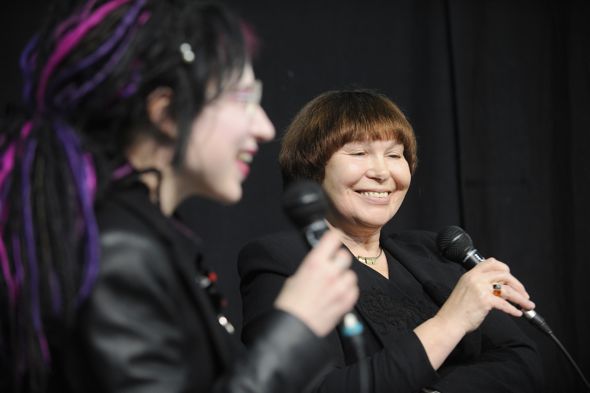
Finland meets Estonia: authors Sofi Oksanen and Viivi Luik in discussion. Photo: Kimmo Brandt/The Finnish Fair Corporation
In memoriam Bo Carpelan 1926–2011
24 February 2011 | Authors, In the news
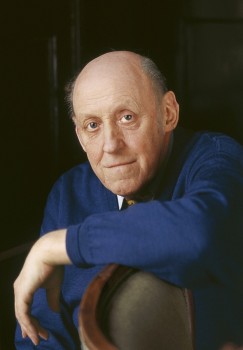
Bo Carpelan. Photo: Irmeli Jung
I write one winter’s day,
write off the day and the night, the planets,
go into my house from a harsh sun
and extend those shadows that are swordlike aimed.
It is a day of drifting snow
and with a voice from that which is I
or was.
(From The Cool Day. English translation by David McDuff, published in Homecoming, Carcanet, 1993)
Bo Carpelan, one of the great names of Finnish literature, died in his home city of Helsinki on 11 February. Carpelan’s first collection of poetry appeared in 1946, his last in 2010.
In his poems and prose he frequently described his childhood in apartment buildings filled with the smell of cooked herring, the noise of quarrels and the sound of the news on the radio. Prosaic life is turned into poetry, images and music, the apartment house is built from the rooms of a dream.
Bo Carpelan loved music. His novel Axel (English translation by David McDuff, 1989), is about his paternal grandfather’s brother, who was a friend of Jean Sibelius and the composer’s first critic. Axel was an unsuccessful musician who chose to live through someone else, and Carpelan relates him to the theme of the dignity of rejected human beings. More…
A portrait of Elmer Diktonius
30 June 1982 | Archives online, Authors
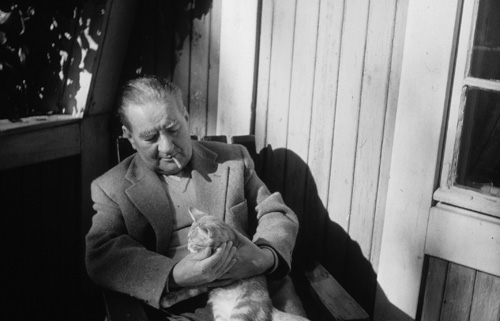
Elmer Diktonius at his home in Kauniainen (Grankulla). Photo: Wikimedia Commons / Public domain
Elmer Diktonius, one of the leading Finland-Swedish modernists of the 1920s, was a revolutionary poet, prose-writer and critic who also tried his hand at composing. Professor George Schoolfield, whose article on Diktonius appears below, appends his own translations of several of the lyrics: a filler selection is going to be published in the United States, Recently Professor Schoolfield has been working on a biography of Diktonius which he hopes to publish soon.
The literary fate of the Finland-Swedish modernist Elmer Diktonius (1896-1961) has not been an altogether happy one. Saluted early and late in his career as Finland’s Strindberg and as a possible rival to Mayakovsky in the contest for the greatest lyricist of the revolution, Diktonius would seem, surely, to deserve a place on the world’s literary stage. Yet the attention he has received outside the north has been mostly unwitting: the writers of program notes quote his description of the Silbelius Fourth, ‘the bark-bread symphony’ without knowing its source, the collected concert-reviews of Opus 12: Musik (1933). Surveys that might have introduced him to a larger public are silent. The chubby Pelican Guide to the European Literature of Modernism ignores him; the Penguin Book of Socialist Verse omits him from its 134 specimens of the lyric left; and Ulrich Weisstein’s volume of Expressionism as an International Literary Phenomenon does not have him in its chapter on ‘Expressionism in Scandinavia’, although he would qualify – as the Swedish scholar Bill Romefors has proved – as the major northern heir of German expressionism. More…