

Search results for "tommi+musturi/2010/05/song-without-words/2009/09/what-god-said/2011/04/matti-suurpaa-parnasso-1951–2011-parnasso-1951–2011"
Homo ludens, vita brevis
18 March 2011 | Letter from the Editors
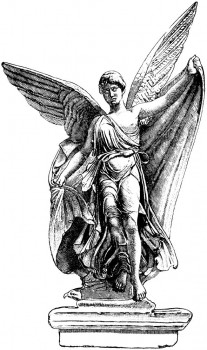
Goddess of victory: charioteer and runner Nike (constructed from the damaged statue of Nike of Paionios, from ca. 420 BCE). Photo: Wikimedia
No one should ever start a piece with ‘already the ancient Greeks…’ , but here goes:
Already the ancient Greeks practised the noble arts of sport. The Romans extended the cultivation (their word!) of culture to leisure, amusing themselves by throwing Christians to the lions. Formula F1 came a couple of thousand years later, as did post-modern art, sitcoms and reality TV, whose presenters take the place of lions and whose celebrities are today’s Christians.
The Olympics, founded by the Greeks, were in full swing as early as the seventh century BCE, until the Christian Roman Caesar Theodocius I banned them as irretrievably pagan in the year 393. However, they were revived 1,500 years later. More…
Human destinies
7 February 2014 | Articles, Non-fiction
To what extent does a ‘historical novel’ have to lean on facts to become best-sellers? Two new novels from 2013 examined
When Helsingin Sanomat, Finland’s largest newspaper, asked its readers and critics in 2013 to list the ten best novels of the 2000s, the result was a surprisingly unanimous victory for the historical novel.
Both groups listed as their top choices – in the very same order – the following books: Sofi Oksanen: Puhdistus (English translation Purge; WSOY, 2008), Ulla-Lena Lundberg: Is (Finnish translation Jää, ‘Ice’, Schildts & Söderströms, 2012) and Kjell Westö: Där vi en gång gått (Finnish translation Missä kuljimme kerran; ‘Where we once walked‘, Söderströms, 2006).
What kind of historical novel wins over a large readership today, and conversely, why don’t all of the many well-received novels set in the past become bestsellers? More…
Works in progress
30 September 2008 | Archives online, Essays, On writing and not writing
Olli Jalonen’s latest novel, 14 solmua Greenwichiin (’14 knots to Greenwich’, 2008), was 19 years in the making. He ponders the joys and tribulations of such a slow maturation
When you spend years or decades writing the same book, what is the drive, passion or compulsion that keeps the cogs turning through the quieter months? Or are the months when you don’t write silent at all? Isn’t it the case that the core of a text or a book is born out of a state of peaceful nothingness?
More often than not, the most important ideas, the strongest details and the sturdiest structures of the art of writing come into being somewhere other than at the computer keyboard. One of the greatest benefits and pleasures of a writer’s work is carrying that work around in mind and body. At these times the writing machinery is whirring, quietly, calmly, freely and unpressured. More…
Hannele Huovi: Karvakorvan runopurkki [Furry pooch’s jar of verse]
4 March 2009 | Mini reviews
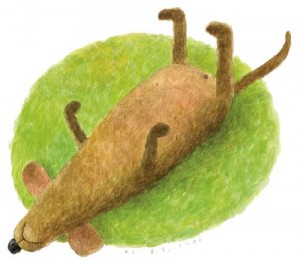 Karvakorvan runopurkki
[Furry pooch’s jar of verse]
Kuvitus [Ill. by]: Kristiina Louhi
Helsinki: Tammi, 2008. 79 p.
ISBN 978-951-31-3974-2
€ 23.30, hardback
‘Methinks,/ said the sausage dog / who loved eating verse, that / poetry is tastier than bone’. Hannele Huovi (born 1949) has written poetry, books for children, novels and fables. The masterly rhymes of Finland’s grand old lady of children’s poetry, Kirsi Kunnas (born 1924), are hard to match, but Huovi comes close. For her, Finnish is easily pliable; her rhymes do not try to be too clever, her tone of voice is warm and humorous, and often the poems are little stories in the tradition of nonsense verse. Huovi’s sense of humour matches perfectly with Kristiina Louhi’s pastel pictures which often add surprising dimensions to the poetic stories. ‘So complete / trust can be: / with your paws skywards, /with your belly bared, you can / lie in the grass.’
Sofi Oksanen wins the 2008 Finlandia Prize
10 February 2009 | In the news

Sofi Oksanen. - Photo: Toni Härkönen/WSOY.
The Finlandia Prize for Fiction, Finland’s most prestigious literary prize, was awarded to Sofi Oksanen’s novel Puhdistus (‘Purge’, WSOY, 2008). ‘When the concentrated focus of drama and the multidimensionality of narrative conjoin, Puhdistus is born – a muscular, harsh, and solid book’, said the writer and critic Pekka Tarkka awarding the prize on 4 December. (For a short review, see the Review section.)
The prize, worth € 30,000, was awarded for the twenty-fifth time. The final choice was made from the shortlist of six candidates; the others were 14 solmua Greenwichiin (‘14 knots to Greenwich’, Otava) by Olli Jalonen, Kosmonautti (‘The cosmonaut’, Tammi) by Katri Lipson, Marie (Otava) by Arne Nevanlinna, Kohtuuttomuus (‘Excess’, Siltala) by Pirkko Saisio and Paholaisen haarukka (‘The Devil’s fork’, WSOY) by Juha Seppälä. More…
The politics of difference
17 June 2011 | Non-fiction, Tales of a journalist
Right or wrong, my country? Illustration: Joonas Väänänen
Right or wrong, my country? Illustration: Joonas Väänänen
Big electoral turnouts are generally considered a good thing. But, writes columnist Jyrki Lehtola, in Finland the fact that the vote went up in the last Finnish general election caused a revelation. Educated urbanites and the media (perhaps near enough the same thing), are shocked by how 20 per cent of their fellow Finns think – and the ramifications caused tremors all across Europe
Listen up. Diversity is a resource. Except of course if it’s the sort of diversity that is a resource for the wrong people.
That sort of diversity isn’t the least bit nice. In Finland in the spring, we ran into the sort of diversity that even got the rest of Europe to start worrying. Out in the thickets and forests, diverse people had been springing up in secret, people of whose existence we urbanites were entirely unaware.
And they threatened to bring Europe down. Europe. Which was a bit much. More…
New from the archives
5 May 2015 | This 'n' that
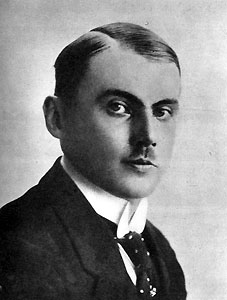
Runar Schildt
It’s a period that seems sometimes to have disappeared from view – Helsinki in the final years of Russian rule – but Runar Schildt’s short story brings it vividly to life. The characters – Sahlberg the baker and his mortal enemy, Johansson from the customs service; the restaurant-owner Durdin and Elsa, daughter of a commissionaire at the Senate, around whom the story revolves – spend a lazy but sexually charged summer Sunday in their villas just outside Helsinki, their hidden emotions all too familiar to those of a later age…
As the story’s translator, the formidably erudite George C. Schoolfield, remarks in his introduction, Runar Schildt (1888-1925) has often been hailed as a Finland-Swedish classic. There’s a quality of aesthetic decadence in his work that makes him very much a product of his time. There’s nothing, in Raketen, with its solid, belle epoque atmosphere, to foreshadow the change that was so soon to engulf Finland, with the granting of independence in 1917 and the bitter civil war that followed. Schildt was in Helsinki during the months when it was ruled by the Red side in the civil war; afterwards, he served as a clerk in the terrible detention camp for Red prisoners of war on Suomenlinna island. It was a new world, in which all the old certainties were questioned. Timid, conservative and something of a dandy (his friend Hans Ruin said he always looked as if he had stepped out of a bandbox), Schildt may well have felt out of tune with the times. By 1920 he had ceased to write the prose at which he excelled, and had turned to drama, with which he had much less success.
Schildt shot himself, in 1925, in the courtyard of the old university clinic in Helsinki. He was not yet 40.
Thirsty for poetry
22 May 2014 | This 'n' that
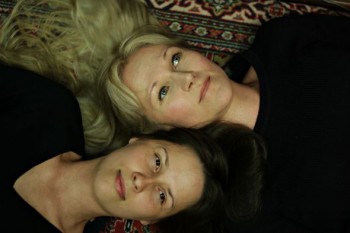
Johanna Venho (above) and Vilja-Tuulia Huotarinen. Photo:
Jano (‘Thirst’) is the name for a new online magazine: according to the writers and poets Johanna Venho and Vilja-Tuulia Huotarinen, its editors, it is a ‘poetry journal for all’ – for poets, the general public, for anybody.
Two issues have been published since November 2013. The theme of the first one is Time, of the second, Place.There are interviews, autobiographical texts, texts by critics and poets. More…
Cycling through a rainbow
30 March 2006 | Fiction, poetry
From Läsning för vandrare (‘Reading for hikers‘, Schildts, 1974). Introduction by Maria Antas
1
The people I was fond of have been
     wiped from my memory.
Do you remember a friend, perhaps?
     Be glad, then, you are still alive.
7
The one who has owned a room in
     someone's heart
is easily reconciled with the thought
     of eventually
gaining a room in the earth's bosom.
8
Love is only a preparation. More…
How to win literary prizes
30 September 1991 | Archives online, Fiction, Prose
A short story from Terveessä ruumiissa (‘In a healthy body’, Gummerus, 1990)
Later, as he mulled over the moments just before it all happened – with himself delivering his appreciative peroration to the prizewinner in the front row – the Chairman of the Prize Committee could recall no warning sign. Antti was tense, of course, but, considering his artistic sensitivity and the hundred-strong audience, there was nothing abnormal about that.
The Chairman was improvising from scanty notes: only the finishing touch was written out in full:
‘And so, with immense gratitude, we shall store up your many achievements in our hearts and minds.’ More…
Goodbye darling
30 March 2005 | Fiction, poetry
Poems from Niin kovaa se tuuli löi (‘So bitterly the wind struck’, Tammi, 2004)
Lord, you've promised to come, don't hang back.
     Here we are already, sitting, me and the dogs,
   and the others that have to go.

Jesus, poor thing, didn't know whom to bloom for,
  just kept on lugging his cross, pretty as a pony.
    He came and shot us down,
   bullets flying without his even noticing.
      The night was gifted with roses
        full of love.
 Through a woman we came here, through a man
    we leave.
On subterranean spaces
30 August 2013 | Authors, Reviews
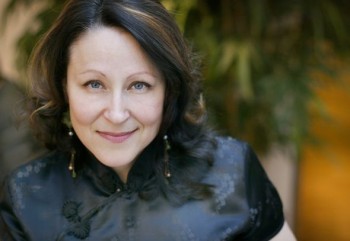
Zinaida Lindén. Photo: Janne Aaltonen
A melancholic diplomat’s wife in Turku recalls her childhood in 1970s Leningrad. This is how one might describe the new novel by Zinaida Lindén – then one might be surprised encountering nuance after nuance that challenge our expectations.
The melancholy in Lindén’s novel isn’t soft and misty; it is sharp and metallic. The life of the protagonist Galina, a diplomat’s wife, is far from glamorous, and consists mostly of standing over the ironing board in the family’s one-bedroom flat, ironing shirts for her conscientious and overworked husband at the consulate. The 1970s Leningrad of her memories is not an arena for ideology or culture, but serves as the backdrop for an intimate familial drama, in which the child always remained on the outside and was eventually left alone after the death of her parents. More…