

Search results for "tommi+musturi/2010/05/song-without-words/2009/09/what-god-said/2011/04/matti-suurpaa-parnasso-1951–2011-parnasso-1951–2011"
In the mirror
30 September 2003 | Archives online, Fiction, Prose
Extracts from the novel Helene (WSOY, 2003). Introduction by Leena Ahtola-Moorhouse
It was raining that day, and I was leafing through art books, as I often do, in the bookshop. Then I happened to pick up a work in which there was a picture; a bowl of apples, one of which was black.
Stories often begin like this, inexplicable as deep waters, secret as an unborn child which moves its mouth in the womb as if it wished to speak. For people do not seek mere understanding… people seek the sulphurous, tumultuous shapes of clouds; people seek bowls of apples of which one is black.
I bought the book and made an enlargement of the still life; on the wall, it was even more remarkable, for its correct position was standing up, tête à tête, looking straight at you, unblinking.
The apples seemed to move, to speak. I began to ponder them more and more. In the end I had to read everything I could lay my hands on about the still life’s painter. I had to visit Hyvinkää, where she lived for a long time, and touch her tree in Tammisaari with my hand. I had to travel as far as Brittany to see the rugged landscape that meant so much to her. More…
The rocket
30 September 1988 | Archives online, Fiction, Prose
Raketen (‘The rocket’), a novella from the collection Den segrande Eros (‘Eros triumphant’), 1912. Introduction by George C. Schoolfield
The sun shone straight in through the veranda’s little windows that made the whole ‘villa’ resemble a hothouse. With a sigh, Elsa let the morning paper fall to the floor; she had gotten halfway through the classified ads: ‘Three lads wish to correspond with likeminded lasses.’ ‘If Mr Söders-m does not fetch his effects, left as bond for unpaid rent, within a week, they will be regarded as our property, and his name will be published in toto.’ Now she could stand no more. The air seemed to come from a bakeoven. Listlessly, she watched two flies as they flicked the ceiling paper in their humming dance of love. It seemed as though knives were being thrust into the back of her head; that was the way her sick headaches began. A long walk might stop it, she knew, but she felt too tired.
At last, she was able to make herself get up and open the door for some fresh air. But with the air she got a powerful smell of roasting pork from the baker’s villa; the yells of the children playing cops and robbers up on the rock were doubled in force. A nasty stabbing sensation began in Elsa ears. And so she decided to take a walk after all, but only to the steamboat jetty. More…
Government Prize for Translation 2011
24 November 2011 | In the news
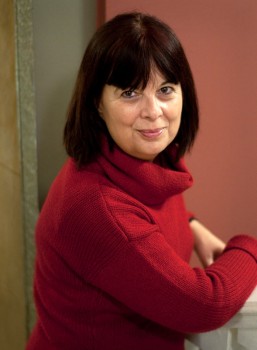
María Martzoúkou. Photo: Charlotta Boucht
The Finnish Government Prize for Translation of Finnish Literature of 2011 – worth € 10,000 – was awarded to the Greek translator and linguist María Martzoúkou.
Martzoúkou (born 1958), who lives in Athens, where she works for the Finnish Institute, has studied Finnish language and literature as well as ancient Greek at the Helsinki University, where she has also taught modern Greek. She was the first Greek translator to publish translations of the Finnish epic, the Kalevala: the first edition, containing ten runes, appeared in 1992, the second, containing ten more, in 2004.
‘Saarikoski was the beginning,’ she says; she became interested in modern Finnish poetry, in particular in the poems of Pentti Saarikoski (1937–1983). As Saarikoski also translated Greek literature into Finnish, Martzoúkou found herself doubly interested in his works.
Later she has translated poetry by, among others, Tua Forsström, Paavo Haavikko, Riina Katajavuori, Arto Melleri, Annukka Peura, Pentti Saaritsa, Kirsti Simonsuuri and Caj Westerberg.
Among the Finnish novelists Martzoúkou has translated are Mika Waltari (five novels; the sixth, Turms kuolematon, The Etruscan, is in the printing press), Väinö Linna (Tuntematon sotilas, The Unknown Soldier) and Sofi Oksanen (Puhdistus, Purge).
María Martzoúkou received her award in Helsinki on 22 November from the minister of culture and sports, Paavo Arhinmäki. Thanking Martzoúkou for the work she has done for Finnish fiction, he pointed out that The Finnish Institute in Athens will soon publish a book entitled Kreikka ja Suomen talvisota (‘Greece and the Finnish Winter War’), a study of the relations of Finland and Greece and the news of the Winter War (1939–1940) in the Greek press, and it contains articles by Martzoúkou.
The prize has been awarded – now for the 37th time – by the Ministry of Education and Culture since 1975 on the basis of a recommendation from FILI – Finnish Literature Exchange.
The report
30 September 1984 | Archives online, Fiction, Prose
A short story from Kesä ja keski-ikäinen nainen (‘Summer and the middle-aged woman’) Introduction by Margareta N. Deschner
Dear Colleague,
First of all, I want to thank you and your wife for the pleasant evening I and my wife had in your summer villa in August. Briitta (since we are old acquaintances: with two i’s and two t’s, remember?) especially wants me to mention that she will never forget the half moon climbing the hill behind your sauna, surprising us with its speed. The next time we looked it was half-way up the sky! Without doubt, your fine tequila had something to do with the matter, one shouldn’t forget that. Even so, it was quite a show, just like the time a bunch of us guys had gone skiing and you bragged that you had arranged for the barn to catch fire. I hope that you and your wife – I mean Alli – will be able to visit us next winter and taste a superb Mallorca red wine called Comas, which we brought home. It is by far the best red I have ever tasted and indecently cheap to boot. I hope you will come soon. The wine won’t keep indefinitely, as you well know. We’ll save it for you. So thanks again.
Looking back on a dark winter
31 December 1989 | Archives online, Fiction, Prose
Extracts from the autobiographical novel Talvisodan aika (‘The time of the Winter War’), the childhood memoirs of Eeva Kilpi. During the winter of 1939–40 she was an 11-year old-schoolgirl in Karelia when it was ceded to the Soviet Union and the population evacuated
Time is the most valuable thing
we can give each other
War’s coming.
One day my father comes out with the familiar words in a totally unfamiliar way, while we’re sitting round the kitchen table eating, or just starting to eat.
He says to mother, as if we simply aren’t there, as if we don’t need to bother, or as if listening means not understanding. Or perhaps they’ve simply no other chance to speak to each other, as father’s always got to be off hunting, or on his way to the station, and mother’s always cooking. More…
Still alive
31 March 2000 | Fiction, Prose
Extracts from the novel Maa ilman vettä (‘A world without water’, Tammi, 1999)
The window opened on to a sunny street. Nevertheless, there was a pungent, sickbed smell in the room. There were blue roses on a white background on the wallpaper and, on the long wall, three landscape watercolours of identical size: a sea-shore with cliffs, a mountain stream, mountaintops. The room was equipped with white furniture and a massive wooden table. The television had been lifted on to a stool so that it could be seen from the bed.
The bed had been shifted to the centre of the room with its head against the rose-wall, as in a hospital. Between white sheets, supported by a large pillow, Sofia Elena lay awake in a half-sitting position. More…
Science and fiction
15 September 2011 | Authors, Interviews
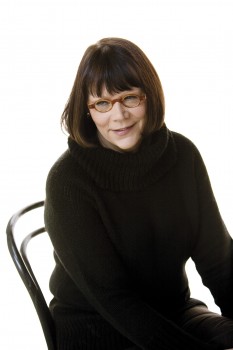
Kristina Carlson. Photo: Tommi Tuomi
Interview with Kristina Carlson, author of William N. Päiväkirja (‘William N. Diary’, Otava, 2011)
‘Monsieur W. Nylander had died alone, his head resting against his desk. We’d known for a long while that your beloved relative was not well, but whenever he was walking along the street and someone enquired as to his health, he always replied that he felt fit and well.’
Finnish-born Monsieur William N. lives in Paris at the end of the 19th century. The grumpy old scientist spends his days studying lichens in his small, dusty apartment and writing bitter comments in his diary about the way of the world, all things meaningless, and the glory and reputation that he never achieved.
William Nylander (born Oulu, 1822 – died Paris, 1899) is a historical figure who truly existed, and the remarks quoted above are taken from a letter sent by William’s housekeeper to his sister Elise in Finland, but other than this William’s diary is entirely the work of Kristina Carlson. The hermetic botanist has now become the protagonist of a novel written in 2011. More…
Finlandia Junior Prize 2011
7 December 2011 | In the news
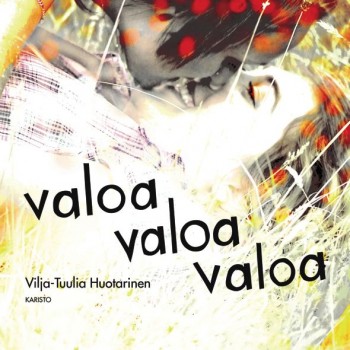 The musician Paula Vesala has chosen, from a shortlist of six, a book for young people by the poet Vilja-Tuulia Huotarinen, Valoa valoa valoa (‘Light light light’, Karisto). The story, which is set at the time of the Chernobyl nuclear power station disaster, poetically describes the passion and pain of first love, longing for mother and death.
‘Not just what is told, but how it is told. The rythm and timbre of Vilja-Tuulia Huotarinen’s language are immensely beautiful. Her phrases do not exist merely to tell the story, but live like poetry or song. Valoa valoa valoa does not incline toward young people from the world of adults; rather, its voice comes, direct and living, from painful, confusing, complex youth, in which young people should really be protected from adults and their blindness. I would have liked to read this book when I was fourteen,’ commented Vesala.
The other five shortlisted books were a picture book for small children, Rakastunut krokotiili (‘Crocodile in love’, Tammi) by Hannu Hirvonen & Pia Sakki, a philosophical picture book about being different and courageous entitled Jättityttö ja Pirhonen (‘Giant girl and Pirhonen’, Tammi) by Hannele Huovi and Kristiina Louhi; a dystopic story set in the 2300s, Routasisarukset (‘Sisters of permafrost’, WSOY), by Eija Lappalainen & Anne Leinonen; a novel about the war experiences of an Ingrian family, Kaukana omalta maalta (‘Far away from homeland’, WSOY) by Sisko Latvus and an illustrated book about gods and myths of the world, Taivaallinen suurperhe (‘Extended heavenly family’, Otava) by Marjatta Levanto & Julia Vuori.
The prize, awarded by the Finnish Book Foundation on 23 November, is worth €30,000.
Out of this world
31 December 1996 | Archives online, Fiction, Prose
Extracts from the novel Virkamatka (‘Business travel’, Otava, 1996). Introduction by Jyrki Kiiskinen
I spent a couple of weeks alone at home that summer. My brother was at camp and my father on a business trip. Bored one rainy day, I opened up their last game on the computer. They had been going on about it for weeks.
I began from the beginning, A splendid start: texts backed by imaginative visions, Then darkness. In the middle of it a gold-coloured, glimmering dot. Nothing else. I waited for a long time. Nothing else, I waited. Nothing. Then I pressed the computer’s space-bar. The dot exploded and the explosion filled the entire screen. From its centre swarmed familiar patterns, Diagrams of atomic nuclei, electrons, radiation. More…
Cityscapes
23 February 2012 | Extracts, Non-fiction
Photographer Stefan Bremer’s home town, Helsinki, provides endless inspiration, material and atmospheric. For forty years Bremer has been recording views of the maritime city, its changing seasons, its cultural events, its people. These images are from his new book – entitled, simply, Helsinki (Teos, 2012)
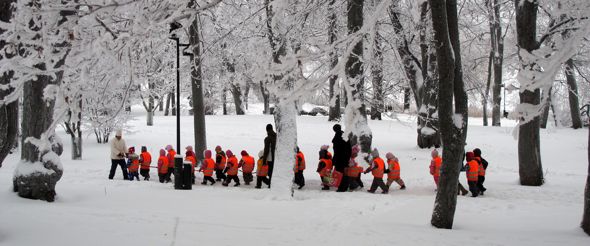
City kids: day-care outing in Töölönlahti park. Photo: Stefan Bremer, 2010
When I was a child, Helsinki seemed to me a grey and sad town. Stooping, quiet people walked its broad streets. The colours of the houses had been darkened by coal smoke over the years, and new buildings were coated a depressing grey.
A lot has since changed. Today, Helsinki is younger than it was in my youth. More…
The Cheap Contractor
30 June 1986 | Archives online, Fiction, Prose
From Kauan kukkineet omenapuut (‘Long-blossoming apple trees’, 1982). Introduction by Arto Seppälä
The men who delivered the hot-water cylinder offered to do the installation as well. I asked how much it would be. They lolled about a bit, exchanged a few private looks, pretended to be thinking. Then one of them fired off a sum. It was three times the quotation I’d already had. They didn’t even look at the location. I told myself I wouldn’t even go to the end of the road with big-dealers like these.
The same evening I rang up ‘a little man’ and told him he could get started as soon as it suited him.
The cheap contractor turned up a couple of days later, driving an elderly van into the yard. I went out. He’d sat himself down in a garden chair near the white lilacs. The morning sun only partially reached there; so half his body was in shade, looking colder than the sunny half. More…
Man and boy
31 December 2006 | Archives online, Fiction, Prose
Extracts from the novel Kansallismaisema (‘National landscape’ Tammi, 2006). Introduction by Tuomas Juntunen
Plans were afoot to establish boys’ camps across the country. This was an experiment, a chance to test the water, to be a pioneer. Here was the opportunity to be the first in line to conquer the Wild West, just as many a brave cowboy had done in years gone by. The Ministry of General Affairs planned to put all 15-year-olds to work for the duration of the summer holidays. Casual labourers were often even younger. Our task was to ascertain a suitable minimum age. In addition, special camps were planned for those not suited to normal work camps. In the summers to come the youth of Finland would be fully employed. Weren’t we in fact driven by the same desire, Tikka had wondered. We both cared about the next generation. We wanted to root out their deficiencies so that they would be able to face life’s challenges to the full. More…
Dinner with Marie
30 June 2008 | Archives online, Fiction, Prose
Extracts from the novel Marie (WSOY, 2008). Introduction by Tuomas Juntunen
For once, Marie decided to plan a dinner without the same old roast beef, boiled potatoes, peas, red wine and berry kissel. And particularly no game. The thought of rabbit reminded her of the hunting trip to Porpakka, the hounds puking up rabbit skins onto the parquet floor, the smell of singed birds, the feathers that turned up even weeks later in a corner of the kitchen, the buckshot in the goose that broke her tooth. Mind you, she had to admit that brown sauce was quite good, especially as an aspic. She had tasted a spoonful once the morning after it was made, when Martta had gone out to buy milk and Marja was cleaning the drawing room, and then Martta had come back quite suddenly, and Marie had panicked and swallowed it the wrong way and had a fit of coughing. ‘Good heavens,’ Martta had said, ‘what’s the matter? I just came back to get my purse. I forgot it on the sideboard.’
The true reason for the plan was that she wanted to show them what a real French formal dinner was like, how much better it was. She planned the menu secretly for months, first in her mind, then in writing, at her bedroom dressing table – the only place she had to herself, although the door wouldn’t lock – at first on wrapping paper, which she later burnt in the tiled stove in the dining room when no one was home. More…
Images of isolation
31 March 1992 | Archives online, Fiction, poetry
Poems by Helvi Juvonen, commentary by Soila Lehtonen
Little is known of the circumstances of Helvi Juvonen’s life. Her fame rests on five collections of poetry – mixing humility and celebration with an uncompromising rigour – published in the ten years before her death at the age of 40 (a sixth appeared posthumously). Her existence, in the drab surroundings of post-war Helsinki, was modest: after studies at Helsinki University, and posts as a bank clerk and proof-reader, she lived by writing and translation, including some brilliant renderings into Finnish of the poems of the 19th-century American poet Emily Dickinson.
Helvi Juvonen’s universe is crowded with ostensibly insignificant phenomena: her eye discerns a mole, lichen, dwarf-trees, a shrew; she studies tones of stone and moss; she ‘doesn’t often dare to look at the clouds’.
Us
Rocks, forgotten within themselves,
have grown dear to me.
The trees’ singing, so useless,
is my friend.
Silver lichen,
brother in beggary,
please don’t hate my shadow
on the streaked rock. More…
Horse sense
2 February 2012 | Essays, Non-fiction
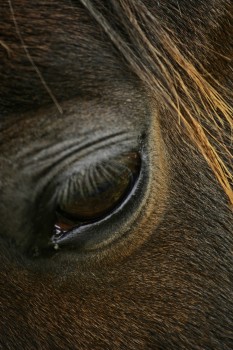
The eye that sees. Photo: Rauno Koitermaa
In this essay Katri Mehto ponders the enigma of the horse: it is an animal that will consent to serve humans, but is there something else about it that we should know?
A person should meet at least one horse a week to understand something. Dogs help, too, but they have a tendency to lose their essence through constant fussing. People who work with horses often also have a dog or two in tow. They patter around the edge of the riding track sniffing at the manure while their master or mistress on the horse draws loops and arcs in the sand. That is a person surrounded by loyalty.
But a horse has more characteristics that remind one of a cat. A dog wants to serve people, play with humans – demands it, in fact. With a dog, a person is in a co-dependent relationship, where the dog is constantly asking ‘Are we still US?’ More…