

Search results for "tommi+musturi/2010/05/song-without-words/2009/09/what-god-said"
Encounters with a language
12 December 2014 | Articles, Non-fiction
Mistranslation: illustration by Sminthopsis84/Wikimedia
Mother tongue: not Finnish. How do people become interested enough in the Finnish language in order to become translators? In the olden days some might have been greatly inspired by the music Sibelius (as were the eminent British translators of Finnish, David Barrett or Herbert Lomas, for example, back in the 1950s and 1960s). We asked contemporary translators to reminisce on how they in turn have become infatuated enough with Finnish to start studying and translating this small, somewhat eccentric northern language. Three translators into English, one into French, German and Latvian tell us why
Still selling best
8 May 2014 | In the news
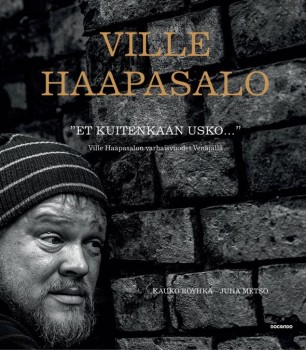
Celebrity in Russia: Ville Haapasalo on the cover of Et kuitenkaan usko… (’You won’t believe it anyway…’)
Not a lot of new titles made it to the list of the best-selling books – compiled by the Finnish Booksellers’ Association – in April, it seems. Number one on the Finnish fiction list was still Tommi Kinnunen’s first novel, Neljäntienristeys (‘The crossing of four roads’, WSOY).
In March this title reached the top after favourable reviews – in the Helsingin Sanomat daily paper in particular. The narrative spans a century beginning in the late 19th century and takes place in the Finnish countryside.
Number two – again – was another first novel about problems arising in a religious family, Taivaslaulu (‘Heaven song’, Gummerus, 2013) by Pauliina Rauhala. Number three was the latest crime/police novel by Seppo Jokinen, Mustat sydämet (‘Black hearts’, Crime Time).
On the translated fiction list, after George R.R. Martin’s A Dance with Dragons – top of the list in March too – is Donna Tartt’s The Goldfinch. Another donna (Donna Leon) was number three with her Beastly Things.
On the non-fiction list number one was a book on the Finnish actor / television journalist Ville Haapasalo’s life – and adventures during his travels in Russia, where he is a big celebrity and film star – by Haapasalo, Kauko Röyhkä and Juha Metso (Docendo). Number two was an autobiographical book by Katri Helena, a pop star who began her career in the 1960s.
The selection among the 20 best-selling books included, as usually, autobiographies and biographies, cookery, books about birds and nature. And Moomins. Books about Moomins and their creator Tove Jansson (1914–2001) certainly will rule this year – Jansson’s centenary.
The matchstick
31 March 1998 | Archives online, Children's books, Fiction
A fairy-tale, first published in the literary yearbook Svea (Stockholm) in 1879. Introduction by Esa Sironen
The matchstick lay for the first time in its new box on the factory table and thought about what had happened to it so far during its short life. It could still dimly remember how the big aspen tree had grown on the river bank, how it had been felled, sawed, and finally planed into many thousand small splinters of which the match was one. After that, it had been sorted into piles and rows with its friends, dipped in horrible melting pans, put out to dry, dipped again and finally placed in the box. This was not really a remarkable fate, nor a great heroic deed. But the match had acquired a burning desire to do something in the world. Its body was made from the timorous aspen, which is constantly a-quiver because it is afraid that the faint evening breeze might grow into a gale and tear it up by the roots. It so happened, however, that the match’s head had been dipped in stuff that makes one ambitious and want to shine in the world, and so a struggle developed, as it were, between body and head. When the inflammable head, fizzing in silence, cried: ‘Rush out now and do something!’ the cautious body always had an objection ready, and whispered: ‘No, wait a little, ask and find out if it’s time yet!’ More…
Like father, like daughter
31 March 1999 | Archives online, Fiction, Prose
Extracts from Tom Tom Tom (Gummerus, 1998). Introduction by Soila Lehtonen
A father and daughter in a hospital back garden
Bits of nail flick to the ground as Kokko cuts Tom’s nails, leaving rather brittle nail-ends among the lichen. In the middle of the hospital afternoon they’ve made their way down to the little park, to care for the hands of both of them, all four.
In the days before Africa Tom used to nurse Kokko on the living-room sofa and cut the nails on her most difficult hand, pushed the cuticles back and taught her the care that ought to be taken of nails, or she’d have smarting and pain round the cuticles. Kokko used to plead to be taken into his nail cutting lap oftener than she should, even when she’d really have preferred to grow longer nails. More…
Horse sense
2 February 2012 | Essays, Non-fiction
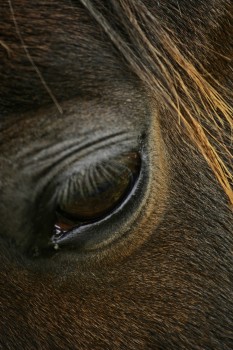
The eye that sees. Photo: Rauno Koitermaa
In this essay Katri Mehto ponders the enigma of the horse: it is an animal that will consent to serve humans, but is there something else about it that we should know?
A person should meet at least one horse a week to understand something. Dogs help, too, but they have a tendency to lose their essence through constant fussing. People who work with horses often also have a dog or two in tow. They patter around the edge of the riding track sniffing at the manure while their master or mistress on the horse draws loops and arcs in the sand. That is a person surrounded by loyalty.
But a horse has more characteristics that remind one of a cat. A dog wants to serve people, play with humans – demands it, in fact. With a dog, a person is in a co-dependent relationship, where the dog is constantly asking ‘Are we still US?’ More…
Mirkka Lappalainen: Jumalan vihan ruoska. Suuri nälänhätä Suomessa 1695–1697 [The lash of God’s wrath. The Great Famine in Finland 1695–1697]
7 September 2012 | Mini reviews, Reviews
 Jumalan vihan ruoska. Suuri nälänhätä Suomessa 1695–1697
[The lash of God’s wrath. The Great Famine in Finland 1695–1697]
Helsinki: Siltala, 2012. 262 p., ill.
ISBN 978-952-234-140-2
€25.50, hardback
There were two major famines in Finnish history: the Great Famine of 1695–97 and the hunger years of 1867–68. Basing her work on the latest research, historian Mirkka Lappalainen has written a general study of the earliest and most deadly years of crop failure. The famine struck Europe just as it was experiencing the main phase of the so-called Little Ice Age. Finland was one of the worst affected countries, as it had only just begun to derive a living from agriculture, and nearly a third of its population died. Finland was governed by the autocratic, centralised great power Sweden; frosts and rains destroyed hundreds throughout the kingdom, but the magnitude of the disaster in Finland was increased by the bureaucratic inertia of the centre in distributing aid, as well as the emergency food (moss, for example) which caused intestinal disorders, and the spreading of disease by beggars. The aid was also distributed unequally within the regions of Finland. In her book Lappalainen describes the fates of kings, gentry and rural poor as reflected in sources that include letters and official court records.
Translated by David McDuff
Three short stories
30 June 1987 | Archives online, Fiction, Prose
from Väärinkäsityksiä (‘Misconceptions’). Interview by Markku Huotari
Love
Kaija couldn’t understand why she felt like laughing all the time.
‘As for me, what I stand for is good old-fashioned courtesy,’ he pointed out.
He’d got a soft, low, caressing voice. He rested his hand on Kaija’s shoulder. They’d got that far already. Kaija had decided to say yes, even though he hadn’t suggested anything yet. She was beginning to picture luxurious rooms, gourmet dishes, expensive drinks, and tender, passionate lovemaking.
‘Socially I’m a radical,’ he said. ‘Culturally a liberal, but in personal things an unshakeable conservative. A woman, in my view, is to be respected – I don’t consider that damaging to her independence. Too often, in today’s world, equality’s used to justify what are quite simply bad manners.’ More…
In the beginning was… DNA?
8 October 2010 | Reviews
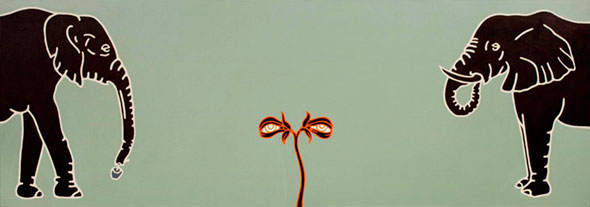
Adam and Eve, or the elephants: Osmo Rauhala’s sketch of The Fall of Man. As the bull eats the apple, evil rises from the ground in the form of a plant with eyes: a ‘misbreed’, a cross of two species alien to each other
Kuutti Lavonen – Osmo Rauhala – Pirjo Silveri
Tyrvään Pyhän Olavin kirkko – sata ja yksi kuvaa /
St Olaf’s Church in Tyrvää – One Hundred and One Paintings
Toim. / Edited by Pirjo Silveri
Translations: Silja Kudel, Jüri Kokkonen
Helsinki: Kirjapaja, 2010. 143 p., ill.
ISBN 978-952-247-103-1
€44.30, hardback
The old shingle roof of the early 16th-century stone church of St Olaf in Tyrvää, in the province of Pirkanmaa, southern Finland, was repaired by village volunteers in 1997. Three weeks after they completed their work, a drunken arsonist set the church on fire. More…
How Real is a Dead Person?
30 September 1979 | Archives online, Fiction, Prose
An Extract from the Novel Sirkus (‘Circus’). Introduction by Pekka Tarkka
Once again I seem to be moving towards a deeper understanding of these people who figure in my recollections, most of whom, by now – by this particular Friday I am now experiencing – are already dead. And this, in its turn, sets me wondering about the degree of reality, if any, that they can claim to possess. How real is a dead person? Is he, perhaps, totally unreal? In memories, of course, he is real to the extent that the memories themselves are real. But objectively, independently of memory? But here a sadness comes over me, many-headed, hard to take hold of.
And in any case I think it is time I came to a clearer understanding of the economic circus founded by my grandfather Feodisius. Uncle Ribodisius has also already made the front pages of the newspapers, and the Bilbao has published an interview.
But I have left a picture unfinished. Father’s cardboard boxes! The separation from Dianita – and from the children! And I have broken off in the middle of these curious memoirs of mine. Thinking of which, I find myself grinding to a halt again, stuck with Yellow-Handed Fred and Haius and Desmer, Lesmer and Sesmer – until I realize that instead of coming to a clearer understanding of my grandfather’s economic circus, I am on Lesmer’s estate, one evening in late May – a couple of months ago – listening to the trilling of an unusually talented song-thrush. Perched on the top of a tall spruce, he goes through the repertoire of all the other birds he has ever heard, both native and foreign – creating, however, new combinations of his own; not content with mere mimicry, he rattles, croons, wails, whistles, whirrs, twitters, flutes, sighs, chirrups and shouts his way through a complete set of variations on themes provided by the rest of the bird world: like some rather advanced medieval chronicler who, no longer content to record faithfully (if perhaps chaotically, as Auerbach points out) what he saw, heard, thought and smelt, had begun to create personal shapes and entities – thus preparing the way for the greatest miracle in the history of world literature, the advent of the perceptive reader. More…
Success after success
9 March 2012 | This 'n' that
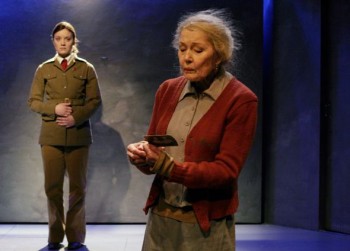
The women of Purge: Elena Leeve and Tea Ista in Sofi Oksanen's Puhdistus at the Finnish National Theatre, directed by Mika Myllyaho. Photo: Leena Klemelä, 2007
Sofi Oksanen’s Purge, an unparalleled Finnish literary sensation, is running in a production by Arcola Theatre in London, from 22 February to 24 March.
First premiered at the Finnish National Theatre in Helsinki in 2007, Puhdistus, to give it its Finnish title, was subsequently reworked by Oksanen (born 1977) into a novel – her third.
Puhdistus retells the story of her play about two Estonian women, moving through the past in flashbacks between 1939 and 1992. Aliide has experienced the horrors of the Stalin era and the deportation of Estonians to Siberia, but has to cope with the guilt of opportunism and even manslaughter. One night in 1992 she finds a young woman in the courtyard of her house; Zara has just escaped from the claws of members of the Russian mafia who held her as a sex slave. (Maya Jaggi reviewed the novel in London’s Guardian newspaper.) More…
Incident at Experience Farm
30 September 1998 | Archives online, Fiction, Prose
A short story from Pakkasyön odottaja (‘Waiting for a frosty night’, WSOY, 1997). Introduction by Jukka Petäjä
I
The round steel teapot is new. Father brought it back from Birmingham, where he went on a visit with the others from the concrete factory. In the shop, the teapot was wrapped in rustling, soft tissue paper. Pirjo was given the honour of opening the package. The pot has been used for brewing tea ever since.
At school, her sister Karoliina is proud of the fact that at home they drink only tea; they are different from other people, different in a good way, one to be proud of. They have a real teapot. Sometimes, during breaktime, a morsel of the excellence of Karoliina Kamppinen falls Pirjo’s way. ‘Yes, let’s include her, she’s Karoliina’s sister, after all.’ More…
Death of a poet
31 December 1989 | Archives online, Articles
Over the last two decades, contemporary Finnish opera has not only become popular at home but has emerged as a significant force on the international music scene. Aulis Sallinen’s The Horseman, The Red Line and The King Goes Forth to France, and Joonas Kokkonen’s The Last Temptations all had their premieres in the 1970s and 1980s and have already earned respected places in the repertory of the Finnish National Opera and the Savonlinna Opera Festival, where performances are sold out months in advance.
The visit by the National Opera to New York’s Metropolitan Opera House in 1983 attracted widespread attention from press and public alike, and its productions of The Red Line and The Last Temptations were for the most part enthusiastically received. Finnish opera earned further international prestige from the joint commissioning of Sallinen’s The King by the Royal Covent Garden Theatre in London and the Savonlinna Festival, and from later performances by companies in Germany and the United States. More…
New literary prize
6 May 2011 | In the news
A new literary prize was founded in 2010 by an association bearing the name of Jarkko Laine (1947–2006) – poet, writer, playwright, translator, long-time editor of the literary journal Parnasso and chair of the Finnish Writers’s Union.
The Jarkko Laine Literary Prize will be awarded to a ‘challenging new literary work’ published during the previous two years. The jury, of nine members, will announce the winner on 19 May.
The shortlist for the first prize is made of Kristina Carlson’s novel Herra Darwinin puutarhuri (‘Mr Darwin’s gardener’, Otava, 2009), Juha Kulmala’s collection of poems, Emme ole dodo (‘We are not dodo’, Savukeidas, 2009) and Erik Wahlström’s novel Flugtämjaren (‘Fly tamer’, Finnish translation Kärpäsenkesyttäjä, Schildts, 2010).
The prize money, €10,000, comes jointly from the publishing houses Otava, Otavamedia and WSOY, the Haavikko Foundation, the City of Turku and the University of Turku.
In pursuit of a conscience
19 March 2012 | Drama, Fiction
‘An unflinching opera and a hot-blooded cantata about a time when the church was torn apart, Finland was divided and gays stopped being biddable’: this is how Pirkko Saisio’s new play HOMO! (music composed by Jussi Tuurna) is described by the Finnish National Theatre, where it is currently playing to full houses. This tragicomical-farcical satire takes up serious issues with gusto. In this extract we meet Veijo Teräs, troubled by his dreams of Snow White, who resembles his steely MP wife Hellevi – and seven dwarves. Introduction by Soila Lehtonen
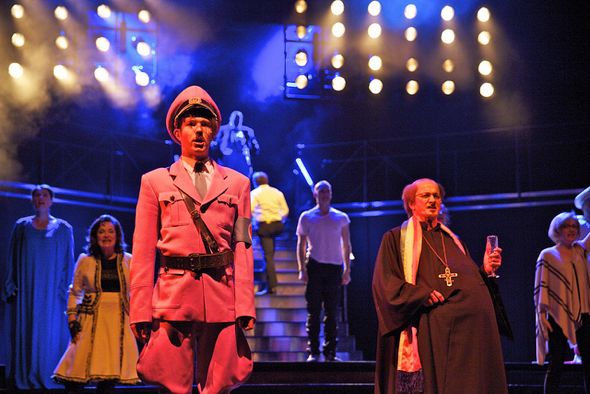
Dictators and bishops: Scene 15, ‘A small international gay opera’. Photographs: The Finnish National Theatre / Laura Malmivaara, 2011
CAST OF CHARACTERS
Veijo Teräs
Hellevi, Veijo’s wife and a Member of Parliament
Hellevi’s Conscience
Rebekka, Hellevi and Veijo’s daughter
Moritz, Hellevi and Veijo’s godson
Agnes af Starck-Hare, Doctor of Psychiatry
Seven Dwarves
Tom of Finland
Atik
The Bishop of Mikkeli
Adolf Hitler
Albert Speer
Josef Stalin
Old gays: Kale, Jorma, Rekku, Risto
Olli, Uffe,Tiina, Jorma: people from SETA [the Finnish LGBT association]
Second Lieutenant, Private Teräs, the men in the company
A Policeman
Big Gay, Little Gay, Middle Gay
William Shakespeare
Hermann Göring
Hans-Christian Andersen
Teemu & Oskari, a gay couple
The Apostle Paul
Father Nitro
Winston Churchill
SCENE ONE
On the stage, a narrow closet.
Veijo Teräs appears, struggling to get out of the closet.
Veijo Teräs is dressed as a prince. He is surprised and embarrassed to see that the audience is already there. He seems to be waiting for something.
He speaks, but continues to look out over the audience expectantly.
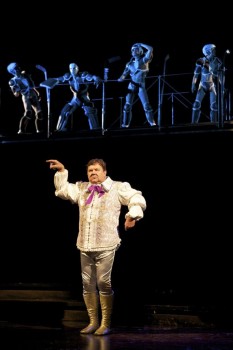
Snow White's spouse, Veijo (Juha Muje), and the dwarves. Photo: Laura Malmivaara, 2011
VEIJO
This outfit isn’t specifically for me, because… I mean, it’s part of this whole thing. This Snow White thing. I’m waiting for the play to start. Just like you are. My name is Veijo Teräs and I’m playing the point of view role in this story. Writers put point of view roles like this in their plays nowadays. They didn’t use to.
Just to be clear – this isn’t a ballet costume. I’m not going to do any ballet dancing, but I won’t mind if someone dances, even if it’s a man. Particularly if it’s a man. But I don’t watch. Ballet, I mean. Not at the opera house, or on television, or anywhere, and I have no idea why we had to bring up ballet – or I had to bring it up – because this is a historical costume, so it’s appropriate. This is what men used to wear, real men like Romeo and Hamlet, or Cyrano de Bergerac. But we in the theatre these days have a hell of a job getting an audience to listen to what a man has to say when he’s standing there saying what he has to say in an outfit like this. People get the idea that it’s a humorous thing, but this isn’t, this Snow White thing, where I play the prince. Snow White is waiting in her glass casket, she died from an apple, which seems to have become the Apple logo, Lord knows why, the one on the laptops you see on the tables of every café in town. More…