

Search results for "tommi+musturi/2010/05/song-without-words/2009/09/what-god-said"
Me and my shadow
Hotel Sapiens is a place where people are made to take refuge from the world that no longer is habitable to them; the world economy has fallen – like the House of Usher, in Edgar Allan Poe’s story – and with it, most of what is called a civilised society. A rapid synthetic evolution has taken humankind by surprise, and the world is now governed by inhuman entities called the Guardians. ‘Kuin astuisitte aurinkoon’ (‘As if stepping into the sun’) is a chapter from the novel Hotel Sapiens ja muita irrationaalisia kertomuksia (‘Hotel Sapiens and other irrational tales’, Teos, 2012), where several narrators tell their stories
The fog banks have dissipated; the sky is empty. I cannot see the sails or swells in its heights, nor the golden cathedrals or teetering towers. I would not have believed I could miss a fog bank, but that’s exactly what it’s like: its disappearance is making me uneasy. For all its flimsiness and perforations it was our protection, our shield against the sun’s fire and the stars’ stings. Now the relentlessly blazing sun has awakened colours and extracted shadows from their hiding places. The moist warmth has dried into heat and the Flower Seller’s herb spirals have dried up into skeletons. The leaves on the trees are full of bronze, sickly red and black spots. Though there is no wind and autumn is not yet here, they come loose as if of their own volition, as if they wanted to die.
This morning, as I was strolling up and down the park path as usual, I saw another shadow alongside my own.
– Ah, you’re back! I said. – I wondered what had happened to you after you lost your shadow; how did you manage to change into your own shadow yourself? More…
The Onlookers
30 September 1978 | Archives online, Fiction, Prose
A short story from Naisten vuonna (‘In women’s year’, 1975). Introduction by Pekka Tarkka
The two elks came out on to the road through a gap between timber sheds. They began to cross the road, and the larger one was very nearly run into by a car. Cars stopped and horns tooted, till the elks turned and made off towards the harbour. Several cars swung round and drove along the cinder track in pursuit of the animals.
The elks headed across the rubble towards the power station; after circling some stacks of railway sleepers, they ended up on the flank of a coalheap sixty feet high. The cars pulled up and their occupants poured out, shouting that the elks wouldn’t go that way, it was a dead end. The elder of the two elks had indeed sensed this, and they moved off to the right, skirting the coal-heap and emerging among the timber-stacks. By this time the first cyclists and pedestrians had arrived on the scene.
“They’ll break their legs,” said a pedestrian to a motorist. “There’s all kinds of junk lying about.” More…
The blow-flower boy and the heaven-fixer
31 December 1984 | Archives online, Fiction, Prose
A short story from Puhalluskukkapoika ja taivaankorjaaja (‘The blow-flower boy and the heaven-fixer’, 1983). Interview by Olavi Jama
Cold.
A chill west wind came over the blue ice. It went right to the skin through woollen clothes. Shivers ran up and down the spine, made shoulders shake.
In the bank of clouds close to the horizon, right where the icebreaker had crunched open a passage to the shore, hung a pale blotch, a substitute for the sun. It gave off more chill than warmth.
Lennu’s teeth were chattering.
He wore a buttoned-up windbreaker, a hand-me-down from Gunnar, over a heavy lambswool shirt. It couldn’t keep off the cold. More…
The many arms of Krishna
14 August 2014 | Extracts, Non-fiction
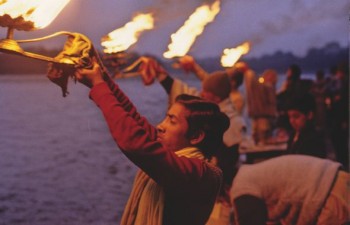
A feast by the Ganges. Photo from Pirjo Honkasalo’s film Atman
Cinematographer, camerawoman and director Pirjo Honkasalo has travelled and filmed widely – Japan, Estonia, India, Chechnya, Ingushetia, Russia – and her documentary films in particular have gained fame. American film critic John Anderson interviews Honkasalo; they talk about her documentary film Atman (1996) about a pilgrimage in India.
Edited extracts from Armoton kauneus. Pirjo Honkasalon elokuvataide (‘Merciless beauty. The film art of Pirjo Honkasalo’, Siltala, 2014; translated from English into Finnish by Leena Tamminen)
You can almost catch a whiff of the Ganges watching Atman [Hindu term, ‘self’], a documentary film in which religious pilgrimage, devotion, exhilaration and hysteria compete with tormented bodies, physical mortification, corpses, pollution and the acrid smoke of ritual cremation for domination of the viewer’s senses. The fact that it won the top prize at the International Documentary Film Festival Amsterdam in 1996 proves there is, if not justice, then good taste in the world. With all due respect to her previous work, Atman signified the full manifestation of Honkasalo’s genius.
What is it about? Eternity. Also, Jamana Lal: a member of the low-caste of Baila, a wifeless, crippled devotee of Lord Shiva whose mother has died, and who must – according to Hindu tradition – take her ashes from the ostensible mouth of the Ganges to the foothills of the Himalayas. More…
Dog
30 September 2002 | Archives online, Fiction, Prose
A short story from Afrikasta on paljon kertomatta (‘Much is still untold about Africa’, WSOY, 2002). Introduction by Maria Säntti
You’re exactly what a dog should be, I told him. You’ve a black ear and a white one. You’re not too big and you’re not all teeth.
I stroked his black-spotted coat. He wagged his curly tail.
I crouched down. He squeezed up against my chest. I sent my ball rolling along the stairway corridor. He shot after it, accidentally running over the top of it. As he braked, his claws screeched on the tiles. Sparks went flying.
He snapped the ball in his jaws, nibbled its plastic and sent it back with a snuffle. His tongue was wagging with glee. Next I wanted to roll the ball so he wouldn’t get it. It bumped against the iron banister and went off in a different direction, skidding under the dog’s belly. He turned and dashed after it. More…
Here and there
11 September 2009 | Extracts, Non-fiction
Extracts and photographs from Jotain on tapahtunut /Something happened (Musta Taide, 2009; translation by Jüri Kokkonen)
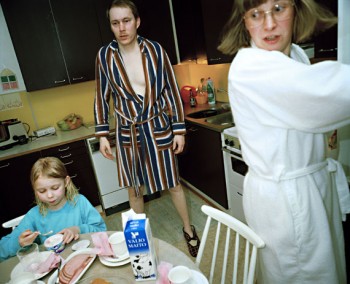 News photos document dramatic, dangerous or tragic incidents – but the photojournalist Markus Jokela is interested in documenting ordinary, domestic and everyday life, be it in Iraq, Russia, Biafra or Sri Lanka. These photographs, with commentaries, are taken from his new book, Jotain on tapahtunut / Something happened (2009), offering glimpses of life in contemporary Finland and in the United States
I’ve never been particularly enthusiastic about individual news photos, especially about taking them.
A good news photo has to state things bluntly and it has to be quite simple in visual terms. It must open up immediately to the viewer.
But the images in photo reportages do not have to scream simplified truths. They can whisper and ask, and open up gradually. One can come back to them. The reportage is something personal. Though a poor medium for telling about the complex facts of the world, it can provide experiences that survive. More…
The dog-man’s daughter
30 December 2001 | Fiction


 Extracts from the radio play Porkkalansaari (‘The island of Porkkala’, the Finnish Broadcasting Company, 1993)
The surface of the earth is the first to freeze; then the still waters. The sea freezes at the shore often at the same time, on the same night, as the slow-flowing brooks. I have watched them for many years. When you live in the same place for a long time, you notice this much: that almost everything just repeats and repeats.
It flows into a plastic tube. I suppose water flows inside it. You could drop matchsticks in on the other side of the road and wait on this side for them to swim through the drum. You’d only have to find one; that would be enough to prove it. More…
The devil has no clothes
31 December 2006 | Fiction, poetry
Poems from Idealrealisation (‘The ideal sale’, 1929)
Stockings
V
I thought:
it was a person,
but it was her clothes
and I didn't know
that it doesn't matter
and that clothes can be very
      beautiful
In the north
30 September 1988 | Archives online, Fiction, Prose
A short story from Luvaton elämä (‘Forbidden life’, 1987). Introduction by Tero Liukkonen
I
I went up north in a sleeping car. It was a relief to see that even in Tampere there was a sign on the car saying ‘Kemijärvi’. That meant I could sleep the whole way. I had the lower berth; a couple more like me were sleeping in the same compartment – just ordinary women. I was nevertheless silent and reserved, so that neither of them would want to make me into a travelling companion. And they did leave me in peace.
I read for a bit, till I began to feel more at home, and settled down to sleep with my woollen socks on. I deliberately went almost to sleep while not wanting to drop off completely; and I gradually reached a point where I didn’t know which direction the train was going in. That was liberating. It was all the same which direction we were going in. The motion of the train got through to my nerves and started releasing things. More…
Elmo’s fire
30 June 2008 | Archives online, Fiction, Prose
Extracts from the novel Elmo (WSOY, 1978)
After returning to Finland and Kainalniemi, Elmo got to feel like a celebrity. The various sport clubs were insufferably keen on getting Elmo into their training rings, but Elmo rebuffed them. He had belonged to Kainalniemi Sweat since he was a little boy, and that was enough for him. His mind was occupied by other matters. In the end, even his mother and father began to wonder at his attitude.
‘Why don’t you just go, since they keep asking, and since you do seem to have some talent in that direction,’ his mother urged as she made Sunday coffee from the can Elmo had brought as a gift.
‘Right. Somewhere down the road you could snatch a few gold medals out from under the noses of the others, just for the hell of it,’ his father said. More…
End of the carnival
31 December 1991 | Archives online, Fiction, Prose
Extract from the novel Ottopoika (‘Otto the adopted’: Otava, 1991). Introduction by Pekka Tarkka
Verily, verily, keep peace with your God!
The way people are arranged in the courtroom means that Joseph Vissarionovich finds himself in the dock. All right, never mind, if they want to play games with Stalin: they’ll soon find out who comes off second best, very much second best.
The former politburo, led by Trotsky, has occupied the right wing of the front bench. Tanya, the girl from Petersburg, is sitting by Rykov, with her artificial leg under her arm, stuffing her pigtail in her mouth; she giggles and tries to stuff the other pigtail into Rykov’s mouth. Not succeeding, she spits in his face and pulls her skirt over her ears, revealing a small reddish quim. The 1925 politburo appears unmoved, but Trotsky jerks round enough for Stalin to see the axe sticking out of the back of his neck. Meanwhile, a susurrus of tut-tuttings goes round the courtroom. More…
The nursemaid
Lapsenpiika (‘The nursemaid’), a short story, first published in the newspaper Keski-Suomi in December, 1887. Minna Canth and a new biography introduced by Mervi Kantokorpi
‘Emmi, hey, get up, don’t you hear the bell, the lady wants you! Emmi! Bless the girl, will nothing wake her? Emmi, Emmi!’
At last, Silja got her to show some signs of life. Emmi sat up, mumbled something, and rubbed her eyes. She still felt dreadfully sleepy.
‘What time is it?’
‘Getting on for five.’
Five? She had had three hours in bed. It had been half-past one before she finished the washing-up: there had been visitors that evening, as usual, and for two nights before that she had had to stay up because of the child; the lady had gone off to a wedding, and baby Lilli had refused to content herself with her sugar-dummy. Was it any wonder that Emmi wanted to sleep? More…
Truth or hype: good books or bad reviews?
8 November 2013 | Letter from the Editors
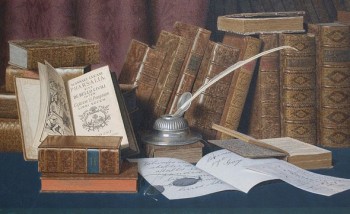
‘The Bibliophile’s Desk’: L. Block (1848–1901). Wikipedia
More and more new Finnish fiction is seeing the light of day. Does quantity equal quality?
Fewer and fewer critical evaluations of those fiction books are published in the traditional print media. Is criticism needed any more?
At the Helsinki Book Fair in late October the latest issue of the weekly magazine Suomen Kuvalehti was removed from the stand of its publisher, Otavamedia, by the chief executive officer of Otava Publishing Company Ltd. Both belong to the same Otava Group.
The cover featured a drawing of a book in the form of a toilet roll, referring to an article entitled ‘The ailing novel’, by Riitta Kylänpää, in which new Finnish fiction and literary life were discussed, with a critical tone at places. CEO Pasi Vainio said he made the decision out of respect for the work of Finnish authors.
His action was consequently assessed by the author Elina Hirvonen who, in her column in the Helsingin Sanomat newspaper, criticised the decision. ‘The attempt to conceal the article was incomprehensible. Authors are not children. The Finnish novel is not doing so badly that it collapses if somebody criticises it. Even a rambling reflection is better for literature than the same old articles about the same old writers’ personal lives.’ More…
Air, blue and gold
16 January 2014 | Fiction, poetry
Poems. Introduction by Tuula Hökkä
The arch bridge
From Ylitse vuoren lasisen (‘Over the glass mountain’, 1949)
And God said: to others I’ll give other tasks, but the task I’ll give to you
is to make a curving bridge, my child, with an arch that’s round and true.
For everywhere around the earth human beings are laden with gloom,
and they’ll come to cross an arching bridge in their anguish and their doom.
Make a bridge that spans the precipice, a bridge over the abyss,
one that shines to my glory with radiance, sparkling like this.
I said: They will come with heavy boots, and heels caked with clay –
how can my bridge withstand their weight, yet also shine this way,
not tarnish or break apart as their crowding presence nears?
And God said: well, it can only be done by means of blood and tears.
Your heart is stronger than mountain rock, the ore that’s buried there –
Put a piece of it into the bridge support, and you’ll get the bridge to bear.
Add a piece of the hearts of those you love, and I know they won’t condemn,
but will surely grant you forgiveness if you make a bridge for them.
Make a bridge to the glory of God, my child, make a bridge with arching light
that will span the depths and shine for ever, with radiance sparkling bright.
Don’t lock the sorrow out of your heart as the bridge you make appears.
Nothing gleams more beautifully than the brilliance of pure tears. More…
The mighty word
15 November 2012 | Fiction, Prose
‘Mahtisana’, a short story from the collection Lapsia (‘Children’, 1895). Introduction by Mervi Kantokorpi
Mother and Dad hadn’t said a single word to each other since lunchtime. The children, Maija and Iikka, were quiet, too. They sat apart, Iikka on the chair at the end of the sofa, where he could see the moon through the window, and Maija next to the window looking out on the street, where children moved about on skis and sleds. They didn’t dare make a sound, not even a whisper to ask for permission to go outside. It had been so quiet all that Sunday evening that when Mother spoke, encouraging them to go out and play, both of them nearly jumped.
They left without saying a word, Maija creeping quite silently. Even out in the courtyard she and Iikka still spoke in whispers as they decided which hill to go to. They didn’t really want to go anywhere, but when they came out to the street and could hear the happy shouts of children from every direction, it refreshed their spirits. Maija sat Iikka down on the sled and set off at a run, pulling him behind her. She felt as if her gloomy mood was falling away in pieces to be trampled underfoot.
A few streets down there was a large crowd of boys on the corner. They decided to go and see what was happening. More…