

Search results for "tommi+musturi/2010/05/song-without-words/2009/09/what-god-said"
Notes related to pharmacist Pemberton’s holy nectar
Extracts from the novel Vådan av att vara Skrake (‘The perils of being Skrake’, Söderström & Co.; Isän nimeen, Otava, 2000)
At the time of Werner’s stay in Cleveland Bruno and Maggie had already been divorced for some years, and in an irreconcilable manner. But they were still interested in their grown-up son, each in their own way; Maggie wrote often, and Werner replied, he wrote at length, and truthfully, for he knew that Bruno and Maggie no longer communicated; to Maggie he could admit that he hated corporate law and bookkeeping, and to her he dared to talk about the raw music he had found on the radio station WJW, he wrote to her that the music of the blacks had body and that he had found a great record store, it was called Rendezvous and was situated on Prospect Avenue and there he had also bought a ticket for a blues concert, wrote Werner, he thought that Maggie would understand. More…
Troubled waters
31 March 2005 | Archives online, Fiction, Prose
Extracts from the novel Den amerikanska flickan (‘The American girl’, Söderströms, 2004). Introduction by Pia Ingström
Doris Night&Sandra Day, Sandra Night&Doris Day: those were their alter ego identities for the game, which also involved the smiles they’d practised in front of the mirror at the bottom of the empty swimming pool, in the house in the muddier part of the woods.
‘We’re two clairvoyant sisters,’ said Doris Flinkenberg. ‘We got that way because of tragic circumstances. The poltergeist phenomenon. Do you know what that is?’
Sandra Wärn shook her head, but looked expectantly at Doris, the perennial crossword – solver, with dictionary to hand, who continued. ‘It’s when the innocent child has been badly abused and has developed supernatural powers in order to survive. Powers to see behind what’s there,’ Doris Flinkenberg explained. ‘To see what no one else can see.’
‘You and I, Sandra,’ Doris confirmed. ‘We were badly abused. I with my scars and you with your tragic family background, your mother and her lover, all of that. You and I, Sandra, we know what it is to suffer.’ More…
Manmother
31 December 2002 | Archives online, Fiction, Prose
Extracts from the novel Granaattiomena (‘Pomegranate’, WSOY, 2002). Introduction by Kristina Carlson
The journey
Mother had sent her son to the island of Rome.
She’d sent him for pleasure and recreation, and also to have a little time by herself. Even though their life together was on an even keel, it was sensible to have some time away from each other. She herself was sixty-eight, and her son an unmarried hermit in his thirties, on sickness allowance for the last couple of years. He was afflicted with chronic depression. The doctors had been unable to identify the cause. The origin of a disorder of that sort was often looked for in some infant trauma; but the boy’s childhood, from all appearances, had been harmonious. One doctor suspected the time of his father’s terminal illness, when the boy had had to nurse his father for a long while. More…
Dead calm
31 December 2007 | Fiction, Prose
Extracts from the novel En lycklig liten ö (‘A happy little island’, Söderströms, 2007)
In the beginning the computer screen was without form, and void, and the scribe’s fingers rested on the keyboard.
The scribe bit his lower lip. His gaze travelled like a fly from the workroom’s crowded bookshelves to the rocking chair in front of the window and the coloured prints of birds on the walls. He went out into the kitchen and drank some water. Then he sat down in front of the computer again.
To create from nothing a fictitious world assisted only by the tools language places at our disposal, surely that must be a great and exacting undertaking!
The scribe hesitated and racked his brains for a long time before finally typing the first word: ‘sky’. Then after long thought he typed another word: ‘sea’. More…
The show must go on
30 June 2007 | Archives online, Fiction, Prose
Extracts from the novel Piru, kreivi, noita ja näyttelijä (‘The devil, the count, the witch and the actor’, Gummerus, 2007). Introduction by Anna-Leena Ekroos
‘I hereby humbly introduce the maiden Valpuri, who has graciously consented to join our troupe,’ Henrik said.
A slight girl thrust herself among us and smiled.
‘What can we do with a somebody like her in the group? A slovenly wench, as you see. She can hardly know what acting is,’ Anna-Margareta snapped angrily.
‘What is acting?’ Valpuri asked.
Henrik explained that acting was every kind of amusing trick done to make people enjoy themselves. I added that the purpose of theatre was to show how the world worked, to allow the audience to examine human lives as if in a mirror. Moreover, it taught the audience about civilised behavior, emotional life, and elegant speech. Ericus thought that the deepest essence of theatre was to give visible incarnation to thoughts and feelings. None of us understood what he meant by this, but we nodded enthusiastically. Anna-Margareta insisted that, say what you will, in the end acting was a childish game. Actors were being something they were not, just like children pretending to be little pigs or baby goats. More…
When sleeping dogs wake
31 December 1994 | Archives online, Fiction, Prose
Extracts rom the novel Tuomari Müller, hieno mies (‘Judge Müller, a fine man’, WSOY, 1994). Introduction by Soila Lehtonen
In due course the door to the flat was opened, and a stoutish, quiet-looking woman admitted the three men, showed them where to hang their coats, indicated an open door straight ahead of them, and herself disappeared through another door.
After briefly elbowing each other in front of the mirror, the visitors took a deep breath and entered the room. The gardener was the last to go in. The home help, or whatever she was, brought in a pot of coffee and placed it on a tray, on which cups had already been set out, within reach of her mistress. The widow herself remained seated. They shook hands with her in tum. The mayor was greeted with a smile, but the bank manager and the gardener were not expected, and their presence came as a shock. She pulled herself together and invited the gentlemen to seat themselves, side by side, facing her across the table. They heard the front door slam shut: presumably the home help had gone out. More…
To live, to live, to live!
31 December 2001 | Archives online, Fiction, poetry
From Kaukainen puutarha (‘A distant garden’, WSOY, 1924). Introductions by Vesa Mauriala and Leena Krohn
Flowering earthThe earth’s spilling out purple lilac clusters, To live, to live, to live! So what if death’s coming! |
Kukkiva maaMaa kuohuu syreenien sinipunaisia terttuja. Elää, elää, elää! Mitä siitä, että kuolema tulee! |
Winning stories of alternative realities
10 February 2011 | In the news
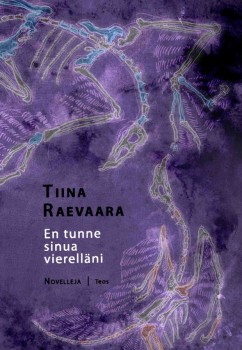 The Runeberg Prize for fiction, awarded this year for the twenty-fifth time, went to a collection of short stories by Tiina Raevaara.
Her En tunne sinua vierelläni (‘I don’t feel you beside me’, Teos, 2010) mixes fantasy and realism, dealing with, for example, animal kingdom, human mind and artificial intelligence. See the introduction and translation of a story which we ran here on the Books from Finland website.
Raevaara (born 1979) holds a doctorate in genetics; the prizewinner is her second work of fiction. The prize, worth €10,000, was awarded on 5 February – the birthday of the poet J.L Runeberg (1804–1877) – in the southern Finnish city of Porvoo.
The jury – representing the prize’s founders, the Uusimaa newspaper, the city of Porvoo, both the Finnish and Finland-Swedish writers’ associations and the Finnish Critics’ Association – chose the winner from a shortlist of eight books: a collection of poetry, Vagga liten vagabond (‘Swing, little wanderer’, Söderströms) by Eva-Stina Byggmästar, the novel Poikakirja (‘Boys’ Own Book’, Otava) by Olli Jalonen, the novel Kiimakangas (WSOY) by Pekka Manninen, two collections of essays, Kuka nauttii eniten (‘Who enjoys most’) by Tommi Melender and Halun ja epäluulon esseet (‘The essays of desire and suspicion’) by Antti Nylén (both publlished by Savukeidas), a collection of poetry, Texas, sakset (‘Texas, scissors’, Otava) by Harry Salmenniemi and another collection of short stories, Apatosauruksen maa (‘The land of the apatosaurus’, WSOY) by Miina Supinen.
Time difference
30 December 2003 | Fiction, Prose
A short story from Kalliisti ostetut päivät (Dearly bought days, Otava, 2003)
She arrived at the airport too early, as always. The reason was not that connections from the small town in which she lived were slow and difficult, or even that she liked the airport’s atmosphere of swift departures and long waits. No; she wanted to spend time at the airport to see that the planes took off and landed without anything awful happening. She wanted to see that a departing plane’s acceleration was rapid, that the plane left the asphalt of the runway elegantly, that its tail did not hit the ground as it rose, break, the plane explode, catch fire, but that, like an arrow fired into the air, following its flight path, it curved upward and, sunlight glancing off the metal of the body, disappeared from view. She wanted to see that the landing gear of a descending plane was out, as it should be, that a tyre did not burst as it hit the ground, at that there was no ice or oil on the runway; that the brakes worked, and that the fire engines at the edge of the airfield stayed in place as a sign that all was well. More…
Two men in a boat
The meaning of life, Bob Dylan, the broken thermostat of the Earth, the authors Ambrose Bierce and Aleksis Kivi…. Two severely culturally-inclined men set out to row a boat some 700 kilometres along the Finnish coastline, and there is no shortage of things to discuss. Extracts from the novel Nyljetyt ajatukset (‘Fleeced thoughts’, Teos, 2014)
The red sphere of the sun plopped into the sea.
At 23.09 official summertime Köpi announced the reading from his wind-up pocket-watch.
‘There she goes,’ commented Aimo, gazing at the sunken red of the horizon, ‘but don’t you think it’ll pop back up again in another quarter of an hour, unless something absolutely amazing and new happens in the universe and the solar system tonight!’
Aimo pulled long, accelerating sweeps with his oars, slurped the phlegm in his throat, spat a gob overboard, smacked his lips and adjusted his tongue on its marks behind his teeth. There’s a respectable amount of talk about to come out of there, thought Köpi about his old friend’s gestures, and he was right.
‘Sure thing,’ was Aimo’s opening move, ‘darkness. Darkness, that’s the thing. I want to talk about it and on its behalf just now, now in particular, while we’re rowing on the shimmering sea at the lightest point of the summer. More…
Science and fiction
15 September 2011 | Authors, Interviews
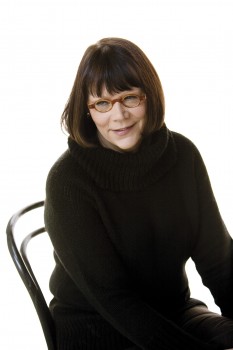
Kristina Carlson. Photo: Tommi Tuomi
Interview with Kristina Carlson, author of William N. Päiväkirja (‘William N. Diary’, Otava, 2011)
‘Monsieur W. Nylander had died alone, his head resting against his desk. We’d known for a long while that your beloved relative was not well, but whenever he was walking along the street and someone enquired as to his health, he always replied that he felt fit and well.’
Finnish-born Monsieur William N. lives in Paris at the end of the 19th century. The grumpy old scientist spends his days studying lichens in his small, dusty apartment and writing bitter comments in his diary about the way of the world, all things meaningless, and the glory and reputation that he never achieved.
William Nylander (born Oulu, 1822 – died Paris, 1899) is a historical figure who truly existed, and the remarks quoted above are taken from a letter sent by William’s housekeeper to his sister Elise in Finland, but other than this William’s diary is entirely the work of Kristina Carlson. The hermetic botanist has now become the protagonist of a novel written in 2011. More…
That remarkable man
31 December 1988 | Archives online, Fiction, poetry
Poems by Lauri Viita. Introduction by Kai Laitinen
Alfhild
Mothers alone, endowed
with hope, see God.
They’re given strength and given will,
to climb in dream from under the cloud,
and look from a higher hill.
Alfhild, she who gave me birth,
nightly sailed away from earth
to where her Eemeli growled his say,
coming and going, as he did in his day.
Now they walk
the bright star track,
father and mother, looking back
at the little hill and the family home,
the cats, the dogs, the people they’ve known,
waving and calling as best they can
lest any of us trip on Pispala’s stone.
On a distant planet on a garden swing
under a rowan they linger and cling
and silently remember their light and dark
as a courting couple in Tampere Park –
and if it was payday, the extra fun
of tucking away a coffee and bun. More…
Favour and fame: becoming a best-seller
10 April 2014 | In the news
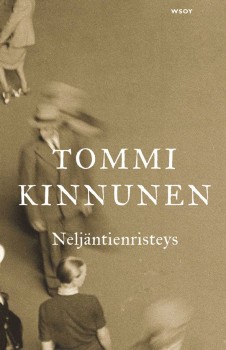 At the top of the list of best-selling books – compiled by the Finnish Booksellers’ Association – in March was the first novel by Tommi Kinnunen, a teacher of Finnish language and literature from Turku. In Neljäntienristeys (‘The crossing of four roads’, WSOY) the narrative spans a century beginning in the late 19th century and is set mainly in Northern Finland, focusing on the lives of four people related to each other. Undoubtedly well-written, it continues the popular tradition of realistic novels set in the 20th-century Finland.
Finland is a small country with one exceptionally large newspaper, Helsingin Sanomat (read by more than 800,000 people daily). The annual literary prize that carries the paper’s name is awarded to a best first work, and candidates are assessed throughout the year.
In February the paper’s literary critic Antti Majander declared in his review of Kinnunen’s book: ’Such weighty and sure-footed prose debuts appear seldom. If I were to say a couple of times in a decade, I would probably be being over-enthusiastic. But let it be. Critics’ measuring sticks are destined for the bonfire.’ More…