

Search results for "tommi+musturi/2010/05/song-without-words/2009/09/what-god-said"
Delina
30 September 1999 | Archives online, Fiction, Prose
A short story from Löytöretkeilijä ja muita eksyneitä (‘The explorer and other lost people’, Tammi, 1999). Introduction by Soila Lehtonen
The stranger met Delina at a development organisation’s work camp, but Delina was not a volunteer. Delina lived in the country permanently.
The stranger did not spend very much time in Delina’s company. His evenings were spent with fellow-volunteers in the village cafe, where Delina’s parents did not allow her to go. During the day, both of them worked in their separate ways: Delina at home and the stranger in the work camp’s fields.
The stranger did, however, get to know the girl well enough to hear that she was in love with a soldier called Zmiri from the nearest garrison. This soldier was arrested once when he and his comrades drunkenly molested volunteers – but Delina knew nothing of the case. More…
Choosing a play
30 September 1981 | Archives online, Fiction, Prose
A short story from Leiri (‘The camp’). Introduction by Vesa Karonen
The local amateurs were having their theatre club meeting on a Friday evening in the main part of the parish hall. It was late August, the light was beginning to fade and no one had remembered to put the lights on. First the stage grew dark, then the floor, then the ceiling. The light lingered on the inside wall for the longest. There were creaks and groans from the rooms at the back and from the attic. The caretaker had been moving around in there about three in the afternoon, and his traces lingered, as they do in old buildings.
“Something of that sort but short, and it’s got to be bloody funny,” said the chairman, a carpenter called Ranta.
In the store cupboard there were 108 old scripts. Tammilehto, the secretary, hauled out about 30 scripts onto the table. His job was running a kiosk down the road.
“Nothing out of date,” said Ranta.
“There’s got to be a bit of love in it, I say,” said Mrs Ranta.
She had a taxi-driver’s cap on her head and was wearing a man’s grey summer jacket, a white shirt and a blue tie. Her car could be seen from the window. It was in the yard. She always parked her car so it could be seen from inside. More…
Finnish best-sellers in Estonia
8 February 2010 | In the news
In mid-January four books out of ten on the best-sellers’ list in Estonia were translations of Finnish books: a history of Estonia by Seppo Zetterberg (Viron historia, 2007, number 1), a book on 20th-century Estonian history edited by Sofi Oksanen and Imbi Paju (Kaiken takana oli pelko, ‘Fear behind it all’, 2009, number 6), the 2008 Finlandia Prize-winning novel, set in 20th-century Estonia, by Sofi Oksanen (Puhdistus, ‘Purge’, number 7) and a new translation of the classic 1940s novel Sinuhe, egyptiläinen (English translation, Sinuhe the Egyptian) by Mika Waltari (number 10).
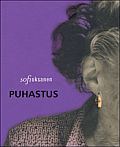 Oksanen’s novel was the second on the list of best-sellers in 2009. The list is run by Apollo bookstore chain; the largest in Estonia, it has ten shops in four cities and an internet shop. Apollo is owned by the Finnish Sanoma Trade, one of the five divisions of Sanoma Group, an European media corporation with activities in 20 countries and net sales of 3,030.1 million €.
Yikes! How good are Finnish schools now?
28 November 2013 | This 'n' that
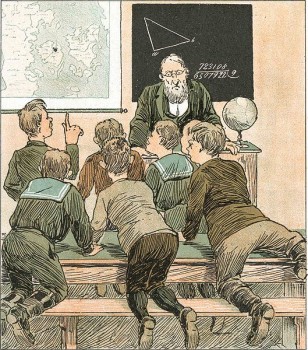
Questions and answers. Illustration, from a Danish magazine, 1890: Wikimedia
The new PISA results were published in December: these tests, conducted by the Organisation for Economic Co-operation and Development (OECD), measure the level of education of 15-year-old schoolchildren every three years.
Finland has done pretty well in recent years, so there has been interest in other countries in finding out what it is that makes Finnish schools better places for learning.
In 2000 Finnish pupils had been best at reading, and second at maths in 2003 – although competition has grown due to a larger number of countries, particularly in Asia – taking part in the study: for example, only 32 in 2000, but 65 in 2009 and in 2012.
In 2009 Finnish kids were third best in reading and sixth in maths. Now PISA 2012 results place Finnish kids in 12th place in maths, which created a stir in various educational circles. The best five were all Asian countries.
On the index list measuring skills at maths, science and literacy together, Shanghai leads, then come Singapore and Hong Kong. Finland is the best European country, number 7; Estonia is 8, Germany 16, Great Britain 21, the US 29, Sweden 38.
Non scholae, sed vitae discimus. Competition permeates everything now more than ever, but we do not learn for school but for life – not for PISA either. Still, teaching methods and students’ motivation are clearly worth improving.
The chances of learning on this globe are greater and more accessible than ever, but learning still takes brains, motivation and time. Yikes!
Comics turns
16 April 2010 | In the news
Comics make frequent appearances on the lists of best-selling Finnish books: on the ‘What Finland reads’ list in March, Pertti Jarla’s new comic strip book, Fingerpori 3, about the eponymous, weird city of Fingerpori (‘Fingerborg’), is number one. His two other Fingerpori books are number eight and ten on the list. The zany comedy in them is verbal, based on puns – and therefore not easily exportable.
The new and final volume of Hannu Väisänen’s autobiographical, fictional trilogy about the young wannabe artist Antero, Kuperat ja koverat (‘Convex and concave’) made its way into the top ten right away, making its appearance at number two.
The Finlandia Prize -winning novel, Gå inte ensam ut i natten (‘Don’t go out into the night alone’, translated into Finnish as Älä käy yöhön yksin) by Kjell Westö, is number three – the novel was published in September 2009, and this reappearance is partly explained by special campaigns in the bookstores, says Westö’s publisher, Otava.
Sofi Oksanen’s prize-winning novel Puhdistus (Purge, now published in English) from 2008, is back on the list again, now at number four. Kari Hotakainen’s latest novel, Ihmisen osa (‘Human lot’, 2009, to appear in English in 2012) is at number six.
Antti Hyry: Uuni [The stove]
22 January 2010 | Mini reviews, Reviews
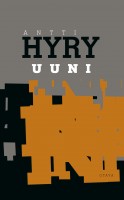 Uuni
Uuni
[The stove]
Helsinki: Otava, 2009. 400 p.
ISBN 978-951-1-23845-4
28 €, hardback
Many authors have inspired imitators, at least for a brief period, but few prove to be so original that they lend their name to an entire stylistic movement. Antti Hyry (born 1931), whose debut work was published in 1958, is a member of this most influential class of writers. His pared-down ‘Hyryesque’ sentences, which convey in a stark, crystal-clear manner only that which his characters think or observe, have been at the core of Finnish modernism for over half a century now. His latest novel, a tranquil, even meditative work, describes in minute detail – virtually brick by brick – how a man constructs a great wood-burning hearth in his house. Alongside the building work, Hyry provides minutely observed details of the natural surroundings and nearby people. Rich in content and brilliant in its simplicity, this novel was awarded the 2009 Finlandia Prize for fiction.
Talvisota muiden silmin [The Winter War through the eyes of others]
11 December 2009 | Mini reviews, Reviews
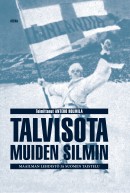 Talvisota muiden silmin. Maailman lehdistö ja Suomen taistelu
[The Winter War through the eyes of others. The world press and Finland’s battle]
Toim. [Edited by] Antero Holmila
Jyväskylä: Atena, 2009. 237 p., ill.
ISBN 978-951-796-589-7
€ 36, hardback
November 2009 marks the 70th anniversary of the outbreak of the Winter War in Finland. Based on extensive archival research, this book traces discourses (media, private diaries) about this war in various countries: the Soviet Union, Sweden, Germany, Italy, Greece, Britain, France, Hungary, Japan, the United States and the United Kingdom. Japan’s favourable image of Finland arose from its own vehement opposition to Communism. Under the right-wing dictatorship in Greece, the Winter War provided an opportunity to emphasise the importance of a unified nation to safeguard the existence of its people. Britain expressed both moral support for Finland and doubt concerning the truth of news reports. In Finland, the view was repeatedly put forward that the Winter War would unite global opinion behind Finland against the Soviet Union. The essays in this book show that attitudes were varied, with a wide range of critical voices.
Dear Reader!
13 January 2011 | This 'n' that

Reading Books from Finland here, there and... Photo: Google Analytics
2011 is well underway, and it’s back to business – reporting on good books from Finland, that is!
The new year also marks the beginning of our third year online: we are very pleased to note that last year visits to this site increased by 187 per cent compared to 2009!
Our foreign readers hail from a total of 149 countries, although the majority are in the United States and the United Kingdom – with a surprisingly large number of neighbourly visits from readers in Finland.
There are some countries where only one reader has taken a look at Books from Finland last year; greetings to our own readers in Honduras and Papua New Guinea…. But, on the other hand, readership in Belarus has grown by 2.400 per cent, from just one in 2009 to a grand total of 25!
We’ve been very glad to have your online feedback, which prompted us to think that since we haven’t done a reader survey for a longish time, we might take the opportunity to run another one now – so we’ll be quizzing you about your views of the contents of the journal on this page soon.
We hope to offer you more that is diverting, entertaining and thought-provoking this year than ever before. Remember, you can also keep abreast of what’s going on on the Books from Finland website by subscribing to our RSS and e-mail delivery services (and we’re on Facebook, too).
Happy new year, and good reading!
The editors
Soila Lehtonen (Helsinki)
Hildi Hawkins (London)
Form follows fun
4 December 2012 | Non-fiction, Reviews
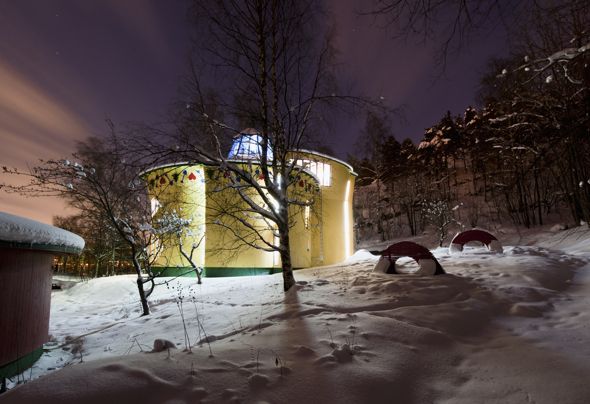
The house that the artist built: ‘Life on a leaf’ (2005–2009, Turku). Photo: Vesa Aaltonen
Jan-Erik Andersson: Elämää lehdellä [Life on a leaf]
Helsinki: Maahenki, 2012. 248 p., ill.
ISBN 978-952-5872-82-4
€42, hardback
‘I am Leaf House –
root house, sky house.
Enter me, be safe
And wander, dream.
The artist’s I is all our eyes….’
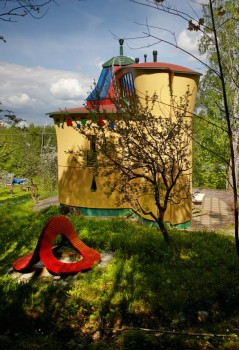
In the garden: red ‘apple’ benches designed by the English artist Trudy Entwistle. Photo: Matti A. Kallio
We all live – exceptions are really rare – in cubes. Not in cylinders or spheres, let alone in buildings of organic shapes like flowers or leaves; and houses in the shape of a shoe, for example, belong to the fairy-tale world, or perhaps to surrealism.
Artist Jan-Erik Andersson wanted to build a fairy-tale house in the shape of a leaf, and that is what he did (2005–2009), together with his architect partner Erkki Pitkäranta. Instead of the geometry of modernist architecture, he is inspired by the organic forms of nature.
Andersson’s house project, entitled ‘Life on a leaf’, also became an academic project, resulting in a dissertation at Finnish Academy of Fine Arts and now a book, including a detailed journal of the building process itself. The artist was at first advised, by a professor of architecture, not to proceed with his building project – he wouldn’t ‘like living in the house’, he was told. More…
Happy birthday to us!
13 February 2014 | Letter from the Editors

Picture: Wikipedia
It’s been five years since Books from Finland went online, and we’re celebrating with a little bit of good news.
In the past year, the number of visits to the Books from Finland website has grown by 11 per cent. The number of US and UK readers grew by 29 per cent, while the number of readers in Germany – stimulated perhaps by the publicity Finnish literature is attracting as a result of its Guest Country status at this year’s Frankfurt Book Fair – increased by an astonishing 59 per cent.
We’re chuffed, to put it mildly – and very thankful to you, dear readers, old and new. More…
Mikko Ylikangas: Unileipää, kuolonvettä, spiidiä. Huumeet Suomessa 1800–1950 [Opium, death’s tincture, speed. Drugs in Finland 1800–1950]
29 April 2010 | Mini reviews, Reviews
 Unileipää, kuolonvettä, spiidiä. Huumeet Suomessa 1800–1950
[Opium, death’s tincture, speed. Drugs in Finland 1800–1950]
Jyväskylä: Atena, 2009. 264 p., ill.
ISBN 978-951-796-578-1
€ 34, hardback
This book presents an account of the history of drugs in Finland, as well as changes in legal and illegal drug use. Even in the early 19th century, the authorities were concerned about opium abuse. Medical doctor Elias Lönnrot – best known for collecting the folk poems that make up the Kalevala, the Finnish national epic – coined the name ‘unileipä’, ‘the staff of dreams’, for opium. A period of prohibition of alcohol in the 1920s spurred a huge increase in the sale of cocaine; in the 1930s Finland led the Western world in consumption of heroin as a cough suppressant. In the late 1940s, the United Nations investigated why Finland, with a population of four million, consumed as much heroin in a year as other countries did over an average of 25 years. This was explained by the severity of wartime conditions: drugs were used to maintain battle readiness and to combat anxiety, sleeplessness and tuberculosis. Social problems caused by misuse did not, however, get out of control. This book was awarded a prize for the best science book of the year in Finland in 2009.
Jaakko Heinimäki & Juha Metso: Miina – Äkkijyrkkä
6 November 2009 | Mini reviews, Reviews
 Miina – Äkkijyrkkä
Text: Jaakko Heinimäki
Photos: Juha Metso
Helsinki: Johnny Kniga Kustannus, 2009. 190 p., ill.
ISBN 978.951-0-35552-7
€41, hardback
Miina Äkkijyrkkä (born 1949; real name Riitta Loiva) is a Finnish artist known for her cattle-themed paintings and sculptures. Äkkijyrkkä is also widely known as a passionate supporter and breeder of Eastern Finncattle, an endangered breed native to Finland. Most of the accompanying texts in this book which describe her ideas and her art come from a series of discussions with author and Lutheran minister, writer Jaakko Heinimäki, recorded in the spring of 2009. Miina Äkkijyrkkä speaks openly about her art and the diverse phases of her life, her values and faith, and her clashes with the authorities and the rest of society. This book is magnificently illustrated with Juha Metso’s photographs, which were taken over a period of 15 years in Finland and abroad. More information about the artist and her works is available here.
On the job
10 December 2010 | Extracts, Non-fiction
‘I like my pictures to be realistic and truthful, not that I can satisfactorily define what realism is. The real people in my pictures are in their real surroundings, even though they are posing for me. I see this as a series of encounters. The subjects present their “working role” for me, which I record‚’ says photographer Eija Irene Hiltunen. In these extracts she introduces her project and samples of her photography present people at work in contemporary Finland
Extracts from Työn tekijät. Muotokuvia suomalaisesta työstä. / Doing the job. Portraits of Finnish working life by Eija Irene Hiltunen. Texts: Pasi Alametsä. Translations: Joseph White. Layout: Petri Kuokka & Eija Irene Hiltunen (Avain, 2009)
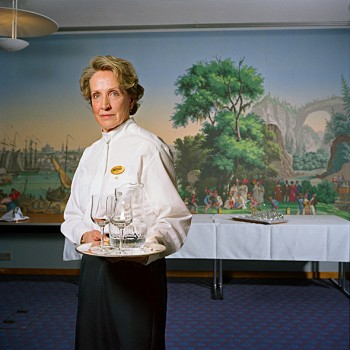
A waitress. Photo: Eija Irene Hiltunen, 2001
One of the most important aims of my portraits has been to record an image of the times. I chose work as the common denominator because it relates to the social structure on so many levels.
The ‘visual inventory’ of Weimar Germany by the classic photographer August Sander has been the major inspiration for my work. He made a huge impression on me during my student days. He told of the upheavals of his own time through his portraits, as the old class society broke down, and of the time before the Second World War and the birth of modern Germany. Sander beautifully depicted history through the individual, and his portraits have remained as testaments to life during that era. More…
Jouni K. Kemppainen: Onnellinen mies. Arto Paasilinnan elämä [A happy man. The life of Arto Paasilinna]
21 June 2012 | Mini reviews, Reviews
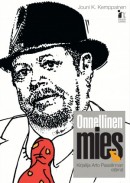 Onnellinen mies. Arto Paasilinnan elämä
[A happy man. The life of Arto Paasilinna]
Espoo: Paasilinna, 2012. 307 p.
ISBN 978-952-5856-37-8
€ 28, hardback
Arto Paasilinna (born 1942) is an uncanny phenomenon. For Finns he is a popular, prolific author of picaresque novels – which in the 1970s, 80s and 90s were praised by the critics, while the books he produced later received less acclaim, though most of them have sold tens of thousands of copies. Paasilinna’s best-known novel is Jäniksen vuosi (The Year of the Hare, 1975). In Europe – particularly in France and Italy – he is considered to be a major natural philosopher. However, the charming social man of the world was capable of turning into a violent ruffian; journalist Jouni K. Kemppainen’s fluent biography highlights every aspect of the author’s character. The book describes the development of a boy from a poor northern Finnish family to an international best-selling author (his works have been translated into more than 40 languages) and introduces interesting correspondence between the author and his publisher. Kemppainen emphasises some recurring themes in Paasilinna’s work: relations between humans and animals, travelling. In 2009 the author suffered a head injury while drinking, and lost his memory almost completely. The title of his latest, thirty-fifth novel is Elävänä omissa hautajaisissa (‘Alive at his own funeral’, 2009). The impression that this biography leaves on the reader’s mind is a picture of a now gentle man who delights in the fact that he has accomplished all that he is reported to have accomplished – and in that he managed to survive.
Translated by David McDuff
Worlds apart
18 June 2009 | Extracts, Non-fiction
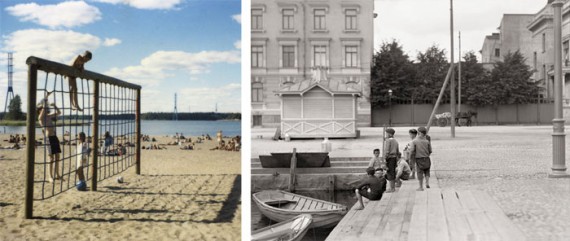
Helsinki boys by the sea: in Martti Jämsä’s Polaroid lads play on the beach; in I.K. Inha’s photograph (Hietalahden satama, ‘Hietalahti harbour’), taken a century earlier, barefoot urchins meet up on the quayside
A hundred years ago the photographer I.K. Inha (1865–1930) was asked to illustrate a tourist guide to Helsinki. He took some 200 photographs, of which some 60 were included in the book, which was published by WSOY in 1910. In his new book of photographs, OPS! Helsinki Polaroid¹, Martti Jämsä (born 1959), wanders the same streets a century on, taking snapshots with his Polaroid camera. More…