

Search results for "tommi+musturi/2010/05/song-without-words/2009/09/what-god-said"
Mari Kujanpää: Minä ja Muro [Muro and me]
28 January 2010 | Mini reviews, Reviews
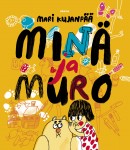 Minä ja Muro
[Muro and me]
Kuvitus [Ill. by]: Aino-Maija Metsola
Helsinki: Otava, 2009. 207 p.
ISBN 978-951-1-23418-0
15.10 €, hardback
The heavy themes of this children’s novel, winner of the 2009 Finlandia Junior Prize, have provoked discussion of who its target audience should be. Lauha is a 9-year-old girl who is considered an oddball at school; her classmates claim that she smells bad. Within her own family she’s an outsider. Her little brother’s serious illness has troubled the family for a long time, and even when he gets better her parents don’t know how to listen to Lauha, and their negligence verges on physical violence. But playing with Muro, her teddy bear, eases Lauha’s troubles, and luckily she finds a soul sister in Heta, the new school intern. Mari Kujanpää (born 1976) uses language suitable for a child’s state of mind in a very creative way. Muro ja minä is difficult for a child to read on his/her own, and would work best read aloud and discussed in a group of children or as a book for adult caregivers. The black and white illustrations are by Aino-Maija Metsola (born 1983), whose previous work includes designing fabrics for Marimekko.
John Simon: Koneen ruhtinas. Pekka Herlinin elämä [The Prince of Kone. The life of Pekka Herlin]
15 January 2010 | Mini reviews, Reviews
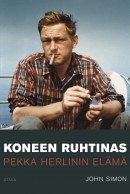 Koneen ruhtinas. Pekka Herlinin elämä
[The Prince of Kone. The life of Pekka Herlin]
Finnish translation of original English manuscript completed by various translators in collaboration with the author
Helsinki: Otava, 2009. 415 p., ill.
ISBN 978-951-1-23478-4
€ 33, hardback
Pekka Herlin (1932–2003) was the long-serving chairman of the board of the Kone lift and escalator company. During Herlin’s tenure, Kone completed a number of corporate acquisitions to become a major global corporation. John Simon, an American writer and researcher, takes an unusually honest and direct approach; the project was undertaken at the request of Antti Herlin, the current chairman of the board at Kone and son of Pekka Herlin. Pekka Herlin was known for being both gregarious and a cool-headed business strategist, but his irascible, unorthodox nature was familiar to many as well. Within his family he emerged as a tyrannical alcoholic with a severely disturbed personality, feared by his children. John Simon interviewed a great many people who knew Pekka Herlin personally, including members of Herlin’s immediate family. This biography was Finland’s best-selling non-fiction book in the autumn of 2009.
Tapio Markkanen Paratiisista katsoen. Tähtitaivaan karttojen historiaa [Viewed from Paradise. A history of maps of the night sky]
4 June 2010 | Mini reviews
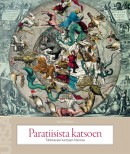 Paratiisista katsoen. Tähtitaivaan karttojen historiaa
[Viewed from Paradise. A history of maps of the night sky]
Helsinki: Ursa (Astronomical Association), 2009. 143 p., ill.
ISBN 978-952-5329-80-3
€ 32, paperback
This book presents a scientific and cultural history of mapping the night sky, from ancient times up to the present day. In addition to the technical processes involved in producing celestial maps, it touches on a broad range of cultural connections, since the practice of mapping the heavens has always been inextricably linked with economic, cultural and political concerns throughout human history. How has mankind around the world experienced and comprehended the night sky? The title of this book refers to the ancient practice of portraying the skies the wrong way round – as a mirror image, as if viewed from heaven. ‘That’s how the gods would have seen it,’ the author, Professor Tapio Markkanen, an astronomer at the University of Helsinki, reminds us. This book was published in conjunction with an exhibition organised by the National Library of Finland as part of the International Year of Astronomy in 2009. Many of the maps reproduced in this book are from the Nordenskiöld Collection, housed in the National Library, and included in the UNESCO Memory of the World programme.
Monika Fagerholm: Glitterscenen [The Glitter Scene]
17 November 2009 | Mini reviews, Reviews
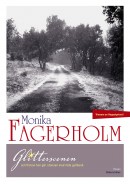 Glitterscenen
[The Glitter Scene]
Helsingfors: Söderströms, 2009. 407p.
ISBN 978-951-522-467-5
€29.90
Säihkenäyttämö
Finnish translation by Liisa Ryömä
Helsinki: Teos, 2009. 455 p.
ISBN 978-951-851-127-7
€29.90, hardback
In Glitterscenen Fagerholm reveals the shabby details of the murder mystery that was the essence of her celebrated Den amerikanska flickan, The American Girl (2006). In a sense, the two books are psychological thrillers, but they are also much more than that: the American girl’s death is a myth about destruction and creation – a narrative about love, death and glamour that attracts and seduces cohort after cohort of young women in the District, a place somewhere in Finland that is in the process of being transformed from the rural to the suburban. Like no other author, Fagerholm combines the advantages of plot-based realism with the deep psychological excavation of collective dreams and the secret layers of the unconscious. In the centre of the District there is a kiosk where the local priest’s daughter, fat May-Gun, presides over dirty magazines, sickly candy and magnificent dreams. Across the square, eyed by horny small-town greasers, walks young and blonde Suzette. The result is a deadly drama, propelled by grief and narcissism. The Glitter Scene is the goal of our dreams, but also a dangerous place of instant gratification and sudden death.
Not a world language, and yet….
16 January 2015 | Articles, Non-fiction
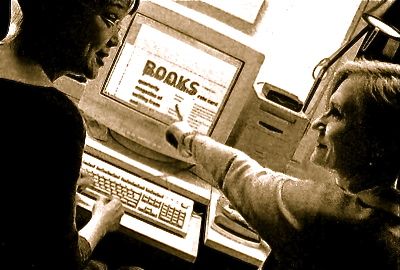
The editors (Hildi Hawkins and Soila Lehtonen) at the screen: we begun publishing material on our website in 1998. Photo: Jorma Hinkka, 2001
Longevity may not generally be a virtue of literary magazines – they tend to come and go – but Books from Finland, which began publication in 1967, has stuck around for a rather impressively long time. Literary life, as well as the means of production, has changed dramatically in the almost half-century we have been in existence. So where do we stand now? And what does the future look like?
This is the farewell letter from the current Editor-in-Chief, Soila Lehtonen – who began working for the journal in 1983
‘The literature of Finland suffers the handicap of being written in a so-called “minor” language, not a “world” language…. Finland has not entirely been omitted from the world-map of culture, but a more complete and detailed picture of our literature should be made available to those interested in it.’
Thus spake the Finnish Minister of Education, R.H. Oittinen, in early 1967, in the very first little issue of Books from Finland, then published by the Publishers’ Association of Finland, financed by the Education Ministry.
Forty-seven years, almost 10,000 printed pages (1967–2008) and (from 2009) 1,400 website posts later, we might claim that the modest publication entitled Books from Finland, has accomplished the task of creating ‘a more complete and detailed picture’ of Finnish literature for anyone interested in it. More…
Sound and meaning
20 January 2012 | Essays, Non-fiction
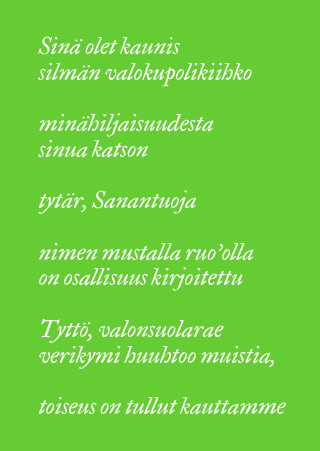
Harri Nordell’s poem from Huuto ja syntyvä puu (‘Scream and tree being born’, 1996)
Translating poetry is natural, claims Tarja Roinila; it is a continuation of writing it, for works of poetry are not finished, self-sufficient products. But is the translator the servant of the meaning – or of the letter?
I am sitting in a cafe in Mexico City, trying to explain in Spanish what valokupolikiihko, ‘light-cupola-ecstasy’, means. And silmän valokupolikiihko, ‘the light-cupola-ecstasy of the eye’.
I take to praising the boundless ability of the Finnish language to form compound words, to weld pieces together without finalising the relationships between them, never mind establishing a hierarchy: the eye is a light-cupola, the eye is ecstatic about light-cupolas, light creates cupolas, the cupola lets out the light, the eye, in its ecstasy, creates a light-cupola. More…
Sisters beneath the skin — the letters of Edith Södergran and Hagar Olsson
11 February 2009 | Articles, Authors, Extracts
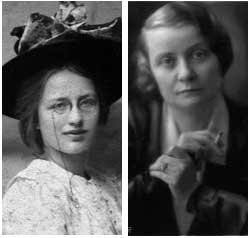
Edith Södergran and Hagar Olsson. – Photos: Svenska litteratursällskapet i Finland, Åbo Akademis bildsamlingar.
Almost one hundred years ago, a small Karelian village close to St Petersburg, near the Finno-Russian border, saw the birth of a fearless new form of modern poetry.
The Finland-Swedish poet Edith Södergran (1892–1923) began writing her burning lines inspired by Friedrich Nietzsche’s ideal of the new man and his philosophy of creativity. Södergrans’ poems were free of any traditional pattern and full of strong images. Her work, which ran to six collections of poems, later achieved classic status in the modernist traditon that she presaged.
Cut time, paste space
12 September 2013 | Articles, Non-fiction
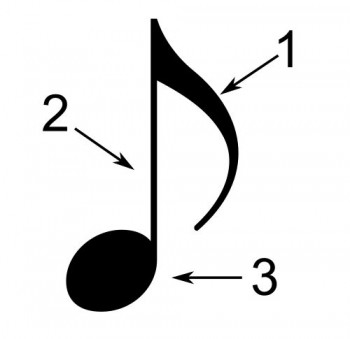
Back to basics. Parts of a musical note. Picture: Wikimedia
How different are the art of words and the art of sounds, author Teemu Manninen ponders, as he unexpectedly finds himself in the role of a musician in a performance. Time, space or both?
Some time ago I got the chance to participate in an unusual concert – as a performer: six players, myself included, were grouped around a table with a triangle in one hand and a glove in the other. Pieces of dry ice and a bucket of water were placed in front of each of us.
The performance began: we took a piece of dry ice and pressed it against the triangle. As the metal cooled, it burned through the ice, releasing gas, which in turn made the metal vibrate very fast. This produced a keening sound that filled the room. More…
Des res
Extracts from the novel Juoksuhaudantie (‘The Trench Road’, WSOY, 2002)
Matti Virtanen
I belonged to that small group of men who were the first in this country to dedicate themselves to the home front and to women’s emancipation. I feel I can say this without boasting and without causing any bickering between the sexes.
A home veteran looks after all the housework and understands women. Throughout our marriage I have done everything that our fathers did not. I did the laundry, cooked the food, cleaned the flat, I gave her time to herself and protected the family from society. For hours on end I listened to her work problems, her emotional ups and downs and her hopes for more varied displays of affection. I implemented comprehensive strategies to free her from the cooker. I was always ready with provisions when she got home exhausted after a day at work. More…
Special effects
14 June 2012 | Authors, Reviews
Veikko Huovinen. Photo: Harri Nurminen
Depictions of simple country folk who live close to nature, diabolical satire of the powers that be, playful rambling tales.
The humour of Veikko Huovinen has two dimensions: it is learned, intelligent, and insightful, but it is also exuberant and folksy. Critics have made comparisons to Nikolai Gogol and Mark Twain, and not without reason.
Huovinen (1927–2009) began writing stories in 1949 and published his final work in 2007, two years before his death. This half century saw the birth of a broad and multifaceted library, including a good number of works that do not fit any genre as such – Huovinen called his works that lay in the interstices between the short story, causerie and satire ‘short specials’. More…
Johan Leche & Johan Grysselius
The birds and the bees
2 May 2011 | Non-fiction
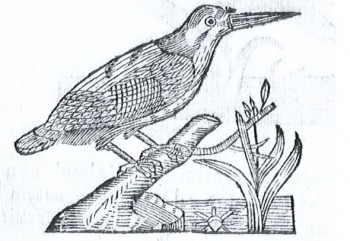
Halcyon or Ispida (kingfisher)? A picture of this mythical bird from a 17th-century thesis, published in Suomen lintutieteen synty
Halcyon or Ispida (kingfisher)? A picture of this mythical bird from a 17th-century thesis, published in Suomen lintutieteen synty
The famous Swedish scientist Carl von Linné claimed in his doctoral thesis in 1757 that swallows spend their winters underwater.
Two of Linné’s countrymen, working at Åbo Academy in Finland, proved him wrong seven years later by giving evidence of migration, but to no avail: the silly theory prevailed until the 19th century.
In these extracts doctors Leche and Grysselius eloquently present a ‘Well-Intended Reader’ with errors of humanity that become epidemic
Extracts from ‘An Academic Treatise on The Wintering and Migration of Swallows’ by Johan Leche & Johan Grysselius (1764), published in Finnish (translated from Latin by Sari Kivistö) in Suomen lintutieteen synty. Turun Akatemian aika (‘The birth of the Finnish ornithology. The era of the Åbo Akademi’, Faros, 2009), edited by Esa Lehikoinen, Risto Lemmetyinen, Timo Vuorisalo & Sari Kivistö
Preface
As we know, humanity is no less inclined to err in matters pertaining to nature than in matters of morals. With regards to errors concerning the natural world, even the most experienced scholars are not always immune. The common people, for their part, have not learned to avoid such pitfalls and are thus constantly bumping into them. This is no wonder, since they are not accustomed to using the help of natural science or mathematics, and are thus unable to perform appropriate tests, to correctly assess future eventualities, or to observe phenomena closely unless they concern something already familiar to them. More…
Mother-days
30 June 2006 | Fiction, poetry
Poems from Yhtä juhlaa (‘It’s all a big celebration’, WSOY, 2006)
(a square metre, 3.)
Now for the-kick-of-being-the-good-mum:
after the rye porridge
after the sons washed with camomile foam
and slipped into clean sheets
with mummy singing a sweet song.
Something about shadowed snow
and how at the blue twilit-moment one can
go inwards. If you’re up to looking. All that garbage and slag:
ash from the too-small days, clotted with
non-combustible blots, even though here
the sky’s clear
and the windows open to the winds.
Good grief, here we’re making new people.
But all I’d time for
was the track from the dishcloth to the nappy bin,
and back from the children’s painting-table
to the sink. No job
for spoilt girls, this: the prissiest minx
would soon turn woman in this fix:
kids coming next after next,
years of full-time labour
in a square metre where
you make no point about peccadilloes,
because so much is at stake.
You’re no longer a rose,
pimpinella, rosabella,
but subsoil: loam
and spots of unrottable compost.
A feebler person would have reversed on
the first tantrum;
the child’s learnt to say things
and is saying things
I never thought would come. More…