

Search results for "tommi+musturi/2010/05/song-without-words/2009/09/what-god-said"
The coder’s Latin
30 October 2014 | Articles, Non-fiction
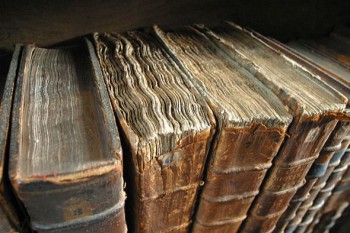
Pleasant interface still? Old book bindings (Merton College library, Oxford, UK). Photo: Wikipedia
Writing is arguably brain-control technology, notes our columnist Teemu Manninen. Writing might not be on its way out, at least not quite yet, he thinks, but the printed book might not stay with us for ever. And would that be a happier world?
When the future of literature is discussed, either here in Finland and elsewhere, topics usually revolve around changes in the economics and practicalities of reading, writing, and publishing: how will writers and publishers get paid, and how can readers find more books to read.
What is taken for granted in these instances is that literature itself will continue to be something that exists in a recognisable way – which itself of course implies that writing itself will remain a viable mass medium for the transmission of information over the transcendent, enormous, unfathomable gulfs of space and time, as it has been for thousands of years. More…
A taste of life
30 March 2004 | Authors, Reviews
 The origins of the world, personal histories and Finnish history intertwine in a language bringing new meanings to familiar words and placing newer words in their older contexts. In her new collection of poetry, her fourth, Olen tyttö, ihanaa! (‘I’m a girl, wonderful!’, Tammi, 2003), Merja Virolainen (born 1962) combines reality and make-believe, life lived and that yet to come, in an outstanding fusion of themes and images.
Virolainen is a master of words. Last year she published and edited a substantial body of long-awaited translations of poetry from two continents. The Finnish-German poetry anthology Toisen sanoin / Mit den Worten des Anderen (‘In someone else’s words’, Like, 2003) demonstrates how meanings and reading between the lines can open up across two languages. The volume Hän jota ei ole (‘The one who doesn’t exist’, Nihil Interit, 2003), focusing on contemporary English-language poetry from India, is a fine testament to the immense undertaking of its two editors, Virolainen and Markus Jääskeläinen. The anthology is the most extensive collection of post-colonial poetry ever published in Finland. More…
Nationalism in war and peace
3 May 2012 | Reviews
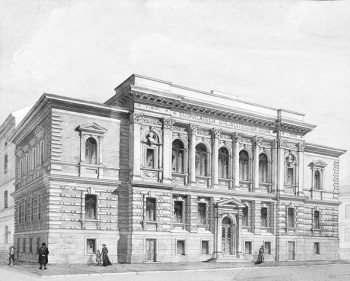
House of words: the Finnish Literature Society building in Helsinki. Architect Sebastian Gripenberg, 1890. Watercolour by an unknown Russian artist, 1890s
Kai Häggman
Sanojen talossa. Suomalaisen Kirjallisuuden Seura 1890-luvulta talvisotaan
[In the house of words. The Finnish Literature Society from the 1890s to the Winter War]
Helsinki: Suomalaisen Kirjallisuuden Seura, 2012. 582 p., ill.
ISBN 978-952-222-328-9
€54, hardback
The Finnish Literature Society has, throughout its history, played a multiplicity of roles: fiction publisher, research institute specialising in folklore studies, organiser of mass campaigns in support of national projects, literary gatekeeper, learned society, controller of language development.
The priorities of these areas of interest have changed from decade to decade, so Kai Häggman has taken on an exceptionally difficult subject to describe. He has, however, succeeded brilliantly in gathering the different threads together, using as as lowest common denominator the ideas of nationalism and nation whose role in global modernisation and European history have been studied, among others, by the British historians Ernest Gellner and Eric Hobsbawm. More…
Narcissus in winter
31 December 1984 | Archives online, Fiction, Prose
Risto Ahti. Kuva: Harri Hinkka
Poems from Narkissos talvella (‘Narcissus in winter’, 1982). Introduction by Pertti Lassila
Risto Ahti (born 1943) published his first work in 1975. His poetic expression finds form remarkably often in prose poems, and Narkissos talvella is made up exclusively of these. His poems transmute language into a mystical, surreal world, sometimes enigmatic and subjective in the extreme, and at its best strangely suggestive. It is as if Ahti’s world were in a state of constant change, subjected to a relentless process of demolition and rebuilding. The experience of the individual, generally his encounter with truth, is central to many of Ahti’s poems; the inner reality of a person manifests itself as more essential than the outward appearance. Ahti’s poems exhibit a fruitful contradiction: on the one hand, the accuracy with which he uses words and, on the other, the continual shape-changing and lack of definite boundaries of the world they describe. More…
The aphorism reborn
31 December 1986 | Archives online, Authors, Essays, Non-fiction
Markku Envall. Photo: Pertti Nisonen
With the passage of time a literary genre may continue, change or disappear. During the 1960s it was widely believed that the Finnish aphorism was dead. Modernism, which had consolidated its victory during that decade, was not favourable to the genre, and not one of the central figures of the post-war generation had touched the genre. Nevertheless, phoenix-like, the aphorism rose from the ashes, and by the 1970s it was strongly in evidence again, thanks, in the main, to just four writers, Mirkka Rekola, Paavo Haavikko, Samuli Paronen and Erno Paasilinna.
The renaissance took place between 1969 and 1972; in 1969 Mirkka Rekola’s first book of aphorisms was published, followed in 1972 by Paavo Haavikko’s. Rekola now has three books of aphorisms to her name, Haavikko four. The other two major aphorists have published one volume each. There have been a few other collections of aphorisms have appeared, but their authors are ‘merely’ aphorists, while these four are recognised as major authors in other fields too.
What was new in the renaissance of the aphorism? The question is easiest to answer in respect of the three men; Rekola is in many ways an exception. There were two major new features, one concerning meaning, the other form. The subject matter of the new writers was broader than the wisdom and teachings about life encompassed by the traditional aphorism. Their main subjects were nothing if not ambitious; the nature of the world, the progress of history, the structure of society. More…
The Poet as a Progressive
30 September 1979 | Archives online, Authors
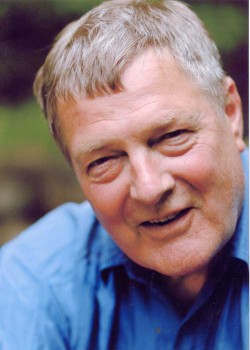
Claes Andersson. Photo: Johan Bargum.
Why do some poets adopt a chill tone or an intellectual stance, while others bleed in public, clench their fists or bellow with pain? Temperament alone cannot explain this. Poetical traditions, and the current climate, are more influential.
Modern Swedish poetry – in fact all Scandinavian poetry, including that of Finland – has inclined toward German and Continental Expressionism. This is, in essence, a romantic tradition, and there are other, more endogenous romantic traditions, as well, driving poets the same way. In such an ambience any pronouncedly intellectual poet will always seem exceptional. He will risk being accused of aloofness or disdain, be easily damned as a ‘difficult’ writer. Rabbe Enckell and Paavo Haavikko in Finland, Gunnar Ekelöf in Sweden, are cases in point.
Claes Andersson (born 1937) seems to belong to this category. He certainly tells his readers where he stands, unapologetically. But he is also a lover of his language – the Swedish spoken in Finland – and he likes to play intellectual games with the language, to coin a word or a phrase and turn it over, sometimes upside-down, to reflect and comment on the language itself: ‘Words,’ he once wrote, ‘possess hidden valences – shown, for instance, when the word Sodium jumps into the word Water to cool itself, never suspecting what will happen. Hidden tensions may thus be disclosed.’ More…
Kullervo’s story
31 March 1989 | Archives online, Fiction, Prose
Paavo Haavikko wrote this manuscript for the television series Rauta-aika (‘Age of iron’), broadcast in 1982. lt also appeared as a book in 1982, complemented by Kullervon tarina (‘Kullervo’s story’ ) which had been omitted from the original. The text follows the stories of the Kalevala, but they are given a new interpretation: the characters are demythologised, they resign themselves to their fates – they are like ourselves. These extracts are the final scenes in which incest, revenge and death appear in a slightly different guise from Kalevala, or Kivi’s Kullervo.
– Mother, on the road I met your daughter, who is my sister, and took her into my sleigh. She had broken one of her skis. Spring came in one day, the clouds in front of the moon tore themselves to shreds so that two moons passed in one night. Winter went, Spring came, I brought the sleigh back, and I slept on top of the sacks so that not a single grain or seed would be lost. It’s all in the sacks now, saved. The clouds tore off their clothes and washed them in the rivers of rain, and naked, in the dark, they waited for their clothes to dry, those clouds. They even darkened the moon, they would have killed it if they could have reached that far, as it spied on the cloud women who were washing the clothes they had taken off in the waters of heaven, and two moons passed in one night, Kullervo says to his mother, piling up lies like a little boy. Many words. More…
A life at the front
30 September 2001 | Archives online, Fiction, Prose
Extracts from the novel Marsipansoldaten (‘The marzipan soldier’, Söderström & Co., 2001). Introduction by Maria Antas
[Autumn 1939]
Göran goes off to the war as a volunteer and gives the Russians one on the jaw. Well, then. First there is training, of course.
Riihimäki town. Recruit Göran Kummel billeted with 145 others in Southern elementary school. 29 men in his dormitory. A good tiled stove, tolerably warm. Tea with bread and butter for breakfast, substantial lunch with potatoes and pork gravy or porridge and milk, soup with crispbread for dinner. After three days Göran still has more or less all his things in his possession. And it is nice to be able to strut up and down in the Civil Guard tunic and warm cloak and military boots while many others are still trudging about in the things they marched in wearing. The truly privileged ones are probably attired in military fur-lined overcoats and fur caps from home, but the majority go about in civilian shirts and jackets and trousers, the most unfortunate in the same blue fine-cut suits in which they arrived, trusting that they would soon be changing into uniform. More…
As in a dream
31 December 1992 | Archives online, Fiction, Prose
From Kun on tunteet (‘When you have feelings’, 1913). Introduction by Irmeli Niemi
‘No, they’re not rich, those Kolehmainens, not rich at all. Even the house is a bit on the small side.’
‘So how did you end up there? That’s one thing I’ve often wondered about.’
‘How did I end up there? Well, it must have been my fate.’
‘You sure weren’t looking to get rich.’
‘No, I sure wasn’t. Got married when I had to.’
‘Had to. You can’t tell me it had to be to him. You, with suitors in every size and shape. All you had to do was pick out the best, but no, you just up and take off with somebody from out of town, and a poor man at that.’ More…
The Finlandia prizes: Non-fiction, Junior
28 November 2013 | In the news

Ville Kivimäki. Photo: Pertti Nisonen
The Finlandia Prize for Non-Fiction 2013, worth €30,000, was awarded on 21 November to the historian Ville Kivimäki for his book Murtuneet mielet. Taistelu suomalaissotilaiden hermoista 1939–1945 (‘Broken minds. The battle ofor the nerves of Finnish soldiers 1939–1945’, WSOY).
The other works on the shortlist of six were as follows: 940 päivää isäni muistina (‘940 days as my father’s memory’, Teos; a book on Alzheimer’s disease) by Hanna Jensen, Kokottien kultakausi: Belle Epoquen mediatähdet modernin naiseuden kuvastimina (‘The golden era of the cocottes: the media stars of Belle Epoque as mirrors of modern femininity’, Finnish Literature Society) by Harri Kalha, Viipuri 1918 (‘Vyborg 1918’, Siltala) by Teemu Keskisarja, Suomi öljyn jälkeen (‘Post-oil Finland’, Into) by Rauli Partanen, Harri Paloheimo and Heikki Waris and Vapaalasku – tieto, taito, turvallisuus (‘Freestyle – knowledge, skill, safety’, Kustannus Oy Vapaalasku) by Matti Verkasalo, Jarkko-Juhani Henttonen and Kai Arponen.
The prize-winner was chosen by the director of the Ateneum Art Museum, Maija Tanninen–Mattila. In her celebratory speech she said: ‘The symptoms of many psychologically disturbed soldiers remained untreated during the war. For many, their symptoms appeared only after the war. Their experiences have remained unexpressed in language, the history of those who lack history. Ville Kivimäki has given voice to these experiences… and succeeded in writing a book that speaks across the generations.’
In his acceptance speech Ville Kivimäki (born 1976) commented: ‘The great majority of the war generation is now dead, and the words of a youngish scholar cannot, even when successful, reach those traumatic experiences whose depth we can never fully understand. But all the same, I would like to take this opportunity to say something that should have been said years ago: the psychological injuries of the war were war wounds in exactly the same sense as physical ones. In the end anyone could suffer a psychological breakdown.’
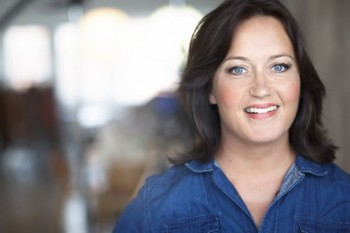
Kreetta Onkeli. Photo: Jouni Harala
The Finlandia Junior Prize 2013 was awarded on 26 November, also worth €30,000. It went to Kreetta Onkeli for her book Poika joka menetti muistinsa (‘The boy who lost his memory’, Otava).
Arto, 12, gets such a massive fit of laughter that he loses his memory and needs to find his identity and his home in contemporary Helsinki.
The winner was chosen from the shortlist of six by Jarno Leppälä, a media personality and member of the popular stunt group Duudsonit, the Dudesons. At the award ceremony he said:
‘Poika joka menetti muistinsa is, in my opinion, a well-written story about how young people in society are put on the same starting line and expected to do equally well in all circumstances – often irrespective of the fact that their starting points may actually be very different, and completely independent of the young people themselves.’
Kreetta Onkeli (born 1970) explained in her award speech how her aim was to write a proper, old-fashioned novel for children: ‘Not hundreds of pages of magic tricks but ordinary, real contemporary life that children could identify with.’ In her opinion the current, massive trend of fantasy has narrowed the scope of children’s literature.
The following five books made it on to the shortlist: Poika (‘The boy’, Like), about a boy who feels he was born in the wrong gender by Marja Björk, Hipinäaasi, apinahiisi (onomatopoetic pun, ‘Donkeymonkey’, Tammi), about bullying and friendship, written by Ville Hytönen and illustrated by Matti Pikkujämsä, Isä vaihtaa vapaalle (‘Father on his own time’, WSOY), an illustrated story about children with too busy parents, written by Jukka Laajarinne and illustrated by Timo Mänttäri, Aapine (‘ABC’, Otava), an illustrated primer written by Heli Laaksonen in her own south-western dialect and illustrated by Elina Warsta and Vain pahaa unta (‘Just a bad dream’, WSOY) by graphic designer and writer Ville Tietäväinen and his daughter Aino, a book on a child’s nightmares.
Finlandia literary prizes are awarded by Suomen Kirjasäätiö, The Finnish Book Foundation, established in 1983.
The first Finlandia Prize for Fiction was awarded in 1984. This year it will be announced on 3 December.
Family mysteries
31 March 2003 | Archives online, Fiction, poetry
Extracts from Einen keittiö, Eines kök (‘Eine’s kitchen’, Tammi, 2002). Introduction by Satu Koskimies
This sort of detached block of flats is as much of a living organism
as the folk dwelling in it.
For above are the brains and below are the intestines and outlets.
The upper floors were flaunting their kitchen taps, sink-tops,
lion-clawed sofas, mahogany chests and
sapphire-pendant crystal chandeliers, flashing the violet-tones of sea and
rain. More…
The dead speak kindly
1 November 2012 | Fiction, poetry
Memory, winter and everyday are studied in Tua Forsström’s new collection of poems, En kväll i oktober rodde jag ut på sjön (‘One evening in October I rowed out on the lake’, Schildts & Söderströms, 2012). Introduction by Michel Ekman
I fell through the papers laid aside
I came to a place where I was supposed to stay
for four nights but I stayed four years
Someone said: you have caused the council considerable expense
I said: this is my situation
A brave little cat came to my rescue
I could see what I wanted in the dark
at night and no one saw me
It was like a dream but I wasn’t dreaming
I was not afraid and I could pass through chalcedony
I could pass through quartz crystals
I could pass through sad and sick
On the bottom in the mud coins from many lands lay gleaming
We wish for anything between heaven and earth
All that we see and cannot see and lost
I do not recognise myself, and no one sees me More…
The ladies’ dining club
30 September 1994 | Archives online, Fiction, Prose
From the novel Luonnollinen ravinto (‘A natural diet’, WSOY, 1994). Interview by Tuva Korsström
My dear, wise and ever-faithful secretary, colleague, friend and right hand, you who, without counting the hours, have been my helpmeet in many awkward situations, and not only in work matters but in others, all sorts of matters that belong to my private life and particularly those, you have remembered things that I have found hard to remember, like the birthday of my wife or some important colleague, and at Christmas you have always remembered me with some small gift, always different and always carefully chosen, of which I hardly need say how much it has warmed my heart, when I haven’t been able to do better than a single miserable hyacinth. And you have always reminded me of engagements I haven’t been able to keep track of: dentists, barbers, garages, less important and more important receptions, lunches and dinners, but what is most important, and why l am most grateful to you, is that in your generosity and open-mindedness – your eternal femininity – you have understood that a person in my position may sometimes find himself in situations whose consequences he cannot always control, and that he begins to be bothered by all sorts of people, although they should understand from the smallest hint that their company is not required, and you have sensitively but firmly turned them away, sometimes telling a little lie, and you have never, ever taken a moral stand or judged my actions, but have averted your eyes, having made the decision to accept that your boss is anything but perfect. For that reason I wish to express my gratitude to you; but not, however, unreservedly. Our seamless collaboration, my ever-lovable secretary, has meant that something belonging to me has begun to belong to you, that you have become part of me just as I have become part of my wife, even before she touches me with her fork. So I have no doubt that you, too, could appear at the dinner that is soon to be arranged. Bon appetit! More…
Leena Lander: Liekin lapset [Children of the flames]
23 June 2010 | Mini reviews, Reviews
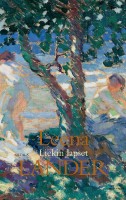 Liekin lapset
[Children of the flames]
Helsinki: Siltala, 2010. 419 p.
ISBN 978-952-231-022-1
€ 27.30, hardback
Novels by Leena Lander (born 1959) have been translated into more than 20 languages. Liekin lapset is a family saga, told in two parallel timelines. One is a portrait of a small coastal community in south-western Finland from the turn of the 20th century up to the end of the Finnish civil war in 1918 and the years following it. Life in the area is governed by a sawmill and a manor, socially dividing the community in two. Saida, Joel, Anders and Arvi grow up together, the future workers dreaming of socialism and the sons of the manor playing warlords. In the contemporary strand of the story, Sakari Salin, Saida’s grandson, begins researching his grandmother’s life. The documents reveal some rather remarkable events: here, the author defends the rights of those who were on the losing side in the civil war and creates a lively – as well as historically grounded – portrait of the times. The dialogues and characters in this novel work well, and the structure supports a complex system of psychosocial interconnections, in which the present finds an explanation in the past.