

Search results for "tommi+musturi/2010/05/song-without-words/2009/09/what-god-said"
More Tumpkin tales
30 June 1992 | Archives online, Children's books, Fiction, poetry
Poems from Tiitiäisen pippurimylly (‘The Tumpkin’s pepper mill’, Otava, 1991). Kirsi Kunnas’s classic children’s books, Tiitiäisen satupuu (‘The Tumpkin’s story tree’) and Tiitiäisen tarinoita (‘The Tumpkin’s tales’), appeared in 1956 and 1957
Mr Saxophone and Miss Clarinet
Mr Saxophone
	went moony
	beginning to fret
about Miss Clarinet:
	Moan moan moan
	darling little crow!
	I love you so!
moaned Mr Saxophone.
Miss Clarinet
was very upset:
	I won't be owned!
	And I'm no little crow!
	I sob like a dove,
	and even about love
	I sing alone!

	Oh moan moan moan
groaned Mr Saxophone.
Eino Leino Prize to Hannele Huovi
17 April 2009 | In the news

Hannele Huovi. - Photo: Laura Vesa
‘Methinks,/ said the sausage dog / who loved eating verse, that / poetry is tastier than bone.’ (From Karvakorvan runopurkki [Furry pooch’s jar of verse])
Hannele Huovi (born 1949) has received the 2009 Eino Leino Prize, worth € 5,200 and funded by the Finnish Book Foundation, for her extensive work as a writer of books for children and young people, of novels, poetry and text books. More…
From the land of abundant reindeer…
17 March 2011 | This 'n' that
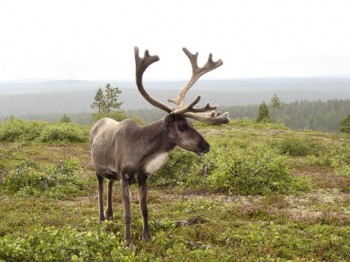
Rangifer tarandus, Finnish Lapland. Photo: Grand-duc (http://en.wikipedia.org/wiki/User:Grand-Duc)
Is Finland, a land of reindeer, ‘dense pine forests and deep snows’ also a ‘quiet literary landscape’?
Not exactly, as we at Books from Finland hope we are demonstrating. And over on the Bookslut website, Bonnie B. Lee comes to the same conclusion, after having mused about the reindeer (yes: in Helsinki you find tasty chunks of them in the freezer boxes of any foodstore) and reading three Finnish novels in English translation.
The novels Lee reviews are Purge by Sofi Oksanen (Puhdistus, 2008, translated by Lola Rogers, published last year), When I forgot by Elina Hirvonen (Että hän muistaisi saman, 2005, translated by Douglas Robinson, published in 2009) and The Year of the Hare by Arto Paasilinna (Jäniksen vuosi, 1975, first published in an English translation by Herbert Lomas in 1995, reprinted as a Penguin edition last year).
We have just entered the Year of the Rabbit, in recognition of which Paasilinna’s book (about a man who rejects his old life and goes roaming the wildernesses with a hare as his only companion) has appeared on the tables of large bookstores in the US. ‘The Year of the Hare is only the most Finnish, and perhaps most antically Zen-ish, of a shelf-load of books that tell us to find and live by our own ideas of contentment,’ said The Wall Street Journal.
The traumatic experiences of war and Finland’s deep forests are the common feature of these novels, Bonnie B. Lee finds. She also opines that ‘melancholy pervades the Finnish psyche’, and that ‘Finland vies with Hungary for highest suicide rate in Europe‘. Oh, but this latter is no longer true: number one on a World Health Organisation suicide rates list is Lithuania, followed by Hungary, Slovenia, Estonia and Latvia – Finland is number six.
Lee is clearly intrigued by her travels in contemporary Finnish literature. ‘The search for identity, a reckoning with a troubled past, and an outsider’s view looking in,’ she comments, ‘are all the stuff of great writing, and Finland is poised to continue to produce poignant and introspective literature that we can appreciate now that English translators have begun the work.’
Poignant and introspective or occasionally funny and fantastical, this is the work we try to offer an early glimpse of, in translation, at Books from Finland. Stay with us!
Best Translated Book Award 2011
13 May 2011 | In the news
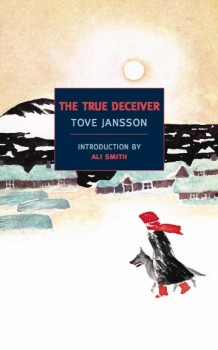 Thomas Teal’s translation from Swedish into English of Tove Jansson’s novel Den ärliga bedragaren (Schildts, 1982), entitled The True Deceiver (published by New York Review Books, 2009), won the 2011 Best Translated Book Award in fiction (worth $5,000; supported by Amazon.com). The winning titles and translators for this year’s awards were announced on 29 April in New York City as part of the PEN World Voices Festival.
Organised by Three percent (the link features a YouTube recording from the award ceremony, introducing the translator, Thomas Teal [fast-forward to 7.30 minutes]) at the University of Rochester, and judged by a board of literary professionals, the Best Translated Book Award is ‘the only prize of its kind to honour the best original works of international literature and poetry published in the US over the previous year’. ‘Subtle, engaging and disquieting, The True Deceiver is a masterful study in opposition and confrontation’, said the jury.
Tove Jansson (1914–2001), mother of the Moomintrolls, story-teller and illustrator of children’s books, translated into 40 languages, began to write novels and short stories for adults in her later years. Psychologically sharp studies of relationships, they are written with cool understatement and perception.
Quality writing will work its way into a wider knowledge (i.e. a bigger language and readership) eventually… even though occasionally it may seem difficult to know where exactly it comes from; in a review published in the London Guardian newspaper, the eminent writer Ursula K. Le Guin assumed Tove Jansson was Swedish.
Jarkko Nieminen: Pelaamisen lumo [The fascination of the game]
20 August 2009 | Mini reviews, Reviews
 Pelaamisen lumo [The fascination of the game]
Helsinki: Avain, 2009. 175 p., ill.
978-952-5524-69-7
€ 38, hardback
Tennis is a curious game, as everyone who plays it knows – and even those who don’t, which is why it is such a popular sport. Although Jarkko Nieminen (born 1981), a professional player since 2000, has not yet won a Grand Slam event for Finland, in 2006 he was ranked no. 13. (Unfortunately, this spring Nieminen injured his wrist and missed the top matches of the season.) In this book (edited and published by his sister Anna-Riikka Carlson, who founded the publishing company Avain in 2003), Nieminen tells the story of his athletic career. ‘In Japan my visa said I was an “entertainer”,’ he recalls as he describes what it’s like to walk out on a court filled with thousands of spectators. Tennis is a gentleman’s game, a polite duel (or double), and Nieminen is certainly a gentleman par excellence. His personal story is designed to be strictly informative, as he chooses to keep his family life private, for example (his wife Anu, née Weckström, a Finnish multiple badminton champion, is referred to once). There is no doubt, though, that the reader will be convinced of Nieminen’s happy choice of an athletic profession.
Adam, Eve and vegetarianism
30 September 2006 | Archives online, Fiction, Prose
Short prose from En god Havanna. Besläktad (‘A good Havana. Kith and kin’, Söderströms, 2006). Introduction by Bror Rönnholm
Ode
My alter ego has relatives who have bad teeth and the names of Greek gods. They live in ramshackle houses in suburbs which the taxi drivers can’t find, dangerous ex-no man’s lands in a rapid metastasis into concrete. They are wild and threatened with extinction, they are Finland-Swedish working class. Disorganised, of course they’re disorganised, my alter ego’s relatives never organise themselves. They don’t form part of any community other than their own. They go to sea and they breed, they buy shuteye dolls in whore ports and return home in grand style, always at night, always one surprising night when no one is expecting them. The women raise a cry of joy, the children go leaping barefoot, and the dog, which is called Zeus-Håkan, is quite beside himself. There’s a party. There’s no school that day. At twilight the women travel to their jobs in key factories and warehouses. When they come home the party continues and in the outside toilet there are new pictures of new places. My alter ego’s relatives have dyed hair and prominent busts in tight-fitting silver nylon jumpers. They pay for my alter ego’s father’s education so he can become middle class. They are proud of him. When we go to visit them they dress up. They clap their hands and the nail varnish peels as they loudly, just a shade too loudly, shout OH, oh splendid, such fine guests! My alter ego’s father is grateful and confused. He has long ago paid it back, paid the money back, and now what’s left is only what cannot be repaid.
With the passage of the years my alter ego’s working-class relatives are disappearing from my alter ego’s life. I miss them. More…
Poetic excercises by the sea: Herbert Lomas (re)visited
21 November 2009 | Authors, Interviews
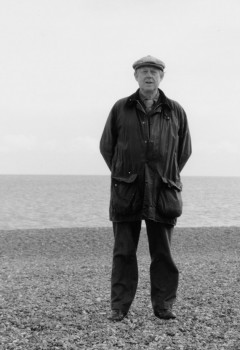
Poet ahoy: Herbert Lomas in Aldeburgh. Photo: Soila Lehtonen
The prize-winning British poet Herbert Lomas has been translating Finnish poetry – much of it for Books from Finland – for more than thirty years. Soila Lehtonen, our Editor-in-Chief and his long-time collaborator, interviews him on the occasion of the publication of his collected poems, A Casual Knack of Living
The shoreline and the seaside promenade stretch out along the windy East Suffolk coast in Aldeburgh, where Herbert Lomas lives in a pink house called North Gable.
In summer thousands of tourists frequent the picturesque village, particularly during the music festival in June, founded in 1948 by the local composer Benjamin Britten. A poetry festival, too, takes place every autumn, this year for the 21st time.
Herbert – Bertie to those, like us at Books from Finland, who know him well – has just published a handsome tome of poetry, A Casual Knack of Living, containing poems from nine earlier collections plus a selection of previously unpublished poems, entitled Nightlights. The home of his publisher, Arc Publications, is in the village where he was born, 85 years ago, Todmorden in the Pennines. More…
The next nine lives
30 September 1998 | Authors

Ilpo Tiihonen. Photo: WSOY/ C.G.Hagström
‘I was blamed by another translator for working with the early Ilpo Tiihonen,’ writes Tiihonen’s translator, Herbert Lomas; ‘He was supposedly superficial.’
It’s a mistake to confuse lightness of touch or facility with superficiality. Shakespeare himself, who wrote three plays a year and ‘never blotted a line’, must have had facility. And lightness of touch is a sign of intelligence and artistic security. Ilpo Tiihonen (born 1950) carries his intelligence and his reading of the Swedish and Russian classics (Fröding, Mayakovsky, Yesenin) without self-importance, which may not always pass for a paradoxical humility. More…
Down to business
31 March 2006 | Archives online, Fiction, Prose
An extract from the novel Ystävät kaukana (‘Friends far away’, Gummerus, 2oo5)
The half-day secretary Oksana Pelkonen was already bustling about the office as I squeezed my Mercedes onto the side of Viherniemenkatu Street. I had kept my office next to the Hakaniemi Market even though newer places had been pressed on me. There were new messages taped to the doors and windows, anyway. They explained, in what I thought was a quiet way, that the so VK Corporation’s office was here and that Kärppä Construction, VK East Trade, VK Consulting and Hakaniemi Eastern Aid also belonged to the Group. The slogan was at the bottom: ‘Two centuries’ experience trading with the East’. Would have been just as true to put ‘two millennia’, but the customer might have started to wonder.
‘Good morning, Vityuha, good morning!’ Oksana greeted me doubly. ‘I just put the tea onto steep for you. And look, on top of the pile of mail, three letters to Viktor Kärppä. That’s how I knew you were coming.’ More…
Joni Skiftesvik: arctic storyteller
31 December 1984 | Archives online, Authors, Interviews
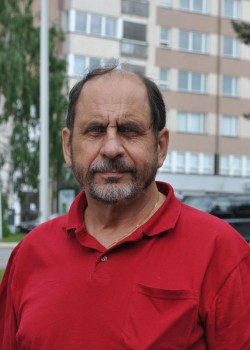
Joni Skiftesvik. Photo: Hilkka Skiftesvik
Olavi Jama interviews Joni Skiftesvik
We’re sitting on the fringes of the arctic zone, in the modern centre of Oulu, a town that built its wealth in the last century on tar export and sailing ships.
In front of us is the sea; behind us curves Oulujoki, the river that has for centuries brought Oulu writers stories from the north. The restaurant is filled with the bright light of midday; we want to see each other clearly.
JS: All summer the wind blows in from the sea. Now there’s a land wind. It comes from the east.
OJ: You’ve published only two books, but you’re hardly a typical debutant writer. All day you work for an Oulu publisher of romantic fiction, whose products attract hundreds of thousands of readers every year. What’s your job there?
JS: Publications director.
OJ: You returned from the Frankfurt Book Fair yesterday. Did you see anything there to interest you as an author?
JS: For a novelist or a short story writer, for a writer concerned with literature it was really quite a depressing sight. Long corridors and exhibition shelves by the kilometre. More…
In the starry heavens
31 March 1987 | Archives online, Fiction, Prose
An extract from Tähtien tarhoissa (‘In the starry heavens’, 1912). Introduction by Matti Apunen
The sun sank and the evening began to draw in. It was a Wednesday towards the end of October, 2140. At Teuvo’s house the electric lights were being switched on.
Teuvo lived in Helsinki on what had once been Korkeavuori Street. Now it had no particular name. It was just Street No 311, for during the course of time there had been so many new streets that it had become impossible to name them all and numbering became necessary.
Teuvo’s home was on the thirtieth storey. But of course it was not important how high up you lived, because no one used stairs. Lifts had replaced the old flights of stairs, and even they were only seldom necessary.
Every storey had an airship stop, and since everyone, even the smallest children, had a pair of wings made of fine aluminium, it was very easy to go from one floor to another without using stairs.
Teuvo looked out of the window. There was a wide space between houses. On the right hand side of the road traffic was flying towards the centre of town, on the left in the opposite direction. What a lot of people there were! He could hear the even whisper of their wings. All kinds of people, old and young, were flying along. More…
Translator at play
28 January 2010 | This 'n' that
 Järjestelmällistämättömyydellänsäkäänköhän?
This is supposed to be the longest Finnish word. Lola Rogers interprets it as ‘You mean, not even (when it’s done) with their (usual) lack of systematization?’ More…
Becoming father and daughter
31 December 1990 | Archives online, Fiction, Prose
A father kidnaps his 10-year-old daughter and flees to the western extremity of Europe, to Ireland, to begin a new life under new names. In the following extract, the girl is in a state of shock after witnessing an event organised by a religious sect in which animals are driven over a cliff to their death. The year 2000 approaches, and with it clarification of the relationship between father and daughter. An extract from Olli Jalonen’s novel Isäksi ja tyttäreksi (‘Becoming father and daughter’). Introduction by Erkka Lehtola
He begins leading his daughter back the way they came, along the hillside and the lip of the precipice.
The blare of the Legion’s display carries far, till finally the voices are scrambled in the bluster of the wind. The electricity crackles in the loudspeakers, and the thundersheets rumble out to the audience. ‘Be silent!’ come the roars from the plat form: ‘And look at each other! Each is fearfully following his way, each is a venue of good and evil, each is inscribed with God’s name!’ More…