

Search results for "tommi+musturi/2010/05/song-without-words/2009/09/what-god-said"
Word-flames
1 March 2012 | Fiction, poetry
Harri Nordell breaks up grammar, invents words and leaves sentences unfinished. His poems are like minimalist, language-shattering sculptures of words. In her introduction Tarja Roinila compares Nordell’s poems to windows on to another world
Poems from Sanaliekki äänettömyydessä. Valitut runot 1980–2006 (‘Word-flame in silence. Selected poems 1980–2006’, WSOY, 2011)
You are beautiful
light-cupola-ecstasy of the eye
I look at you
from I-silence
daughter, bringer of the Word
involvement has been inscribed
with the name’s black reed
Girl, salt-grain of light
the mighty river of blood rinses memory,
otherness has come through us

Writing and power
15 October 2009 | This 'n' that
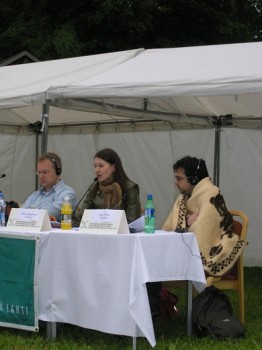
Speaking in the cold: the Chairperson of the Lahti Writers' Union, Jarmo Papinniemi (left), and the Bosnian writer Igor Štiks (right) listen to Riina Katajavuori's presentation
The theme of the biannual International Writers’ Reunion (LIWRE) which took place in Lahti, southern Finland, in June for the 24th time, was ‘In other words’.
The theme inspired the participants (54 in total, foreign and Finnish) to talk, among other things, about the power of the written word in strictly controlled regimes, about fiction that retells human history, about the difference between the language of men and women, about languages that have been considered – by those who rule, naturally – ‘better’ than other languages. Eleven presentations are available in English.
Speaking about the birth of her latest collection of poems, Kerttu ja Hannu (‘Gretel and Hansel’, 2007), the Finnish writer Riina Katajavuori described in her presentation the need to use other words. In her case they were those of poetry, in retelling a tale; here are some extracts (scroll down!). More…
The man and his work
30 September 1984 | Archives online, Authors
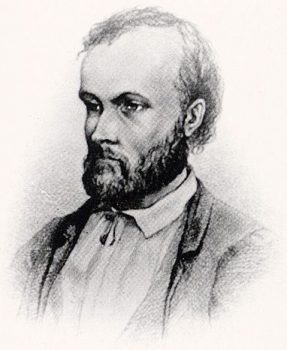
Aleksis Kivi. Drawn in 1873 almost certainly by Albert Edelfelt (1854–1905).
Aleksis Kivi’s Seitsemän veljestä (Seven Brothers, English translation 1929), is the best known and the most beloved in Finland. Its sentences have become part and parcel of the common tongue. Its events are often cited as historical happenings, its characters and their vicissitudes are now permanent national property just as the characters of Shakespeare are for the English, those of Molière for the French, or those of Cervantes for the Spaniards.
Aleksis Kivi’s life (1834–1872) is filled with paradoxes and unanswered questions. How could a village tailor’s son who has acquired only a little learning at home and who managed to graduate from secondary school, after many efforts, only at the age of 23, became an author of the first rank? How could a man who travelled within a radius of only a few dozen miles during his life know the Finnish landscape and the Finnish mind so thoroughly that his novel even today, mutatis mutandis, conveys a true picture of an entire nation? How could he free himself from the spirit and the idealised conception of the art of his own day so completely as to be able to write books sharply at variance with the other literary works of the same era, in which he followed his own path and found fully independent artistic solutions? And how could a book which is, practically speaking, the first Finnish-language novel and which thus springs up as a unique phenomenon from an inadequately cultivated linguistic soil, reach such heights as to become the supreme achievement of all Finnish literature? The enigmatic quality of Kivi’s character is further enhanced by the fact that there exists only one authentic portrait of him, drawn when he already lay dead; that the original manuscript of Seitsemän veljestä is not extant; and that of his letters, only about seventy have been preserved, some only brief notes and most of them dealing with financial arrangements. More…
Poems
30 September 1984 | Archives online, Fiction, poetry
The poems of Aleksis Kivi were long considered no more than a peripheral aspect of his work. They were, as Kivi’s friend Kaarlo Bergbom wrote in a review, ‘gold that can’t be minted into coins’. The reason appears to have been Kivi’s poetic technique, which made a clear break with tradition. He did away almost completely with rhyme and instead emphasised the rhythm and musical sound qualities of words. He shortened words in a way that did not find favour with any subsequent Finnish poets. He avoided emotional expressions of patriotism and romantic love poetry; instead, he composed poems that were extended, narrative and fresco-like. Lauri Viljanen, whose 1953 study brought about a re-evaluation of Kivi’s poetry, has given them the apt soubriquet ‘epic idyll’.
The first of Kivi’s poems appeared in the Kirjallinen Kuukauslehti (‘Literary monthly magazine’) in 1866; a collection of his poetry entitled Kanervala was published the same year. Other poems appear in his novels and plays, and some have appeared in a collection after his death. Karhunpyynti (‘The bear hunt’) is from Kanervala. Its descriptive nature is typical of Kivi. The verse structure is tightly controlled but unrhyming. The winter landscape of the third verse, repeated at the end of the poem, is a ceremonious point of rest among the otherwise busy activity.
– Kai Laitinen
The Bear Hunt
The men on skis set out for the forest, a brave company
With guns and bright spears
And clamouring dogs on the leash,
With blazing eyes,
As the dawn chases gloomy Night
From the sky’s brow,
And the sun raises his head. More…
Journeys to nearby places
18 April 2013 | Authors, Interviews

Workmates: Virpi Talvitie and Katri Tapola. Photo: Teos
Short texts and vibrant illustrations merge composing capricious situations in Katri Tapola and Virpi Talvitie’s adult picture book. Mahdollisuuksien rajoissa. Matkakirja (‘In the realm of impossibility. Travel book’, Teos, 2013) turns the ordinary pleasantly askew
It is a different kind of travel book: instead of faraway places, it explores things nearby, where our gaze and our thoughts don’t usually pause – the little things at the bottom of a pocket, in a dark closet full of outdoor gear, quiet moments in noontime traffic.
The travellers are perhaps Nobody in Particular, or somebody called Random. We keep on travelling, but we don’t get any farther than the corner store. What’s small becomes large, what’s supposedly large shrinks. Our self-image is off-kilter, there’s a hole in our CV, and the world is pleasantly tilted.
A-L E: The book is in the form of short prose – a page, half a page. What was it like to write these compact texts?
K T: I love having constraints; the short form is very rewarding. Focus and compactness make your whole life clear. And this has been good for me to learn because I’m naturally prone to long, extended forms of expression. More…
The light itself
31 March 2008 | Archives online, Essays, On writing and not writing
What should you do when writer’s block strikes? Lie down and wait for inspiration to return, Petri Tamminen suggests
All autobiographical depictions of writer’s block are fundamentally flawed and false. If you happen to be suffering from writer’s block, these accounts make for painful reading.
The wittier, more carefully crafted and closely observed an account the writer gives of his affliction, the more gut-wrenching it feels. It’s like treading water and preparing to drown and having to listen to someone in dry clothes standing on the deck of a ship recalling a close call he had back in the seventies.
On the other hand, when you’re suffering from writer’s block everything annoys you. Good books seem overwhelmingly good, so much so that you realise you can never achieve that level of greatness. Similarly, bad books seem so overwhelmingly bad that you wonder why anyone bothers reading books and realise that it’s pointless trying to write one. More…
Indebted to the centuries
30 September 2007 | Archives online, Fiction, poetry
Poems from Jouni Inkala’s Minuutin ja sen puolikkaan laajenevassa universumissa. Valitut runot 1992–2007 (‘In a minute and its half’s expanding universe’, WSOY, 2007)
Tail references
Mice don’t know that in the case of a human being
the death of a dear one may paralyse
a person’s capacity for years and years.
But in two things they’re more experienced than we.
They understand they’re in constant mortal danger.
That the trap is swift and silent.
That poison is a tear of awareness rising from the heart.
They also realise that in a cat’s claws they fly
like jackknives in the hands of a knife thrower.
And that when the audience finally gets round
to wakening up their hand~ in a rising storm of applause,
they won’t be distinguishable from the arena spotlights
or the ringmaster’s tails.
After their full term of service the mice pass out
from this time to the other side, and there see a miracle:
the sun’s heart beating six hundred times a minute.
                            In Helsinki, recalling
                            the Pinder Circus
Brainstorm
30 September 2007 | Archives online, Essays, On writing and not writing
The poet Jouni Inkala finds the words-to-be of his slowly forming poems unbribable
My little fingertip, the size of
a crocodile brain, and a turpentine-taste
on my palate monitor this moment
on the unoxygenated
planet of weariness.
One will be baptised – spray paint
suddenly swishing its message
in my brains – as often in my life,
with something darker than water
freezing in the font, and I'll recall
it's actually a donkey's-years-old
message from my own stanzas.  More...
On Mirkka Rekola
30 June 1978 | Archives online, Authors
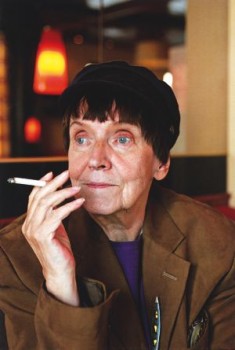
Mirkka Rekola. Photo: Elina Laukkarinen/WSOY
The very title of Mirkka Rekola‘s latest collection of poems, Kohtaamispaikka vuosi (‘Meetingplace the year’, Werner Söderström, 1977), reveals a theme central to Rekola’s poetry: that of unity. The time is the place. ‘I do not imagine I shall meet you this year. / This place will be here in summer.’ Rekola has a particular way of using language of the most intense concentration, so that it brings out unity between a wide variety of moods. ‘I shall meet you this year’ also means that you are this year. ‘This place will be here in the summer’ means that it is autumn and this place (a summer café) will remain deserted until the summer, but also that this place will remain there as the summer.
‘The world, a table already laid, there you see your hunger.’ ‘At the same time a little thirsty and a cowberry.‘ The correspondence of place, the synchrony of season and the general sense of undividedness produce countless pictorial and therefore concrete expressions throughout Rekola’s poetry. ‘I spread my hands / and someone yawned, / I held my fingertips in the breeze / and the boats slid into the water.’ ‘The child said to the old man: you are bent, while I am so little.’ ‘A shout is heard which is no other’s.’ Rekola’s concrete and graphical mode of expression is also based on the same philosophy: ‘Do not make a picture, everything is [a picture]’. ‘The sun, star of the night, introduces the day. And the world is so talkative in its dreams.’ More…
Around zero o’clock
30 June 1996 | Archives online, Fiction, poetry
Poems from the collection Musta oli valkoinen (‘Black was white’, WSOY, 1995). Introduction by Jukka Koskelainen
When?
			         When I learned to pay attention
to unlikely reptiles
to surprising glacier waters
to nightgowned rejections
to wall-mounted assault rifles
to traveling angels
to lips shaped like promises
to mussels swimming in dreams
to crashes, rules and funerals
to shady, secret sacristies
to the indecisiveness of dancing shoes
to the immeasurable indifference of looks like bullets
to spring, myself and seductions slow as clouds
			                                     all of these
					                                         between the words,
was that when the difficulties began?
About the third
To stop waiting, the second step.
To be born of woman. The first.
The price of the word and the moon
	    are determined with the same weightless scales.
The third we don’t know about, don’t ask.
On the ear’s walk
The landscape's deepest melody flowed on
	     over the banks of the resounding Middle Ages.
Do you hear, do you hear it
the way a snail hears,
that snail there who teaches
learns from the earth’s replies, learning
the snail hears and gets there,
gets there for sure
even the slow one gets there,
even the slower one will
then get there, it will
surely get there, into the pot.
Herbal wisdom
New churches, old
	                       harmonized organs and repetitions
like a prayer or a psalm for seven voices.
Against scant blue
	               a hundred people
believe in pilots and safety belts. The wind
	                                                 just a little too strong.
But my heart it was, that loaded institution
through four expectations it came
	                                               here. Exactly here
where you, with both hands,
	               almost inaudibly
intended to break
	              the fragrant life of a sprig of thyme.
That soundless break, the speech of dust, said all
			                                  I understood.
Around zero o’clock
Just be the shape of an angel, be, be
	                be, be a screeching
   hatful of sleepless night	it dresses
even the seagulls in diver's suits, be
	      be lazy intellect and come
to bed
be manager of nightmare
	  and conqueror of desire
to say
Be the disease of saying 	Be the lifelong remedy
	   which 	                        whether you take it or not
	              certainly kills
Be the one who no longer is
	     a dab of the freedom of the void, a flight of three strides
out of thought's night	                    be
Because I’m jading
Translated by Anselm Hollo
Travelling alone
30 June 2005 | Fiction, poetry
Poems from Ödemjuka belles lettres från en till en (‘Humble belles lettres from one to one’, Schildts, 2002)
Blind Alley Travel Bureau
We arrive on the last arrival.
Turn the lights out when you go, the airport staff ask.
To this place you and I must travel. It was the only departure
that was called. The only place there is, said the guide.
One’s vision is blocked by the view. We’ll find no somewhere else.
‘When I fall asleep, drive the last stretch by yourselves,’
says the driver.
A last summer family lift him into
their homeward-returning back seat. More…
Plain sailing
31 March 1996 | Archives online, Fiction, Prose
An extract from Alastalon salissa (‘In Alastalo’s parlour’, 1933). Introduction by Kai Laitinen
A letter from the translator:
Dear Editors,
Reluctantly (I really have tried) I have been driven to conclude that Alastalon salissa is untranslatable, except perhaps by a fanatical Volter Kilpi enthusiast who is prepared to devote a lifetime to it. To mention only one of the difficulties, there is no English equivalent to the style of the Finnish ‘proverbs’ (real or imaginary) with which the main character Alastalo’s thoughts are so thickly larded. Add to this the richness and, yes, eccentricity, of Kilpi’s vocabulary, and the unfamiliarity of much of the subject-matter, centred as it is on the interests of a sea going community that hardly exists any longer, even on the islands, and you have a text that is full of pitfalls for the translator. As for the humour, I’m sorry to say that it depends so much on the idiom and presentation that it doesn’t come over at all. If I did any more, I’m afraid it would just have to be a laborious paraphrase, and I don’t think I’m capable of making it effective, or even readable, in English.
Apart from that, although I’m very grateful for your explanations of the many unfamiliar words and phrases, I’m very unwilling to commit myself to the translation of any of them on the basis of a mere ‘gloss’ (technical word): I need to know the associations, and possible sound-echoes, of every one of them before I can be sure of getting it right. And getting it right affects the rhythm of every sentence: it’s not just a matter of filling in blanks with ‘equivalents’ provided by someone else.
I’ve no objection to your using my version of the opening pages. If you decide to follow it with some kind of comment, do borrow, if you need to, from my remarks above, giving the translator’s point of view. Sorry to have failed you so badly.
Yours, David Barrett More…
In my memory
31 December 1987 | Archives online, Fiction, poetry
Poems and aphorisms from four collections. Introduction by Erkka Lehtola
Let the healing epidemics out! There must be some.
The many-headed monster, the market ideology, it can simultaneously read, count and even write at least 666 works. And without the sign of the beast no one can buy or sell.
Those who can read know you only realise you’ve forgotten how
when you can do it again.
What a handsome winter we have here! If it weren’t so dark, we’d see it. We could orientate ourselves on the stars with the beam from a pocket torch. Somewhere in mid-sky, I’d say, they come flying along on long lights.
As a child I said I’ll do what I want. Now I want what I do.
Who’s in the middle when the two sides of your face are side by side, as they are, in the mirror.
The trees that hide the sun are bright inside.
A frosty night when you feel the stars on your skin and discuss what you’re wearing.
Somebody’s walking over there, with an umbrella over his head, taking the rain for a walk.
I’m so delighted to find so much that’s useless.
What a relief there’s no longer enough time to get acquainted.
From Tuoreessa muistissa kevät (‘Springtime fresh in the memory’), 1987 More…
Metamorphoses
30 June 1992 | Archives online, Fiction, Prose
Extracts from the novel Tummien perhosten koti (‘Home of the dark butterflies’, Kirjayhtymä, 1991). Introduction by Soila Lehtonen
The girl is on the rock every evening.
By the side of the sheltered bay, she knits or reads a book. Sometimes she simply lies, motionless, under a large towel, her closed face towards the sun as it sinks into the sea.
She has undone her thick plait. Sometimes her hair lies against the reddish boulder like a fan. As if it had been placed there deliberately.
She does not notice the boy, who can move soundlessly. More…