

Search results for "tommi+musturi/2010/05/song-without-words/2009/09/what-god-said"
Jacob’s Dream
30 September 1986 | Archives online, Fiction, Prose
An extract from Hänen olivat linnut (‘Hers were the birds’, 1967). Introduction by Pirkko Alhoniemi
‘It was Jacob’s Dream, Alma.’
How could she put it so Alma wouldn’t get hurt. Alma had ruined the surface of the painting. The pastor’s widow stood nervously in front of the window and tried to say what she’d had on her mind for several days but couldn’t quite come out with. When Alma went out of the house, the pastor’s widow would wander through the rooms and check on things. And the painting wasn’t the only object in danger, but also the birds. Their feathers were ruffled because Alma kept wiping them with a wet rag. How could she put it.
‘Alma.’
Alma turned to look at her.
‘It’s called Jacob’s Dream.’ More…
Teemu Kupiainen & Stefan Bremer
Music on the go
3 March 2010 | Extracts, Non-fiction
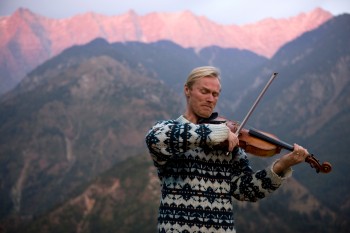
A little night music: Teemu Kupiainen playing in Baddi, India, as the sun sets. Photo: Stefan Bremer (2009)
It was viola player Teemu Kupiainen‘s desire to play Bach on the streets that took him to Dharamsala, Paris, Chengdu, Tetouan and Lourdes. Bach makes him feel he is in the right place at the right time – and playing Bach can be appreciated equally by educated westerners, goatherds, monkeys and street children, he claims. In these extracts from his book Viulun-soittaja kadulla (‘Fiddler on the route’, Teos, 2010; photographs by Stefan Bremer) he describes his trip to northern India in 2004.
In 2002 I was awarded a state artist’s grant lasting two years. My plan was to perform Bach’s music on the streets in a variety of different cultural settings. My grant awoke amusement in musical circles around the world: ‘So, you really do have the Ministry of Silly Walks in Finland?’ a lot of people asked me, in reference to Monty Python. More…
Words of feeling
31 March 2002 | Fiction, poetry
Poems from Vain tahallaan voi rakastaa (‘You can only love deliberately’, WSOY, 2001)
The musicians of Bremen (Self-portrait as a five animals)
People say man’s above all the other beasts.
I decided to prove that – and first turned poet
and then painfully became a flying horse, celebrating its freedom
on great shivering brawn. They captured me and put me to pulling
loads, and, seeing I endured everything docilely, they said,
He’s like the Giant Atlas, or Hanuman, the upholder of the world.
And they whipped me and sat on my back and finally
buried me alive. I became a pig and gorged my bellyful and my senses full
and it horrified people, who said: He’s a disease, an epidemic, Death itself.
And they cut my ears and blinded me and sliced my belly in two.
And I turned into a dog and learned everything I was taught and they said,
He’s completely without a will, like the angels, like an ascetic, and a prophet.
And they drove me out to wander the streets and the wildernesses. And in the desert
I turned into a tiger and people shouted in terror
What on earth
has God done – look, he’s Satan himself. And they shot me
from an elephant’s back. And I died into a cock and people woke up and shouted,
The healer of the world! And whenever I sing, because I only sing untold-to,
People wring my neck. More…
Finlandia Prize for Non-Fiction 2010
19 November 2010 | In the news
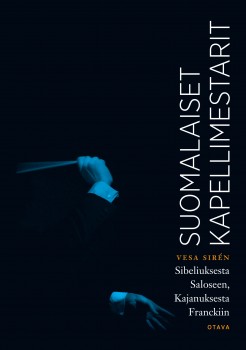 A massive tome running to 1,000 pages by Vesa Sirén, journalist and music critic of the Helsingin Sanomat newspaper, features Finnish conductors from the 1880s to the present day. On 18 November it became the recipient of the 2010 Finlandia Prize for Non-Fiction by the Finnish Book Foundation, worth €30,000.
The choice, from six shortlisted works, was made by economist Sinikka Salo. Suomalaiset kapellimestarit: Sibeliuksesta Saloseen, Kajanuksesta Franckiin (‘Finnish conductors: from Sibelius to Salonen, from Kajanus to Franck’) is published by Otava.
The other five works on the shortlist were Itämeren tulevaisuus (‘The future of the Baltic Sea’, Gaudeamus) by Saara Bäck, Markku Ollikainen, Erik Bonsdorff, Annukka Eriksson, Eeva-Liisa Hallanaro, Sakari Kuikka, Markku Viitasalo and Mari Walls; the Finnish Marshal C.G. Mannerheim’s early 20th-century travel diaries, Dagbok förd under min resa i Centralasien och Kina 1906–07–08 (‘Diary from my journey to Central Asia and China 1906–07–08’, Svenska litteratursällskapet i Finland & Atlantis), edited by Harry Halén; Vihan ja rakkauden liekit. Kohtalona 1930-luvun Suomi (‘Flames of hatred and love. 1930s Finland as a destiny’, Otava) by Sirpa Kähkönen; Suomalaiset kalaherkut (‘Finnish fish delicacies’, Otava) by Tatu Lehtovaara (photographs by Jukka Heiskanen) and Puukon historia (‘A history of the Finnish puukko knife’, Apali) by Anssi Ruusuvuori.
Love is the only song
7 August 2014 | Fiction, poetry
Poems from Helise, taivas! Valitut runot (‘Ring out, sky! Selected poems’, Siltala, 2014). Introduction by Marja-Leena Mikkola
Who will tell me?
Who will tell me why white butterflies
strew the velvet skin of the night?
Who will tell me?
While people walk, mute and strange
and they have snowy, armoured faces,
such snowy faces!
and the eyes of a stuffed bird.
Who will tell me why in the morning, on the grass,
the thrushes begin their secret game?
Who will tell me?
While black soldiers stand at the gate
in their hands withered roses
such withered roses!
and broken tiger lilies.
Who will tell me, quietly in the sun’s shadow
how to bare my heart?
Who will tell me?
Come to me over the fields
Come close and softly
so softly!
Open the clothes of my heart. More…
Digging for gold
30 June 1989 | Archives online, Fiction, Prose
Antti Tuuri has found his theme in the life of Finnish émigré communities and their experience in what used to be called ‘the New World’. Uusi Jerusalem (‘The New Jerusalem’, 1988), is about the Finns who migrated to Canada during the Depression, only to find that their utopian dreams had no basis in reality. In the following extract the narrator finds himself and his fellow mineworkers in the middle of the forest at night, on the way by foot to the Kirkland Lake gold mines, where they are going to be strikebreakers. The novel, an ironical tale of life in a new land, follows on from Pohjanmaa (‘Ostrobothnia’, 1982), Talvisota (‘The Winter War’, 1984), Ameriikan raitti (‘The American road’, 1986).
The train pulled up at Swastika station, many a mile from Kirkland Lake, and Hamina said we’d have to press on by foot from the station to the town.
Swastika, he said, meant the crooked cross, but he didn’t know whether there were any of those German Adolf-fanciers around, who were so keen on the sign. He was certain, in fact, the town had got its name long before anyone in Germany had heard of Adolf or his swastika.
We asked why we had to walk from here to the town. Hamina said we’d got to walk because even in Canada vehicles didn’t drive through the backwoods; moreover, it wasn’t a good idea to walk along the Kirkland Lake road: we might meet up with the kind of guys who’d make our arrival at Kirkland Lake seem very unwelcome. More…
Veikko Huovinen (1927–2009) in memoriam
23 October 2009 | Authors, In the news
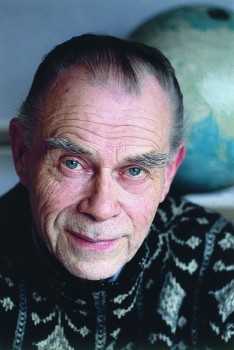
Veikko Huovinen (1927–2009). – Photo: Irmeli Jung /WSOY
Author Veikko Huovinen died on 4 October at his home in Sotkamo, in northern Finland, at the age of 82.
Huovinen was a graduate of the forest research programme at Helsinki University and worked for a period as a forest ranger. In the 1950s he began working as a full-time writer after his first novel, Havukka-ahon ajattelija (‘The thinker of Havukka-aho’, 1952), achieved great success.
Havukka-ahon ajattelija is the story of a stubbornly ruminative backwoods philosopher who ponders natural phenomena and the great political turning points that he hears about on the radio. The novel has been translated into six languages.
The soil that Huovinen’s works spring from is his northern community surrounded by deep forest, and his characters are modelled on its inhabitants: a self-sufficient business owner, a vagrant rascal, an ill-tempered hermit. They withdraw into the shelter of their homes, where the arctic winds and the evil of the world can’t reach them. Such humoresques might bring to mind Mark Twain or the early works of Nikolai Gogol. More…
For your eyes only
11 May 2015 | This 'n' that

Photo: Steven Guzzardi / CC BY-ND 2.0
Imagine this: you’re a true bibiophile, with a passion for foreign literature (not too hard a challenge, surely, for readers of Books from Finland,…). You adore the work of a particular writer but have come to the end of their work in translation. You know there’s a lot more, but it just isn’t available in any language you can read. What do you do?
That was the problem that confronted Cristina Bettancourt. A big fan of the work of Antti Tuuri, she had devoured all his work that was available in translation: ‘It has everything,’ she says, ‘Depth, style, humanity and humour.’
Through Tuuri’s publisher, Otava, she laid her hands on a list of all the Tuuri titles that had been translated. It was a long list – his work has been translated into more than 24 languages. She read everything she could. And when she had finished, the thought occurred to her: why not commission a translation of her very own? More…
Renaissance man
30 September 1990 | Archives online, Fiction, Prose
An extract from the novel Bruno (WSOY, 1990)
Since her first collection of poems, which appeared in 1975, Tiina Kaila (born 1951 [from 2004, Tiina Krohn]) has published four children’s books and three volumes of poetry. Her novel Bruno is a fictive narrative about the Italian philosopher Giordano Bruno, who was burned at the stake in 1600. It is the conflict inherent in her main character that interests Kaila: his philosophical and scientific thought is much closer to that of the present day than, for example, that of Copernicus, and it is this that led him to the stake; and yet he did never abandon his fascination for magic.
The novel follows Bruno on his journeys in Italy; France, Germany and England, where he is accompanied by the French ambassador, Michel de Castelnau. Bruno finds England a barbaric place: ‘…These people believe that it is enough that they know how to speak English, even though no one outside this little island understands a word. No civilised language is spoken here’
In the extract that follows, Bruno, approaching the chalk cliffs of Dover by sea, makes what he feels to be a great discovery: ‘Creation is as infinite as God. And life is the supremest, the vastest and the most inconceivable of all.’

I was leaning on the foredeck handrail, peering into a greenish mist. The bow was thrashing between great swells, blustering and hissing and shuddering like some huge wheezing animal: Augh – aagh – ho-haugh! Augh – aagh – ho-haugh!
Plenty of space had been reserved for our use on this new two-master cargo boat. Castelnau was transferring his whole family from France – his wife, his daughter, his servants, his library, his furniture, his past and me – to London, where, as you know, he had been appointed Ambassador of France. More…
Compelled to write
30 June 2000 | Authors, Interviews

Photo: Marica Rosengård
Kjell Westö (born 1961) is one of a generation of younger, urban Swedish-language writers who are at home in both Swedish and Finnish. An extract from his novel Vådan av att vara Skrake (‘The perils of being Skrake’, Söderströms, 2000), which traces the fortunes of the Helsinki family of Skrake from the 1910s to the present day. Here, Westö is interviewed by his alter ego, the discontented poet Anders Hed, editor of the cultural journal Bokassa (now sadly extinct)
Anders Hed: So, to get us going: do you write any poetry at all nowadays?
Kjell Westö: No. The last poem I wrote comes at the end of the title story in Fallet Bruus (‘The Bruus case’). And that book came out in 1992.
It’s a poem about human face and the search for ‘the Thou’, isn’t it?
Exactly. More…
Mortal song
30 December 2005 | Authors, Reviews

Photo: Irmeli Jung
Names or cultural references suffice to convey meaning to the reader: classics, movie stars, brand names, myths and Joe Bloggs coexist in them. In this sense, Jarkko Laine’s poems are ‘cultural’ and testify to a belief in a shared cultural reality and in the existence of a shared civilisation. Furthermore, they assert, in an Eliotian spirit, that the canon of ‘great books’ and great works is still alive. In the manner of a learned humanist, Laine is not afraid to appear pedantic but is willing to emphasise his points with italics or footnotes whenever necessary. More…
See the big picture?
9 November 2012 | Extracts, Non-fiction
Details from the cover, graphic design: Työnalle / Taru Staudinger
In his new book Miksi Suomi on Suomi (‘Why Finland is Finland’, Teos, 2012) writer Tommi Uschanov asks whether there is really anything that makes Finland different from other countries. He discovers that the features that nations themselves think distinguish them from other nations are often the same ones that the other nations consider typical of themselves…. In Finland’s case, though, there does seem to be something that genuinely sets it apart: language. In these extracts Uschanov takes a look at the way Finns express themselves verbally – or don’t
Is there actually anything Finnish about Finland?
My own thoughts on this matter have been significantly influenced by the Norwegian social scientist Anders Johansen and his article ‘Soul for Sale’ (1994). In it, he examines the attempts associated with the Lillehammer Winter Olympics to create an ‘image of Norway’ fit for international consumption. Johansen concluded at the time, almost twenty years ago, that there really isn’t anything particularly Norwegian about contemporary Norwegian culture.
There are certainly many things that are characteristic of Norway, but the same things are as characteristic of prosperous contemporary western countries in general. ‘According to Johansen, ‘Norwegianness’ often connotes things that are marks not of Norwegianness but of modernity. ‘Typically Norwegian’ cultural elements originate outside Norway, from many different places. The kind of Norwegian culture which is not to be found anywhere else is confined to folk music, traditional foods and national costumes. And for ordinary Norwegians they are deadly boring, without any living link to everyday life. More…
Pauliina Rauhala: Taivaslaulu [Heaven song]
12 December 2013 | Mini reviews, Reviews
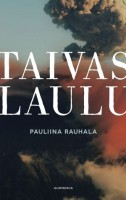 Taivaslaulu
[Heaven song]
Helsinki: Gummerus, 2013. 281 pp.
ISBN 978-951-20-9128-7
€29.90, harcback
A religious revivalist movement is the framework for this skilfully written first novel. A young couple, Vilja and Aleksi, dream of a brood of children. Nine years and four children later Vilja feels that all joy and strength has drained away from her life. Living the reality of their religion’s ban on family planning, the couple is hit hard by the fact that Vilja is expecting twins. This is too much for her; she feels crushed by anxiety and fatigue. The ethical ground of parenthood, the good and bad sides of a religious community as well as the myths and expectations surrounding motherhood are Rauhala’s main themes. This impressive tale also contains a love story; Aleksi is a credible and sympathetic husband who first and foremost wants to believe in his wife and his family.
Mikko-Olavi Seppälä & Riitta Seppälä: Aale Tynni. Hymyily, kyynel, laulu [Aale Tynni. A smile, a tear, a song]
16 January 2014 | Mini reviews, Reviews
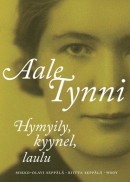 Aale Tynni. Hymyily, kyynel, laulu
[Aale Tynni. A smile, a tear, a song]
Helsinki: WSOY, 2013. 488 pp., ill.
ISBN 978-951-0-38306-3
€37, hardback
The poet, author and translator Aale Tynni (1913–1997), an Ingrian Finn who came to Finland as a refugee after the First World War in 1919, published 15 collections of poetry between 1938 and 1987. Among her translations are works by Ibsen, Shakespeare, Yeats and Racine. This extensive biography, compiled and written by Tynni’s daughter Riitta Seppälä and her grandson, historian Mikko-Olavi Seppälä, is an in-depth, lively portrait of a poet who, in her time, was both admired and criticised for her choices of form and content. Tynni felt that classical metrical tradition was closest to her, and patriotism was one of her themes; however, in the postwar years the freedom of rhythm of Finnish modernism began to flourish, and politics also gained strength in the literary world. In 1948 Tynni won the gold medal for literature in the – rather bizarre and short-lived – art competitions at the Summer Olympics in London with her poem ‘Laurel of Hellas’. Tynni experienced dramatic turns in her personal life; she underwent a prolonged divorce from her first husband who bitterly fought it. Two of her three children committed suicide in adulthood. She was finally free to marry the widowed poet Martti Haavio (aka P. Mustapää) in 1960, a marriage of soulmates that lasted until Haavio’s death in 1973.
In memoriam Herbert Lomas 1924–2011
23 September 2011 | In the news
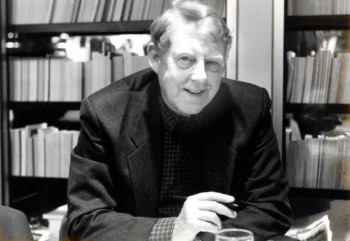
Herbert Lomas. Photo: Soila Lehtonen
Herbert Lomas, English poet, literary critic and translator of Finnish literature, died on 9 September, aged 87.
Born in the Yorkshire village of Todmorden, Bertie lived for the past thirty years in the small town of Aldeburgh by the North Sea in Suffolk. (Read an interview with him in Books from Finland, November 2009.)
After serving two years in India during the war, Bertie taught English first in Greece, then in Finland, where he settled for 13 years. His translations – as well as many by his American-born wife Mary Lomas (died 1986) – were published from as early as 1976 in Books from Finland.
Bertie’s first collection of poetry (of a total of ten) appeared in 1969. His Letters in the Dark (1986) was an Observer book of the year, and he was the recipient of several literary prizes. His collected poems, A Casual Knack of Living, appeared in 2009.
In England Bertie won the Poetry Society’s 1991 biennial translation award for one of his anthologies, Contemporary Finnish Poetry. The Finnish government recognised his work in making Finnish literature better known when it made him a Knight First Class of Order of the White Rose of Finland in 1987.
To Books from Finland, he made an invaluable contribution over almost 35 years – an incredibly long time in the existence of a small literary magazine. The number of Finnish authors and poets whose work he made available in English is countless: classics, young writers, novelists, poets, dramatists.
Bertie’s speciality was ‘difficult’ poets, whose challenge lay in their use of end-rhymes, special vocabulary, rhythm or metre. He loved music, so the sounds and tones of words, their musicality, were among the things that fascinated him. Kirsi Kunnas’ hilarious, limerick-inspired children’s rhymes were among his best translations – although actually nothing in them would make the reader think that the originals might not have been written in English. A sample: There once was a crane / whose life was led / as a uniped. / It dangled its head / and from time to time said:/ It would be a pain / if I looked like a crane. (From Tiitiäisen satupuu, ‘Tittytumpkin’s fairy tree’, 1956, published in Books from Finland 1/1979.)
Bertie also translated work by Eeva-Liisa Manner, Paavo Haavikko, Mirkka Rekola, Pentti Holappa, Ilpo Tiihonen, Aaro Hellaakoski and Juhani Aho among many, many others; for example, the prolific writer Arto Paasilinna’s best-known novel, Jäniksen vuosi / The Year of the Hare, appeared in his translation in 1995. Johanna Sinisalo’s unusually (in the Finnish context) non-realist troll novel Ennen päivänlaskua ei voi / Not Before Sundown, subsequently translated into many other languages, appeared in 2003. His last translation for Books from Finland was of new poems by Vilja-Tuulia Huotarinen in 2009.
It was always fun to talk with Bertie about translations, language(s), writers, books, and life in general. He himself said he was a schoolboy at heart – which is easy to believe. He was funny, witty, inventive, impulsive, sometimes impatient – and thoroughly trustworthy: he just knew how to find the precise word, tone of voice, figure of speech. He had perfect poetic pitch. As dedicated and incredibly versatile translators are really hard to find anywhere, we all realise our good fortune – both for Finnish literature and for ourselves – to have worked, and enjoyed with such enjoyment, with Bertie.
Poet Aaro Hellaakoski (1893–1956) was not a self-avowed follower of Zen, but his last poems, in particular, show surprisingly close contacts with the philosophy. ‘Secrets of existence are revealed once one ceases seeking them’, the literary scholar Tero Tähtinen wrote in an essay published alongside Bertie’s new Hellaakoski translations in (the printed) Books from Finland (2/2007). Bertie was fond of Hellaakoski, whose existential verses fascinated him; among his 2007 translations is The new song (from Vartiossa, ‘On guard’, 1941):
The new song |
Uusi laulu |
| No compulsion, not a sting. | Ei mitään pakota, ei polta. |
| My body doesn’t seem to be. | On ruumis niinkuin ei oisikaan. |
| As if a nightbird started to sing | Kuin alkais kaukovainioilta |
| its far shy carol from some tree – | yölintu arka lauluaan |
| as if from its dim chrysalis | kuin hyönteistoukka heräämässä |
| a little grub awoke to bliss – | ois kotelossaan himmeässä |
| or someone struck from off his shoulder | kuin hartioiltaan joku loisi |
| a miserable old bugaboo – | pois köyhän muodon entisen |
| and a weird flying creature | ja outo lentäväinen oisi |
| stretched a fragile wing and flew. | ja nostais siiven kevyen. |
| Ah limitless bright light: | Oi kimmellystä ilman pielen. |
| the gift of lyrical flight! | Oi rikkautta laulun kielen. |