

Search results for "tommi+musturi/2010/05/song-without-words/2009/09/what-god-said"
Hannele Huovi: Karvakorvan runopurkki [Furry pooch’s jar of verse]
4 March 2009 | Mini reviews
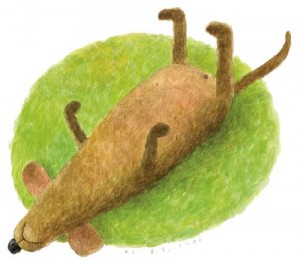 Karvakorvan runopurkki
[Furry pooch’s jar of verse]
Kuvitus [Ill. by]: Kristiina Louhi
Helsinki: Tammi, 2008. 79 p.
ISBN 978-951-31-3974-2
€ 23.30, hardback
‘Methinks,/ said the sausage dog / who loved eating verse, that / poetry is tastier than bone’. Hannele Huovi (born 1949) has written poetry, books for children, novels and fables. The masterly rhymes of Finland’s grand old lady of children’s poetry, Kirsi Kunnas (born 1924), are hard to match, but Huovi comes close. For her, Finnish is easily pliable; her rhymes do not try to be too clever, her tone of voice is warm and humorous, and often the poems are little stories in the tradition of nonsense verse. Huovi’s sense of humour matches perfectly with Kristiina Louhi’s pastel pictures which often add surprising dimensions to the poetic stories. ‘So complete / trust can be: / with your paws skywards, /with your belly bared, you can / lie in the grass.’
Sofi Oksanen wins the 2008 Finlandia Prize
10 February 2009 | In the news

Sofi Oksanen. - Photo: Toni Härkönen/WSOY.
The Finlandia Prize for Fiction, Finland’s most prestigious literary prize, was awarded to Sofi Oksanen’s novel Puhdistus (‘Purge’, WSOY, 2008). ‘When the concentrated focus of drama and the multidimensionality of narrative conjoin, Puhdistus is born – a muscular, harsh, and solid book’, said the writer and critic Pekka Tarkka awarding the prize on 4 December. (For a short review, see the Review section.)
The prize, worth € 30,000, was awarded for the twenty-fifth time. The final choice was made from the shortlist of six candidates; the others were 14 solmua Greenwichiin (‘14 knots to Greenwich’, Otava) by Olli Jalonen, Kosmonautti (‘The cosmonaut’, Tammi) by Katri Lipson, Marie (Otava) by Arne Nevanlinna, Kohtuuttomuus (‘Excess’, Siltala) by Pirkko Saisio and Paholaisen haarukka (‘The Devil’s fork’, WSOY) by Juha Seppälä. More…
Finlandia Prize for Fiction 2011
1 December 2011 | In the news
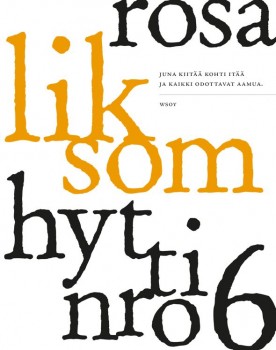 The winner of the Finlandia Prize for Fiction 2011, worth €30,000, is Rosa Liksom, for her novel Hytti no 6 (‘Compartment number 6’, WSOY): read translated extracts and an introduction of the author here on this page.
The prize was awarded on 1 December. The winner was selected by the theatre manager Pekka Milonoff from a shortlist of six.
‘Hytti nro 6 is an extraordinarily compact, poetic and multilayered description of a train journey through Russia. The main character, a girl, leaves Moscow for Siberia, sharing a compartment with a vodka-swilling murderer who tells hair-raising stories about his own life and about the ways of his country. – Liksom is a master of controlled exaggeration. With a couple of carefully chosen brushstrokes, a mini-story, she is able to conjure up an entire human destiny,’ Milonoff commented.
Author and artist Rosa Liksom (alias Anni Ylävaara, born 1958), has since 1985 written novels, short stories, children’s book, comics and plays. Her books have been translated into 16 languages.
Appointed by the Finnish Book Foundation, the prize jury (journalist and critic Hannu Marttila, journalist Tuula Ketonen and translator Kristiina Rikman) shortlisted the following novels: Kallorumpu (‘Skull drum’, Teos) by Eeva-Kaarina Aronen, William N. Päiväkirja (‘William N. Diary’, Otava) by Kristina Carlson, Huorasatu (‘Whore tale’, Into) by Laura Gustafsson, Minä, Katariina (‘I, Catherine’, Otava) by Laila Hirvisaari, and Isänmaan tähden (‘For fatherland’s sake’, first novel; Teos) by Jenni Linturi.
Rosa Liksom travelled a great deal in the Soviet Union in the 1980s. She said she hopes that literature, too, could play a role in promoting co-operation between people, cultures and nations: ‘For the time being there is no chance of some of us being able to live on a different planet.’
The politics of difference
17 June 2011 | Non-fiction, Tales of a journalist
Right or wrong, my country? Illustration: Joonas Väänänen
Right or wrong, my country? Illustration: Joonas Väänänen
Big electoral turnouts are generally considered a good thing. But, writes columnist Jyrki Lehtola, in Finland the fact that the vote went up in the last Finnish general election caused a revelation. Educated urbanites and the media (perhaps near enough the same thing), are shocked by how 20 per cent of their fellow Finns think – and the ramifications caused tremors all across Europe
Listen up. Diversity is a resource. Except of course if it’s the sort of diversity that is a resource for the wrong people.
That sort of diversity isn’t the least bit nice. In Finland in the spring, we ran into the sort of diversity that even got the rest of Europe to start worrying. Out in the thickets and forests, diverse people had been springing up in secret, people of whose existence we urbanites were entirely unaware.
And they threatened to bring Europe down. Europe. Which was a bit much. More…
New from the archives
5 May 2015 | This 'n' that
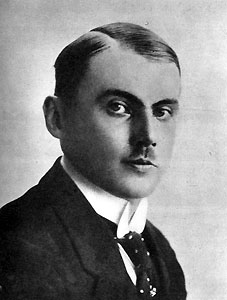
Runar Schildt
It’s a period that seems sometimes to have disappeared from view – Helsinki in the final years of Russian rule – but Runar Schildt’s short story brings it vividly to life. The characters – Sahlberg the baker and his mortal enemy, Johansson from the customs service; the restaurant-owner Durdin and Elsa, daughter of a commissionaire at the Senate, around whom the story revolves – spend a lazy but sexually charged summer Sunday in their villas just outside Helsinki, their hidden emotions all too familiar to those of a later age…
As the story’s translator, the formidably erudite George C. Schoolfield, remarks in his introduction, Runar Schildt (1888-1925) has often been hailed as a Finland-Swedish classic. There’s a quality of aesthetic decadence in his work that makes him very much a product of his time. There’s nothing, in Raketen, with its solid, belle epoque atmosphere, to foreshadow the change that was so soon to engulf Finland, with the granting of independence in 1917 and the bitter civil war that followed. Schildt was in Helsinki during the months when it was ruled by the Red side in the civil war; afterwards, he served as a clerk in the terrible detention camp for Red prisoners of war on Suomenlinna island. It was a new world, in which all the old certainties were questioned. Timid, conservative and something of a dandy (his friend Hans Ruin said he always looked as if he had stepped out of a bandbox), Schildt may well have felt out of tune with the times. By 1920 he had ceased to write the prose at which he excelled, and had turned to drama, with which he had much less success.
Schildt shot himself, in 1925, in the courtyard of the old university clinic in Helsinki. He was not yet 40.
Thirsty for poetry
22 May 2014 | This 'n' that
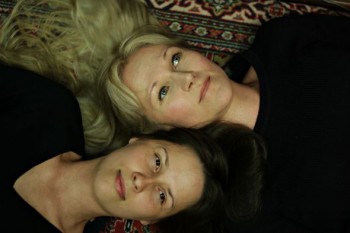
Johanna Venho (above) and Vilja-Tuulia Huotarinen. Photo:
Jano (‘Thirst’) is the name for a new online magazine: according to the writers and poets Johanna Venho and Vilja-Tuulia Huotarinen, its editors, it is a ‘poetry journal for all’ – for poets, the general public, for anybody.
Two issues have been published since November 2013. The theme of the first one is Time, of the second, Place.There are interviews, autobiographical texts, texts by critics and poets. More…
Cycling through a rainbow
30 March 2006 | Fiction, poetry
From Läsning för vandrare (‘Reading for hikers‘, Schildts, 1974). Introduction by Maria Antas
1
The people I was fond of have been
     wiped from my memory.
Do you remember a friend, perhaps?
     Be glad, then, you are still alive.
7
The one who has owned a room in
     someone's heart
is easily reconciled with the thought
     of eventually
gaining a room in the earth's bosom.
8
Love is only a preparation. More…
How to win literary prizes
30 September 1991 | Archives online, Fiction, Prose
A short story from Terveessä ruumiissa (‘In a healthy body’, Gummerus, 1990)
Later, as he mulled over the moments just before it all happened – with himself delivering his appreciative peroration to the prizewinner in the front row – the Chairman of the Prize Committee could recall no warning sign. Antti was tense, of course, but, considering his artistic sensitivity and the hundred-strong audience, there was nothing abnormal about that.
The Chairman was improvising from scanty notes: only the finishing touch was written out in full:
‘And so, with immense gratitude, we shall store up your many achievements in our hearts and minds.’ More…
Goodbye darling
30 March 2005 | Fiction, poetry
Poems from Niin kovaa se tuuli löi (‘So bitterly the wind struck’, Tammi, 2004)
Lord, you've promised to come, don't hang back.
     Here we are already, sitting, me and the dogs,
   and the others that have to go.

Jesus, poor thing, didn't know whom to bloom for,
  just kept on lugging his cross, pretty as a pony.
    He came and shot us down,
   bullets flying without his even noticing.
      The night was gifted with roses
        full of love.
 Through a woman we came here, through a man
    we leave.
On subterranean spaces
30 August 2013 | Authors, Reviews

Zinaida Lindén. Photo: Janne Aaltonen
A melancholic diplomat’s wife in Turku recalls her childhood in 1970s Leningrad. This is how one might describe the new novel by Zinaida Lindén – then one might be surprised encountering nuance after nuance that challenge our expectations.
The melancholy in Lindén’s novel isn’t soft and misty; it is sharp and metallic. The life of the protagonist Galina, a diplomat’s wife, is far from glamorous, and consists mostly of standing over the ironing board in the family’s one-bedroom flat, ironing shirts for her conscientious and overworked husband at the consulate. The 1970s Leningrad of her memories is not an arena for ideology or culture, but serves as the backdrop for an intimate familial drama, in which the child always remained on the outside and was eventually left alone after the death of her parents. More…
In good company
18 October 2013 | This 'n' that
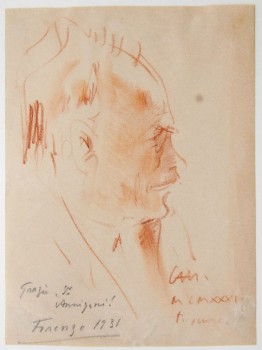
Portrait of an artist: Joel Lehtonen, sketched by Pietro Annigoni in Florence, 1931. Picture: literary archives of the Finnish Literature Society
Margaret, Countess of Snowdon (Princess Margaret, 1930–2002), Joel, Master of Putkinotko (1881–1934), and Philip, Duke of Edinburgh (born 1921) met in the same museum case in Florerence in October, when an exhibition of the work of the artist Pietro Annigoni (1910–1988) was opened.
The morganatic juxtaposition of the English royals and the Finnish writer is based on Annigoni’s reputation as one of the best-known portraitists of the 20th century, in whom the royal courts of England and Denmark, among others, placed their trust.
Joel Lehtonen, author of the novel Putkinotko (‘Hogweed Hollow’, the name also refers to a place) and classic of Finnish literature, is included on account of the fact that, in celebrating his fiftieth birthday in Florence in 1931, he partied throughout the night with students from the Accademia di Belle Arte ‘to the rhythm of an excellent Chianti’.
Also present was the young Piero Annigoni, who, in a cellar restaurant, took out his working tools. A red-chalk portrait of Lehtonen was the result, along with a series of dancing girls drawn in Indian ink. ‘It was five in the morning before I realised,’ Lehtonen wrote back to Finland.
Lehtonen had already spent a year in Italy in 1908 translating Boccaccio’s The Decameron, which, to his annoyance, was censored by the publisher. He published a volume of poetic prose based on his Italian experiences, Myrtti ja alppiruusu (‘The myrtle and the rhododendron’), of which one section is dedicated to Florence, that ‘glittering, passionate city of the spirit’.
Young Florentine artists were used to world-class artists. When the poet Dylan Thomas visited the city in the 1940s, the poet and author Luigi Berti – an acquaintance of Lehtonen’s – complained that ‘poets travelling in Italy no longer give themselves the airs of “milords” – behave like Lord Byron.’ Lehtonen, however, was able to party stylishly and thoroughly in a way that appears to have pleased the sons of Florence.
As he set off on the return journey to Finland, Lehtonen wrote to his wife: ‘An embarrassing day is over’, ‘I am in fine spirits! Heat the sauna.’ He brought with him Annigoni’s works, which are now in the archive of the Finnish Literature Society.
The curator of the Florence exhibition found more sketches of Lehtonen in the Museo Annigoni: in the current show, they are placed alongside sketches of Princess Margaret and Prince Philip.
The opening of the exhibition, in the premises of the Ente Cassa di Risparmio di Firenze, was attended by 300 of the city’s elite. It was as if the nobility of the portraits of the Uffizi art gallery had stepped out of their frames to honour Annigoni, whose paintings continued the traditions of the renaissance. The Corriere della Sera and La Repubblica gave prominent coverage to the event. The young politician and Florence mayor Matteo Renzi said in his speech that in northern Italy Annigoni’s significance to art is parallel to that of Olivetti to industry.
Annigoni’s early portraits of Lehtonen are shown in a section entitled Opere rare o inedited. The 240-page catalogue also includes brief description of Lehtonen as a writer and an account of that night in Florence in 1931.
Translated by Hildi Hawkins
Lassi Nummi in memoriam 1928–2012
16 March 2012 | In the news
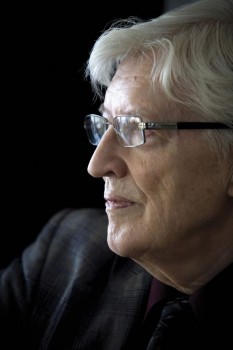
Lassi Nummi. Photo: Jouni Harala
Poet and author Lassi Nummi died on 13 March at the age of 83.
His first collection of poems, Intohimo olemassaoloon (‘A passion for existence’) appeared in 1949. Nummi worked as a journalist, chairman of the Finnish PEN Club and as a member of the Bible translation committee.
Nummi published a couple of prose works and more than two dozen collections of poems; in an interview by Tarja Roinila* he said he was ‘a prose writer who has strayed into poetry’ and that he regarded himself ‘a fairly old-fashioned poet’.
Nummi attempted to find a synthesis between traditionalism and modernism – the prevailing ‘ism’ in the 1950s Finland – and wrote both metrical, traditional and speech-like, free verse.
Religious, philosophical and existential themes are found in his poetry, strongly featuring imagery of nature, music and travelling. His poems have been translated into six languages.
Nummi’s two sons, Markus and Ilari, became artists as well – Markus, an author, Ilari, a filmmaker.
Above and through everything
Above and through everything
the thin web of life. On an evening like this,
its strands
are stretched to breaking
under the moment’s significange, the light’s
weight. So much empty space,
so much lovely desolation
freed from significance
in us, in the world,
it makes you grow faint.
And here, all dreams have to be dreamed by oneself!
When I am dead, a stone
will dream my dreams.
From Hengitys yössä (‘Breathing in the night’, 1995), translated by Anselm Hollo , *) published in Books from Finland 1/1998