

Search results for "tommi+musturi/2010/05/song-without-words/2009/09/what-god-said"
New from the archives
29 January 2015 | This 'n' that
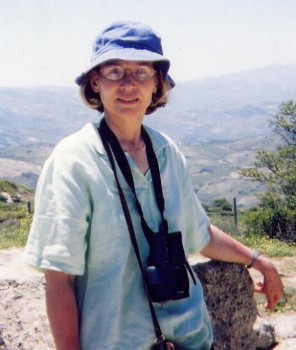
Ulla-Lena Lundberg
Low-lying, sea-girt pieces of rock strewn across the sea midway between Finland and Sweden, the Åland Islands – known in Finnish as Ahvenanmaa – are a world unto themselves. In mind and spirit they are separate from both Finland (to which they technically belong) and Sweden, giving their inhabitants, writers included, a fascinating outsider status.
This week’s archive find, an extract from Leo, the first volume of Ulla-Lena Lundberg’s trilogy set in 19th-century Åland, offers a compelling portrait of the potent mix of cosmopolitanism and (literal) isolation of the islands’ seafaring community, in which the men sail the seas and the women stay at home.
Born on Åland in 1947, Lundberg is a writer of novels, short stories, poems and other essays; her work, she says, derives from her habit of sitting under the table as a small child and listening to what the grown-ups said. She received the Finlandia Prize in 2012 for her novel Is [‘Ice’], and the Tollander Prize in 2011.
*
The digitisation of Books from Finland continues apace, with a total of 354 articles and book extracts made available online so far. Each week, we bring a newly digitised text to your attention.
Panu Rajala: Naisten mies ja aatteiden. Juhani Ahon elämäntaide [A ladies’ man of ideas. Juhani Aho’s art of living]
26 January 2012 | Mini reviews, Reviews
 Naisten mies ja aatteiden. Juhani Ahon elämäntaide
[A ladies’ man of ideas. Juhani Aho’s art of living]
Helsinki: WSOY, 2011. 441 p., ill.
ISBN 9789510374412
€ 35, hardback
Of Juhani Aho (1861–1921) it is said that he created what have proved to be the most enduring descriptions of how traditional Finland began to be modernised; his most famous book is the novella Rautatie (‘The railway’, 1884) which portrays the arrival of the railway in the Finnish countryside. This new biography also shows once again how many international influences can be found in the work of Aho, who is often called a national author. Aho was active in student politics, and as a newspaper journalist. He was nominated for the Nobel Literature Prize twelve times, but for various reasons, some of them connected with language politics, lobbying on his behalf was not successful. Aho developed Finnish prose, bringing to it realism and impressionistic style. His experiences during a visit to Paris in 1889 form the basis of his novel Yksin (‘Alone’), which caused a stir in part because of its erotic flavour. This book by the author and literary scholar Panu Rajala provides a versatile insight into Aho’s personal story, the world of his ideas, his opinions on art, and his complex relationships.
Translated by David McDuff
Daring to dream
30 June 2004 | Fiction, poetry
Poems from Vaaksan päässä taivaasta (‘A span away from heaven’, Teos, 2004)
In the evenings they lit a candle on the cat’s grave
In the daytime they made a cosmological model
with a skipping rope
feet tapped the rhythm and its shadow
the rope slapped against the street
once in a while a rock flew
against a concrete wall
plunged from the oval galaxy’s edge
to the edge of space. More…
Reality versus morality
30 September 1982 | Archives online, Authors
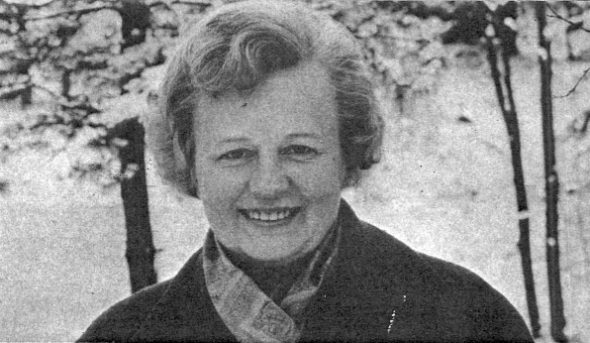
Eila Pennanen. Photo: Anonymous (Suomen Kuvalehti 1965) via Wikimedia Commons
Reviewing Eila Pennanen‘s second collection of essays, which appeared earlier this year under the delightfully ambiguous title of Kirjailijatar ja hänen miehensä (‘The authoress and her… man? … men? … husband?… husbands?’), a critic called attention to the heading she had chosen for her essay on Bernard Malamud: ‘Malamud’s ignoble hero’. His comment on this was that the moral judgment implicit in such a title would be both pointless and valueless if Pennanen had maintained it with logical consistency throughout the essay. If in fact she does no such thing, it is because she knows how to look at a character, however ignoble, with an eye for subtleties and a great deal of psychological insight. This is something one often notices about Eila Pennanen: she is apt to begin by labelling somebody or something ‘good’ or ‘bad’, and even to sound quite defiant about it, but she is never, in the end, content to leave it at that. I once heard her give a lecture on Joel Lehtonen. She startled her audience by the vehemence with which she avowed the feelings of loathing or sympathy aroused in her by characters or events in Lehtonen’s books. Her cheeks blazed as she talked. Then, just as unexpectedly, she chided herself for exaggerating, took back a lot of what she had said, laid bare the reasons for Lehtonen’s contradictoriness, and left her hearers in a condition of fruitful perplexity. Whatever they may have thought or felt about the ‘moral approach’ to criticism, they were left in no doubt as to the wit and intelligence of its leading Finnish exponent. More…
Bring on the white light
12 December 2013 | Fiction, Prose
Extracts from the novel Auringon ydin (‘The core of the sun’, Teos, 2013). Introduction by Outi Järvinen
Jare, March 2017
‘We call the chilli the Inner Fire that we try to tame, just as our forefathers tamed the Worldly Fire before it.’
Mirko pauses dramatically, and Valtteri interrupts. ‘Eusistocratic Finland offers us unique opportunities for experimentation and development. Once all those intoxicants affecting our neurochemistry and the nervous system have been eradicated from society, we will be able to conduct our experiments from a perfectly clean slate.’
‘We fully understand the need to ban alcohol and tobacco. These substances have had significant negative societal impact. And though in hedonistic societies it is claimed that drinks such as red wine can, in small amounts, promote better health, there is always the risk of slipping towards excessive use. All substances that cause states of restlessness and a loss of control over the body have been understandably outlawed, because they can cause harm not only to abusers themselves but also to innocent bystanders,’ Mirko continues.
This is nothing new to me, but I must admit that the criminalisation of chillies has always been a mystery to me. By all accounts it is extremely healthy and contains all necessary vitamins and antioxidants. A dealer that I met once told me that people in foreign countries think eating chillies can lower blood pressure and cholesterol levels – and even prevent cancer. If someone makes a pot of tom yam soup, sweats and pants over it and enjoys the rush it gives him, how is that a threat, either to society or to our health? More…
The Storm • September
30 September 1982 | Archives online, Fiction, Prose
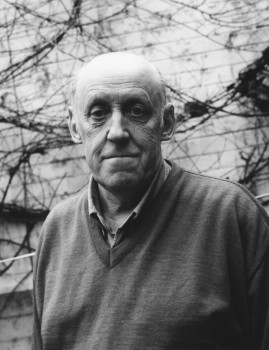
Bo Carpelan. Photo: Charlotta Boucht
Extracts from Jag minns att jag drömde (‘I remember dreaming’, 1979)
The Storm
I remember dreaming about the great storm which one October evening over forty years ago shook our old schoolhouse by the park. My dream is filled with racing clouds and plaintive cries, of roaring echoes and strange meetings, a witch’s brew still bubbling and hissing in the memory of those great yellow clouds.
Our maths teacher – a small sinewy woman who seemed to have swallowed a question mark and was always wondering where the dot had gone, so she directed us in a low voice and with downcast eyes as if we didn’t exist – and yet her little black eyes saw everything that happened in the class, and weasel-like, were there if anyone disobeyed her – was writing the seven times table on the blackboard, when a peculiar light filled our classroom. We looked across at the window; the whole schoolhouse seemed to have been suddenly transformed into a railway station, shaking and trembling, a whistling sound penetrating the cold thick stone walls, and at raging speed, streaky clouds of smoke were sliding past the window, hurtling our classroom forward as if we were in an aeroplane. Our teacher stopped writing and raised her narrow dark head. Without a word, she went over to the window and stood looking out at the racing clouds. More…
Do you speak my language?
23 August 2012 | Articles, Non-fiction
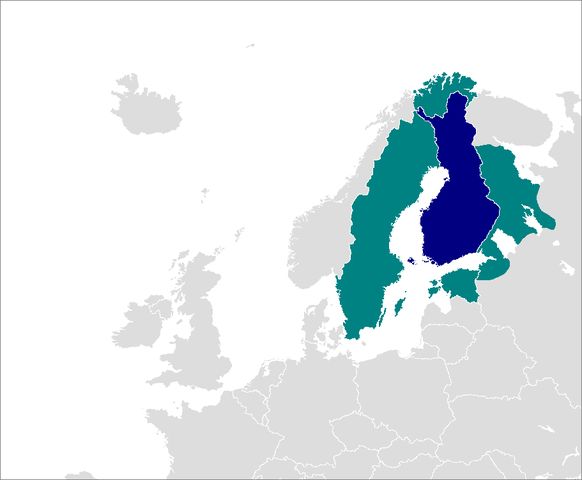
Finnish spoken outside Finland: Sweden (west), Estonia (south), Karelia/Russia (east), Norway (north). Illustration: Zakuragi/Wikipedia
Finland has two official languages, Finnish and Swedish. Approximately five per cent of the population (290,000 Finns) speak Swedish as their native language. All Finns learn both languages at school, and students in higher education must prove they have an adequate knowledge of the other mother tongue. But how do native speakers of Finnish cope with what is, for many of them, a minority language that they will never need or even wish to use? We take a look at bilingual issues – and a new book devoted to them
‘In many parts of the world, language can be a fiery and divisive issue, one that pits the powerless against the powerful, the small against the big. The Basques battle the Spanish. The Flemish tussle with the Walloons. The Québécois scuffle with the rest of Canada.’
That is how Lizette Alvarez illustrated her theme in her article ‘Finland Makes Its Swedes Feel at Home’, published in the New York Times in 2005.
In Finland, language has been a fiery issue at times, though things have cooled down a bit since the early 20th century. The use of Finnish as a written language dates back to the 16th century, but the territory of Finland was part of the Swedish Empire until 1809. Swedish was spoken by the nobility as well as most of the peasant class – the mechanism of the state did not serve Finnish-speaking peasants or other segments of the population in Finnish. More…
Colour me beautiful?
29 June 2015 | This 'n' that
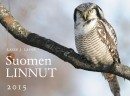 The May list of the ten best-selling non-fiction books compiled by Suomen Kirjakauppaliitto (the Finnish Booksellers’ Association; the list is in Finnish only) included five books on food (smoothies in particular); number one was Suomen linnut (‘The birds of Finland’) by Lasse J. Laine (Otava). Every summer people occasionally seem to remember to look up from their electronic gadgets to spot birds in the sky, wondering what they are.
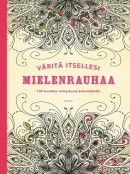 Number three was a book called ‘Find mindfulness by colouring’ (Väritä itsellesi mielenrauhaa, Atena).
Colouring books like this one have now become enormously popular; Johanna Basford’s books, for example, have sold millions of copies in various countries.
Has the oh-so-trendy ‘mindfulness’ has now become so frantically pursued that colouring patterns represent a kind of instant, fast-food-type mandala substitute?
Number six on the best-seller list was The 1000 Dot-to-Dot Book by Thomas Pavitte. Haven’t we all done these as little kids: after connecting, tongue in cheek, the dots with a erroneous pencil, a picture of a doggy or a flower, miraculously, appeared on the page? Yes: for adults it’s doggies, too, but also Elvis Presley, Muhammad Ali, Madonna or John F. Kennedy, or the Eiffel Tower (coming up soon, masterpieces of the world art).
Also available is a Kama Sutra dot-to-dot book (first published by Random House: ‘…this wickedly witty book only exposes its 30 exotic positions to the most persistent hands. Put a little lead in your pencil and get stuck in’).
‘It lets me feel like a “real” artist even though it is a simple dot to dot’, said one customer on Amazon’s pages, where the books are sold with the following sales patter: ‘…much more sophisticated than the one-dimensional images created in childhood connect-the-dot activity books…. Dot-to-dot puzzles have also been proven to increase short-term cognitive acuity, hand-eye coordination, and concentration skills.’
Readers say they feel that they ‘realise their creativity’. Uh-huh? (A scary prospect: some say they might even give their finished pictures to friends as gifts.) It isn’t creative though – rather, contemplative. Or was that navel-gazing…
These trends were interpreted in a recent article in the Swedish newspaper Dagbladet as demonstrating the infantilisation of contemporary society. People want to flee from their stressful grown-up duties (life, reality…) – by retreating (or regressing) to their own simple childhood pastimes?
How about, instead of doting on connecting dots to make time pass, people made live contacts with childhood, i.e. real children, or friends, or read a real book? Their brains would benefit more – and so would their mindfulness.
Finlandia Junior Prize 2012
5 December 2012 | In the news
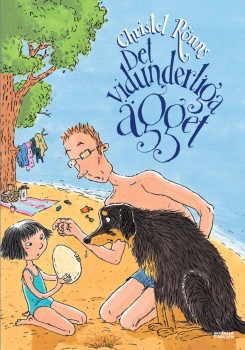 The Finlandia Junior Prize 2012 went to the illustrator and writer Christel Rönns for her book Det vidunderliga ägget (‘The extraordinary egg’, Söderströms & BonnierCarlsen).
The winner was chosen from the shortlist of six by the film director and actor Mari Rantasila. Awarding the prize, worth €30,000, on 29 November she said:
‘The book has masterly, original and clear illustrations that support the story; the drawings include amusing details. It is refreshing to read a story about a family that all pulls in the same direction.
‘Det vidunderliga ägget deals with important matters, in a way that is suitable for small children: toleration of difference and the difficulty of loss, underlining that difference is not frightening or negative.’
The following five books also made it to the shortlist: Nörtti: new game (‘The nerd: new game’, Otava), about a schoolboy, bullying and social media by Aleksi Delikouras, Tatu ja Patu pihalla (‘Tatu and Patu on the yard’, Otava), a new picture book in the series about two curious little boys by Aino Havukainen and Sami Toivonen, Hurraa Helsinki! (‘Hurrah Helsinki!’, Tammi), a picture book about Helsinki by Karo Hämäläinen and Salla Savolainen, Puhelias Elias (‘Talkative Elias’, Tammi), an illustrated story about a little boy and his parent’s separation by Essi Kummu and Marika Maijala, and Kirkkaalla liekillä (‘With a bright flame’, Robustos), about 15-year-old Maaria, who lives through difficult times, by Venla Saalo.
Burnt orange
30 September 1992 | Archives online, Drama, Fiction
Extracts from the play Poltettu oranssi (‘Burnt orange‘): ‘a ballad in three acts concerning the snares of the world and the blood’. Introduction by Tuula Hökkä
The scene is a small town in the decade before the First World War
Cast:
DR FROMM
an imperial,bearded middle-aged gentleman
ERNEST KLEIN
a moustached, ageing, slightly shabby leather-manufacturer
AMANDA KLEIN
his wife, well-preserved, forceful, angular
MARINA KLEIN
their daughter, shapely, withdrawn, wary
NURSE-RECEPTIONIST
open, direct, not too ‘common’
ACT ONE
Scene two
After a short interval the receptionist opens the door and ushers Marina Klein into the surgery. Exit the receptionist. Marina immediately goes to the end of the room and presses herself against the white wall. The white surface makes her look very isolated in her ascetic black dress. The Doctor, who now appears to be headless – an impression produced by the lighting and the yellowish background – half-turns towards her. More…
Juha Mannerkorpi (1915–1989) and the metamorphosis of the self
30 June 1982 | Archives online, Authors
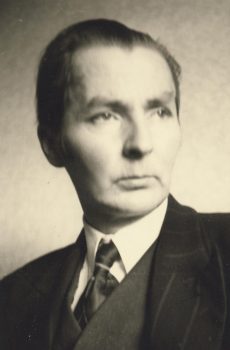
Juha Mannerkorpi. Photo: SKS Archives
The chapter, entitled ‘About calendars and other documents’, is a section of Juha Mannerkorpi’s book, Sudenkorento eli erään pakaraisen esittävät seikkailut (‘The dragonfly, or the representative adventures of a certain buttocks’, 1970). The main character is a writer, Caleb Buttocks, a long-term diabetic who can get around only on crutches and spends most of his days sitting in his room smoking and drinking beer. Pain and depression are his daily companions.
In the beginning, Caleb Buttocks attempts a real adventure: lifting himself out of the swamp like Baron von Münchhausen and going on an outing with his wife. The adventure comes to a bad end; he is not up to it. Thereafter, he has to be content with ‘representative adventures’: dreams, memories, and nightmares which are interwoven with the present time.
Sudenkorento is largely a first-person narrative which operates on many levels and the language of which is exceptionally rich. The narrator makes use of many different elements: fairy tales, poems, fantasies realistic narratives, and reminiscences. Sudekorento can be considered the most important book by Juha Mannerkorpi (1915-1980), and represents a synthesis of his earlier writing, which includes some twenty works since 1946: poems, plays, radio-plays, novels, and short stories. After the publication of Sudenkorento Mannerkorpi wrote a short diary-like work, Päivänsinet (‘Heavenly blue’, 1979), a study of the will to live in the shadow of a serious illness, diabetes, which is a subject he often dealt with in his work. Characteristic of Mannerkorpi’s writing are his analyses of the relationship of the self with the world and his explication of existential questions. In the European literary milieu, he is closest to Camus, Sartre and Beckett, all of whom he has translated into Finnish. More…
New from the archive
29 June 2015 | This 'n' that
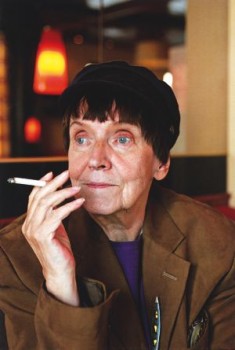
Mirkka Rekola. Photo: Elina Laukkarinen/WSOY
Enigmatic stories, poems and aphorisms by Mirkka Rekola
This week, poems and aphoristic short stories by Mirkka Rekola (1931-2015).
Rekola, as the long-time Books from Finland translator Herbert Lomas put it, was ‘a minimalist before minimalism was invented’. Amazingly enough, her sparklingly terse writing was considered ‘difficult’, and she had to wait until the 1990s before her work was widely read.
Rekola produced her first collection, Vedessä palaa (‘Burning water’) in 1954, making the cardinal mistake of choosing as publisher the conservative WSOY rather than the avant-garde Otava. The book received mixed reviews; as she said, ‘for readers of traditional verse I was completely unfamiliar, while for ultra-modernists I was not modern enough.’
All the work we revisit here shows the extraordinary vividness, accuracy and exuberance of her writing – both in the poems and the often ruefully funny short stories called ‘Mickeys’.

The Books from Finland digitisation project continues, with a total of 402 articles and book excerpts made available on our website so far. Each week, we bring a newly digitised text to your attention.
Poems
31 December 1977 | Archives online, Fiction, poetry
Poems from Tanssilattia vuorella (’The dancing-floor on the mountain’). Introduction by Pekka Tarkka
I
Having studied
Krinagoras
the flower of Philippos’ wreath
under the vaults in a cool library far away in silence
I have gone to see the boat how it is coming on
whether it will be in working order next summer
we have no strong men
have sat on the beach-hut steps thinking of him
the politician the negotiator:
poetry is a holding of council, an art of negotiation More…