

Search results for "tommi+musturi/2010/05/song-without-words/2009/09/what-god-said"
The search goes on
31 December 2007 | Archives online, Essays, On writing and not writing
The Finlandia Prize-winning author Kjell Westö recalls his literary adolescence, and the moment – of a dark January night – when he stopped worrying about writer’s block and began to write
When I was in my twenties, my urge to write was very strong. I was driven, almost consumed, by this ever-present zeal, which tore me apart nearly as inexorably and effectively as love did. But I wrote precious little. Now, some twenty years later, I have a general idea about the traps I so unknowingly walked into. More…
Onward, downward!
31 March 1994 | Archives online, Fiction, Prose
Lauri Viita (1916–1965) was one of the self-taught writers who made his debut after the Second World War. His extensive, realist novel Moreeni (‘Moraine’, 1950) taking place in Viita’s native Tampere, begins with this prose poem
…over wolds, hummocks, ridges, between boulders, under branches, from cabin to cottage to manor, from coppice to fen, and ditch to puddle – down it drew us, the sloping earthcrust, southward the magnificent granite ploughland slanted.
Paths linked to paths, brooks joined brooks. Onward, downward! The roads widened, the currents strengthened. Bigger and bigger, heavier and heavier were the loads they could sustain. More and more trees, bread, potatoes, butter, meat, people and gravestones, huge boulders, rocks, went into the maw of those channels, and the hunger only redoubled. From channel to strait, from hour to hour, the lines of barges crawled along; from day to day the broad rafts of logs passed their sleepless summer on the long blue strip of Lake Näsijärvi. Spruce, pine, birch, aspen – different pieces for different purposes. How vast the supply and how vast the need! The months and days went by; in the depths of the lake, layer after layer, there wandered the shades of clouds, ships, faces. More…
Besotted with colour
30 June 2007 | Authors, Interviews

Photo: Otava/Petri Puromies
Colours, smells and sounds paint a vivid word-picture of a small, northern Finnish town in the 1950s in Hannu Väisänen’s first novel, Vanikan palat (‘The pieces of crispbread’, 2004; see Books from Finland 2/2004).
Little Antero, the novel’s protagonist, is an alter ego of the painter and graphic artist Hannu (born 1951). Antero has three brothers, a sister and an alcoholically inclined widower NCO father. The queue of potential stepmothers is a long and tragicomical one. The title of the novel refers to the stone-hard, thick rye crispbread produced for army consumption; the greyness of barracks life and a small town with incredibly harsh winters did not add up to a colourful life.
But Hannu became an artist to whom colour speaks. More…
Bear necessities
10 January 2013 | This 'n' that
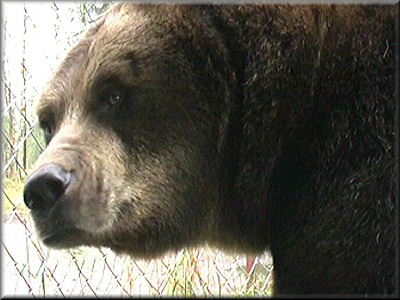
Ursus arctos: Juuso the bear. Photo: The Predator Centre, Kuusamo
In our odd quiet moments we occasionally amuse ourselves by checking out what’s happening in the bear village of Kuusamo, in the north-east of Finland, by watching ‘bear TV’ (the bears speak Finnish only with the staff, but the link offers plenty of expressive action without words).
The brown bear (Ursus arctos) – feared, respected and even mythical animal of the ancient Finns – can weigh more than 400kg. It can run fast (60km/h) and scare the pants off people in the woods, although it always avoids humans if possible. There are approximately 900–1300 wild bears in Finland. This large, intelligent beast hibernates from October to April. Omnivorous, it eats meat as well as plants and berries – carrots, too, if it can lay its paws on them.
Kuusamon suurpetokeskus (The Predator Centre) in Kuusamo has given home to several bears who have lost their mother when cubs or injured in accidents. The bears regard Sulo Karjalainen, their carer – beartaker? – their dear pal, or even mum.
It is really heart-warming to watch him and Pasi Jäntti socialising with their furry friends, who politely – or occasionally slightly rudely – devour the healthy treats that they are given in exchange for posing in several little home movies on their ‘bear TV’ website. In them, the endearing giants – Juuso, Niisku, Vyöti and others – lick Sulo’s cheek, have a bath, and Juuso tests a specially made bear weighing machine and, getting sleepy, a man-made lair with Sulo, his dear pal.
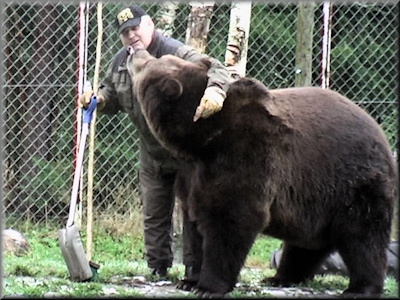
Beartaker at work: Sulo and his 400+-kilo friend. Photo: The Predator Centre, Kuusamo
Dangerous? Texts on the videos point out that only the staff can enter the bears’ home.
Sulo bears a scar on his cheek, yet he is perfectly fearless. With the largest mammal in Europe, there is a risk involved…
A life of one’s own
31 March 1984 | Archives online, Authors
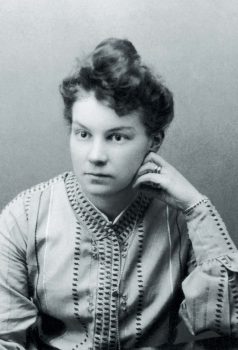
L. Onerva. Photo: Otava, 1907
When L. Onerva (1882–1972) published her novel Mirdja in 1908 she was twenty-six years old. Two previously published collections of poetry had already established a reputation for her as a promising young writer and she was also achieving a name as a first-rate critic. Her career thus began in circumstances which augured well for distinction and fame, both of which came to her, although her fame derives not only from her literary abilities – it is due in part to the notoriety of her private life. Her works, always thought to have a biographical element, are often read for glimpses of bohemian and artistic life at the start of the century.
In the puritanical climate of the period Onerva was unquestionably unusual, although Finland was not without independent and literary women. Onerva had many talents; she was well educated, and when she met Eino Leino, the most famous poet of the day, she had published her first collection of poems. This meeting changed the nature of Onerva’s life. She left her husband. Leino’s marriage also broke down and the couple ran away to Germany and Italy for a year. They were never married and both later married other people. Nevertheless, their profound friendship lasted until Leino’s death in 1926. More…
Expat, fun
30 August 2013 | In the news
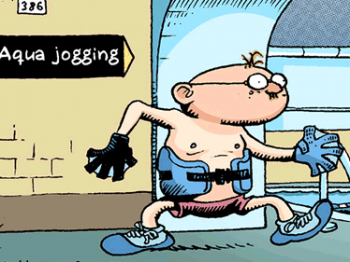
Popular Finnish aqua sports à la Pertti Jarla
Expat Finland, created by Stuart Allt – an Australian web designer living in Turku, Finland – is an information resource on the Internet. It is particularly useful for people moving to Finland, or for anyone who is interested in finding out about Finnish services and products and in living in the country in general.
If you’re looking for maps, restaurants or universities, are interested in knowing more about the language(s), culture, sports etc, take a look at the recently redesigned Expat Finland.
And what do Finns think is funny?
Among latest additions on the Expat site is a selection of comic strips by Pertti Jarla. The creator of the cartoon town Fingerpori is often impossible to translate as he constantly plays with words and their meanings (getting the joke sometimes takes a while, too).
Take also a look at the samples of Jarla’s illustrations to Zoo – eläimellinen tarina (‘Zoo – a bestial story’), a book for children by Roman Schatz and Jarla, featured in Books from Finland.
Where have I gone?
30 June 1988 | Archives online, Fiction, poetry
Poems from Näköisveistos ruumiskirstusta (‘An effigy of a coffin’, 1987). Introduction by Erkka Lehtola
The maple is being stripped for nesting materials
by big crow and his lady.
Their endeavours are more pleasing
than the imminent drinking party, in a finished house
in celebration of early spring. Dreary, to know
in advance that one is insulting one’s guests
– and not even in a constructive manner. More…
Subterranean, pre-verbal
31 March 2007 | Archives online, Essays, On writing and not writing
Claes Andersson, poet and psychiatrist, ponders the difficulties of writing, and how to get down to it. These are extracts from the collection of articles, Luova mieli. Kirjoittamisen vimma ja vastus (‘The creative mind. The rage and burden of writing’, Kirjapaja, 2002)
Some subjects or ideas need years on the back burner before they submit to being written about. The wise writer learns the basic rule ofthe good midwife: don’t panic, don’t force, wait, and help when the time for birth is at hand, but know also when a Caesarean section is advisable or even necessary. More…
Homo ludens, vita brevis
18 March 2011 | Letter from the Editors
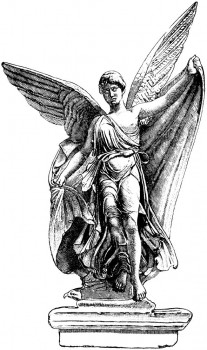
Goddess of victory: charioteer and runner Nike (constructed from the damaged statue of Nike of Paionios, from ca. 420 BCE). Photo: Wikimedia
No one should ever start a piece with ‘already the ancient Greeks…’ , but here goes:
Already the ancient Greeks practised the noble arts of sport. The Romans extended the cultivation (their word!) of culture to leisure, amusing themselves by throwing Christians to the lions. Formula F1 came a couple of thousand years later, as did post-modern art, sitcoms and reality TV, whose presenters take the place of lions and whose celebrities are today’s Christians.
The Olympics, founded by the Greeks, were in full swing as early as the seventh century BCE, until the Christian Roman Caesar Theodocius I banned them as irretrievably pagan in the year 393. However, they were revived 1,500 years later. More…
Human destinies
7 February 2014 | Articles, Non-fiction
To what extent does a ‘historical novel’ have to lean on facts to become best-sellers? Two new novels from 2013 examined
When Helsingin Sanomat, Finland’s largest newspaper, asked its readers and critics in 2013 to list the ten best novels of the 2000s, the result was a surprisingly unanimous victory for the historical novel.
Both groups listed as their top choices – in the very same order – the following books: Sofi Oksanen: Puhdistus (English translation Purge; WSOY, 2008), Ulla-Lena Lundberg: Is (Finnish translation Jää, ‘Ice’, Schildts & Söderströms, 2012) and Kjell Westö: Där vi en gång gått (Finnish translation Missä kuljimme kerran; ‘Where we once walked‘, Söderströms, 2006).
What kind of historical novel wins over a large readership today, and conversely, why don’t all of the many well-received novels set in the past become bestsellers? More…
Works in progress
30 September 2008 | Archives online, Essays, On writing and not writing
Olli Jalonen’s latest novel, 14 solmua Greenwichiin (’14 knots to Greenwich’, 2008), was 19 years in the making. He ponders the joys and tribulations of such a slow maturation
When you spend years or decades writing the same book, what is the drive, passion or compulsion that keeps the cogs turning through the quieter months? Or are the months when you don’t write silent at all? Isn’t it the case that the core of a text or a book is born out of a state of peaceful nothingness?
More often than not, the most important ideas, the strongest details and the sturdiest structures of the art of writing come into being somewhere other than at the computer keyboard. One of the greatest benefits and pleasures of a writer’s work is carrying that work around in mind and body. At these times the writing machinery is whirring, quietly, calmly, freely and unpressured. More…