

Search results for "tommi+musturi/2010/05/song-without-words/2009/09/what-god-said"
In memoriam Mirkka Rekola 1931–2014
20 February 2014 | Authors, In the news
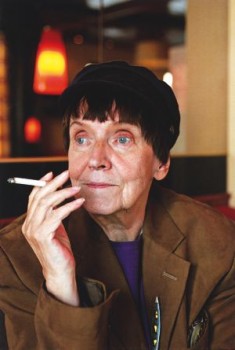
Mirkka Rekola. Photo: Elina Laukkarinen/WSOY
The poet and author Mirkka Rekola died on 5 February at the age of 82. From 1954 onwards she has written aphorisms, essays and 18 collections of poetry. Rekola was awarded many literary prizes, among them the Eino Leino prize (1979), the Finland prize (Suomi-palkinto, 1995) and the Dancing Bear poetry prize (1997). Her intellectual, linguistically brilliant poetry was not easy to translate – however, translations have appeared in Swedish, German, French, Hungarian, English and Macedonian.
The poet and translator Herbert Lomas wrote in his introduction to Rekola’s collection Valekuun reitti (‘The path of a false moon’) in 2004: ‘Mirkka Rekola was a minimalist before minimalism was invented.’ Her poems are, he said, ‘moments of crossing an edge towards an intenser awareness of the universe’s continuum, requiring us to wake up from sleep, as we do at times of heightened consciousness and love.’
At first light I put my hand
      in the hollow of a white willow –
once someone's cigarette box
had been left there –
      now a bird flew out
going seaward.
Touch of a wingquill on the back of my hand.
      It flew higher.
            In the evening
I felt its touch on my shoulder blade.
From Valekuun reitti, translated by Herbert Lomas
Panem et circenses, Part II
10 May 2012 | This 'n' that

The Guggenheim Foundation's global network of museums
Helsinki has said no thanks to a new Guggenheim art museum in the city – for the time being, at least.
On 2 May the City Council voted 8-7 against the mayor’s motion to build such a gallery in Helsinki. Politically, the move was supported by the National Coalition Party and the Swedish People’s Party, while the Greens and the left-wing parties opposed it.
What happens after the upcoming national elections – in autumn this year – is another matter. The director of the Guggenheim Foundation, Richard Armstrong, is persistent: he says he wants Helsinki. Well, if the Foundation offers a better deal in the future, the proposal may be considered again.
Three months ago we wondered – see Panem et circenses – whether ‘the people of Helsinki wish to begin to pay additional taxes for the revival, yet again, of the age-old dream of guaranteeing Finland “a place on the world map”, in a situation where economic difficulties are a matter of everyday life for increasing numbers of them? (We believe, incidentally, that Finland already has an appropriate place on the world map.) Will their opinion be asked, or heard?’ More…
Country matters
30 June 2001 | Archives online, Fiction, Prose
A short story from Peili (‘Mirror’, Tammi, 2000). Introduction by Suvi Ahola
I’m getting so old, my Master and Mistress no longer take note of when I’m on Heat. They don’t even notice when some moisture comes dripping out of my innards, as a sign of it, like they did in the good old days. Anyway, this time I really boobed, I dirtied my Mistress’s Christmas slippers with my secretions. So what could I do? – if it drips it drips. I happened to be lying on my Mistress’s feet at the time, she’d invited me there herself. ‘Spot, Spot, come and warm my feet,’ she said. Of course I went, I always have done when I’m called, it’s rather nice. Your belly gets nice and warm there, and if you’re lucky your Mistress scratches your back now and then with her knitting needle. I sleep and snore a little – it amuses my Mistress and Master. But then the warming of my belly led to this boob – a big dose of this wetness slurped onto my Mistress’s feet. It caused a sudden departure. My Mistress yelled, and my Master flung me out into the yard. I’d scarcely managed a squeak before I found myself in the snow. I shan’t forgive them, no. It’s beyond my comprehension.
Movies and mores
16 April 2012 | Authors, Interviews
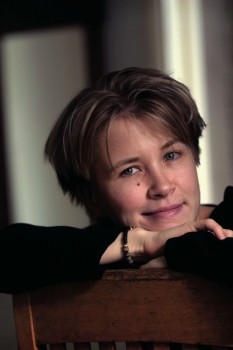
Tuuve Aro. Photo: Liisa Takala
Interview with Tuuve Aro, author of Himokone (‘Desire machine’): in these short stories she borrows titles and ambiance from the silver screen
A dark theatre, the smell of popcorn, expectation quivering in the air. Since childhood, the author and film critic Tuuve Aro (born 1973) has loved that magic moment when a new, exciting story is about to begin once again on the silver screen.
The stories in her fourth short story collection Himokone (‘Desire machine’, WSOY, 2012) have taken their names from films – Vertigo, Alien, and Invasion of the Body Snatchers, for example. The book’s title comes from a certain Dr Samuel L. Brimstone, member of the ‘Royal Film Academy of Suffolk’: according to him, a film projector is a desire machine: it doesn’t give anything, it only shows, and for that very reason it is hard to resist. More…
Madness and method
10 May 2012 | Authors, Reviews
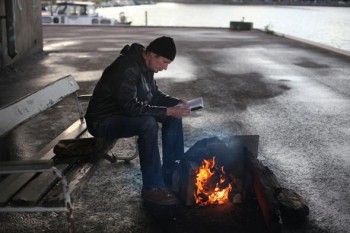
Juha Hurme. Photo: Stefan Bremer
One day during Advent in Helsinki the narrator in the novel Hullu (‘The lunatic’, Teos, 2012), a middle-aged man, goes mad.
Complete confusion fills his mind. He thinks he must be dead, but nevertheless manages to knock on the door of the mental hospital. To his amazement, he is admitted to the yellow building.
Because the boundaries between reality and self are, for him, completely blurred, he believes that the people in the hospital know absolutely everything about his unsuccessful life, and that he must expect humiliations and punishments. The people in white coats are aliens, or perhaps holograms. More…
Just business?
24 September 2010 | Letter from the Editors
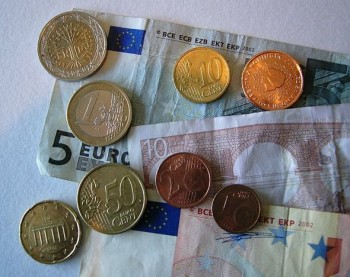
Money, money, money... Photo: Twid/Wikipedia
Through his work, a writer provides a living for both himself and his publisher. The publisher makes his profit through the work of his writers, and both parties are satisfied. Is this how it goes?
The novel Puhdistus (Purge, 2008) by the Finnish author Sofi Oksanen (born 1977) has been translated into 13 languages, including English, and by now it has sold who knows how many copies.
One would imagine her publisher would like to live happily ever after with his superstar, and perhaps also vice versa – for WSOY (est. 1878) has long been one of the most powerful, as well as the most enlightened, publishing houses in Finland. More…