

Search results for "Riikka/2010/10/mikko-rimminen-nenapaiva-nose-day"
Stories in the stone
2 December 2010 | Extracts, Non-fiction
Extracts from Jägarens leende. Resor in hällkonstens rymd (‘Smile of the hunter. Travels in the space of rock art’, Söderströms, 2010)
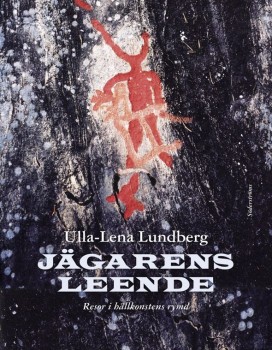 ‘Why do some people choose to expend what is often a great deal of effort hammering images in the bedrock itself, while others conjure up, in the blink of an eye, brilliantly radiant pictures on a rock-face that was empty yesterday but is now peopled by mythological animals, spirits and shamans?
‘I think about this often – I who love painting but who still chose a career that involves me sitting and hammering away, day in and day out, like a true rock-carver,’ writes author and ethnologist Ulla-Lena Lundberg in her new book on the art of the primeval man
When the children of Israel went into Babylonian captivity, hanging up their harps on the willow-trees and weeping as they remembered Zion, my sister and I were already sitting by the rivers of Babylon. We knew how they felt. Our father was dead and we had been sent away from our home. We sat there clinging to each other, or rather I was the one clinging to Gunilla, and she had to try to rouse herself and find something for us to do, to give us something else to think about. More…
Nature’s not my thing
A short story from Hommes (Tammi, 2006)
Lying unemployed on my sofa I hear a lot of stuff on the radio almost every day you hear some children’s choir chanting the same songs over and over about our country’s blue lakes the sky and all our trees and their white trunks. They’ve all finally worked their way into my subconscious. After hearing enough of these songs my subconscious rears its head and commands my idle body: go to the forest. In a situation like that it’s hard to put up a fight or struggle against something you can’t see or hear or smell that all of a sudden pops into your head.
The great debate was over so quickly that hardly anyone managed to get a word in I think to myself as I lie in bed at night just before falling asleep. More…
It takes a life to say
31 December 2007 | Archives online, Fiction, poetry
Poems, published in You go the words (Action Books, Scandinavian Series, Indiana, 2007). Introduction by Trygve Söderling
|
We go and search it is not words * You go the * And spread out To only * The song * One time I have a name * a longing * A morning’s * Words are words But word’s image Alas stay not * Fly out, my day
fly, fly day to meet
fly, fly, you the wretched's
their, everyone's
in all times
peace and day
on ground's floor
floor ground
o you
in man's name
* Suneveningspring * Dog bolts happy * And to not speak more it takes a life to say but – as the everyday moment O no beauty But your light – a smile what and to know * And allthesame The white day * |
Vi går och söker det är ej ord * Du går de * Och bredd ut Att endast * Sången * En gång Jag har ett namn * en längtan * En morgons * Ord är ord Men ords bild Ack stanna ej * Flyg ut, min dag
flyg, flyg dag till möte
flyg, flyg, du de armas
deras, allas
i alla tider
lugn och dag
på marks golv
golv mark
o du
i människans namn
* Solaftonvår * Hund skenar glad * Och att ej tala mer det tar ett liv att säga men – som vardagens stund O ingen skönhet Men ditt ljus – ett leende vad och att veta * Och alltjämt Den vita dag * |
Translated by Fredrik Hertzberg
Daughter of Cain
30 June 1985 | Archives online, Fiction, Prose
An extract from the novel Kainin tytär (‘Daughter of Cain’, 1984). In the following extract Anna and Risku spend a single night recalling the early days of their relationship; Anna is in the country, Risku is in the city. Introduction by Soila Lehtonen
Anna
The moon hangs before the bosom of the sky, a slender crescent, but giving light all the same.
On the horizon a black, glimmering line emerges from the water. It is the skerry, a low, lone rock.
I shut off the motor. The sea laps minutely against the side of the boat. This far out there are no longer any birds.
The silence here is deeper than even that of an empty room.
The skerry is as black and glistening as the back of a pike.
Light is matter, it’s never steady.
Whatever is understood in life is understood in a sudden blue illumination, like lightning cleaving the night to expose the landscape – shadows, hollows and all. More…
How love begins
31 March 1992 | Archives online, Fiction, Prose
A short story from Kuinka rakkaus syntyy (‘How love is born’; Otava, 1991)
All that day the words of the song ran through Annika’s mind.
‘How love begins, nobody knows’: those were the words with which the clock radio had woken her this morning.
They had bought a clock radio so as not to have to listen to the ticking of a clock in the dark, echoing room, or its ear-splitting alarm, like the screaming of a small wounded animal.
They had bought other things, too, to make their lives easier: a dish-washer, and a washing machine that also dried the clothes, and a microwave oven, and a second telephone, because the flat was a big one. Life went on; there was plenty of time to be, and to think about what had been, and what could have been, and what would come to be. More…
Images of isolation
31 March 1992 | Archives online, Fiction, poetry
Poems by Helvi Juvonen, commentary by Soila Lehtonen
Little is known of the circumstances of Helvi Juvonen’s life. Her fame rests on five collections of poetry – mixing humility and celebration with an uncompromising rigour – published in the ten years before her death at the age of 40 (a sixth appeared posthumously). Her existence, in the drab surroundings of post-war Helsinki, was modest: after studies at Helsinki University, and posts as a bank clerk and proof-reader, she lived by writing and translation, including some brilliant renderings into Finnish of the poems of the 19th-century American poet Emily Dickinson.
Helvi Juvonen’s universe is crowded with ostensibly insignificant phenomena: her eye discerns a mole, lichen, dwarf-trees, a shrew; she studies tones of stone and moss; she ‘doesn’t often dare to look at the clouds’.
Us
Rocks, forgotten within themselves,
have grown dear to me.
The trees’ singing, so useless,
is my friend.
Silver lichen,
brother in beggary,
please don’t hate my shadow
on the streaked rock. More…
Mind the gaffe
14 December 2012 | Non-fiction, Tales of a journalist
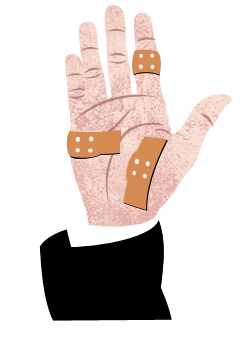
Illustration: Joonas Väänänen
Celebrating Finnish Independence Day is a serious business involving lots of handshakes and plenty of pitfalls for the unwary, observes columnist Jyrki Lehtola. But luckily there’s plenty of fun to be had for ordinary Finns in complaining about it all
When Finland makes the news, it’s usually because of a national tragedy or something odd we do. The latter ripe fodder for filling the blank pages of the international media on slow news days includes such things as the Finnish penchant for competitions in such sporting events as Wellington boot /mobile phone tossing (saappaan- / kännykänheitto) and wife carrying (akankanto).
We have another odd national tradition, although it has never received as much international recognition as the fact that we carry our wives competitively. This time- honoured custom repeats annually on the sixth of December, when we close our shops and barricade ourselves gloomily within our homes. Its name is Independence Day. More…
If grief smoked
31 March 1989 | Archives online, Fiction, poetry
Poems from six collections of poetry. Introduction by Herbert Lomas
The City
How the houses have ascended in this city,
the abysses deepened, the water blackened,
soon to be creeping along the streets.
The railings are rusting through,
the water table’s rising,
the cellars are slopping.
Fear is rising, or being covered up
behind strangling discretion,
outbreaks of crime.
Goodbye darling
30 March 2005 | Fiction, poetry
Poems from Niin kovaa se tuuli löi (‘So bitterly the wind struck’, Tammi, 2004)
Lord, you've promised to come, don't hang back.
     Here we are already, sitting, me and the dogs,
   and the others that have to go.

Jesus, poor thing, didn't know whom to bloom for,
  just kept on lugging his cross, pretty as a pony.
    He came and shot us down,
   bullets flying without his even noticing.
      The night was gifted with roses
        full of love.
 Through a woman we came here, through a man
    we leave.
A greater solitude
30 December 2004 | Fiction, Prose
Extracts from the novel Runoilijan talossa (‘In the house of the poet’, Tammi, 2004)
Images of love
The double door to the patio is tightly swollen into the framework, so tight I’m chary of using force to prize it open. The windows might break. The lower part remains stuck, as if screwed to a carpenter’s bench, while the upper part gapes – leans out as if longing to liberate itself from its lintel. That’s an image of love: one part longs to be free, the other part holds on fast. I get a toolbox from the cleaning cupboard and try to hammer a chisel into the space between the bottom edge and the threshold. I succeed, but the chisel marks the door, defacing it. That’s an image of love too. More…
Time difference
30 December 2003 | Fiction, Prose
A short story from Kalliisti ostetut päivät (Dearly bought days, Otava, 2003)
She arrived at the airport too early, as always. The reason was not that connections from the small town in which she lived were slow and difficult, or even that she liked the airport’s atmosphere of swift departures and long waits. No; she wanted to spend time at the airport to see that the planes took off and landed without anything awful happening. She wanted to see that a departing plane’s acceleration was rapid, that the plane left the asphalt of the runway elegantly, that its tail did not hit the ground as it rose, break, the plane explode, catch fire, but that, like an arrow fired into the air, following its flight path, it curved upward and, sunlight glancing off the metal of the body, disappeared from view. She wanted to see that the landing gear of a descending plane was out, as it should be, that a tyre did not burst as it hit the ground, at that there was no ice or oil on the runway; that the brakes worked, and that the fire engines at the edge of the airfield stayed in place as a sign that all was well. More…
Close encounters
31 March 1999 | Fiction, Prose
Viimeinen syli (‘The last embrace’, Otava, 1998)
The hospital looked as if a child had been given a big pile of building blocks and told to make a house, a big house. And then, when the building was ready, more bricks had been brought, and the child had been forced to pile them up over a wider and wider area, to spread rows of blocks across the adults’ routes and over the edge of the carpet until at last it had grown bored and left the last blocks higgledy-piggledy next to its creation.
Around the hospital ran a road from which the whole mess was revealed. Wing after wing, corridors and windows from which no one really ever looked out. The hospital was full of window views that did not belong to anyone, which did not open up from anyone’s office or day-room, but varied meaninglessly like a motorway landscape from the window of an accelerating car. Viivi had been born there, on the sixth floor of the old part of the hospital. As Mikael waited in the tiled fathers’ room next to the room where the Caeserean section was being carried out for his child to be brought to him, the view out had been breathtaking. More…
Wo/men at war
9 February 2012 | Essays, Non-fiction
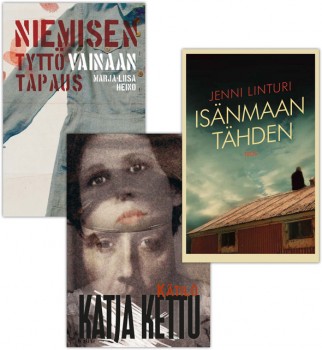 The wars that Finland fought 70 years and a couple of generations ago continue to be a subject of fiction. Last year saw the appearance of three novels set during the years of the Continuation War (1941–44), written by Marja-Liisa Heino, Katja Kettu and Jenni Linturi
In reviews of Finnish books published this past autumn, young women writers’ portraits of war were pigeonholed time and again as a ‘category’ of their own. This gendered observation has been a source of annoyance to the writers themselves.
Jenni Linturi, for instance, refused to ruminate on the impact of her sex on her debut novel Isänmaan tähden (‘For the fatherland’, Teos), which describes the war through the Waffen-SS Finnish volunteer units and the men who joined them [1,200 Finnish soldiers were recruited in 1941, and they formed a battalion, Finnische Freiwilligen Battaillon der Waffen-SS].
The work received a well-deserved Finlandia Prize nomination. Tiring of questions from the press about ‘young women and war’, Linturi (born 1979) was moved to speculate that some critics’ praise had been misapplied due to her sex. The situation is an apt reflection of the waves of modern feminism and the reasoning of the so-called third generation of feminists, who reject gender-limited points of view on principle. More…
The last melody
30 September 1995 | Archives online, Fiction, Prose
Extracts from the novel Kadotettu puutarha (‘The lost garden’, WSOY, 1995). Introduction by Riina Katajavuori
Their sojourn at the villa extended into the autumn of 1944; the schools did not go back as usual on the first of September. Repair of the university buildings progressed rapidly; the work had begun immediately after the bombing. The Doctor went to town from time to time, but nothing bound the family to it, and he returned to his desk in the attic room and to his solitary walks by the lake. His heart troubled him from time to time. It did not like these walks, did not like exertion; but he had succeeded in concealing the matter from Elisabet. After one particular attack, he had secretly seen a doctor in town, and now, instead of camphor tablets, he always had those little buttons in his pocket, the breast pocket of his waistcoat. He swallowed one from time to time on these expeditions, a pain in his wrists and his eyes staring dimly at a clump of ferns that seemed to have become hazy, or a tree-top that seemed to be falling toward him. He did not wish Elisabet to know. Not this, in Elisabet’s world, not this, in air that was suffused with grief for their dead son Leo, with well controlled and beautifully expressed emotion, with concern for the remaining boy, who was there, on the frontier, with the burdensome and universal tragedy that filled the air as light filled it in daytime. More…