

Search results for "harjunpää/2010/10/mikko-rimminen-nenapaiva-nose-day/2011/04/matti-suurpaa-parnasso-1951–2011-parnasso-1951–2011/2009/09/what-god-said"
Looking for Moominpappa
30 June 1994 | Archives online, Children's books, Fiction
Tove Jansson wrote the first Moomin book in the dark days of Finland’s Winter War in 1939. This extract, from Småtrollen och den stora översvämningen (‘The little trolls and the big flood’, Schildts, 1945, 1991), tells the story of how the Moomins found their home
It had become very hot late in the afternoon. Everywhere the plants drooped, and the sun shone down with a dismal red light. Even though Moomins are very fond of warmth, they felt quite limp and would have liked to rest under one of the large cactuses that grew everywhere. But Moominmamma would not stop until they had found some trace of Moomintroll’s Papa. They continued on their way, even though it was already beginning to get dark, always straight in a southerly direction. Suddenly the small creature stopped and listened. ‘What’s that pattering around us?’ he asked.
And now they could hear a whispering and a rustling among the leaves. ‘It’s only the rain,’ said Moominmamma. ‘Even so, now we must crawl in under the cactuses.’
All night it rained, and in the morning it was simply pouring down. When they looked out, everything was grey and melancholy. More…
The house in Silesia
31 December 1989 | Archives online, Fiction, Prose
A short story from Talo Šleesiassa (‘ The house in Silesia’, 1983). Read the interview
We set off, my brother-in-law and I, at the beginning of September. The tourist season was already over, and on the Gdansk ferry there was stacks of room for my brother-in law’s Volvo and the two of us.
We’d driven from his home on the shore of Lake Mälar to the ferry port at Nynäshamn, about fifty miles south of Stockholm. We’d driven in an atmosphere of cheerful resolution, accelerator down, but going steadily. The resoluteness was due to my brother-in-law’s decision after forty years’ absence to visit his childhood home. If it was still standing, that is – or whatever of it was.
‘Oh the house is definitely still in place there all right,’ he said: ‘I’ve got that sort of tickly feeling in my arse.’ It was a direct translation from the German – German humour of the vulgar variety centring round the bottom. More…
The situation in Narva
31 December 1993 | Archives online, Fiction, Prose
A short story from Pakosarja (‘Exhaust manifold’, WSOY, 1993)
We went into the building where Voroshilov said the waitress had disappeared. Inside was a big room lined with wooden benches. A tin-clad stove radiated heat. Someone had shut the dampers too early, probably out of meanness; it had that kind of smoky smell.
A corridor led from the room, with a few doors off it. We peered inside, but there was no one to be seen. There was nobody in the entire building. We left.
We walked across the railway yard in what I thought was the direction of the train. We heard the sound of the engine long before we could see anything through the snowstorm. At regular intervals the engine’s pressure valve let off steam. Voroshilov went for a leak. He leaned against the engine’s big back wheel and watered the lever, which had been left in the down position. The liquid ran down the engine’s rounded flank. The snowflakes melted as they fell on to the black casing of the water-tank. More…
The bully
31 March 1996 | Archives online, Fiction, Prose
A short story from Tulen jano (‘Thirst for fire’, Gummerus, 1995); power relations between doctor and patient in a situation where the past will not leave either alone
Nurmikallio, an apparently ordinary middle-aged man, came back again and again, and it seemed as if there would be no end to his story.
I listened to him patiently at first. Repeatedly he returned to the same subject. The form and emphases of the story changed, new memories emerged, but the gist was the same: he had failed in his life and believed that the root cause of his failure was a particular person, a childhood class-mate, a bully.
On the basis of his first visit I wrote a short character-sketch:
Intellectually average. Talkative, but by his own account solitary. Difficulties in human relationships, separated, no children. Electrician by profession, says he likes his work. Biggest problem obsessive attachment to childhood traumas.
And that’s all, I thought. But he was not to be so easily dismissed.
Conversations with a horse
31 December 2004 | Archives online, Fiction, Prose
Extracts from the novel Kiinalainen puutarha (‘The Chinese garden’, Otava, 2004). Introduction by Anna-Leena Nissilä
Colonel Mannerheim.
Near Kök Rabat, on the caravan route between Kashgar and Yarkand.
October 1906
It is growing dark. Let the others go on ahead. Let us wait here awhile. Perhaps the pain will go over. We’ll get through.
Steady, Philip.
You always obey. And listen. Your ears proudly, handsomely pricked.
Steady, I said, there in the garden. No reaction. Everyone was moving. Pure comedy. And something else.
An illusion, two girls. Then gone.
How to explain.
Before that. I had a conversation with Macartney, the British chargé d’affaires…
Pain…. It burns, now it burns again. Let us wait now, Philip. Steady, steady now. More…
A spot of transmigration
13 January 2011 | Fiction, Prose
A short story, ‘Sielunvaellusta’, from the collection Rasvamaksa (‘Fatty liver’, WSOY, 1973)
‘Where will you be spending Eternity?’ a roadside poster demanded as Leevi Sytky sped by in his car.
‘Hadn’t really thought about it,’ Leevi muttered , as if in reply, and lit a cigarette.
But at the next level crossing, a kilometre or so further on, he was run down by a train, whose approach he had failed to notice. His attention had been distracted by the sight of a young woman who was picking black currants by the side of the track, and who happened to be bending forward in his direction. Intent on obtaining a better view of her ample bosom by peering over the top of her blouse, Leevi neglected to look both ways, and death ensued. Damned annoying, to say the least.
In due course he secured an interview with God, who turned out to be a biggish chap, about a hundred metres tall, wearing thigh-boots and sitting behind a large desk.
‘Well, and how’s Leevi Sytky getting along?’ God asked, lighting his pipe.
‘Mustn’t grumble,’ said Leevi politely.
‘And how are you thinking of spending Eternity?’ God inquired, sucking at his pipe and puffing out his cheeks. More…
In pursuit of a conscience
19 March 2012 | Drama, Fiction
‘An unflinching opera and a hot-blooded cantata about a time when the church was torn apart, Finland was divided and gays stopped being biddable’: this is how Pirkko Saisio’s new play HOMO! (music composed by Jussi Tuurna) is described by the Finnish National Theatre, where it is currently playing to full houses. This tragicomical-farcical satire takes up serious issues with gusto. In this extract we meet Veijo Teräs, troubled by his dreams of Snow White, who resembles his steely MP wife Hellevi – and seven dwarves. Introduction by Soila Lehtonen
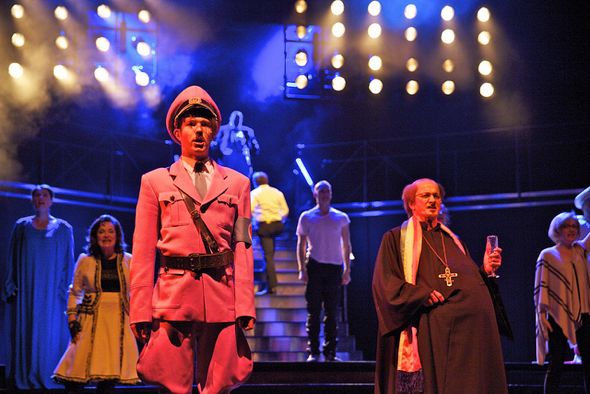
Dictators and bishops: Scene 15, ‘A small international gay opera’. Photographs: The Finnish National Theatre / Laura Malmivaara, 2011
CAST OF CHARACTERS
Veijo Teräs
Hellevi, Veijo’s wife and a Member of Parliament
Hellevi’s Conscience
Rebekka, Hellevi and Veijo’s daughter
Moritz, Hellevi and Veijo’s godson
Agnes af Starck-Hare, Doctor of Psychiatry
Seven Dwarves
Tom of Finland
Atik
The Bishop of Mikkeli
Adolf Hitler
Albert Speer
Josef Stalin
Old gays: Kale, Jorma, Rekku, Risto
Olli, Uffe,Tiina, Jorma: people from SETA [the Finnish LGBT association]
Second Lieutenant, Private Teräs, the men in the company
A Policeman
Big Gay, Little Gay, Middle Gay
William Shakespeare
Hermann Göring
Hans-Christian Andersen
Teemu & Oskari, a gay couple
The Apostle Paul
Father Nitro
Winston Churchill
SCENE ONE
On the stage, a narrow closet.
Veijo Teräs appears, struggling to get out of the closet.
Veijo Teräs is dressed as a prince. He is surprised and embarrassed to see that the audience is already there. He seems to be waiting for something.
He speaks, but continues to look out over the audience expectantly.
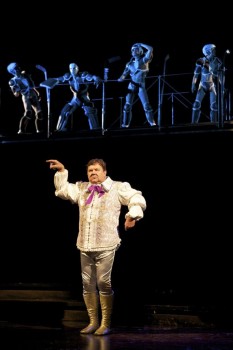
Snow White's spouse, Veijo (Juha Muje), and the dwarves. Photo: Laura Malmivaara, 2011
VEIJO
This outfit isn’t specifically for me, because… I mean, it’s part of this whole thing. This Snow White thing. I’m waiting for the play to start. Just like you are. My name is Veijo Teräs and I’m playing the point of view role in this story. Writers put point of view roles like this in their plays nowadays. They didn’t use to.
Just to be clear – this isn’t a ballet costume. I’m not going to do any ballet dancing, but I won’t mind if someone dances, even if it’s a man. Particularly if it’s a man. But I don’t watch. Ballet, I mean. Not at the opera house, or on television, or anywhere, and I have no idea why we had to bring up ballet – or I had to bring it up – because this is a historical costume, so it’s appropriate. This is what men used to wear, real men like Romeo and Hamlet, or Cyrano de Bergerac. But we in the theatre these days have a hell of a job getting an audience to listen to what a man has to say when he’s standing there saying what he has to say in an outfit like this. People get the idea that it’s a humorous thing, but this isn’t, this Snow White thing, where I play the prince. Snow White is waiting in her glass casket, she died from an apple, which seems to have become the Apple logo, Lord knows why, the one on the laptops you see on the tables of every café in town. More…
Moving on
30 June 2003 | Archives online, Fiction, Prose
Extracts from the short story ‘Tunnin kuvat’ (‘One-hour processing’, from the collection Vapiseva sydän, ‘Tremulous heart’, Tammi, 2002). Introduction by Harry Forsblom
Last summer, when I was helping my brother with his move, he said I could take as many of his old LPs as I wanted. There were actually two of us on the job: his younger friend Timbe was along, and when we’d almost completely cleared out the flat and my brother’s two cellar closets (he’d rented an extra closet from the next-door flat, as he was submerging under the clobber lying around everywhere), he said the same to Timbe: ‘Just help yourself.’ The records we ourselves didn’t want would be chucked in the rubbish.
He came in through the bathroom window
30 June 1991 | Archives online, Fiction, Prose
A short story from Utslag och andra noveller (‘Rash and other stories’, Alba, 1989). Introduction by Pekka Tarkka
He heard a voice behind him:
‘Hey, Aspelin, what are you doing here?’
Awakening from a half-sleep, he looked around as Ilpo approached his seat.
‘I work near here. I’m teaching math to the visually impaired.’
Ilpo sat down next to him. For several seconds they sat without speaking. Then Aspelin collected himself.
‘And you?’
‘Visiting a friend. He lives in Mäkkylä.’ More…
Wo/men at war
9 February 2012 | Essays, Non-fiction
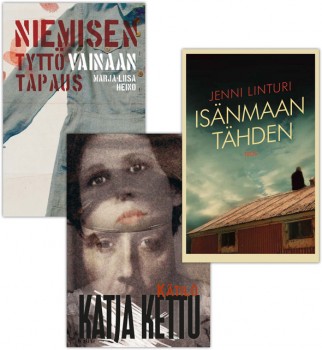 The wars that Finland fought 70 years and a couple of generations ago continue to be a subject of fiction. Last year saw the appearance of three novels set during the years of the Continuation War (1941–44), written by Marja-Liisa Heino, Katja Kettu and Jenni Linturi
In reviews of Finnish books published this past autumn, young women writers’ portraits of war were pigeonholed time and again as a ‘category’ of their own. This gendered observation has been a source of annoyance to the writers themselves.
Jenni Linturi, for instance, refused to ruminate on the impact of her sex on her debut novel Isänmaan tähden (‘For the fatherland’, Teos), which describes the war through the Waffen-SS Finnish volunteer units and the men who joined them [1,200 Finnish soldiers were recruited in 1941, and they formed a battalion, Finnische Freiwilligen Battaillon der Waffen-SS].
The work received a well-deserved Finlandia Prize nomination. Tiring of questions from the press about ‘young women and war’, Linturi (born 1979) was moved to speculate that some critics’ praise had been misapplied due to her sex. The situation is an apt reflection of the waves of modern feminism and the reasoning of the so-called third generation of feminists, who reject gender-limited points of view on principle. More…
Wolf-eye
30 June 2004 | Archives online, Fiction, Prose
Extracts from the novel Käsky (‘Command’, WSOY, 2003). Introduction by Jarmo Papinniemi
Only once he had led the woman into the boat and sat down in the rowing seat did it occur to Aaro that it might have been advisable to tie the woman’s hands throughout the journey. He dismissed the thought, as it would have seemed ridiculous to ask the prisoner to climb back up on to the shore whilst he went off to find a rope.
It was a mistake.
After sitting up all night, being constantly on his guard was difficult. Sitting in silence did not help matters either, but they had very few things to talk about. More…
In memoriam Herbert Lomas 1924–2011
23 September 2011 | In the news
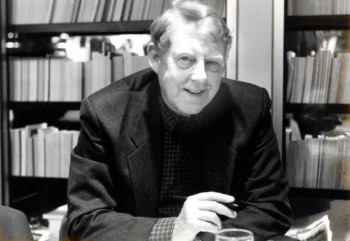
Herbert Lomas. Photo: Soila Lehtonen
Herbert Lomas, English poet, literary critic and translator of Finnish literature, died on 9 September, aged 87.
Born in the Yorkshire village of Todmorden, Bertie lived for the past thirty years in the small town of Aldeburgh by the North Sea in Suffolk. (Read an interview with him in Books from Finland, November 2009.)
After serving two years in India during the war, Bertie taught English first in Greece, then in Finland, where he settled for 13 years. His translations – as well as many by his American-born wife Mary Lomas (died 1986) – were published from as early as 1976 in Books from Finland.
Bertie’s first collection of poetry (of a total of ten) appeared in 1969. His Letters in the Dark (1986) was an Observer book of the year, and he was the recipient of several literary prizes. His collected poems, A Casual Knack of Living, appeared in 2009.
In England Bertie won the Poetry Society’s 1991 biennial translation award for one of his anthologies, Contemporary Finnish Poetry. The Finnish government recognised his work in making Finnish literature better known when it made him a Knight First Class of Order of the White Rose of Finland in 1987.
To Books from Finland, he made an invaluable contribution over almost 35 years – an incredibly long time in the existence of a small literary magazine. The number of Finnish authors and poets whose work he made available in English is countless: classics, young writers, novelists, poets, dramatists.
Bertie’s speciality was ‘difficult’ poets, whose challenge lay in their use of end-rhymes, special vocabulary, rhythm or metre. He loved music, so the sounds and tones of words, their musicality, were among the things that fascinated him. Kirsi Kunnas’ hilarious, limerick-inspired children’s rhymes were among his best translations – although actually nothing in them would make the reader think that the originals might not have been written in English. A sample: There once was a crane / whose life was led / as a uniped. / It dangled its head / and from time to time said:/ It would be a pain / if I looked like a crane. (From Tiitiäisen satupuu, ‘Tittytumpkin’s fairy tree’, 1956, published in Books from Finland 1/1979.)
Bertie also translated work by Eeva-Liisa Manner, Paavo Haavikko, Mirkka Rekola, Pentti Holappa, Ilpo Tiihonen, Aaro Hellaakoski and Juhani Aho among many, many others; for example, the prolific writer Arto Paasilinna’s best-known novel, Jäniksen vuosi / The Year of the Hare, appeared in his translation in 1995. Johanna Sinisalo’s unusually (in the Finnish context) non-realist troll novel Ennen päivänlaskua ei voi / Not Before Sundown, subsequently translated into many other languages, appeared in 2003. His last translation for Books from Finland was of new poems by Vilja-Tuulia Huotarinen in 2009.
It was always fun to talk with Bertie about translations, language(s), writers, books, and life in general. He himself said he was a schoolboy at heart – which is easy to believe. He was funny, witty, inventive, impulsive, sometimes impatient – and thoroughly trustworthy: he just knew how to find the precise word, tone of voice, figure of speech. He had perfect poetic pitch. As dedicated and incredibly versatile translators are really hard to find anywhere, we all realise our good fortune – both for Finnish literature and for ourselves – to have worked, and enjoyed with such enjoyment, with Bertie.
Poet Aaro Hellaakoski (1893–1956) was not a self-avowed follower of Zen, but his last poems, in particular, show surprisingly close contacts with the philosophy. ‘Secrets of existence are revealed once one ceases seeking them’, the literary scholar Tero Tähtinen wrote in an essay published alongside Bertie’s new Hellaakoski translations in (the printed) Books from Finland (2/2007). Bertie was fond of Hellaakoski, whose existential verses fascinated him; among his 2007 translations is The new song (from Vartiossa, ‘On guard’, 1941):
The new song |
Uusi laulu |
| No compulsion, not a sting. | Ei mitään pakota, ei polta. |
| My body doesn’t seem to be. | On ruumis niinkuin ei oisikaan. |
| As if a nightbird started to sing | Kuin alkais kaukovainioilta |
| its far shy carol from some tree – | yölintu arka lauluaan |
| as if from its dim chrysalis | kuin hyönteistoukka heräämässä |
| a little grub awoke to bliss – | ois kotelossaan himmeässä |
| or someone struck from off his shoulder | kuin hartioiltaan joku loisi |
| a miserable old bugaboo – | pois köyhän muodon entisen |
| and a weird flying creature | ja outo lentäväinen oisi |
| stretched a fragile wing and flew. | ja nostais siiven kevyen. |
| Ah limitless bright light: | Oi kimmellystä ilman pielen. |
| the gift of lyrical flight! | Oi rikkautta laulun kielen. |
The tower
31 December 1987 | Archives online, Fiction, Prose
A short story from the collection Torni (‘The tower’, 1987). Introduction by Erkka Lehtola
The dog came through the door first, a big, long-haired brute. He hadn’t said anything about it on the phone, but from the look on his face you could tell it was his and that he meant to take it with him into the forest.
He shuffled across the yard with his rubber boots on and a rucksack on his back. In one hand he held a camera tripod.
I rolled down the window.
‘Wait a minute,’ he said.
He walked behind the cars standing in the parking lot, over to his own car and opened the trunk. The dog twisted around his legs whining softly. He took something out and slammed the trunk shut. More…
Findians, Finglish, Finntowns
16 May 2013 | Extracts, Non-fiction
Workers, miners, loggers, idealists, communists, utopians: early last century numerous Finns left for North America to find their fortune, settling down in Michigan, Minnesota, Wisconsin and Ontario. Some 800,000 of their descendants now live around the continent, but the old Finntowns have disappeared, and Finglish is fading away – that amusing language cocktail: äpylipai, apple pie.
The 375th anniversary of the arrival of the first Finnish and Swedish settlers, in Delaware, was celebrated on 11 May. Photographer Vesa Oja has met hundreds of American Finns over eight years; the photos and stories are from his new book, Finglish. Finns in North America

Drinking with the workmen: The Työmies Bar. Superior, Wisconsin, USA (2007)
The Työmies Bar is located in the former printing house of the Finnish leftist newspaper, Työmies (‘The workman’). The owners, however, don’t know what this Finnish word means, or how to pronounce it.
The Työmies Society, which published the newspaper of the same name, Työmies, was founded in Worcester, Massachusetts in 1903 as a socialist organ. It moved to Hancock, Michigan the following year. More…